Anja Dodevska

The clinical audit cycle: Stages, challenges, and how to complete it
The clinical audit cycle is a repeating process for measuring care against an ag...

Last Updated: Nov 10, 2026
Free PDF 3 pages, print-ready Clinician-reviewed
A vulnerability worksheet is a structured reflection form that helps a therapy patient name when they feel exposed and how they protect themselves. Our free three-page PDF covers what vulnerability means to the patient, where it shows up, and the defenses they use. It adds a time openness went well, a personal reflection, a written commitment and three small ways to practice. Therapists use it in session as a shared record to revisit, not as a diagnostic test.
A three-page form covering what vulnerability means to the patient, where it shows up, and the defenses they use. It adds a time it went well and a personal reflection, and closes with a written commitment and three small ways to practice.
Start from scratch, or upload this PDF or any form you already use, and Pabau's AI Form rebuilds it with tick boxes, text fields and a signature. Attach it to the treatment once, and every patient gets it on time.
AI Form rebuilds the consent, history and aftercare forms you already use. You review each one, then publish.
Patients complete forms on their phone before they arrive, so the front desk stops retyping paper.
Every signed form is versioned and attached to the treatment record, ready when you need it.
Set how long a consent stays valid. Returning patients skip forms they have already signed.
Supports HIPAA and GDPR compliance AES-256 encryption 4.8 on G2 4.7 on Capterra Trusted by 4,000+ practices worldwide

A vulnerability worksheet is a reflective tool for therapy sessions, not a diagnostic instrument or a treatment in itself.
The free PDF runs five sections, from what vulnerability means to the patient through to a personal commitment and three practice steps.
Brené Brown’s definition of vulnerability as uncertainty, risk, and emotional exposure underpins the worksheet’s language.
The protection section names the defenses a patient relies on, which gives the therapist concrete patterns to work with.
Completed worksheets are sensitive health records, and Pabau’s digital forms save them straight to the patient record.
A vulnerability worksheet is a reflective therapy tool that helps a patient name when they feel exposed and how they protect themselves. It also asks what opening up could change. It is designed for guided use in session, not for self-completion without clinical oversight.
Its clinical purpose is reflective rather than diagnostic. The worksheet structures a conversation, records what the patient identifies, and gives both of you something concrete to revisit. It supports treatment planning but does not replace a formal assessment.
Clinicians working under frameworks such as the BACP or APA codes of ethics should note that the worksheet was a collaborative support. Record the patient’s consent in their file.
The PDF runs to three pages and five sections, and each one asks the patient to write rather than tick a yes or no. The order moves from meaning to experience, then to defenses, then to change, as the diagram shows.
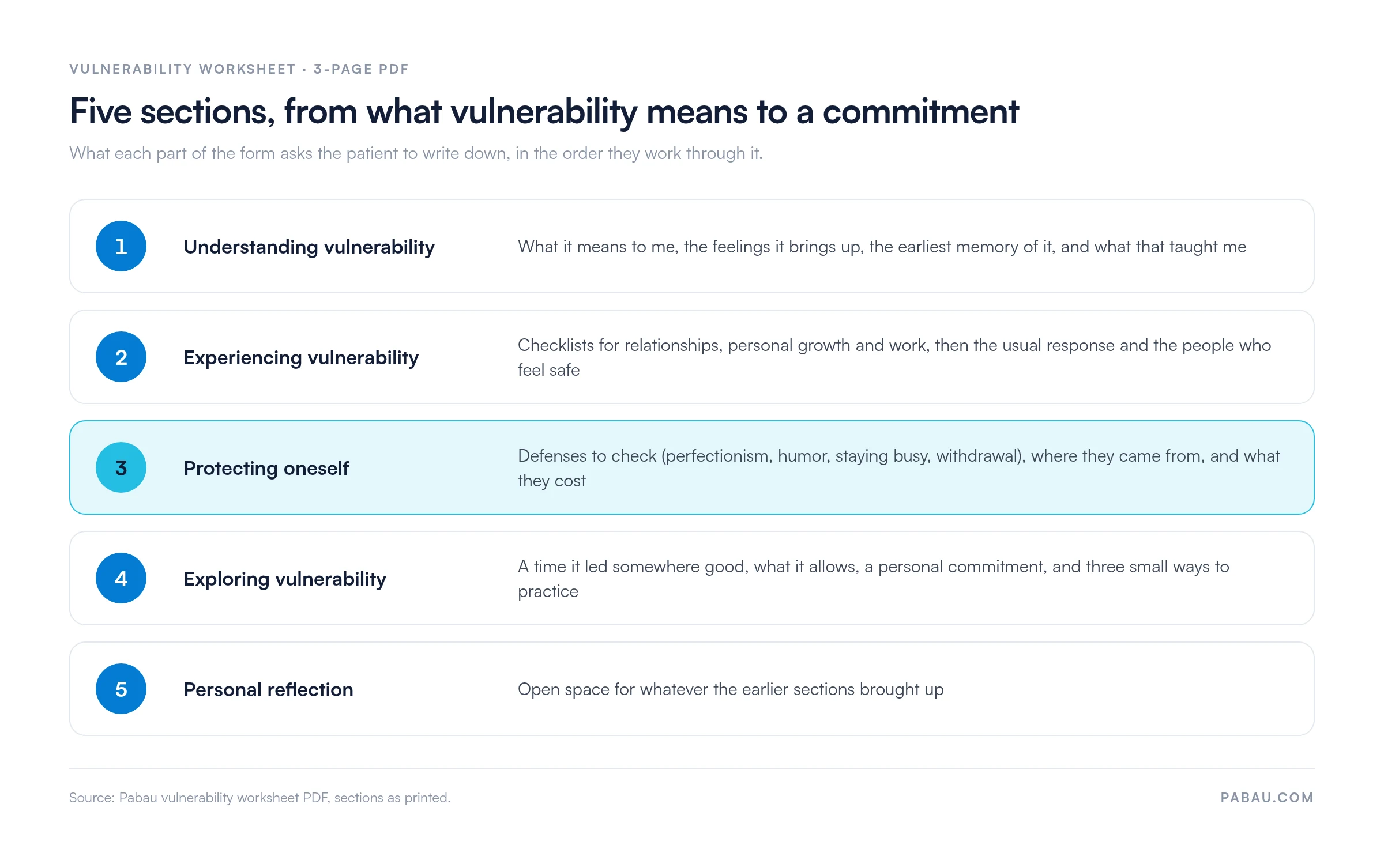
The form has no separate support or action-planning section. Support appears as one prompt, the people the patient feels safe being vulnerable with.
The three practice steps on page three are the closest it comes to homework. Setting boundaries is one of the relationship checkboxes, and an emotional boundaries worksheet takes that item further.
Using a vulnerability worksheet works best as a sequence of short, structured conversations. Clinicians tend to complete one section per session rather than the whole form at once.
Review the worksheet at the start of each following session. Ask what has shifted since last time. Revisiting the same entries shows change over time and gives the patient evidence of their own progress.
Psychotherapists, counselors, and clinical psychologists use vulnerability worksheets most often, particularly with patients working on shame, anxiety, or relationship difficulties. Where shame is the main theme, one of these shame worksheets can run alongside it.
Private practices running group sessions, coaching services, and employee assistance programs also use them as structured prompts. Practice managers benefit too, because a standard template keeps documentation consistent across clinicians.
A worksheet gives the session a clear structure, which helps clinicians keep difficult material contained and manageable. Patients often find it easier to name feelings on paper before saying them aloud.
Consistent documentation also supports clinical audit and continuity of care. When a standard template is used, a covering clinician can pick up the thread without relying on memory.
Brené Brown’s research defines vulnerability as uncertainty, risk, and emotional exposure, and most worksheets borrow that language. Her book Daring Greatly (2012) is the usual reference for the concept.
Barlow’s triple vulnerability model, published in 2002, describes biological, psychological, and specific psychological vulnerabilities. Clinicians use it as theoretical context for why some patients feel chronically exposed, not as a scoring instrument.
Cognitive behavioral therapy (CBT) often pairs these ideas with behavioral experiments and thought records. The early-memory prompt can also surface a belief worth unpacking with a core belief worksheet.
Vulnerability exercises extend the worksheet into practice between sessions. They work best when the patient has already named a specific situation to practice around.
Keep exercises small and time-limited. Patients who attempt large disclosures before they have built trust often retreat, which reinforces the shame the work is meant to reduce.
Mapping the vulnerability cycle means tracing one repeating sequence from trigger to outcome. The worksheet’s situation checklists and protection section provide the raw material.
Clinicians often find the cycle reveals one or two leverage points. Those become the focus for the next block of sessions.
On paper, a completed worksheet sits in a folder away from the session notes it explains. Comparing a patient’s answers across months then means finding every sheet by hand.
Pabau, the software built for therapists and other specialists, turns the worksheet into one of its digital forms. The patient fills it in before the session, and the answers save straight to their record.
Pabau’s Client records keep each worksheet beside intake forms, consent and session notes. A covering therapist can read the last entry before the session starts, and you can compare this month’s protection section with the first one.

Pabau’s digital forms send the vulnerability worksheet before the session and save the answers to the patient record. Review progress across sessions without searching paper folders.

The worksheet earns its place when it is revisited. A patient’s first answers to the protection section are a baseline. The same page filled in three months later shows whether withdrawal or perfectionism still drives the response.
Start with one section per session, and keep the commitment small enough to act on before the next appointment. Book a demo to see how Pabau keeps each completed worksheet beside the session notes it informs.

Working on attachment patterns as well? Attachment theory worksheet helps patients trace how early relationships shape the way they connect now.
Need a gentler first step before vulnerability work? Emotional awareness worksheet builds the habit of naming feelings as they happen.
Seeing anxiety in the situation checklists? Anxiety triggers worksheet maps the situations that set anxiety off and the response that follows.
A vulnerability worksheet is a guided reflection tool that helps a patient name when they feel exposed and how they protect themselves. It supports therapy and is not a diagnostic test.
Brené Brown’s work is widely cited, but this worksheet is an independent clinical template and is not an official Brené Brown product. Its language draws on her published definition of vulnerability.
Licensed practitioners should hand it out as a collaborative support within their scope of practice. It is not a self-help substitute for professional therapy.
Store them as part of the patient record with appropriate access controls. Practices in the US should consider HIPAA obligations, and UK practices should consider GDPR.