Emotional intelligence scale: Free PDF and how to score it
Download your free emotional intelligence scale A three-page questionnaire with ...

1
Last Updated: Nov 2, 2026
Shame worksheets are structured writing exercises that help patients notice, name, and question the belief at the center of shame: “I am bad.” That belief is hard to reach by talking alone, because shame pushes people to hide the moment it shows up. Writing it down gives the patient some distance, and that distance often keeps them in the conversation.
The type you choose matters as much as the worksheet itself. A psychoeducation handout suits the first few sessions. A CBT thought record suits a patient who can already spot the belief, and resilience work needs the room as much as the page. In Shame and Guilt (Guilford Press, 2002), June Tangney and Ronda Dearing link shame to depression, anxiety, and withdrawal. A mismatched worksheet can cost more than a wasted session.
Below, each type is matched to the moment it fits. After that come a quick checklist and the mistakes that decide whether a patient uses it at all.

Shame worksheets help patients examine shame-based beliefs in writing, and they support therapy rather than replace it.
Shame targets the self (“I am bad”) and guilt targets an action (“I did something bad”), so the emotion decides the worksheet.
The shame cycle runs from trigger to shame response, behavioral reaction, and reinforcement, and each worksheet type interrupts a different stage.
Fill in the first section together in session, then set one small task for home.
Review every completed worksheet in the next session, because an unreviewed worksheet tells the patient their effort didn’t matter.
Shame worksheets are paper or digital forms that let patients explore shame outside the moment it fires. They do three jobs in therapy:
Why bother with paper when you could just talk? Shame produces avoidance, and a patient who feels exposed often goes quiet. A written prompt moves the belief out of their head and onto the page. That small step outward is often what keeps a patient talking instead of shutting down.
Shame focuses on the self (“I am bad”), while guilt focuses on behavior (“I did something bad”). The two pull in opposite directions. Guilt tends to push people toward repair. Shame tends to produce avoidance and withdrawal, and in chronic cases, depression.
Here’s how a mix-up plays out. A patient says, “I keep letting my team down,” and you hand over a guilt-focused repair exercise. If the belief underneath is “I’m a failure,” the exercise tells them to simply do better. That confirms the shame instead of easing it.
So ask one question first. Is the patient upset about what they did, or about who they think they are?
The shame cycle is a self-reinforcing loop. Something triggers a shame belief, the feeling hits, the patient reacts, and the fallout seems to prove the belief right. The four stages below are a practical framework for matching worksheets, not a named model from the research literature.
A patient who maps their own cycle on paper stops feeling shame as one overwhelming wave. They start to see a pattern with clear entry and exit points, and each worksheet type targets a different one.
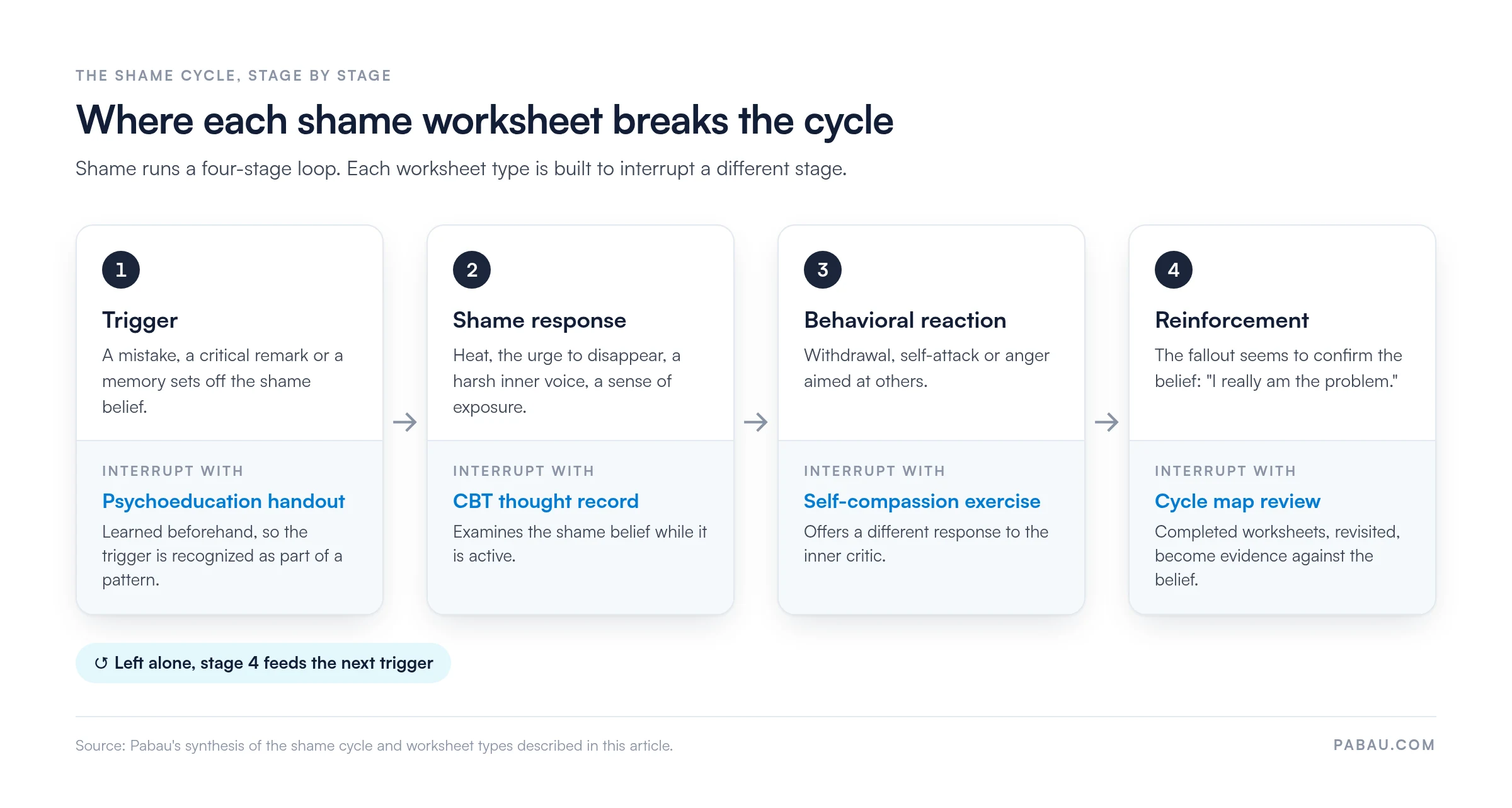
In practice, a psychoeducation worksheet introduces the map before the patient is inside the cycle. A CBT thought record examines the belief at stage 2, while it’s active. A self-compassion exercise offers another response at stage 3, and reviewing completed worksheets later chips away at stage 4.
Introduce the shame cycle worksheet in a session before the patient is in acute distress. When shame is actively triggered, cognitive access is limited. Patients learn the map best when they are emotionally regulated, then use it as a reference during high-distress moments between sessions.
Choosing the right shame worksheet depends on where the patient is in treatment and what the session needs to do. Use the table as a quick decision guide. Find the situation in the middle column, then reach for the tool on the left.
Shame resilience worksheets follow the four-element model from Brené Brown’s research at the University of Houston. The elements are recognizing shame and its triggers, practicing critical awareness, reaching out, and speaking shame. Her central finding is that shame can’t survive being spoken and met with empathy.
Brown built the model from grounded theory interviews with women, so the evidence behind it is qualitative. Use it to structure the conversation, and lean on trial-tested methods when you need outcome evidence.
The first two elements work well on paper. For element one, a prompt might read: “Describe the situation that triggered shame. What did you feel in your body?” For element two: “What messages does shame send you? Who taught you those messages?”
Elements three and four are different, because reaching out and speaking shame need another person. Treat them as session prompts, not solo homework.
A CBT thought record applied to shame follows five steps:
The catch is step four. Early in treatment, the evidence-against column tends to be thin. Shame is often held at an implicit, pre-verbal level and has been reinforced for years. Plan to build that column together in session, using the thought record template from the types table as your starting format.
Self-compassion worksheets draw on Kristin Neff’s three-part framework. Self-kindness means treating yourself as you’d treat a close friend. Common humanity recognizes that suffering and imperfection are universal, and mindful awareness holds pain without over-identifying with it.
A 2019 meta-analysis by Ferrari and colleagues in Mindfulness pooled 27 randomized controlled trials. Self-compassion interventions produced moderate improvements in self-criticism, depression, and anxiety compared with control groups. Three formats work well with shame:
Neff’s work is research on self-compassion rather than a therapy. The therapy built for shame is compassion-focused therapy (CFT), developed by clinical psychologist Paul Gilbert. In his 2009 introduction to CFT, Gilbert notes that people high in shame and self-criticism often struggle to be kind to themselves.
CFT builds that capacity through compassionate mind training. For a patient whose inner critic shouts down every worksheet, CFT training or a referral to a CFT therapist is worth considering.
Four quick checks decide whether a worksheet helps or sits unused. Each one takes seconds.
Finding a free printable shame worksheet is the easy part. The value comes from how you introduce it, and the five steps below cover that. For a starting point, every template linked in the types table above is free to download.
Group therapy is one of the strongest settings for shame work. Shame fears exposure, and a group offers witnessed disclosure in a safe container. When a patient voices shame and the room responds with empathy, the shame response is contradicted on the spot.
Adapting shame and guilt worksheets for a group takes three changes:
One rule comes before any disclosure work: cover group therapy informed consent first. Patients need explicit agreement on confidentiality before they’ll risk speaking shame in front of others. Without it, the exercise breeds guardedness instead of openness.
Shame plays a well-documented role in addiction. Randles and Tracy recruited 105 newly sober Alcoholics Anonymous members for a 2013 study and followed up 46 of them months later.
Those who showed more shame in their body language were more likely to relapse months later. For someone in recovery, the quickest escape from shame can be the substance behind it.
That’s why shame work shows up across recovery programs. It runs from the moral inventory in Steps 4 and 5 of 12-step programs to SMART Recovery’s cognitive tools. Worksheets that help in recovery tend to share three aims:
Store completed recovery worksheets securely in the patient record. When patients revisit them at three, six, and 12 months, their documented progress builds evidence against the shame belief in a way reassurance can’t. Pair them with a relapse prevention plan so shame triggers sit alongside other warning signs.
In many therapy practices, shame worksheets live on paper. They’re printed, filled in at home, sometimes forgotten, and filed in a folder nobody opens at the six-month review. When a patient wants to see how far they’ve come, someone has to dig through it. Good therapy practice management software removes that digging.
Pabau lets you send a worksheet as one of your digital forms before the session. The patient fills it in on their phone, and the answers are already in their record when you open the session.
Completed worksheets then sit in Client records next to your session notes, stored securely. At a follow-up, you open the patient’s file and the whole history is there, with no filing cabinet or scanner involved.
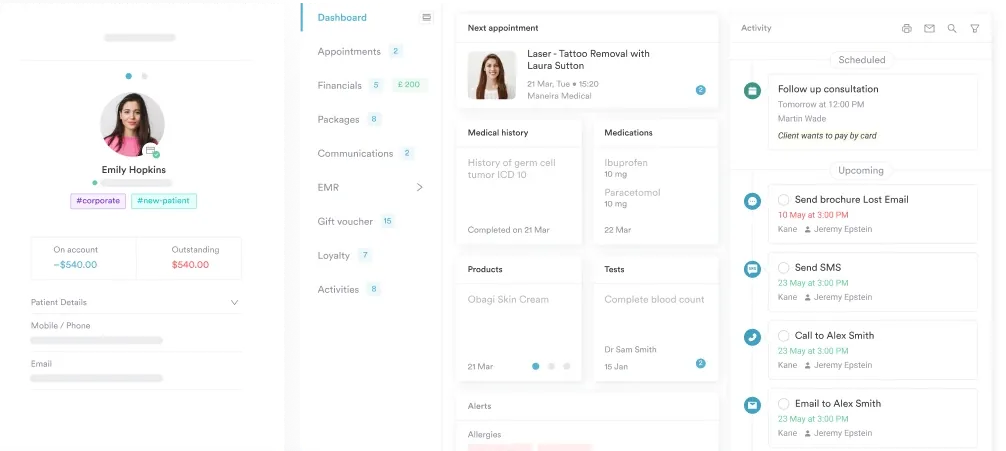

Pabau’s digital forms store completed worksheets securely in the patient record, so every session tool is ready to review at the next appointment. No filing, scanning, or separate storage.

Shame worksheets earn their place when the tool matches the moment. Hand a patient the wrong one, or the right one at the wrong time, and the page confirms the belief you’re trying to loosen. Get the match right, and shame finally has somewhere to go other than inward.
So start small. Pick one worksheet for the stage your patient keeps getting stuck in, complete the first section together, and put the review on next session’s plan. The cost is time in the room, and shame work is worth it.
If paper worksheets keep going missing between sessions, Pabau keeps every completed one in the patient record, ready for the next review. Book a demo to see how it fits your therapy practice.

Want to show patients how thoughts drive feelings? The cognitive triangle explains the thought, feeling and behavior loop that sits under most shame work.
Looking for a between-session self-compassion tool? Self-compassion journal gives patients daily prompts to practice a kinder inner voice.
Need a structured compassion exercise? Compassion worksheet walks patients through extending warmth to themselves and others.
Working with patients in recovery? Stages of relapse worksheet helps patients spot emotional and mental warning signs before a relapse.
Ready to build long-term shame resilience? Resilience worksheet helps patients identify strengths and coping strategies they can rely on.
Yes, for psychoeducation and self-compassion exercises, which are low-risk to complete alone. Deeper work, such as thought records on core beliefs or resilience steps that involve disclosure, goes better with a therapist. Anyone with a history of self-harm should do shame work with professional support.
Embarrassment follows a minor, often public slip and fades quickly, usually without changing how someone sees themselves. Shame feels heavier and targets the self, carrying the message “I am bad.” Embarrassment rarely needs a worksheet, while persistent shame often does.
The Compass of Shame is Donald Nathanson’s model of four ways people defend against shame: withdrawal, avoidance, attack self, and attack other. Spotting a patient’s dominant direction helps you choose a worksheet, such as self-compassion work for someone who mostly attacks themselves.
They can help as part of a structured recovery program, not as a replacement for one. Research links shame to relapse risk, so shame work is clinically relevant in substance use treatment. Shame-to-use maps, identity-behavior prompts, and self-forgiveness narratives tend to work best.
Yes, with adjustments. Use plain language, shorter prompts, and examples from school, friendships, and social media. Teens often need more of the worksheet completed in session, and involving a parent depends on the patient’s age and local consent rules.