Seated flexion test
The seated flexion test is a palpation-based assessment of sacral motion at the ...

4
Last Updated: Oct 15, 2026
Yeoman’s test is a prone provocation test for sacroiliac joint (SIJ) pain. With the pelvis held down, the examiner flexes the knee to 90 degrees and passively extends the hip. That rotates the ilium forward and stresses the anterior sacroiliac ligament. Familiar pain reproduced over the SIJ, below the posterior superior iliac spine (PSIS), is a positive result.
Physical therapists, chiropractors, and sports medicine clinicians use it to separate SIJ pain from lumbar or hip pain. Published accuracy figures vary widely, so the test belongs inside a group of SIJ tests rather than on its own. This guide covers the procedure, how to read the result, and what to record.
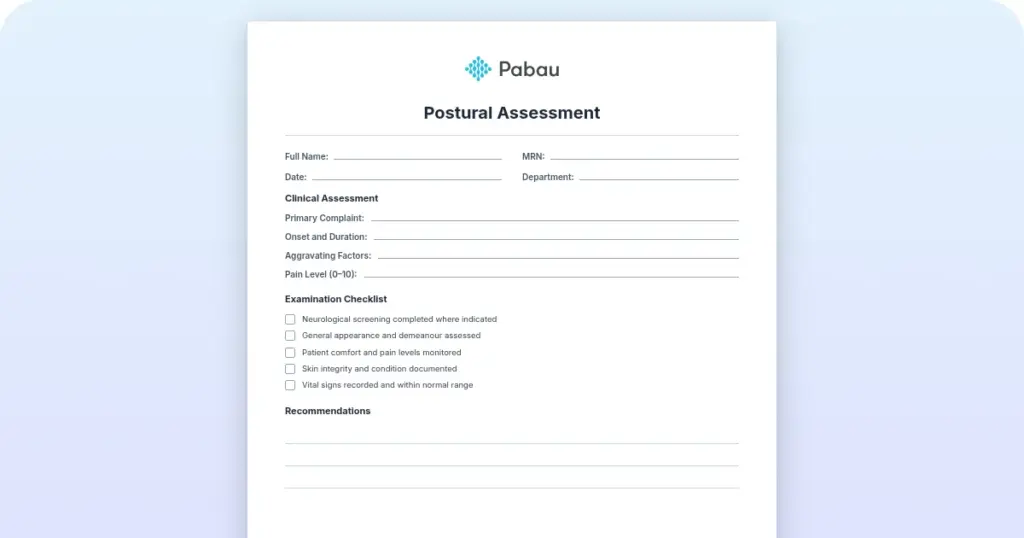
A one-page form with step-by-step instructions for the prone test. It has fields for the patient, examiner, and test date, a positive or negative result checkbox, and space for comments.
Download template
Yeoman’s test is a prone SIJ provocation test. Passive hip extension with the pelvis fixed rotates the ilium forward and stresses the anterior sacroiliac ligament.
A positive result is familiar pain over the SIJ region, below the PSIS, rather than midline lumbar pain.
Published accuracy figures disagree widely, from 64.1% sensitivity and 33.3% specificity in one 2020 study to much higher numbers elsewhere.
Pair it with other SIJ provocation tests, such as the thigh thrust and Gaenslen’s test, before you conclude the SIJ is the pain source.
Practice management software like Pabau stores the result, pain location, and clinical impression in the patient record, so serial retests are easy to compare.
Yeoman’s test is a prone SIJ provocation maneuver. The examiner flexes the knee to 90 degrees and passively extends the hip while holding the sacrum down. Patrick’s test (FABER) loads the SIJ through hip flexion, abduction, and external rotation. Yeoman’s uses hip extension instead, which rotates the ilium forward on a fixed sacrum.
Clinicians reach for it when a patient reports posterior pelvic pain, buttock pain, or referred leg symptoms. Those symptoms could come from the SIJ or from the lumbar facet joints, and the test helps tell them apart. It’s usually run alongside other SIJ provocation tests, because no single test settles the question.
The sacroiliac joint links the sacrum to the ilium on each side of the pelvis. It’s a synovial joint braced by three ligament groups. The thin anterior sacroiliac ligament covers the front, the posterior sacroiliac ligaments cover the back, and the deep interosseous ligament sits between the bones.
During Yeoman’s test, the fixed sacrum and the lifted thigh rotate the ilium anteriorly. That puts the main load on the anterior sacroiliac ligament. The posterior structures are loaded only briefly, early in the movement.
Record exactly where the pain is reproduced. Pain over the SIJ region, below the PSIS, means something different from midline lumbar pain. Marking the spot on back pain location charts keeps the finding comparable from one visit to the next.

The steps below follow the standard prone technique. Firm stabilization and gentle overpressure keep the findings consistent from one clinician to the next.
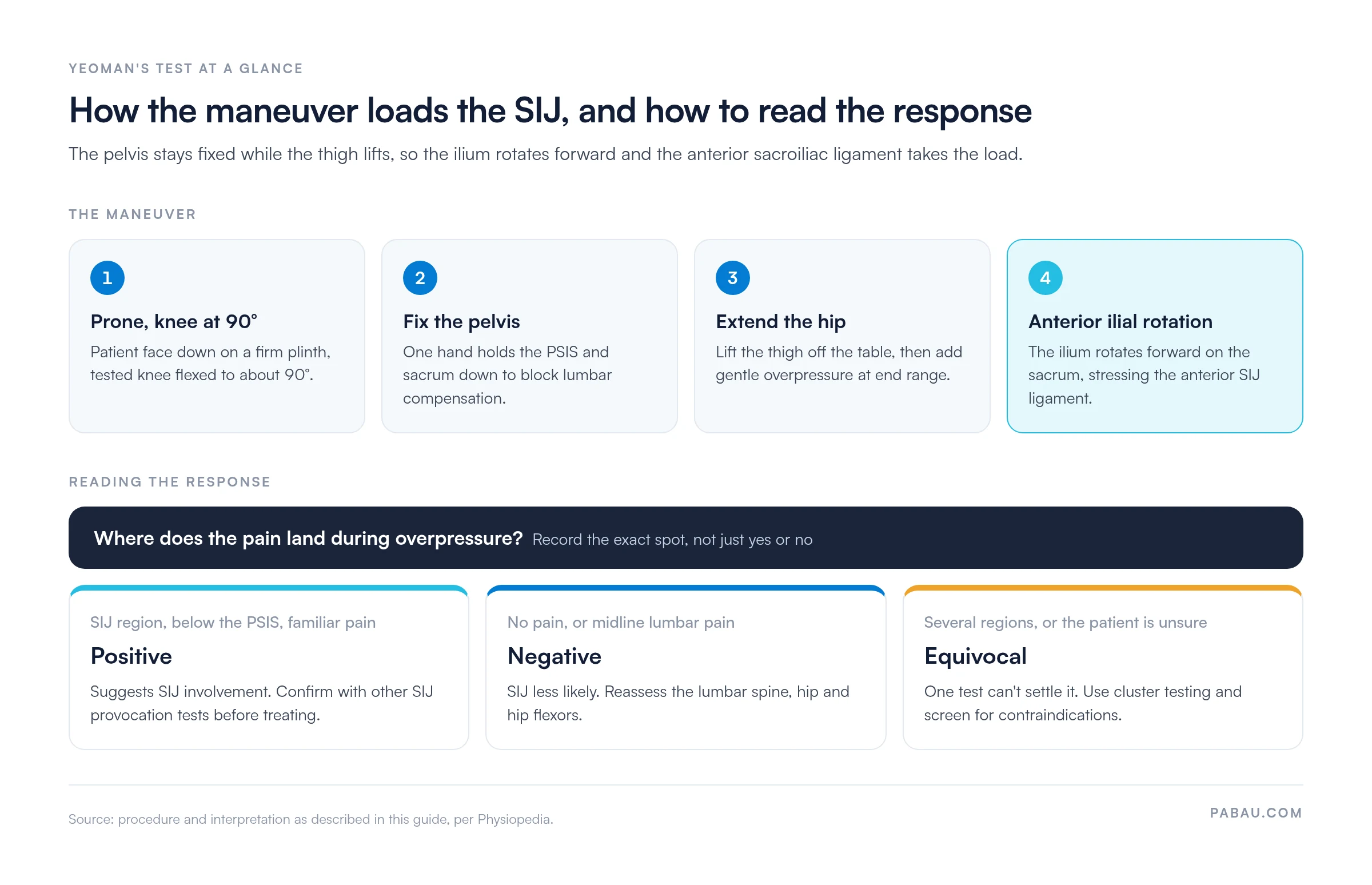
A positive Yeoman’s test reproduces posterior pelvic or buttock pain, below the PSIS, during the overpressure phase. The pain should sit over the SIJ region rather than the lumbar midline, the lower back, or the hip flexors. The diagram below pairs the four moves of the test with the three ways the response can read.
Evidence on the accuracy of Yeoman’s test is limited and inconsistent. A 2020 study by Nejati and colleagues reported 64.1% sensitivity and 33.3% specificity. Other sources cite much higher figures, around 93% sensitivity and 89% specificity, as one research review notes. With results that far apart, never rely on this one provocation test in isolation.
Accuracy improves when you combine tests. The best-studied cluster, described by Laslett, uses distraction, compression, sacral thrust, the thigh thrust test, and Gaenslen’s test. Three or more positive results point toward SIJ pain. Yeoman’s test isn’t part of that cluster, so treat a positive Yeoman’s as supporting evidence alongside it.
Three SIJ provocation tests turn up most often in routine practice. Knowing how each one positions the patient and loads the joint helps you read a mixed set of results.
Record the result the same way every time, so a retest three weeks later means something. A structured assessment form prompts each field, which makes audits and trend tracking far easier than free text.
In chiropractic practices, the result and pain location you record also feed the medical-necessity note Medicare expects behind a spinal manipulation claim. Pain or tenderness and a range-of-motion abnormality are two of the four PART criteria, and a claim needs at least two. So billing software for chiropractors works best when it pulls straight from the exam note.

Document the following:
Pabau Scribe, our AI scribe, can speed this up without losing detail. Dictate your findings straight after the test, and it structures them into the patient’s record.
Use Yeoman’s test when:
Avoid or modify it when the patient has:
Add these screening questions to your physical therapy intake form. Contraindications then surface before the patient is on the plinth.
On paper or in free-text notes, a Yeoman’s result is hard to find at the next visit. It’s harder still to compare across a plan of care, because each clinician words it differently.
In Pabau, you can build Yeoman’s test into a digital assessment form alongside SIJ palpation, lumbar clearing tests, and hip mobility screening. The result, side, and pain location save to the patient’s Client record. Whoever reviews the record next sees the full SIJ picture at a glance.
Appointments, notes, and invoices share that same record, which makes Pabau a time-saving physical therapy EMR for practices running serial assessments. Book the follow-up before the patient leaves, and automated reminders keep each retest on schedule.

Pabau’s digital forms and Client records capture Yeoman’s test results, pain location, and clinical impression in one place. Serial retests stay easy to compare across a plan of care.

Yeoman’s test earns its place as a quick, low-cost check within a wider SIJ exam. Its value rests on two habits: fixing the pelvis firmly, and recording exactly where the pain lands.
The trade-off is accuracy. A single positive Yeoman’s can’t confirm SIJ pain, so use it to support a cluster result. Then retest the same way at each visit, and changes in the response become a usable measure of progress.
The downloadable form gives you a consistent place to log each test. Book a demo to see how Pabau stores SIJ assessment results in the patient record, so serial retests are easy to compare.

Want another SIJ motion test to compare against? The Gillet test shows how to assess SIJ movement in standing, a useful contrast to provocation tests.
Need to rule out a lumbar source first? The passive lumbar extension test covers a quick prone screen for lumbar instability.
Suspect the hip rather than the SIJ? The hip scour test explains how to load the hip joint and read the response.
Looking for a structured pain intake? This pain assessment intake form captures pain location, intensity, and history before the physical exam.
Planning a full hip workup? Our hip examination guide walks through the tests that sit alongside SIJ screening.
Yeoman’s test screens for sacroiliac joint dysfunction and posterior pelvic pain. Passive hip extension rotates the ilium forward and stresses the anterior SIJ ligament. Reproduced familiar pain suggests the SIJ is contributing to the patient’s symptoms.
A positive result is pain reproduction in the sacroiliac region (posterior, below the posterior superior iliac spine) during the test. Pain should feel familiar to the patient’s current symptoms. A positive test suggests SIJ involvement, but it must be combined with other tests and clinical reasoning for diagnosis.
Yeoman’s test uses hip extension, which rotates the ilium forward and stresses the anterior SIJ ligament. Patrick’s test (FABER) uses hip flexion, abduction, and external rotation, and it also loads the hip joint. Positive results on several SIJ tests increase confidence in SIJ involvement.
The evidence is limited and inconsistent. One 2020 study reported 64.1% sensitivity and 33.3% specificity, while other sources cite much higher figures. Because of that spread, combine it with other SIJ provocation tests rather than relying on it alone.
No. Avoid or modify the test if the patient has an acute SIJ sprain, a hip fracture, or recent hip surgery. The same applies to severe hip flexor tightness or trouble lying prone. Always screen for contraindications during patient intake.
Record the test position, the overpressure applied, and whether pain was reproduced. Note the exact pain location using landmarks like the PSIS, and whether it matched the patient’s familiar pain. Add the results of other SIJ tests, your clinical impression, and the resulting treatment plan.