Slocum test: How to perform, interpret and record it
The Slocum test is a knee drawer test performed with the tibia rotated. It check...

2
Last Updated: Oct 21, 2026
The medicine ball throw test is a field test of upper body explosive power. The subject pushes a medicine ball from the chest with both hands, and the score is the distance it travels. Strength coaches, sports scientists, physical therapists and fitness assessors use it to measure how much force an athlete or patient can produce.
Sports medicine practices, fitness centers and tactical fitness programs use it as a standard part of physical assessment batteries. Unlike lab-based isokinetic dynamometry, it needs minimal equipment and takes under five minutes. It also produces a distance that is easy to track across training blocks.
Two variants exist. The seated version isolates upper body output by removing leg drive, and the standing version adds trunk and lower limb contribution. Either way, a score only means something when the ball weight, the setup and the norm table all match the person being tested.

The medicine ball throw test measures upper body explosive power as a two-handed chest-pass distance, in a seated or standing variant.
The seated variant isolates the upper body, while the standing variant adds trunk and leg drive.
A score only compares against norms built with the same ball weight and setup, such as the Utah protocol’s 2 kg floor-seated throw.
Use the best of three trials, and run a familiarization session first to limit the learning effect.
Practice management software like Pabau stores every trial against the patient record, so retests compare like for like.
The medicine ball throw test measures upper body explosive power, specifically the capacity to generate rapid force through a bilateral push pattern. It captures both muscular strength and the rate of force development. Where speed of movement matters, that makes it more functionally relevant than a static grip or isometric push test.
Four groups use it most:
The seated variant is especially common in rehabilitation and adolescent testing because it removes the confounding contribution of lower body drive.
The seated and standing variants measure different qualities. Pick the wrong one and a poor standing score can look like upper body weakness when the problem sits in trunk transfer or leg drive.
Equipment requirements are minimal, but ball weight selection is critical. Using the wrong ball weight invalidates any comparison against published normative data for your population.
Consistent administration also means controlling room temperature and using a non-slip floor. If you compare results over time, standardize the warm-up across all sessions.
Administer a standardized warm-up before either variant. Start with 3-5 minutes of light upper body movement, such as arm circles, band pull-aparts, and bodyweight push movements. Follow it with 2-3 submaximal practice throws at 50-75% effort. Allow 60 seconds rest after the final practice throw.
Record all three trial distances. Use the best single trial as the subject’s score. Round to the nearest centimeter. Do not average the trials, as averaging underestimates peak performance and reduces sensitivity to improvement over training blocks.
A trial is void after a foot fault, a back leaving the chair, or a countermovement. Record it as void and allow a replacement trial after a standard rest period, with a maximum of one replacement per session. Note each voided trial and the reason if results will feed longitudinal tracking or an audit.
Practice management software like Pabau handles this through its measurements tracking software, which stores raw trial data alongside the best result. Voided trials then stay visible in the session record.
Normative reference values for the medicine ball throw test are population-specific. Comparing an adolescent’s result against an adult athlete table produces a misleading interpretation. Always select the table that matches your subject’s age, sex, and population category. The three reference sets below each assume a different ball and setup.
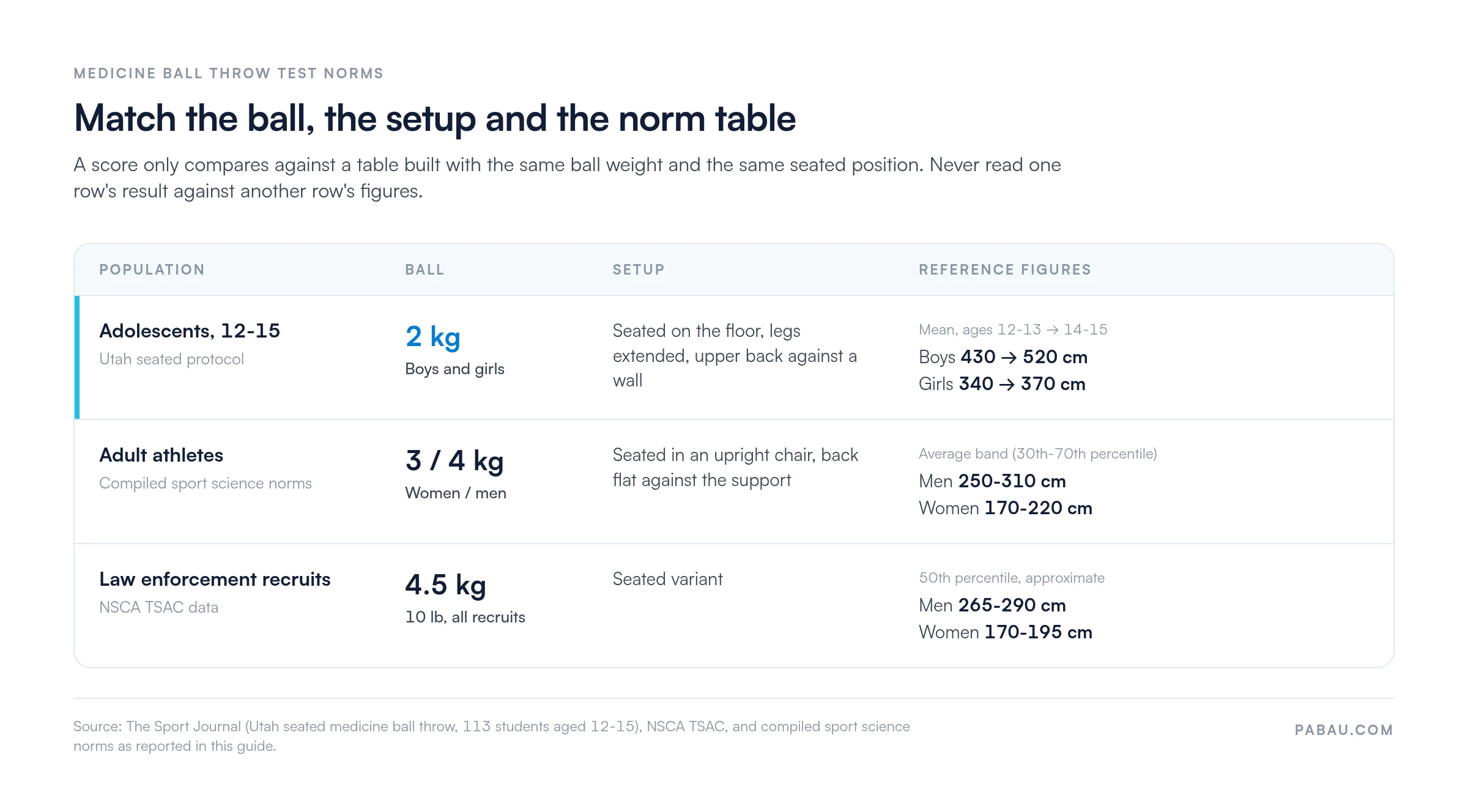
Compiled sport science literature gives benchmarks for adult athletes using a 3 kg ball (females) or a 4 kg ball (males). They typically fall in the ranges below. These are general reference figures, so confirm sport-specific norms against the source publications.
Adolescent reference values come from a study in The Sport Journal that used the Utah seated medicine ball throw protocol. Researchers tested 113 students aged 12-15 at one northern Utah school, in two age bands: 12-13 and 14-15. Boys and girls threw the same 2 kg ball.
The Utah setup differs from the chair protocol described above. Students sat on the floor with their legs extended and their upper back against a wall. Replicate that position and use a 2 kg ball before comparing a student’s score with the table below.
The study reports its means in meters, such as 4.3 ± 0.7 m for boys aged 12-13. They are converted to centimeters here to match the rest of this guide. Between the two bands, the boys’ mean rose by about 90 cm and the girls’ by about 30 cm.
These distances run longer than the adult athlete figures above because the ball is much lighter. Never compare a Utah score against the adult table, or an adult score against this one.
The data covers ages 12-15 only, so it does not apply to older teenagers or adults. The original paper also lists quartile cut-offs for each band if you need a percentile rank.
The NSCA Tactical Strength and Conditioning (TSAC) program has published normative data for law enforcement recruits. These use a 4.5 kg (10 lb) ball in the seated variant. The figures reflect occupational fitness standards rather than sport performance benchmarks. They are meant for pre-employment or fitness program screening.
Check the current NSCA TSAC tables before using these figures in formal recruit screening programs, because the standards are reviewed periodically.
Six variables shift throw distance beyond upper body strength. Knowing them helps practitioners separate performance change from measurement noise. It also stops a short throw being blamed on weakness when a protocol variable caused it.
The seated medicine ball throw test has shown good to excellent test-retest reliability in published research. One validation study, indexed on PubMed (PMID 21572350), tested 33 older adults with a mean age of 72.4. It found the seated throw a valid measure of upper body power in that group, so treat it as evidence for older populations specifically.
Across studies, intraclass correlation coefficients (ICC) typically run from 0.89 to 0.97. That indicates low measurement error when the protocol is administered consistently.
Concurrent validity against isokinetic dynamometry and one-repetition maximum bench press is moderate to strong. The test correlates meaningfully with established lab-based measures. It is not, however, a substitute for load-specific strength assessment when precise force-velocity profiling is needed.
The seated variant does not capture the power transfer from lower body to upper body that underpins most sport-specific pushing actions. It is an isolation measure, useful for rehabilitation baselines and for populations where lower body contribution needs to be removed. As a standalone indicator of sport performance, it is limited.
Like most field tests, it belongs in a broader test battery rather than serving as the sole outcome measure. The learning effect also means a first test result underestimates capacity, so flag it before any normative comparison.
Run a familiarization session at least 48 hours before the formal test. One set of three submaximal throws and one maximal practice throw is enough. It cuts learning-effect variance and gives you a steadier baseline for longitudinal comparison.
A result only has value when it informs a decision. Build these four applications into your testing workflow.
Tracking progress across a training block: Retest every 6-8 weeks and plot distance against the program variables, such as volume, intensity and push-pattern exercise selection. A flat or falling result under an appropriate load is a signal to review programming or recovery.
Those comparisons only work if every session’s results can be pulled up without manual spreadsheet work. That retrieval check is worth running when you compare sports medicine software options.
Part of a field test battery: The medicine ball throw test pairs well with a countermovement jump (lower body power) and a 20-meter sprint (speed). Together these three tests give a power profile across the three major movement qualities. A subject who throws well but jumps poorly has a different training priority than one who jumps well but throws poorly.
Rehabilitation milestones: In upper limb rehabilitation, the seated variant can serve as a criterion for return to sport or to specific occupational tasks. Compare throw distance against the pre-injury score where one exists, or against same-age normative values as a functional threshold.
The return-to-running assessment protocol uses a similar milestone-driven approach for lower limb rehabilitation, and the logic transfers directly.
Communicating results to athletes and patients: Present the result alongside the relevant normative percentile, not just the raw distance. “You threw 290 cm” means very little. “You threw 290 cm, which puts you at about the 65th percentile for adult male athletes” gives the number context.
A physical therapy EMR that produces patient-facing reports cuts the time spent formatting results after each session. In Pabau, Client records hold each assessment in date order, so practitioners can pull comparison data between sessions quickly.
Many practices log throw distances on a paper sheet or a spreadsheet kept apart from the patient record. The ball weight, the variant and any voided trials drift away from the score. A retest six weeks later then becomes hard to compare like for like.
Pabau keeps each test session in one place. Digital assessment forms capture the ball weight, the variant and every trial while the test is running. Measurements tracking then stores the trials and the best score against the patient’s record, so nobody retypes results afterward.
The result is a retest you can trust. Practitioners pull up earlier sessions in seconds and show athletes their progress without rebuilding a spreadsheet.

Pabau’s measurements tracking and Client records let you log medicine ball throw results and monitor progress over training blocks. Share reports with athletes or referrers without the paper trail.

The medicine ball throw test earns its place in a field battery because it is quick, cheap and reliable. That value holds only when the ball weight, the seating setup and the norm table all match. A 2 kg floor-seated throw from a 13-year-old and a 4 kg chair throw from an adult athlete cannot share a scale.
Choose the variant that answers your question, then lock the protocol and retest under the same conditions every six to eight weeks. The trend across sessions will tell you more than any single percentile. Book a demo to see how Pabau keeps every throw, retest and report in one patient record for sports medicine and physical therapy practices.

Building a lower body power profile? Drop jump test guide covers the protocol, the metrics and how to interpret results.
Need another upper body field test? Alternate hand wall toss test sets out the protocol, adult norm tables and scoring rules.
Adding change of direction to your battery? Illinois agility test guide explains the course setup, norms and scoring.
The medicine ball throw test measures upper body explosive power, specifically the rate and magnitude of force generated through a bilateral pushing movement. It captures both muscular strength and speed of force development, making it useful for athlete profiling, rehabilitation milestones, and fitness battery screening.
Ball weight varies by protocol and population. The Utah adolescent protocol uses a 2 kg ball for boys and girls aged 12-15. Adult sport science norms typically use 3 kg for females and 4 kg for males. NSCA TSAC guidelines for law enforcement recruits use 4.5 kg (10 lb). Always verify against the specific normative table you plan to use.
The seated variant isolates upper body output by preventing lower body drive. The standing variant allows trunk, hip, and leg contribution, which produces higher distances and measures a more integrated power expression. Use the seated version for rehabilitation assessment and adolescent testing. Use the standing version for athletic power profiling.
Complete three maximal trials with 45-60 seconds rest between each. Record the distance of each trial in centimeters from the release point (chair base or start line) to first ball contact. Use the best single trial as the score. Do not average trials.
Yes, when administered with a standardized protocol. Published research reports ICC values of 0.89-0.97 for the seated variant, indicating good to excellent test-retest reliability. Concurrent validity against bench press 1RM and isokinetic dynamometry is moderate to strong. The main threat to reliability is inconsistent protocol delivery across sessions.
Compare the best trial distance against the normative table that matches the subject’s sex, age group, and population category (athlete, adolescent, or law enforcement). Expressing the result as a percentile rank gives more practical meaning than the raw distance alone. Track change over time relative to training block design for longitudinal interpretation.