Mental health self-care checklist
A mental health self-care checklist is a structured daily tool for tracking the ...

5
Last Updated: Oct 20, 2026

A SIRP note documents a therapy session in four parts: Situation, Intervention, Response, and Plan.
The format suits therapists because it puts what you did, and how the client responded, on the record every session.
Payers read the Intervention and Response sections hardest, so name the technique and note the observable change.
Writing each section while the session is fresh keeps the detail that a note reconstructed days later loses.
Practice management software like Pabau includes clinical note templates you can shape around the SIRP structure.
A four-section therapy note form with writing prompts for Situation, Intervention, Response, and Plan. It leaves space for session details, homework, and the focus you agree on for next time.
Download templateInsurance reviewers rarely ask whether your therapy worked. They ask whether your note shows it. A SIRP note answers that by splitting the session into four parts: Situation, Intervention, Response, and Plan.
This guide covers what belongs in each section, how to write the note during the session rather than days later, and two completed examples. The free template above gives you the structure to work from.
A SIRP note is a progress note format that documents four parts of a therapy session: Situation, Intervention, Response, and Plan. Each part captures a different layer of the same hour. Together they tell the clinical story in order. What the client brought in, what you did about it, how they responded, and what happens next.
Therapists in private practice, community mental health centers, and integrated care settings use it because it is fast to complete and familiar to payers. The Response section is what sets it apart. It puts the client’s reaction to treatment on the record every single session, rather than leaving it implied.
Practices that chart in a mental health EMR can build the four headings straight into the note template. That way the format is a set of prompts on screen, not something you have to hold in your head between clients.
Each letter names one section of the note. Here is what belongs in each, and roughly how long each one runs in a standard 50-minute session.
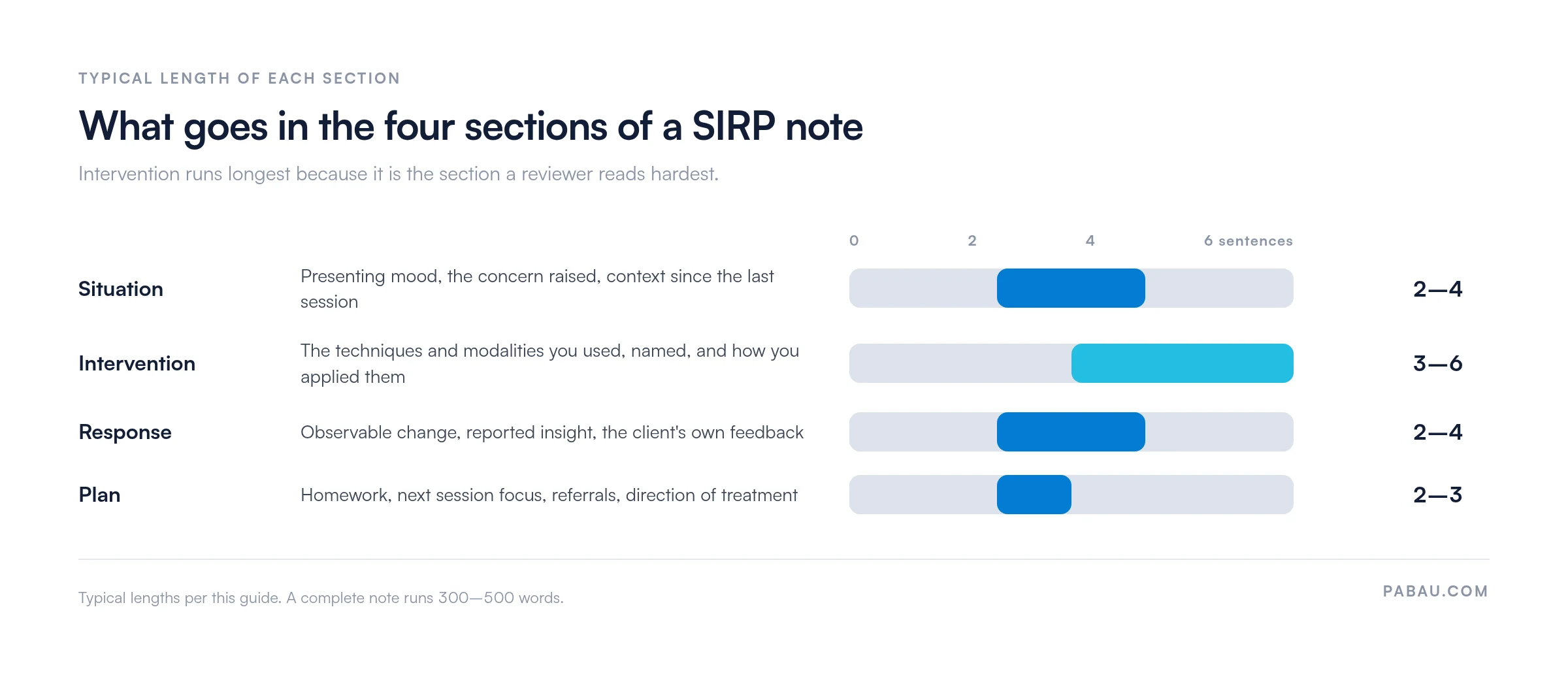
Document the client’s presenting concern at the start of the session. Record their mood, their emotional state, and the issue they brought that day. Add context from the time since the last session. This sets the starting point that the rest of the note measures against.
Intervention describes what you did. Name the technique or modality, then say briefly how you applied it. Cognitive restructuring, exposure work, motivational interviewing, and grounding exercises all belong here. This is the section where your clinical reasoning becomes visible to anyone reading the chart later.
Response records how the client reacted to what you did. Note observable change, any insight they reported, and their own feedback on the session. Did their affect shift? Did they finish the exercise? A reviewer reads this section to see that treatment is moving.
Plan sets the next steps. Include the focus for the next session, homework or between-session tasks, referrals, and the direction of treatment. Written well, it doubles as your prep note for next week.
SIRP works across most therapy settings. Private practice therapists like it because they handle their own documentation and billing, and the four sections line up with what payers ask for. Community mental health teams use it to keep records consistent across a rotating group of clinicians.
Integrated care adds another reason. When mental health services sit alongside primary care, colleagues from other disciplines need to skim a note and understand it quickly. Four labeled headings make that possible in a way a narrative paragraph does not.
The format holds up for individual therapy, couples work, family sessions, and groups. It also covers most modalities, from cognitive behavioral therapy to psychodynamic and solution-focused work. Standardizing it across a team is far easier inside software for therapy practices than across a shared folder of documents.
The note gets easier when you build it in pieces across the session, instead of reconstructing the hour afterward. These five steps follow the session’s own timeline.
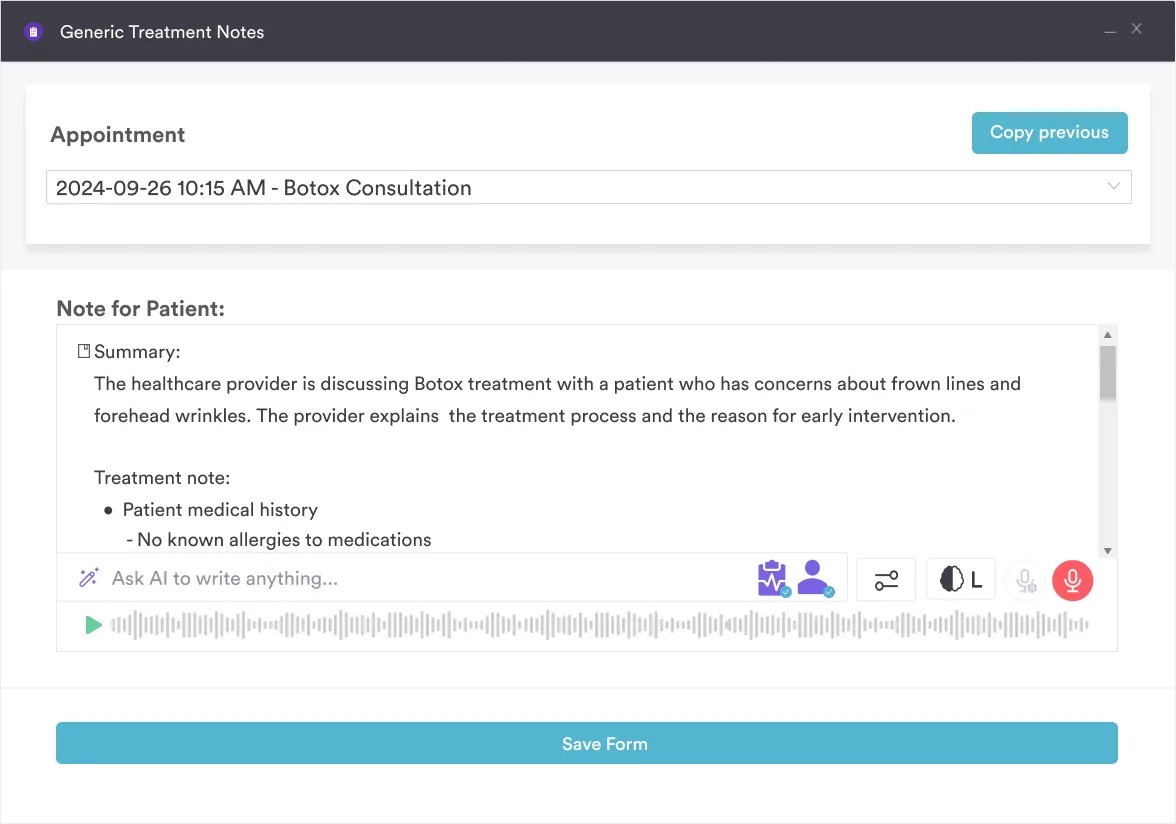
Notes written days later lose the detail that made them worth writing. AI-assisted clinical documentation can carry part of the load by transcribing the session and drafting the structure. You spend the hour with the client instead of the keyboard.
Two completed notes, one from individual therapy and one from a couples session. Both are written at the level of detail a reviewer expects.
Example 1: Individual therapy for anxiety
Situation: Client presented with rising anxiety about a job interview on Tuesday. Reported sleep disruption and racing thoughts over the weekend. Mood was anxious but engaged. We worked on identifying worry patterns last week. Client has been practicing mindfulness but finds it hard to apply under pressure.
Intervention: Used cognitive rehearsal. Client walked through the interview aloud while I coached on evidence-based answers to common questions. Practiced the 5-4-3-2-1 grounding exercise to address physical symptoms. Reviewed last week’s worry record and picked three catastrophic thoughts to challenge before the interview.
Response: Client reported feeling calmer after the rehearsal. Identified one catastrophic thought, “I’ll freeze and say nothing,” and generated three realistic alternatives. Demonstrated the grounding exercise twice and said it gave them more control. Expressed more confidence about the interview.
Plan: Homework is grounding practice twice daily until the interview, plus a thought record on any anxiety spike. Client will text a confidence rating on Monday evening. Next session will process the interview and consolidate what worked. Reviewed crisis line and safety resources.
Example 2: Couples therapy
Situation: Couple presented with conflict over household responsibilities. Wife reported feeling unsupported and overloaded. Husband felt criticized and had withdrawn. Both said they want to communicate better. Mood was guarded but cooperative. This is week three, and trust in the process is building.
Intervention: Taught the speaker-listener technique, using household responsibilities as the practice topic. Wife spoke while husband listened without interrupting, then they swapped. Reframed the conflict as a problem they face together rather than against each other. Normalized it as a common couples issue.
Response: Both partners said they felt heard for the first time in months. Husband articulated his experience without defensiveness once roles switched. Wife noticed her anger dropped when she felt listened to. Together they chose one household task to redistribute this week.
Plan: Homework is one more speaker-listener practice on a low-stakes topic, not household work yet. Each partner will journal one thing they appreciated about the other. Next session moves the practice on to finances. Reinforced that progress here is incremental.
Three formats dominate mental health documentation. The table shows where each one is strongest, so you can pick one and stay with it.
SIRP centers on the client’s response to intervention, which is why therapy-focused practices favor it. SOAP notes lead with clinician assessment, which suits settings where the diagnosis drives the claim. DAP puts objective data first and appeals to practices doing measurement-based care.
These five turn up most often in notes that come back for clarification. Each one is quick to fix once you know to look for it.
A structured clinical record with SIRP prompts built in removes most of these before they happen. The form asks for each section by name, so a missing Response is obvious while you are still writing.
Most therapists write notes between clients, or at home after the last session of the day. By then the wording has faded and the sequence is blurred. The note ends up thinner than the session deserved, and the Response section is usually the first casualty.
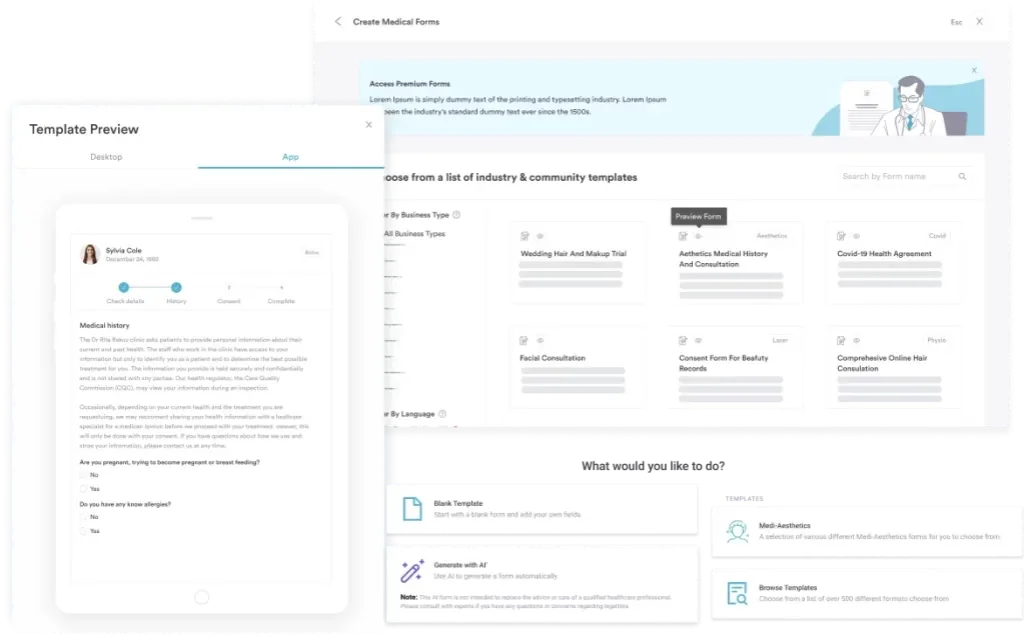
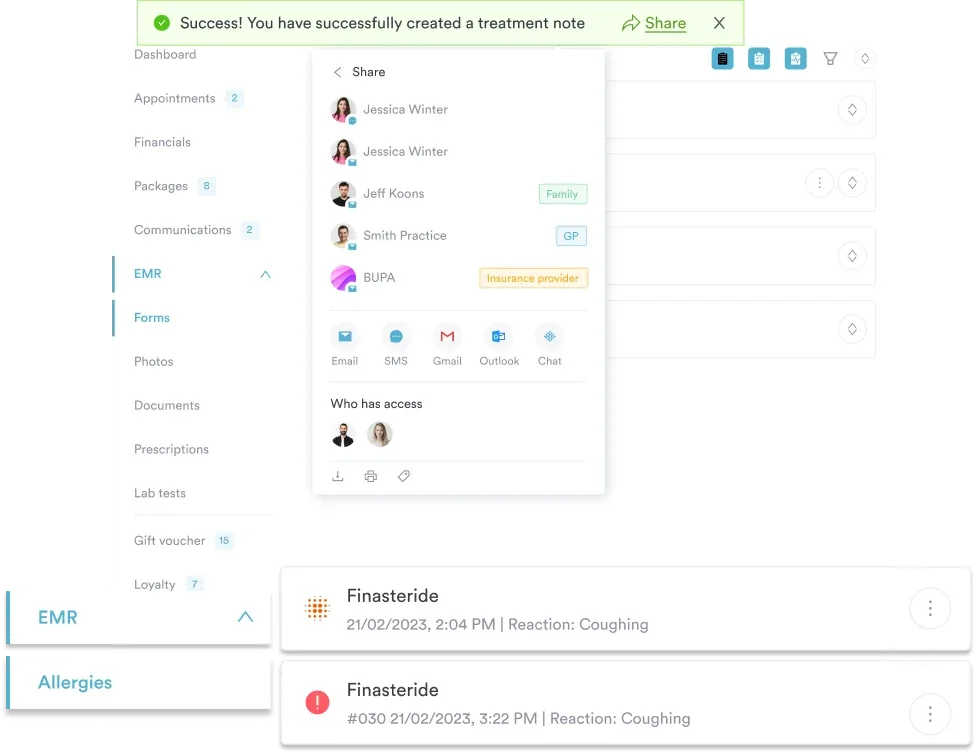
Practice management software like Pabau puts the structure in front of you instead. You can build a clinical note template carrying the four SIRP headings, so each prompt is waiting when you open the client’s chart. The note saves against the appointment and the client record together.
Pabau Scribe, our AI scribe, goes a step further and drafts the note from the session itself. You review and correct rather than compose. Every subscription includes the full platform, so your note templates, client records, and billing sit in one system rather than three.

Pabau’s clinical note templates hold your SIRP structure, and Pabau Scribe drafts the session note for you. Notes save straight to the client record, so next week’s session starts with last week’s plan.

Pick one note format and stay with it. Consistency is what makes a chart readable to a colleague and defensible to a payer. SIRP earns that consistency cheaply, because its four questions are ones you already answer in the room.
The trade-off is that SIRP goes light on assessment. If your work turns on diagnosis or medication, SOAP will serve you better. For therapy itself, the Response section is what shows the treatment is working, and SIRP gives it a heading of its own.
Download the template above and use it for a month. Notice how much of the note is finished before you stand up. Book a demo to see how Pabau builds the four SIRP headings into your notes and drafts the first version for you.

Comparing note formats before you commit? DAP note template shows how the data, assessment, and plan structure handles the same session.
Working toward behavior-focused goals? BIRP note template swaps Situation for Behavior, which suits case management and skills work.
Want the SOAP version written for therapy? SOAP note for mental health template covers the subjective, objective, assessment, and plan sections for counseling sessions.
Stuck on wording mid-session? Therapy progress notes cheat sheet gives you phrasing for interventions and client responses you can lift straight into a note.
Documenting longer-term work? Progress notes for psychotherapy explains how a progress note differs from a psychotherapy process note.
SIRP stands for Situation, Intervention, Response, and Plan. Therapists use the format to document a session in four structured parts, from the client’s presenting concern through to next steps.
Situation and Response usually run two to four sentences each. Intervention runs three to six sentences when several techniques were used. Plan is usually two or three. A complete note lands between 300 and 500 words, depending on session complexity and payer requirements.
Yes. Insurance carriers widely accept SIRP notes for therapy and counseling claims. The structure shows clinical decision-making and treatment response, which is what supports the claim. Check your own payer’s documentation requirements before you switch formats.
Use SIRP if you work mainly in therapy, counseling, or community mental health. Use SOAP in medical or psychiatric settings where diagnosis and clinician assessment lead. Use DAP if you practice measurement-based care or track outcomes with formal tools.
Yes. Document the group’s shared Situation at the start, then the interventions you used with the whole group. Record their collective Response and the Plan for the next session. For individual progress inside a group, write a separate note for each participant’s Response.
Include the presenting mood and concern, the interventions by name, and what the client did and said in response. Add clinical observations, agreed goals, between-session tasks, and any safety concerns or referrals. Leave out personal detail that has no bearing on treatment.