Pabau vs ICANotes: Psychiatry billing software compared
Psychiatry billing software decides whether your practice gets paid accurately, ...

Last Updated: Oct 14, 2026
A therapy letter for emotional support animal is a clinical document written by a licensed mental health professional. It confirms that a patient has a disability-related need for an emotional support animal, or ESA. Housing providers treat it as grounds for a reasonable accommodation under the Fair Housing Act.
Service animals are trained to perform specific tasks. An ESA does its work simply by being present. The letter therefore rests on an established therapeutic relationship rather than a task list. This guide covers who can write one, what it must contain, and how to document the disability-animal link.
The template sets out the letterhead, license credentials, and diagnosis reference in the order a housing provider reads them. It also carries the functional limitation statement, the nexus statement, and a signature block. Fill in the bracketed fields and it is ready to sign.
Download template
Only a licensed mental health professional with an established therapeutic relationship can issue a legally recognized ESA letter.
An ESA letter supports a housing accommodation request under the Fair Housing Act, but airlines have not recognized ESAs since 2021.
Required elements are the clinician letterhead, license credentials, diagnosis reference, functional limitation statement, nexus statement, and signature.
A patient qualifies only when a documented disability, an existing clinical relationship, and a clear animal-disability link all hold.
Practice management software like Pabau keeps the assessment, the signed letter, and the audit trail on one patient record.
A therapy letter for an emotional support animal is a formal recommendation from a licensed mental health professional. It states that the patient has a qualifying disability and benefits therapeutically from living with a specific animal. The letter documents that need and supports a reasonable accommodation request under the Fair Housing Act (FHA).
Housing providers must accept ESA letters from qualified clinicians. They have no obligation to recognize online ESA registries or certificates, which carry no federal standing. The letter also has to reflect an established clinical relationship rather than a one-time assessment arranged to produce it.
Therapists who issue ESA letters carry professional and ethical responsibility. You need enough clinical knowledge of the patient’s disability to explain why the animal is necessary. That judgment stays yours throughout the assessment.
Patients often confuse emotional support animals with service animals and therapy animals. The distinctions decide what rights the letter actually creates, so they are worth explaining during the assessment.
Service animals are dogs trained to perform specific disability-related tasks. The Americans with Disabilities Act (ADA) governs them, and they receive both housing and air travel protections.
Therapy animals work in clinical or institutional settings and give the handler no legal rights. An ESA letter grants no air travel rights either, so say that plainly during the assessment.
An ESA letter is the only mechanism a patient has for requesting a housing accommodation that waives a no-pet policy. The Fair Housing Act prohibits housing discrimination based on disability, and that covers refusing a supported accommodation request.
Landlords keep limited verification rights. They may ask the patient to confirm the disability and describe the functional limitation. They cannot demand diagnostic details, charge pet fees, or reject the letter because they have not met the clinician.
Only licensed mental health professionals (LMHPs) can issue a legally recognized ESA letter. The clinician has to hold a current, active license in the state where the patient lives or seeks housing. Qualifying license types include:
The clinician must also have an established therapeutic relationship with the patient before writing the letter. A single consultation arranged to produce a letter falls short of that standard. It also exposes you to professional liability.
HUD guidance expects the relationship to predate the request. That history is what demonstrates genuine clinical knowledge of the disability. Record the relationship duration in the patient record so it is easy to evidence later.
An ESA letter needs specific components to withstand a housing provider’s scrutiny. Missing elements weaken its credibility and can sink the accommodation request.
A compliant ESA letter takes clinical judgment, clear documentation, and awareness of your professional boundaries. Seven steps get you there.
Not every patient with a mental health diagnosis qualifies for an ESA letter. Three conditions have to hold together before you write one, and each has to be evidenced in the record.
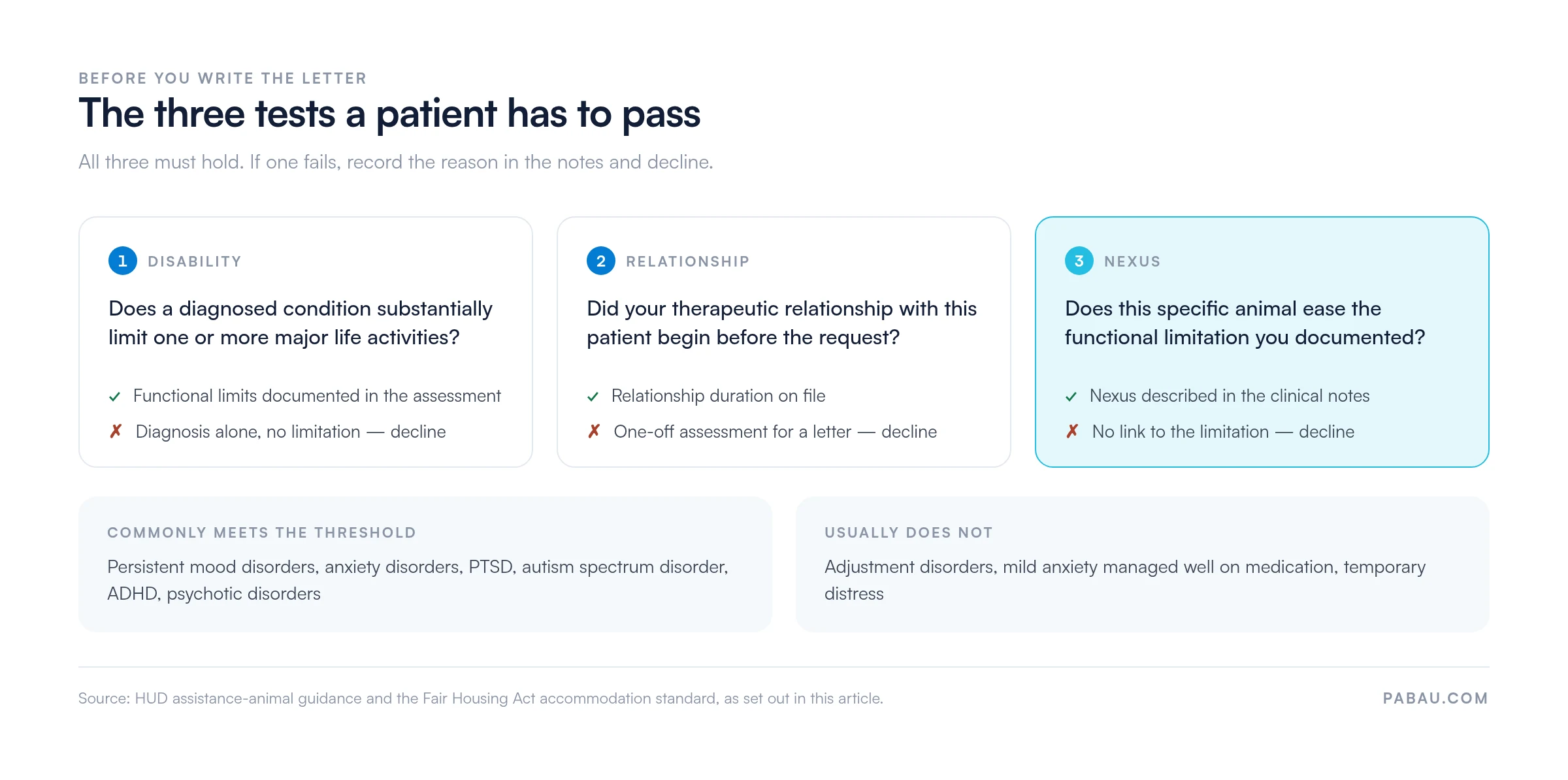
Patients with adjustment disorders, mild anxiety managed well on medication, or temporary distress usually fall short of the threshold. Persistent mood disorders, anxiety disorders, PTSD, autism spectrum disorder, ADHD, and psychotic disorders may qualify.
The functional limitation and the animal’s role in easing it are what you weigh. A diagnosis on its own does not settle the question. Validated screening instruments and a structured ESA assessment template keep that evidence consistent from patient to patient.
A request does not oblige you to write a letter. Your responsibility is to issue one only where the patient meets the standard and genuinely benefits from the accommodation.
The hardest part of an ESA letter is explaining the disability-animal link while keeping protected diagnostic detail out of it. The housing provider has to find the connection convincing. The patient’s privacy still has to hold.
Be specific about function instead of naming the condition. A line such as “the patient experiences significant anxiety symptoms that interfere with social functioning and housing stability” does the work without a diagnosis.
Then connect the animal in the sentence that follows. “The animal’s presence grounds the patient during episodes of heightened anxiety and supports social engagement.” That wording satisfies the FHA standard and keeps clinical confidentiality intact.
Several ethical traps sit around ESA letters. Conflicts of interest come first. Never issue a letter simply because a patient asked, and never let a fee override clinical judgment.
Fraudulent online ESA services are widespread, and patients arrive influenced by their marketing. If a patient mentions buying a letter from an online registry, explain that those services carry no legal standing. Only a letter from a licensed mental health professional counts.
Do not write ESA letters for patients you have no genuine therapeutic relationship with, whatever the pressure or the offer. Watch dual relationships too. Issuing a letter to someone you supervise or train creates liability, so keep the clinical boundary clear.
Document your assessment thoroughly in the patient’s clinical record. A standard assessment process across the practice keeps that documentation consistent. It protects you in a dispute and shows professional diligence to any reviewing body.
Online ESA mills are easy to spot once a patient knows the signals. Four come up repeatedly.
Tell patients that a legitimate ESA letter comes only from a licensed clinician they have an ongoing relationship with. If a service has already approached them, acknowledge the need behind the request and point them back to the clinical route.
Declining to take part in that market protects your license and your practice’s reputation. A properly issued letter is worth more to the patient than a bought one, because a housing provider can act on it.
Most practices run this workflow across three places. The assessment sits in the notes, the letter lives in a word processor, and the signed copy ends up in an email thread. When a housing provider queries the letter months later, someone has to reassemble it.
Practice management software like Pabau keeps all three on the same patient record. Build the ESA assessment as a digital form, so every clinician captures the same evidence. Store the signed letter against the record, where it stays searchable with a full audit trail.
Patients can download their own copy through the Client Portal, so your front desk stops re-sending letters to landlords. Renewal reminders prompt you to review validity dates before a patient chases you. Software for therapy practices ties the sequence to the clinical record rather than to someone’s inbox.

Pabau stores the assessment, the signed ESA letter, and the audit trail on one patient record. You can evidence a housing accommodation months later without hunting through email, and digital forms keep the process the same for every clinician.

The letter is only as strong as the clinical record behind it. A housing provider wants to see a clinician who knows the patient, names the functional limits, and explains what the animal does.
Use the template for the structure and keep your judgment for the decision. Where a patient does not meet the standard, saying so and recording why protects them as much as it protects you.
Book a demo to see how Pabau stores ESA assessments, signed letters, and renewal dates on one patient record.

Need model wording for the letter itself? Emotional support animal letter sample walks through a full letter paragraph by paragraph.
Documenting the sessions behind the letter? Mental health note template keeps session records consistent enough to evidence the therapeutic relationship.
Looking for compliance tools for your practice? Mental health EMR brings clinical documentation, e-signature, and audit trails into one system.
An ESA letter comes from a licensed mental health professional and grants housing accommodations under the Fair Housing Act. A service animal letter documents training for a dog that performs disability-specific tasks, and it grants ADA and air travel protections. Only trained service animals have received ACAA airline accommodations since 2021. ESAs do not.
No federal law mandates a specific validity period. One year is the industry standard, though housing providers may ask for an updated letter. Many clinicians tie validity to the course of care. They state that the letter holds while the patient remains in clinical care and continues to benefit from the animal. Set a renewal reminder in your practice management system.
You can issue an ESA letter only if you are licensed in the state where the patient lives or seeks housing. Some states allow licensed therapists to see out-of-state telehealth patients. Check your state’s regulations, because federal jurisdiction does not override state licensure requirements.
The diagnosis itself does not determine qualification. The patient must have a disability that substantially limits one or more major life activities. Anxiety disorders, depression, PTSD, bipolar disorder, and autism spectrum disorder commonly qualify, provided that functional limitation threshold is met. Your clinical assessment decides it.
Housing providers must accept ESA letters from qualified LMHPs and grant a reasonable accommodation waiving a no-pet policy. They keep limited verification rights. They may ask the patient to confirm the disability and describe the functional limitation. They cannot demand diagnostic details or reject a letter over its formatting or the clinician’s identity.
No. ESA letters are clinical documents from LMHPs that grant housing rights. Therapy animal certifications are credentials for animals used in clinical or institutional settings, such as hospital visitation programs. Therapy animal status confers no legal rights on the handler.