Antipsychotic medication list
An antipsychotic medication list is a structured reference that organizes psychi...

2
Last Updated: Oct 13, 2026
A teenage schizophrenia test is a structured self-report screening tool that checks whether an adolescent’s experiences match the symptoms of schizophrenia or early psychosis.
No online test can diagnose the condition. It sorts questions into the same symptom domains a clinician uses, then tells you whether a psychiatric evaluation is worth booking.
Schizophrenia is rare. The National Institute of Mental Health (NIMH) puts the international prevalence at 0.33% to 0.75% of people. Onset before age 18 is rarer still, which is why parents and clinicians so often read the early signs as ordinary teenage behavior.
This guide covers what the test measures, the questions it asks, how to read a result, and what to do after a positive screen.

A teenage schizophrenia test screens for symptoms rather than diagnosing them, so a qualified mental health professional must review the result.
Early-onset schizophrenia typically appears between ages 13 and 18, and its prodromal signs are often mistaken for ordinary teenage behavior or depression.
Negative symptoms such as flat affect, social withdrawal and lost motivation are the ones adolescent screenings miss most often.
After a positive screening result, the next step is a full psychiatric evaluation against DSM-5 criteria, not a second online test.
A teenage schizophrenia test measures how often and how severely symptoms show up across three clinical domains. Those are positive symptoms such as hallucinations and delusions, negative symptoms such as emotional flatness and withdrawal, and disorganized thinking. The output is a risk signal rather than a diagnosis. It tells a clinician whether a full evaluation is warranted.
Most reputable online screeners draw on DSM-5 diagnostic criteria published by the American Psychiatric Association. They ask respondents to rate how often they experience specific thoughts, perceptions or behaviors over a set window, usually the past month. The score flags a pattern that needs clinical follow-up, never schizophrenia itself.
A teen who scores high on an online screener does not have schizophrenia. A teen who scores low may still need evaluation if a parent reports months of functional decline. Treat the score as the opening of a clinical conversation.
Yes, teenagers can develop schizophrenia, though it is far rarer than adult-onset presentations. Early-onset schizophrenia (EOS) means onset before age 18, and very early-onset schizophrenia (VEOS) means onset before 13. EOS usually begins between 13 and 18, often with a prodromal phase that precedes full psychosis by months or years.
Early intervention changes outcomes. NIMH’s RAISE trial enrolled people aged 15 to 40 after a first psychotic episode. Coordinated specialty care beat standard care on quality of life and on symptom severity. Participants with a shorter delay before treatment gained the most. The difficulty is that prodromal symptoms in teens look like several other conditions first.
The early warning signs of schizophrenia in teenagers fall into three categories. Positive symptoms draw attention first, while the other two are quieter and easier to explain away. A structured screening tool covers all three, which is why it surfaces symptoms a family would not think to raise.
Positive symptoms are additions to ordinary experience, meaning perceptions or beliefs that would not normally be there. In teenagers they often start subtly before becoming obvious.
Negative symptoms are the loss of ordinary functions, and in a teenager they look almost identical to depression, burnout, or ordinary disengagement. Screeners tend to lead with the more dramatic positive symptoms, so this category gets underreported.
Disorganized thinking shows up in speech patterns such as tangential replies, word salad, and losing the thread of a sentence part way through. At school it looks like an unexplained drop in academic performance. At home it sounds like conversations that do not quite track. Video and text-based consultations mask these patterns easily, so ask a parent what conversations at home sound like.
Schizophrenia screening tests use a Likert scale, running from never to always, across questions mapped to DSM-5 symptom domains. The questions are not diagnostic. They identify whether a clinical conversation is warranted.
The question domains typically covered are:
DSM-5 requires at least two Criterion A symptoms present for a minimum of one month, with continuous signs of disturbance across six months. An online screener can suggest that pattern exists. Only a psychiatrist or psychologist can confirm it. Those thresholds are what separates a high score from a diagnosis, and they are worth seeing laid out.
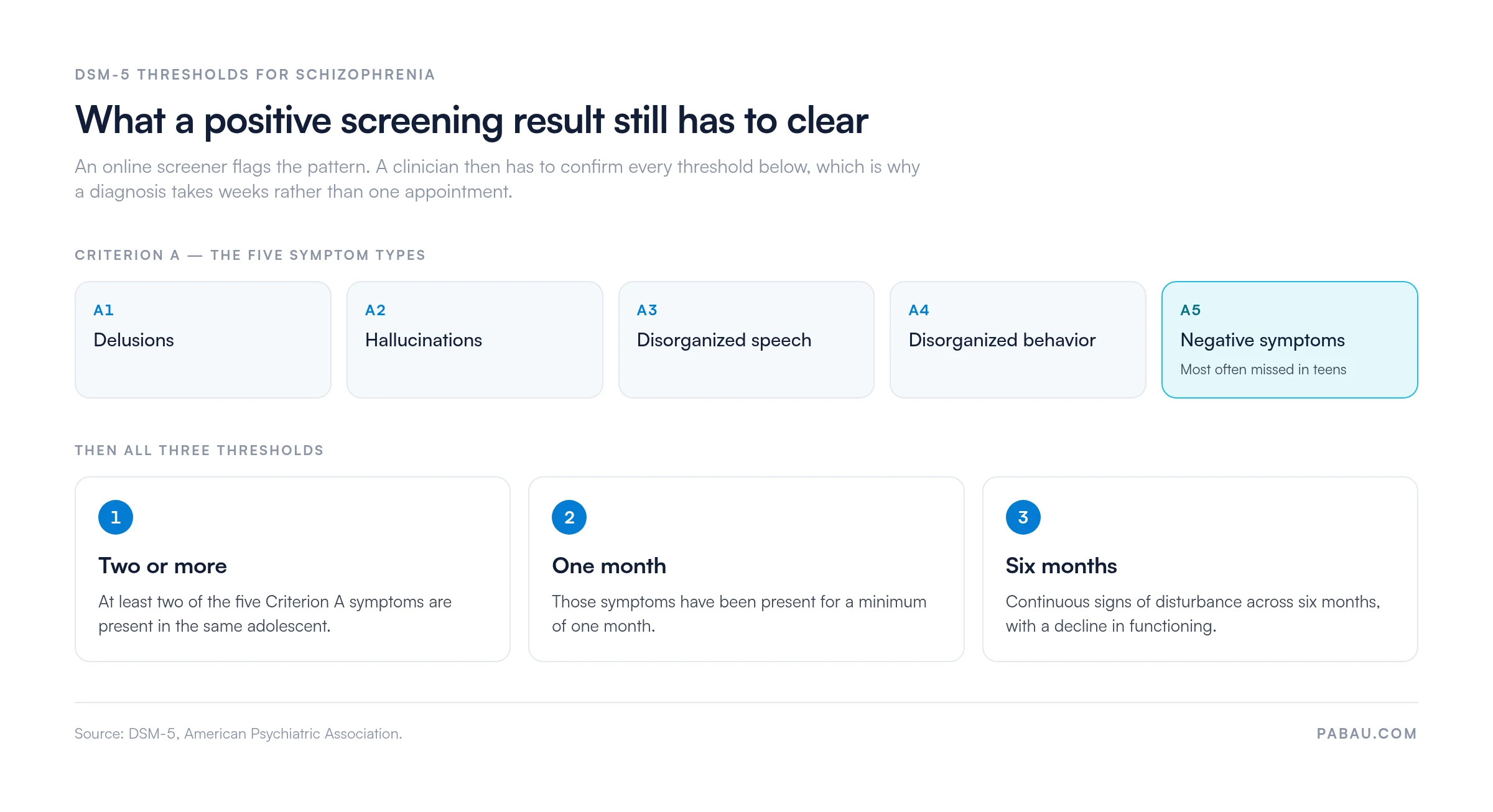
Several reputable organizations publish free online screeners that work as a legitimate first step. What separates a clinically informed tool from a consumer quiz is whether its questions trace back to validated instruments.
Low-quality screeners share a few signs:
Avoid any tool that will not state its limitations. Practices running their own screening usually pair a validated screener with an adolescent intake questionnaire, so the symptom history and the family context arrive together.
If you’re a clinician, don’t rely on a patient-reported screener result alone. Ask about symptom duration, substance use, and family psychiatric history before you treat a positive result as a signal. Schizophrenia has one of the longest prodromal periods of any psychiatric condition.
Schizophrenia and bipolar disorder with psychotic features share symptoms, since hallucinations and delusions appear in both. The difference is timing. In bipolar disorder, psychotic symptoms are bound to mood episodes and resolve when the episode ends. In schizophrenia, psychosis continues independently of mood.
A well-built screener probes that distinction by asking how mood and perception relate. “Do you hear voices only when your mood is very high or very low?” does different work from “Do you hear voices regardless of your mood?” Comorbid anxiety, autism and substance use complicate the picture further, so one screener result rarely stands on its own.
No online test settles this for a teenager. A positive result for either condition is grounds for professional evaluation, and it is not a basis for self-diagnosis.
Formal diagnosis follows a structured process that no online test can replicate. Clinicians combine a clinical interview, collateral history, rule-out investigations, and DSM-5 criteria applied over time.
A standardized psychiatric evaluation template usually structures the assessment across five stages:
The process spans multiple appointments across weeks or months. Early-onset schizophrenia is not diagnosed in a single visit.
A positive screening result gives you grounds to act, even though it settles nothing diagnostically. Work through these steps in order.
Treatment for confirmed early-onset schizophrenia combines antipsychotic medication, cognitive behavioral therapy for psychosis (CBTp), family therapy, and school-based support. Earlier treatment lowers the risk of long-term functional impairment.
For practices that screen adolescents for psychosis, the clinical tools are only half the job. Intake, documentation, follow-up scheduling, and referral tracking all sit around the screening itself, and that work lands on clinical and front-desk staff alike. Therapy practice management software is what carries it.
Practice management software like Pabau is used by psychiatry and psychology practices with complex adolescent caseloads. Our mental health practice software lets you send a structured pre-appointment questionnaire that a patient or caregiver fills in online. The clinician opens the consultation with a symptom baseline already on screen.
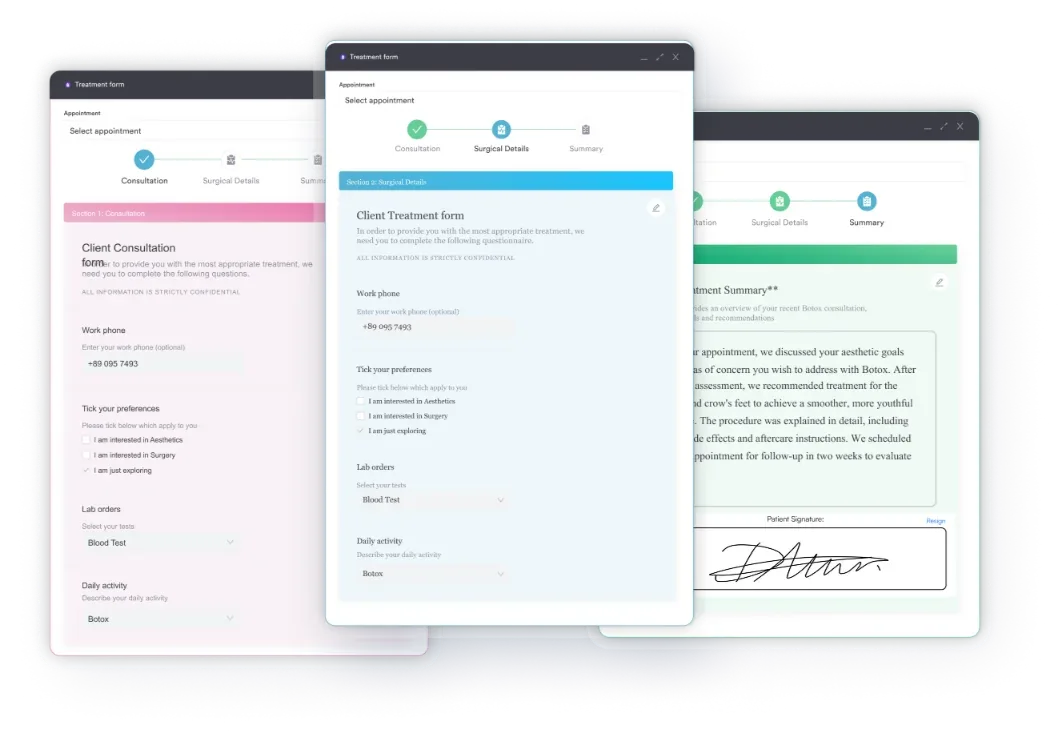
Consultation notes, symptom timelines, and referral letters then live in one patient record, so the next clinician sees the whole history. Automated follow-up workflows book the review appointment for any teenager a positive screen flags, without anyone chasing it by hand. Across several sites, a practice manager can see the whole caseload in one view.

Pabau handles screening workflows, digital intake forms, and automated follow-up for psychiatry and psychology practices. Clinicians spend more time with patients and less on admin.

A teenage schizophrenia test is worth running as a first step. What it produces is a written record of what has been happening and for how long, and that is what the first clinical conversation needs.
Prodromal periods in schizophrenia can run for years, so the date you start that conversation matters more than the score you started it with. If the screen worries you, book the appointment this week rather than waiting to see whether it settles.
If your practice sees adolescent mental health presentations, a screening intake process is worth building once and running for every patient. Book a demo to see how Pabau structures adolescent screening, documentation, and follow-up.

Need a structured framework for psychiatric assessments? Psychiatric evaluation template provides a step-by-step clinical guide for comprehensive mental health assessments across outpatient settings.
Managing adolescent crisis presentations in your practice? Crisis intervention strategies for clinicians covers evidence-based approaches for acute mental health presentations.
Building an adolescent screening intake? ADHD screening test template shows how a validated screener is structured for a younger patient and their caregiver.
Looking for practice management built for psychiatry? Psychiatry practice software covers how Pabau supports psychiatric practices with documentation, scheduling, and patient management.
A teenage schizophrenia test is a structured self-report questionnaire that screens an adolescent’s experiences against schizophrenia symptoms. It covers hearing voices, paranoid thoughts, emotional withdrawal, and disorganized thinking. It is not a diagnostic instrument, and it cannot confirm or rule out schizophrenia on its own.
Yes. Onset before age 18 is classified as early-onset schizophrenia (EOS), and the typical window is 13 to 18. Very early-onset cases begin before 13. EOS is rarer than adult-onset schizophrenia, but it follows the same DSM-5 criteria and the same treatments.
Yes. Mental Health America offers a free psychosis screener built on validated clinical items. PsychCentral publishes a medically reviewed schizophrenia quiz. Both state that results are not diagnostic, and both recommend professional follow-up for an elevated score.
In bipolar disorder, hallucinations and delusions are bound to mood episodes and resolve when the episode ends. In schizophrenia, psychosis continues regardless of mood state. A teenager who hears voices only during high or low moods needs a different diagnostic pathway. Only a psychiatrist can settle it reliably.
As soon as you notice sustained change, particularly hallucinations, paranoid beliefs, marked social withdrawal, or a drop in school performance. Early intervention in adolescent psychosis produces better long-term outcomes than delayed treatment. A screening result and an appointment are enough to start a referral.
Questions cover five DSM-5 domains: delusions, hallucinations, disorganized speech or thinking, negative symptoms, and functional decline. Negative symptoms include flat affect, lost motivation, and social withdrawal. Respondents rate how often each one occurs, usually on a scale running from never to always.