Antipsychotic medication list
An antipsychotic medication list is a structured reference that organizes psychi...

2
Last Updated: Oct 13, 2026
The Intelligent Change journal is a guided notebook that pairs daily gratitude with one intention for the day and a short evening review. Its best-known format, the Five Minute Journal, asks four questions across two sittings of about five minutes each.
The morning page asks for three things you are grateful for and one outcome that would make the day great. In the evening you name three good moments and one thing you could have done better.
This guide covers how to work the format, what the gratitude research shows, and how therapists adapt the prompts for patients between sessions. The template below is free and editable.
A ready-to-use journal covering presenting concerns, symptom tracking, and progress measurement against baseline scores. The daily pages carry the morning gratitude and intention prompts alongside the evening review.
Download template
The journal runs on four fixed prompts, split across a morning sitting and an evening one.
The morning page sets gratitude and one intention, and the evening page records what went well and what you learned.
Emmons and McCullough’s gratitude research found a larger effect when people wrote daily rather than weekly.
Therapists use the entries as between-session material, reading mood shifts and thinking patterns straight off the page.
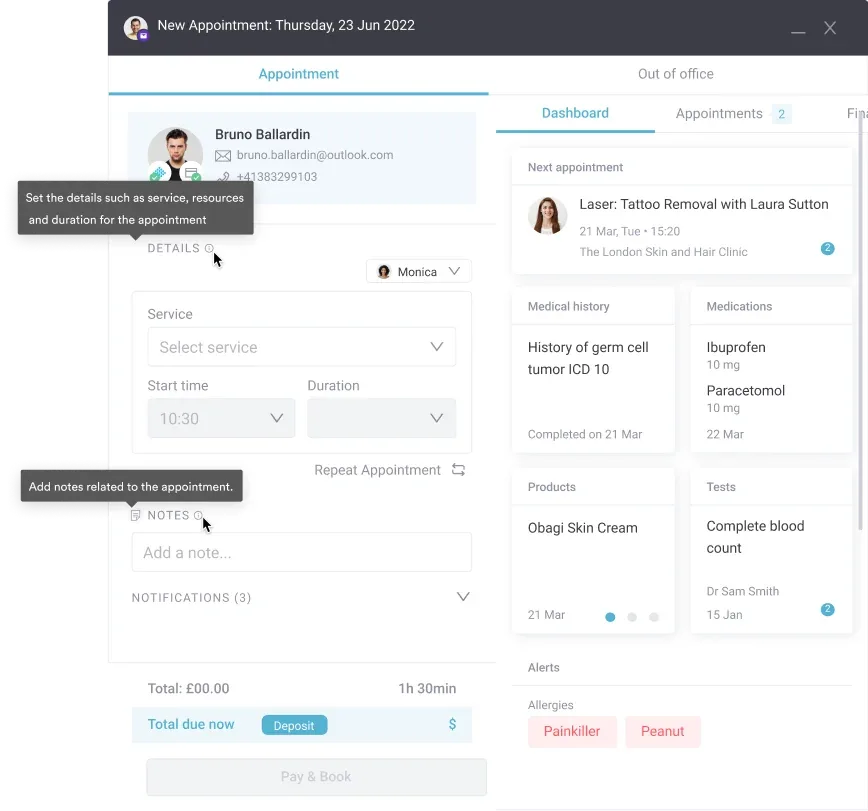
Pabau’s digital forms and Client Portal let you send the template to patients, automate reminders, and track completion.
It is a structured daily practice that combines gratitude with intention-setting and a short review, using the same four prompts every day. Intelligent Change, a brand that publishes wellness journals and planners, built the format around habit-formation research.
Open-ended journaling asks you to decide what to write about before you write anything. This one does not. The prompts are fixed, which lowers the effort of starting and makes entries comparable from one day to the next.
That repeatability is why it travels well into clinical settings. A therapist reading four weeks of the same four answers can see movement that a verbal check-in would miss.
The Five Minute Journal is Intelligent Change’s flagship product, and its page layout is the whole method. Each sitting asks for three short entries and one single answer, which is what keeps it near five minutes.
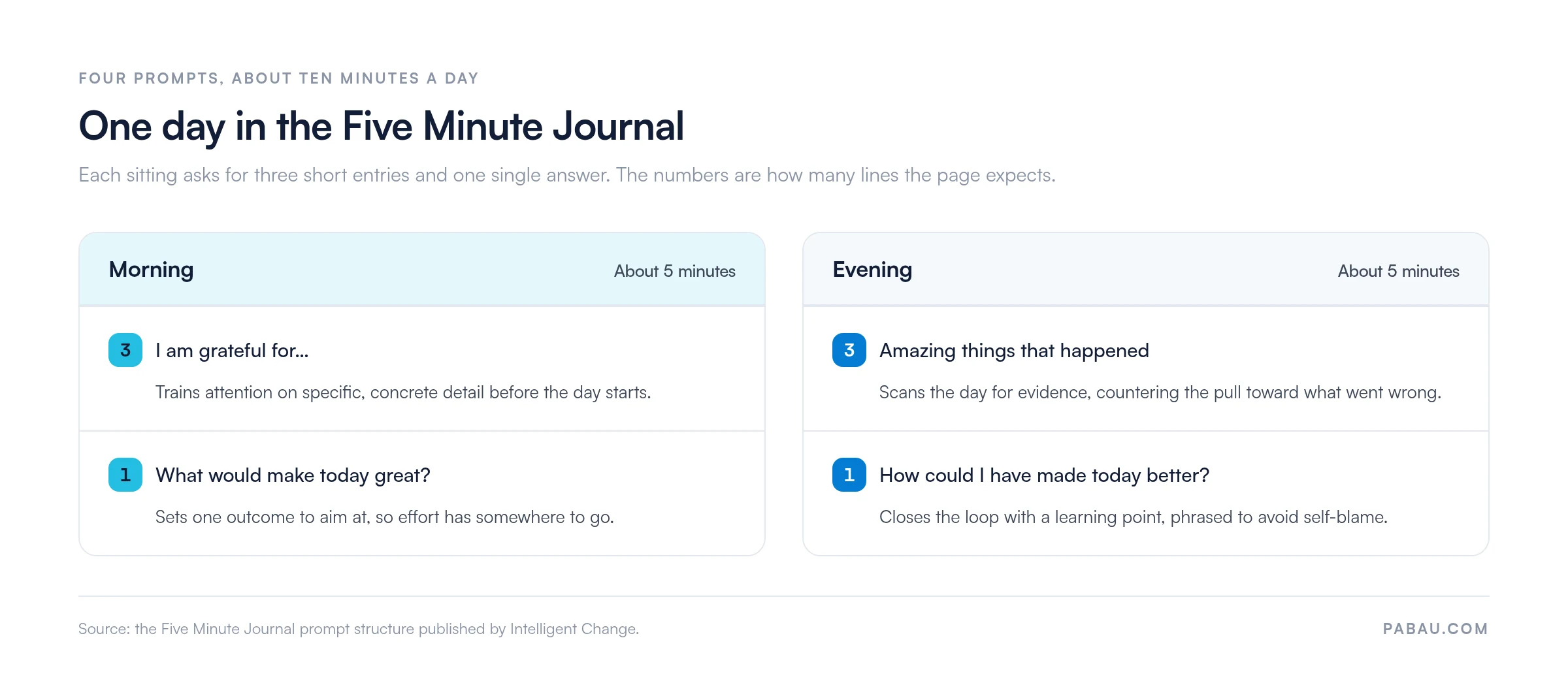
Each prompt does a different job. Gratitude turns attention toward detail you would otherwise walk past. The intention question gives the day one target. The evening list builds a record of what went right, and the learning point turns a bad day into something usable.
The format only pays off as a daily habit. Keep each sitting short enough that you come back to it tomorrow.
Therapists and coaches can set the journal as a between-session task. Ask patients to bring it to appointments and read a week of entries together. Our psychiatric evaluation template covers the formal intake side, and the journal fills in what happens between those appointments.
Write the gratitude entries with sensory detail. Instead of “my partner”, write “the way my partner brought me coffee before they left for work”. A specific image is easier to recall later in the day than an abstract category.
The “What would make today great?” prompt works as an anchor. Naming one meaningful outcome cuts down the number of decisions you make about where to put your effort.
The evening page closes the day rather than reopening it. Listing three good moments forces a search for evidence, which is harder work than it sounds after a difficult shift.
The “How could I have made today better?” prompt is deliberately non-punitive. Phrased as “could have” rather than “should have”, it frames the day as something to learn from. That wording matters for patients who already run a harsh internal commentary.
Intelligent Change sells two products that people often mix up. One is a daily well-being practice. The other is a weekly planning system.
Plenty of practitioners run both. The journal handles daily well-being, and the planner handles weekly planning for the business. Some patients journal daily while their therapist uses the planner to track session goals.
Gratitude journaling has a research base behind it, and it helps to know what that research measured. Several decades of positive psychology work has tracked mood, optimism and well-being in people asked to write down what they are grateful for.
The best-known study is Robert Emmons and Michael McCullough’s 2003 paper in the Journal of Personality and Social Psychology. One group listed what they were grateful for, another listed hassles, and a third listed neutral events. The gratitude group reported better well-being and more optimism about the week ahead.
The size of that difference is the interesting part. It was moderate in the weekly version of the study and noticeably larger in the version where participants wrote every day. That is the argument for the Five Minute Journal’s daily rhythm over a weekly list.
The proposed mechanism is attentional. Repeatedly writing down what went well asks the brain to go looking for it, and over weeks that search gets easier. Imaging work links gratitude to reward and social-bonding regions, though that strand of research is younger and less settled.
For mental health practitioners, that makes the journal a cheap, high-adherence homework task rather than a wellness trend. It takes ten minutes a day and it produces something you can read together in session.
The printed journal ships with fixed prompts. The template here is editable, so you can match it to the people you treat.
Common adaptations follow the clinical focus. Therapists working with trauma add a felt-safety question to the morning page. Coaches swap the evening learning point for progress against a goal. Addiction specialists rewrite the gratitude prompt around recovery wins.
Each version keeps the same shape, with two sittings, four questions and one page a day. Keeping a copy of the version you issued in your mental health EMR tells you later which prompts a patient was working from.
Handing the journal over as a PDF at the end of a session leaves the follow-up to chance. Practice management software like Pabau sends the template straight from the patient’s record and logs what comes back.
You can set it to go out automatically at intake, so the patient starts journaling before their first appointment. Scheduled reminders then nudge them on the days you choose, which is usually where adherence is won or lost.
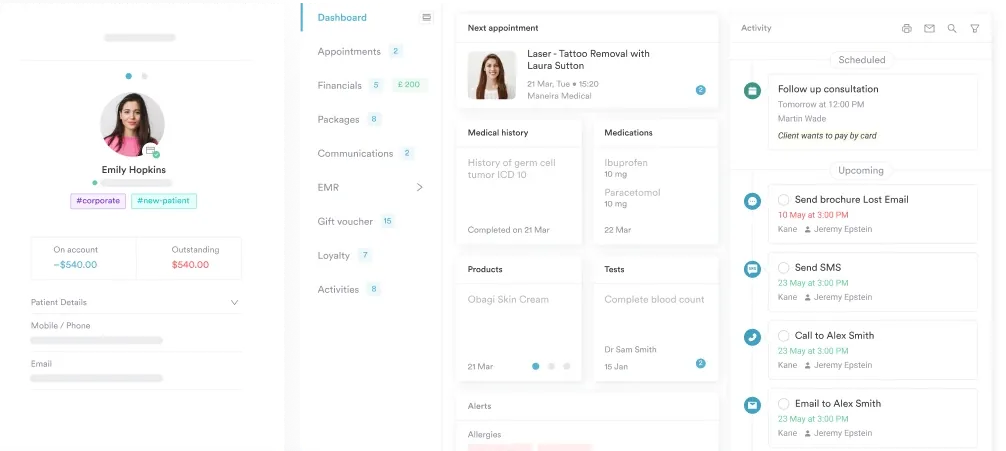
Returned entries land in the patient’s record next to your SOAP notes and assessments. Pabau’s Client Portal gives patients one place to read and submit them, so you are not collecting journals out of an email inbox.
The whole picture then sits in one therapy practice management system. That lets you read a month of journal entries, session notes and outcome scores side by side rather than piecing them together from three places.
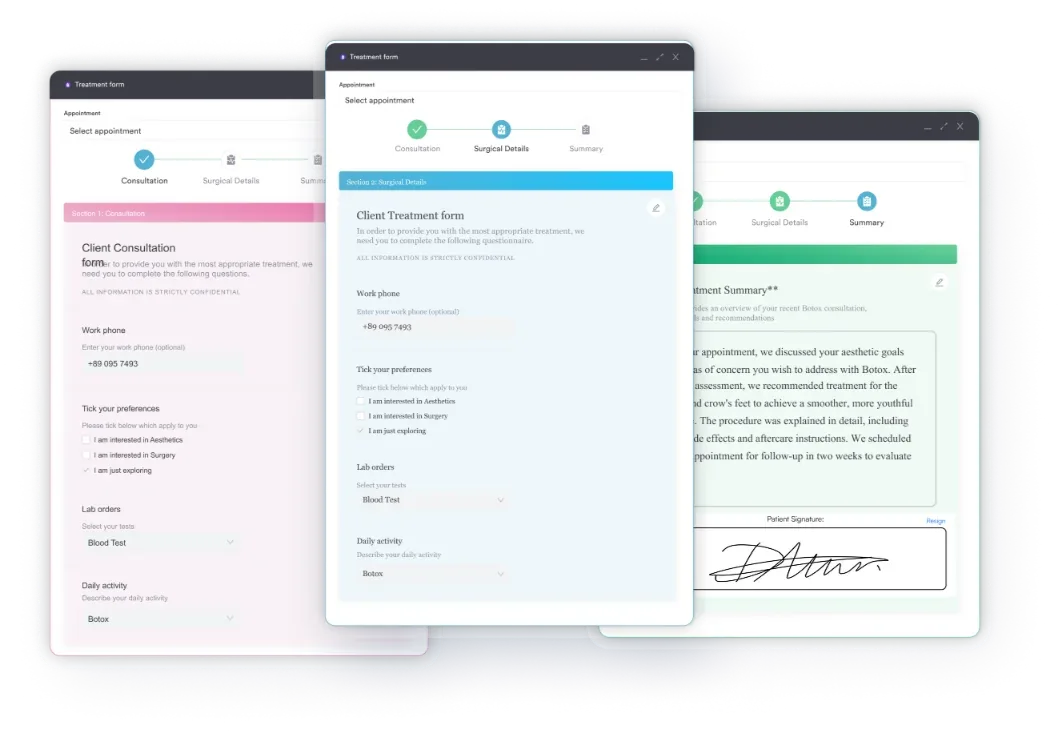

Pabau’s digital forms and Client Portal send the journal from the patient’s record, automate the reminders, and log every entry that comes back.

The Intelligent Change journal earns its place because the format is small enough to survive a bad week. Four questions, ten minutes, one page a day. That is a lower bar than most homework a practice sets, which is why patients tend to stay with it.
Download the template and cut or add a prompt so it suits the people you treat. Issue it at intake rather than at a crisis point. Then read it with the patient instead of filing it. Entries are only worth collecting if someone looks at them.
Book a demo to see how Pabau sends journals straight from the patient record and shows you who has filled one in.

Working with a patient on changing a habit? Change plan worksheet turns a stated intention into steps, obstacles and a date to review it.
Need a plan for the weeks between appointments? Mental health safety plan sets out warning signs, coping steps and who to call.
Comparing systems to run the practice on? Top 7 mental health software ranks the platforms US practices use for notes, scheduling and billing.
It is a guided daily journal built around four fixed prompts. The Five Minute Journal format splits them into a morning page and an evening page, each taking about five minutes.
It pairs gratitude with a forward-looking intention in the morning and a learning point at night. Most gratitude journals only ask you to look back, so the loop never closes.
Emmons and McCullough’s 2003 study found that people listing what they were grateful for reported better well-being than people listing hassles. The effect was larger when they wrote daily rather than weekly.
Yes. Therapists and coaches commonly set it as a between-session task. The entries show mood patterns, stated intentions and how a patient frames setbacks, which is material worth reading together in session.
About five minutes in the morning and five in the evening, so ten minutes in total. The brevity is the point, because a short task survives a busy week.
Yes. The template is editable. Practitioners often add a safety-grounding question for trauma work, a goal-progress check for coaching, or a recovery-specific gratitude prompt.