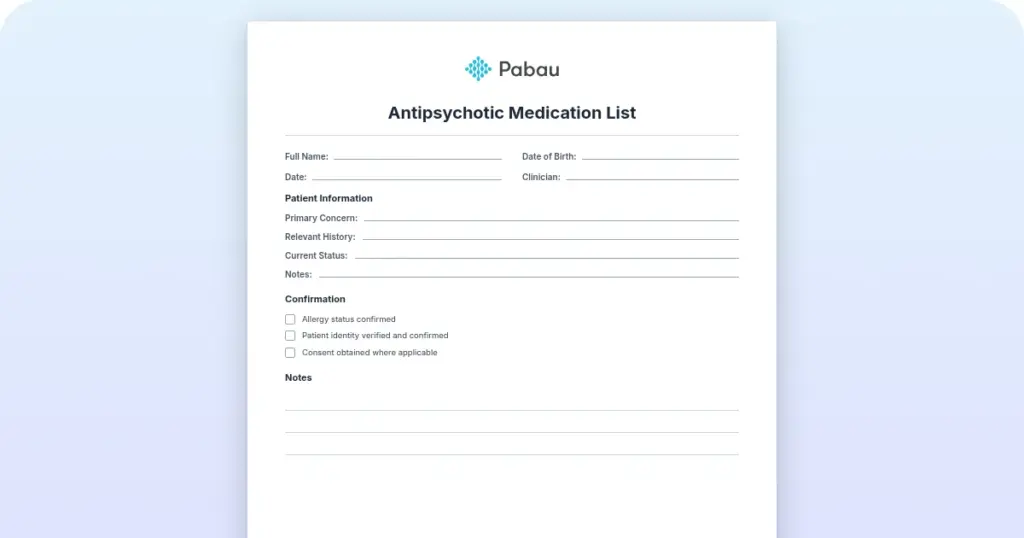
Antipsychotic medication list
An antipsychotic medication list is a structured reference that organizes psychi...

2
Last Updated: Oct 13, 2026

The free download is a four-page narrative progress note template with 10 fill-in sections, from session overview to follow-up recommendations.
The SOAP, DAP, and BIRP comparisons, the phrase bank, and the modality-specific intervention language sit on this page rather than in the download.
Progress notes are part of the official medical record, must comply with HIPAA, and shape both claim approval and audit outcomes.
Vague language, weak intervention-to-goal links, and unclear goal progress are the top reasons claims get denied and licensing boards ask questions.
Pabau’s clinical templates prompt for every required element and pull session details from the appointment, so notes stay complete.
A four-page narrative template you can print or complete on screen. Its 10 sections run from session overview and observations through goal progress, interventions, client responses, homework, and follow-up recommendations.
Download templateWriting therapy progress notes takes up 15% to 20% of most clinicians’ working time, so a rushed note carries real risk. As a result, vague wording invites insurance denials. Meanwhile, missing intervention-to-goal links trigger audits, and thin clinical reasoning attracts licensing board scrutiny.
The free download above gives you a structured page to fill in after each session. Specifically, it is a narrative template with 10 sections, built for writing the note rather than for comparing formats.
Whether you document in SOAP, DAP, or BIRP format, the sections below cover the mandatory elements. They also give you the wording insurers expect, a six-step method for goal progress, and the mistakes that cost practices thousands in denied claims.
The download is a four-page clinical form. In practice, each of its 10 sections opens with ready-written narrative prompts and bracketed blanks you complete for the session in front of you.
A closing Additional notes box catches anything the 10 sections miss. The form stays format-neutral, so it suits a narrative note rather than a strict SOAP, DAP, or BIRP layout. For those structures and the wording insurers look for, use the sections below.
Progress notes are part of the official medical record and are open to third-party review. Under HIPAA, they can be released to patients with authorization. In turn, insurance companies read them at claim review, and licensing boards read them during complaints or renewal audits.
Ultimately, a well-structured note lowers claim denial risk, speeds reimbursement, and keeps your practice clear of regulatory findings.
Under time pressure, notes drift toward wording like “client presented with anxiety” or “discussed coping skills.” As a result, that phrasing undercuts clinical clarity and billing defensibility. In turn, a mental health EMR with built-in note templates and HIPAA-compliant documentation standards makes precision the default.
Four progress note formats dominate mental health practice. In particular, each has a distinct structure and use case. The right one depends on your modality, treatment setting, and payer requirements.
The format you pick shapes how your notes read to insurers and supervisors. SOAP note structure is the standard in medical settings because it mirrors how physicians document, so reviewers recognize it instantly. By contrast, the shorter DAP note suits community mental health, where caseloads are high and sessions are brief.
A BIRP or GIRP note earns its place where behavior change and measurable response matter most. In a group practice, picking one format and holding everyone to it matters more than which one you pick. In turn, psychology practice software that enforces the same fields keeps notes consistent when a client moves between clinicians.
Regardless of format, every progress note needs these elements to pass audit scrutiny and support claim reimbursement:
A note that records what the clinician did, but not how the client reacted, is the most common source of claim denials. Indeed, audit findings follow the same pattern. Client records in an integrated system prompt for that response field, so it is harder to leave blank.
First sessions work differently. The diagnostic picture belongs on a psychiatric evaluation template, and the progress notes that follow track movement against the plan it produces.
Insurance reviewers and licensing boards respond to precision. In fact, vague language (“good progress,” “client seemed better,” “worked on anxiety”) costs you credibility and claim dollars. The table below sorts audit-ready terminology by clinical category.
The intervention section is where a note earns or loses its medical necessity. “Did exposure work” tells an auditor nothing. By contrast, a specific entry reads very differently.
“Client completed in-vivo exposure to a crowded grocery store. Client used grounding and self-talk when anxiety peaked at 6/10, and anxiety returned to baseline by the end of the exercise.” In short, that version proves clinical rigor and justifies your code selection.
Each modality has recognized language that supervisors and claim reviewers expect. Write “client practiced mindfulness” and an ACT-trained reviewer knows what you did. Similarly, write “client completed exposure” and a CBT-trained reviewer will ask which hierarchy you followed and how you measured the anxiety drop.
Between-session assignments belong in the note by name. For example, a secondary emotions worksheet gives you something concrete to review next session, and it shows the reviewer that treatment continued outside the room.
The most common documentation failure is a session that never connects its interventions to a treatment goal. Insurers look for a causal chain. In other words, the goal exists, the intervention targets it, the client responds, and the session earns its medical necessity. With that in mind, follow these six steps in every note.
Pick instruments you can repeat every week. For instance, a short measure like the outcome rating scale takes a minute to score and gives you a number that moves. In turn, that number sits next to your narrative and does most of the work for a reviewer.
Written out, a single goal entry looks like this. “Goal 2: reduce panic episodes to one per week. Intervention: interoceptive exposure using breath-holding trials. Response: peak anxiety 7/10, falling to 3/10 after four trials. Progress: partially met, two episodes this week against four at intake. Plan: repeat the exposure with longer trials next session.”
Write that entry for every active goal, not only the one you spent most of the hour on. In fact, a goal with no entry for several sessions reads to an auditor like a goal you quietly dropped. If a goal is on hold, say so and give the clinical reason.
Where several clinicians share a client, plan changes get agreed at the case meeting rather than in one therapy hour. Reference the multidisciplinary review date in your note so the two records line up.
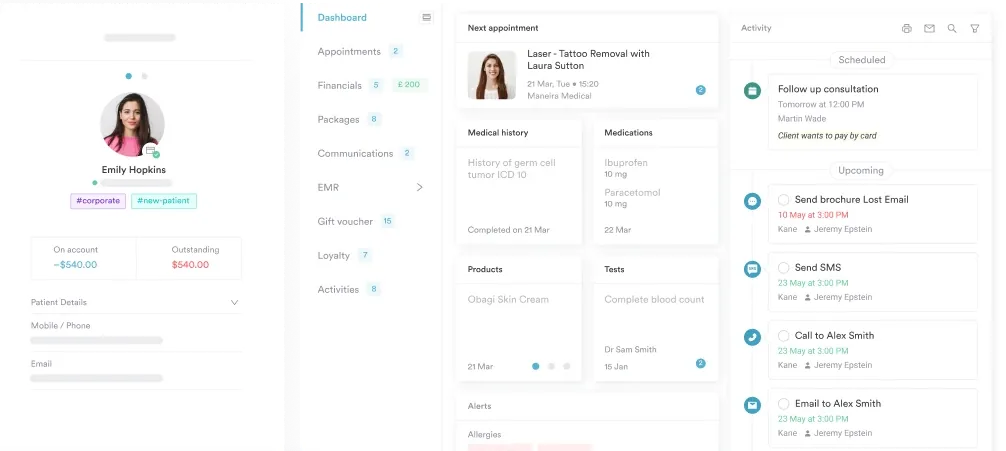
A cheat sheet only helps if the therapist remembers it at 6PM, after the sixth session of the day. In fact, that is where detail slips. Practice management software like Pabau moves the structure into the note itself, so the prompts arrive while the session is fresh.
You build a SOAP, DAP, or BIRP template once, and every clinician in the practice writes against the same fields. As a result, client identifiers, session date, and duration populate from the appointment. The note starts with the details a reviewer checks first, and nobody retypes them.
Treatment goals sit in the client record beside the note, so the goal-to-intervention link is quick to write and easy to audit. Notes connect to billing, so the documentation behind a claim travels with it.
Pabau Scribe, our AI scribe, can draft the session note for you to review and sign. Every subscription includes every feature, so nothing here sits behind an upgrade.

Pabau’s customizable clinical templates, linked treatment goals, and connected billing keep every therapy progress note complete. Your team documents faster and defends claims with far less back-and-forth.

The note you write in four minutes today is the same note a payer may read two years from now. So write it for that reader.
Precision costs you time in the moment and returns it at every review, appeal, and audit afterward. In turn, structure is what makes precision cheap, whether it comes from a printed sheet or from the fields on your screen.
Download the template, work with it for a week, and watch which sections you keep leaving thin. From there, those are the ones to build into your practice management software. Book a demo to see how Pabau structures therapy progress notes and keeps them ready for review.

Looking for between-session homework? Self-care inventory gives you a printable list to assign and review at the next session.
Trying to pin down why a behavior keeps happening? Motivation assessment scale ranks the four functions behind it and shows you how to score the result.
Documenting risk after a difficult session? Mental health safety plan sets out the warning signs, coping steps, and contacts to record with the client.
Documenting psychotic symptoms consistently? Schizophrenia system disorder template gives clinicians a systematic framework for evaluating psychotic symptoms, functional decline, and treatment response.
Want the modality language in one place? Counseling theories chart maps the major approaches to the interventions you would name in a note.
SOAP (Subjective, Objective, Assessment, Plan) is the most widely used format in medical settings. By comparison, DAP (Data, Assessment, Plan) is shorter and common in community mental health. BIRP (Behavior, Intervention, Response, Plan) emphasizes observable behavior change, and it suits applied behavior analysis and school settings. In short, your treatment setting and payer requirements decide which one you use.
There is no fixed length, so aim for completeness rather than volume. A well-written note covers presenting concern, intervention, client response, goal progress, and plan in 250 to 400 words. In short, specific clinical detail in 300 words beats vague rambling in 600.
No. Progress notes are part of the official medical record and are releasable to patients. Psychotherapy notes hold personal clinical reflections, such as feelings about the client and case formulation hypotheses. As a result, they receive stronger HIPAA protection and are not required to be released. Keep objective session facts in the progress note and file psychotherapy notes separately.
Avoid vague descriptors (good, bad, fine), judgmental language (difficult, resistant, in denial), unsupported assumptions (sounds like PTSD), and slang. Instead, describe observable behavior, tie claims to diagnostic criteria, and use professional clinical terminology. In short, licensing boards and insurance auditors read those vague phrases as a sign of poor documentation quality.