Despina Petrushevska
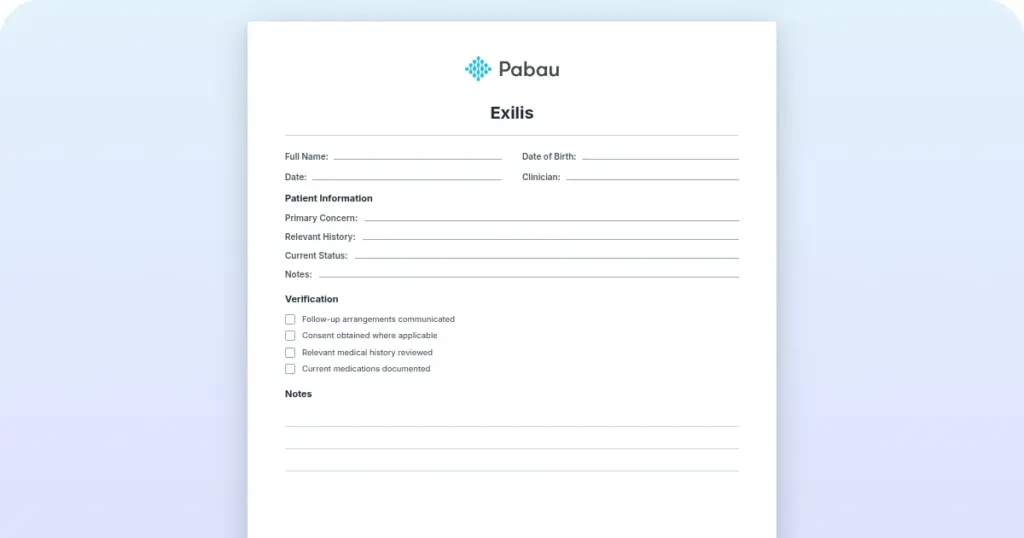
Exilis patient treatment record: Free PDF for RF sessions
An Exilis patient treatment record is the session log for BTL’s radiofrequ...

3
Last Updated: Oct 23, 2026
Free PDF 1 page, print-ready Clinician-reviewed
Download your free sclerotherapy consent form template Sclerotherapy consent form template A ready-to-use consent form covering patient details, contraindication screening, risk disclosures, informed consent statements, hyperpigmentation warnings, photography consent, and medical director sign-off. Download template Sclerotherapy treats varicose veins and spider veins by injecting a sclerosant solution directly into the affected vessels. Any practice that […]
A ready-to-use consent form covering patient details, contraindication screening, risk disclosures, informed consent statements, hyperpigmentation warnings, photography consent, and medical director sign-off.
Upload this PDF, or any form you already use, and Pabau's AI Form rebuilds it with tick boxes, text fields and a signature. Attach it to the treatment once, and every patient gets it on time.
AI Form rebuilds the consent, history and aftercare forms you already use. You review each one, then publish.
Patients complete forms on their phone before they arrive, so the front desk stops retyping paper.
Every signed form is versioned and attached to the treatment record, ready when you need it.
Set how long a consent stays valid. Returning patients skip forms they have already signed.
Supports HIPAA and GDPR compliance AES-256 encryption 4.8 on G2 4.7 on Capterra Trusted by 4,000+ practices worldwide

Sclerotherapy consent forms document informed patient consent, contraindication screening, and risk disclosures – essential for legal protection and regulatory compliance in aesthetic and vascular practices.
A comprehensive template covers patient medical history, pre-procedure instructions, sclerosant agent details, potential side effects (hyperpigmentation, matting, DVT risk), compression stocking guidance, and activity restrictions.
Consent forms must be reviewed by local legal/compliance counsel before use, as template sufficiency varies by jurisdiction (HIPAA in the US, GDPR/CQC in the UK, local equivalents elsewhere).
Practice management software like Pabau delivers sclerotherapy consent forms electronically, collects e-signatures, stores HIPAA-compliant records, and automates post-procedure reminders — all in one system.
Sclerotherapy treats varicose veins and spider veins by injecting a sclerosant solution directly into the affected vessels. Any practice that offers sclerotherapy needs documented informed consent on file before treatment begins.
A sclerotherapy consent form confirms the patient understands the procedure, its risks and benefits, and their aftercare responsibilities, so both the patient and your practice are protected if a question comes up later. Use the template above as your starting point, then customize it to the sclerosant agents you use, your supervision setup, and your local regulations.
A sclerotherapy consent form is a legal and clinical document confirming that a patient has received information about the procedure, understands the risks and benefits, and agrees to treatment. A complete form:
Beyond legal protection, consent forms are a cornerstone of clinical governance. In the US, state medical practice acts and medical board regulations set informed consent requirements, and HIPAA requires practices to keep any consent documentation secure and private. In the UK, the Care Quality Commission (CQC) requires documented evidence of informed consent for all invasive procedures.
A signed form also shows your commitment to patient safety and compliance if an audit or investigation ever reviews your records.
This template is structured for practice workflow and includes five operational steps:
Many practices capture this form through digital consent forms in software like Pabau, which speeds up the whole check-in workflow. Electronic capture removes paper storage.

This template is designed for aesthetic practices, dermatology practices, medical spas, and vascular centers that perform sclerotherapy. It applies to practices in the US (HIPAA), the UK (CQC and GDPR), and other jurisdictions with equivalent informed-consent regulations. Medical spas that offer sclerotherapy can compare dedicated software built for their specific compliance needs.
Practices offering skin clinic services. For billing guidance on foam-based treatments.
If nurse practitioners, physician assistants, or estheticians perform sclerotherapy under a medical director’s supervision, add signature lines for the supervising medical director where your state or country requires it.
Telehealth tools make it easy to review this resource with clients face to face online.
Legal and regulatory protection: A signed consent form is your practice’s primary defense against claims that a patient was not informed of risks. It demonstrates adherence to informed-consent standards. State medical practice acts, professional bodies like the American Society for Dermatologic Surgery (ASDS), and — for Medicare/Medicaid-participating facilities — CMS conditions of participation all set these standards. In the UK, consent documentation satisfies CQC expectations and reduces compliance findings during inspections.
Documentation clarity: The form creates a structured, durable record of exactly what information was provided and when. This becomes critical in malpractice defense — documented consent is evidence that the patient was fully informed.
Patient safety: By asking patients to review contraindication questions and confirm they understand the aftercare, you improve adherence to compression stocking use and activity restrictions, which reduces avoidable complications. Practices offering microneedling, laser, or peels alongside sclerotherapy can pair this form with dedicated aftercare instructions for those treatments.
Operational efficiency: Digital forms reduce data-entry errors, eliminate lost documents, and enable automatic population of standard sections — freeing clinical staff to focus on patient care instead of form administration.
This template is provided for educational reference only. Before using it in your practice, have your forms reviewed by local legal counsel and your compliance or risk management team. Template adequacy varies by jurisdiction:
If your practice performs sclerotherapy under a medical director’s supervision (common for nurse practitioners and estheticians), confirm that the consent form includes a medical director signature line consistent with your jurisdiction’s delegation and supervision requirements. Flag any off-label use of sclerosant agents in the consent form and document it in the patient record. For an overview of non-compounded foam sclerotherapy billing.
A complete clinical governance system for sclerotherapy includes consent forms, pre-procedure checklists, procedure notes, and aftercare instructions. Beyond the consent form, practices should maintain:
Electronic patient record systems like Pabau’s client records software store all these documents in a linked, searchable format, with built-in access controls so only authorized team members can view sensitive consent and procedure information. Practices using chemical peel treatments alongside sclerotherapy may also benefit from reviewing our chemical peel consent form guide for a comparable consent framework.
Book a demo to see how Pabau’s digital forms, electronic consent capture, and automated post-care reminders streamline your sclerotherapy workflows while keeping all patient records secure and compliant.

Losing revenue to last-minute cancellations? Waitlist management for med spas shows how automated waitlists fill last-minute cancellations that would otherwise sit empty.
How does a med spa differ? Med spa definition and treatments explains what separates a med spa from a day spa and how the treatments work.
Opening a med spa in Texas? Med spa ownership rules in Texas explains who can legally own a med spa in Texas before you sign a lease.
A sclerotherapy consent form is a legal document confirming that a patient has received information about the procedure, understands the risks and benefits, and agrees to treatment. It documents medical history, contraindications, potential side effects, post-care instructions, and includes signatures from the patient and treating practitioner or medical director.
In most jurisdictions (US, UK, EU, Canada, Australia), documented informed consent is a legal requirement before performing any invasive procedure, including sclerotherapy. In the US, state medical boards and CMS Conditions of Participation require consent documentation; in the UK, the CQC does. Failure to obtain consent creates significant legal liability.
No. While this template provides a comprehensive framework, have your local legal counsel and compliance team review and approve it before use. Consent form requirements vary by jurisdiction, state, and sometimes by individual medical board, so customization is essential.
Do not perform the procedure. Documented informed consent is both an ethical and legal requirement. For practices managing multiple consent workflows. If a patient declines to sign, do not proceed – instead, discuss their concerns, answer questions, and offer to reschedule if needed. Document their refusal in the patient record.
The patient must always sign to confirm understanding. The practitioner performing the procedure should also sign to attest that they discussed risks and benefits verbally. If a medical director supervises the practitioner (required in many jurisdictions for nurse practitioners and estheticians), the medical director should also sign to acknowledge supervisory oversight.