CCSD code G5100: Bypass of duodenum billing guide
CCSD code G5100 bills a bypass that leaves the duodenum in place CCSD code G5100...

Last Updated: Oct 16, 2026

CPT code 11302 covers the shave removal of a single epidermal or dermal lesion measuring 1.1 to 2.0 cm on the trunk, an arm, or a leg. Both conditions have to be true, not just one.
The code is easy to confuse with its neighbors. A 0.6 to 1.0 cm lesion on the same sites is 11301, and the same size lesion on the face is 11312 instead.
Selection turns on two documented variables only: the anatomic group and the diameter measured before removal. Shave codes never take a surgical margin, unlike the excision family.
Technique and intent, not the diagnosis, decide whether a removal is a shave, a biopsy, or an excision. Billing a shave code for what was really a tangential biopsy invites a denial.
In 2026 the code carries 1.02 work RVUs and 3.94 total non-facility RVUs, worth roughly $132 nationally before geographic adjustment. Facility payment is far lower, at 1.45 RVU.
Modifiers 25, 51, and 59 (or XS) each answer a different question about the visit, and attaching the wrong one is a routine denial source. Laterality matters too: the limb-specific ICD-10 pairings read as incomplete without it.
A defensible claim documents the site, the pre-removal diameter in centimeters, the technique, and the clinical indication. Missing any one of those four is a frequent reason this code gets denied on review.
Practice management software like Pabau keeps the site, the measurement, and the indication in one patient record, so your coder and any auditor read the same note.
CPT code 11302 bills the shave removal of a single epidermal or dermal lesion on the trunk, arms, or legs. Specifically, the lesion has to measure 1.1 to 2.0 cm.
That size band is where the code goes wrong most often. A 0.8 cm lesion on the forearm is 11301, and a claim that reaches for 11302 instead comes back for rework.
The American Medical Association (AMA) owns the CPT code set, and it splits the shaving family into three anatomic series. Each series repeats the same four size tiers. So the site you pick and the number you write both change what the claim pays.
Below you get the official descriptor, the selection matrix for the whole family, and the 2026 RVUs and payment amounts. In addition, modifiers, ICD-10 pairings, documentation requirements, and the usual denial patterns follow.
CPT code 11302 describes the shaving of a single epidermal or dermal lesion measuring 1.1 to 2.0 cm. Specifically, the listed sites are the trunk, the arms, and the legs.
The code sits in the Integumentary System section of the CPT manual. Its subsection, Shaving of Epidermal or Dermal Lesions, runs from 11300 to 11313. According to the AMA CPT code set, shaving means sharp removal with a blade or razor.
Instead, no full-thickness dermal excision is performed. The lesion comes off at or just below the plane of the surrounding skin, and the base is left to heal by secondary intention.
Chemical or electrocauterization of the wound is part of the same service. So you do not report it separately, and no suture closure is involved.
Sending the specimen to pathology is optional and does not change the code. However, intent does change it. A tangential biopsy taken for diagnosis belongs to belongs to 11102 and 11103 and 11103 instead.
Two conditions must both be true before you report 11302. The lesion sits on the trunk, an arm, or a leg, and the measured diameter falls between 1.1 and 2.0 cm. In other words, either one on its own is not enough.
The shaving family works as a grid. Three anatomic series run across it, and four size tiers run down each one. So, pick the wrong row or the wrong column and you have the wrong code.
The trunk, arms, and legs series runs 11300 to 11303. Similarly, the scalp, neck, hands, feet, and genitalia series runs 11305 to 11308. Likewise, the face, ears, eyelids, nose, lips, and mucous membrane series runs 11310 to 11313.
Every series steps through the same four tiers. Specifically, they run 0.5 cm or less, 0.6 to 1.0 cm, 1.1 to 2.0 cm, then over 2.0 cm. CPT 11302 is the third tier of the first series.
The matrix below carries the 2026 total non-facility RVU for each code, taken from the CMS relative value files.
The last column shows what a wrong tier costs. For example, a 1.4 cm trunk lesion billed as 11301 gives up 0.46 RVU, which is roughly $15 per lesion at the 2026 national rate.
The wrong series costs more. The same 1.4 cm lesion on the cheek is 11312, worth 4.51 RVU, so coding it here surrenders 0.57 RVU.
Measure the lesion before you remove it, and record the greatest clinical diameter in centimeters. As a result, a ruler measurement in the pre-procedure note is the defensible standard.
Shave removal codes take the lesion diameter alone. Unlike the excision codes, you never add a surgical margin to reach the size tier.
Likewise, do not work backward from the pathology report either. Tissue contracts in formalin, so a specimen measured after fixation will usually undersize the lesion you treated.
A lesion measuring 1.0 cm exactly is 11301. By contrast, a lesion measuring 1.1 cm is 11302. So write the number itself in the note rather than a range, because “approximately 1 cm” will not support either code on review.
Three code families can describe taking something off the skin. Instead, technique and intent decide which one applies, and the diagnosis has nothing to do with it.
Medicare article A57113 is explicit on the first two rows. Specifically, do not report a shave removal code when the procedure performed was a tangential biopsy of the lesion.
The excision comparison matters at this size. For example, CPT 11402 covers excision of a benign trunk or extremity lesion in the same 1.1 to 2.0 cm band, margins included.
11402 carries 5.12 total non-facility RVUs and a 010-day global period. By contrast, 11302 carries 3.94 and a 000-day global period, so a related visit two days later is still separately billable.
Relative value units are the basis of Medicare payment under the Physician Fee Schedule. Specifically, work RVU covers clinician time and skill, and malpractice RVU covers professional liability.
Practice expense RVU covers overhead, and it splits by setting. In fact, office overhead and hospital overhead are not the same thing. The figures below come from the CMS relative value file for calendar year 2026.
The two settings pay very differently. The office total is nearly three times the facility total, because the practice absorbs the tray, the room, and the staff time.
Check the current year before you use these numbers in a compensation model. For instance, the CMS fee schedule tool returns the locality-adjusted figures.
Medicare payment is the total RVU multiplied by the annual conversion factor, then adjusted for your locality. For 2026 there are two conversion factors.
Qualifying alternative payment model participants are paid at $33.5675. By contrast, everyone else is paid at $33.4009. The national amounts below apply the second figure and carry no geographic adjustment.
Your actual payment will differ. Geographic practice cost indices move each locality up or down, and commercial payers set their own multiples of the Medicare rate. So treat these figures as a national baseline rather than a quote.
Medicare covers shave removal when medical necessity is documented, and not otherwise. Specifically, Novitas billing and coding article A57113, which supports local coverage determination L34938, sets out the requirements for removal of benign skin lesions.
Cosmetic removal of a lesion that causes no symptoms and no functional problem is a non-covered service. Your own Medicare Administrative Contractor may publish its own policy, so check the one that applies to you.
The right skin assessment tools make this straightforward. In practice, the symptom that justified the removal is easiest to record while the patient is still in the room.
CPT 11302 carries a multiple procedure indicator of 2, so the standard reduction applies. The highest valued procedure of the session pays in full, and each additional one pays at 50 percent. That reduction is expected and correct, so it is not a denial to appeal. Where a code carries an evaluation and management component, documented complexity sets the level billed. A resubmission does not restart the clock, so the original filing limit still governs.
The code also has a 000-day global period. There is no postoperative window, which is why a separately identifiable visit on the same day can still be billed with modifier 25.
The bilateral surgery indicator is 9. The bilateral payment rule does not apply to this code, so two lesions on two limbs are two line items rather than one bilateral claim.
National Correct Coding Initiative edits change quarterly. So, check the current quarter before you append a bypass modifier to a pair that an edit has flagged.
Modifier choice depends on what else happened at the visit. As a result, attaching the wrong one, or leaving out a required one, is a routine denial source in this code family.
The distinction between 51 and 59 is worth getting right. Modifier 51 says a second procedure happened, and modifier 59 says a bundling edit should be bypassed because the services were genuinely separate.
Bill 11302 once per lesion, not once per encounter. For example, two qualifying lesions on the back are two lines of 11302. The second line needs modifier 59 or XS, plus a note that names both sites.
Every CPT claim needs a diagnosis code that establishes medical necessity. On a limb, this is mostly a laterality problem.
The limb codes split into right and left; the unspecified options, D23.60 and D23.70, read as incomplete. The pairings below reflect the FY2026 ICD-10-CM code set.
Pick the code that matches the documented finding for that encounter. A generic code where a specific one exists is a standing audit flag — and on a limb, an easy denial.
Practices that record the site at intake have less work here. Structured SOAP charting puts the site and the finding on the chart before anyone opens the claim.
Documentation decides whether an 11302 claim survives review. In practice, the procedure note has to let a reviewer who has never seen the patient confirm the code without asking a question.
Structured medical documentation forms help here. They capture the required fields at the point of care instead of leaving them to be reconstructed at the billing desk.

When tissue does go to pathology, the laboratory bills the examination itself under CPT 88305. Confirm the lab is submitting that line so your practice does not duplicate it.
Keep the note, the measurement, and the pathology result together in the patient record. In short, HIPAA-compliant record keeping and audit readiness are the same filing job done once.
Denials on this code cluster into a short list. In fact, each one traces back to a sentence missing from the note or a tier chosen from memory.
Aesthetic practices see the cosmetic line tested most often. So, a working knowledge of med spa compliance requirements keeps the consent conversation and the billing decision in step.
Most 11302 problems start before anyone builds a claim. In a solo practice, the clinician codes their own removals. In a group practice, the note reaches someone else, and the measurement is what goes missing.
Practice management software like Pabau keeps both in the same patient record, so the note your coder reads is the note the clinician wrote — nothing has to be reconstructed later.
The practical fix is a procedure template that won’t close with a field empty. For example, Pabau’s skin clinic software lets you build a shave removal form with four required fields.
The form asks for the anatomic site, the pre-removal diameter in centimeters, the technique, and the indication. That turns the two variables 11302 depends on into a step nobody can skip.
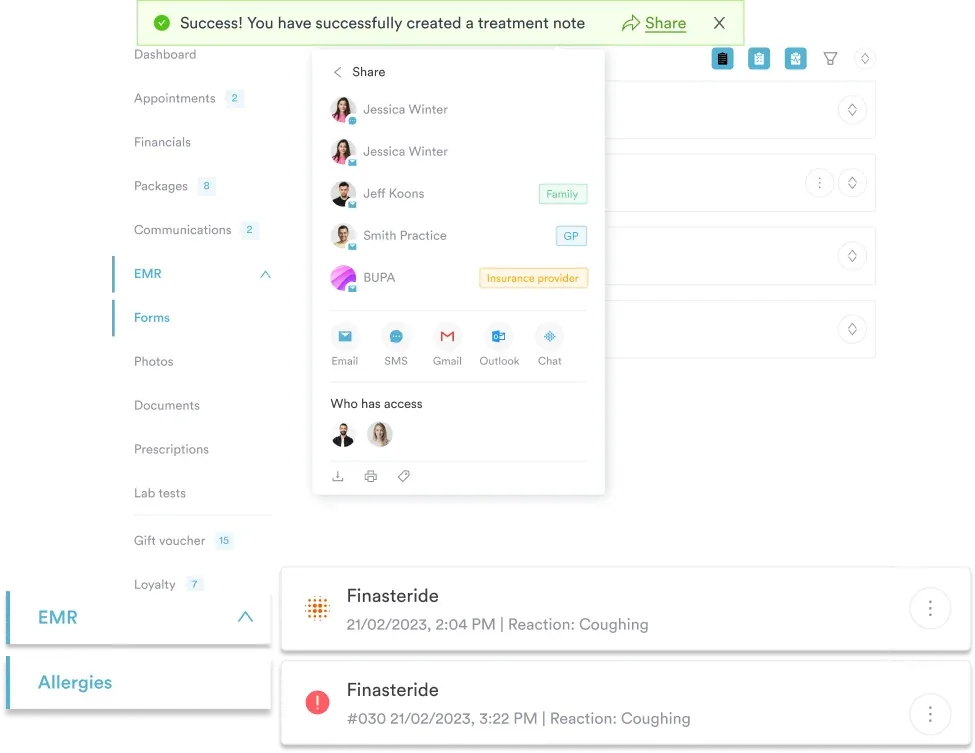
In a US practice, Pabau’s job is the record — your biller or billing service builds the claim. Then, Claims management in Pabau pulls the chart details into a pre-filled submission and tracks its status.
It doesn’t choose the code for you — the tier, modifier, and diagnosis stay clinical decisions, which is why the note has to carry the facts behind them.
When a reviewer asks for support months later, everything comes from one system — the procedure note, photographs, diagnosis codes, and audit trail sit together instead of in three places.
In turn, for dermatology EMR software users, that consistency is what shortens an audit response.
Together, pairing patient record management with digital intake forms builds that documentation baseline into every encounter.

Pabau keeps procedure notes, photographs, and lesion measurements in one patient record. Your coder never has to guess the site or the size behind a shave removal claim. Book a demo to see how dermatology and aesthetics practices set this up.

CPT code 11302 has two conditions and no others. The lesion sits on the trunk, an arm, or a leg, and it measures 1.1 to 2.0 cm before removal.
Almost every denial in this family traces back to a note that missed one of those two facts. Otherwise, the rest come from a coder reaching for the neighboring size tier out of habit.
So measure first, name the exact site, describe the technique, and say why the lesion had to go. Those four lines decide the code, the modifier, and whether Medicare pays.
Pabau builds those habits into the encounter itself, so the documentation is right before the claim is ever created. To see how that works in a dermatology or aesthetics setting, book a demo with the Pabau team.

Is the trunk or limb lesion smaller than 1.1 cm? CPT code 11301 is the 0.6 to 1.0 cm tier of the same series, with its own RVUs.
Same size, but the lesion is on the face? CPT code 11312 covers the face, ears, eyelids, nose, lips, and mucous membrane at 1.1 to 2.0 cm.
Was the lesion excised rather than shaved? CPT code 11402 covers excision of a benign trunk or extremity lesion in the same size band.
Was the intent diagnostic instead of therapeutic? CPT code 11102 is the tangential biopsy code that article A57113 tells you to use instead.
Treating an actinic keratosis? CPT code 17000 covers destruction of a premalignant lesion, which is counted rather than measured.
CPT code 11302 covers the shaving of a single epidermal or dermal lesion on the trunk, arms, or legs, measuring 1.1 to 2.0 cm. The American Medical Association maintains the code. In practice, dermatology, aesthetics, and general surgery practices use it for tangential removal without suture closure.
The difference is lesion diameter, measured before removal. CPT 11301 covers a lesion of 0.6 to 1.0 cm on the trunk, arms, or legs. By contrast, CPT 11302 covers the next tier up, 1.1 to 2.0 cm, on those same sites. Both use the same technique.
Medicare covers CPT 11302 when medical necessity is documented. Novitas article A57113, which supports local coverage determination L34938, lists indications such as bleeding, inflammation, pain, and concern for malignancy. Cosmetic removal of an asymptomatic lesion is not covered, and it needs an Advance Beneficiary Notice on file.
Modifier 25 goes on the evaluation and management code when a separately identifiable visit happens the same day. Meanwhile, modifier 51 applies to additional procedures at one session. Modifier 59, or XS where the payer prefers it, bypasses a bundling edit for a lesion at a distinct site. Check current National Correct Coding Initiative edits each quarter.
Not for the same lesion. Medicare article A57113 says a shave removal code should not be reported when a tangential biopsy was performed. Tangential biopsy codes 11102 and 11103 describe a diagnostic intent, while 11302 describes therapeutic removal. Billing both for one lesion at one encounter is duplicate billing.