Anja Dodevska

Self-harm worksheet: Free PDF with a safety plan
Download your free self-harm worksheet A two-page worksheet in four parts, writt...

1
Last Updated: Nov 6, 2026
Free PDF 3 pages, print-ready Clinician-reviewed
A problem solving therapy worksheet is a structured form that takes a patient from one practical problem to a dated review of their plan. Its six sections cover the problem and its causes, the emotions and thoughts it triggers, and possible solutions. The patient then picks a solution, writes an action plan and reviews it later. Clinicians use it in session and as homework, printed or sent as a digital form. It supports your clinical judgment and does not replace it.
A six-section PDF that takes a patient from defining one problem to a dated review of their action plan. It ends with a box for your clinician notes.
Start from scratch, or upload this PDF or any form you already use, and Pabau's AI Form rebuilds it with tick boxes, text fields and a signature. Attach it to the treatment once, and every patient gets it on time.
AI Form rebuilds the consent, history and aftercare forms you already use. You review each one, then publish.
Patients complete forms on their phone before they arrive, so the front desk stops retyping paper.
Every signed form is versioned and attached to the treatment record, ready when you need it.
Set how long a consent stays valid. Returning patients skip forms they have already signed.
Supports HIPAA and GDPR compliance AES-256 encryption 4.8 on G2 4.7 on Capterra Trusted by 4,000+ practices worldwide

The worksheet works best on one specific, practical problem, not on open-ended distress.
Its six sections run from defining the problem to a dated review, so the work continues between sessions.
Sorting what sits inside and outside the patient’s control decides whether the plan targets the problem or how they cope with it.
Evidence for problem solving therapy is strongest in depression, so check the literature before using it for other presentations.
Pabau’s digital forms send the worksheet to patients and keep the completed copy with their record.
A problem solving therapy worksheet is the written form of the core method in problem solving therapy (PST). It sets out that method as prompts a patient answers alone or with you. PST traces back to a 1971 paper by D’Zurilla and Goldfried.
NICE depression guidance includes problem solving among the psychological options clinicians can consider for mild to moderate depression. The evidence is strongest for depression and thinner for other presentations, so check the current literature for your patient group.
Introduce the worksheet in session and complete the first sections together. Set the action plan as homework, then use the review section at the next visit.
Section 3 often redirects the work. When most of the problem sits outside the patient’s control, the action plan shifts. It leans on emotion regulation and support instead of fixing the problem itself.
Section 2 can also surface catastrophic predictions that block every option. Work through those with a decatastrophizing worksheet before moving on to solutions. The diagram below shows what the patient writes in each section.
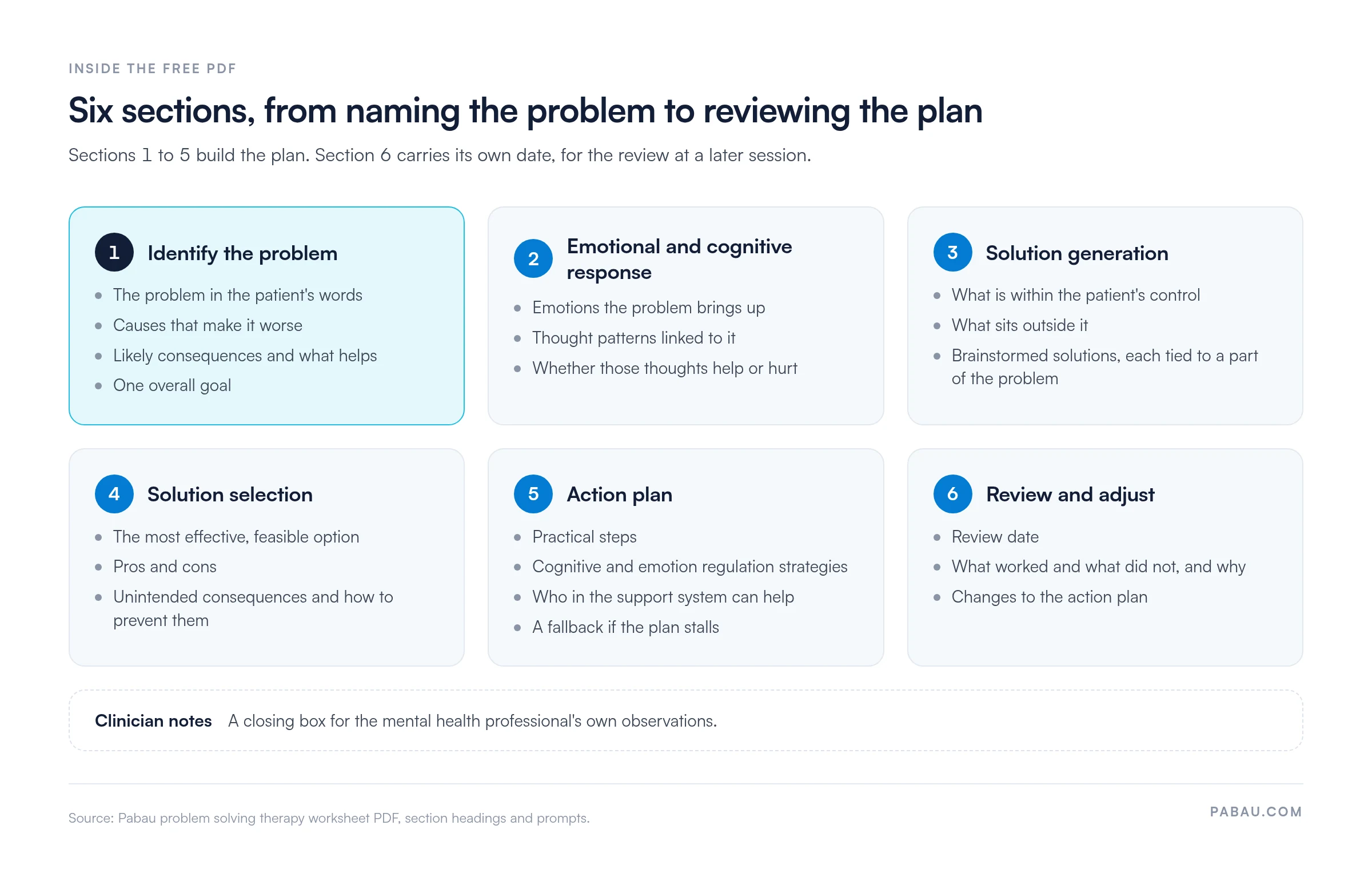
It helps clinicians working with adults, teens and younger patients who face a defined, practical problem. Typical examples are a recurring conflict, work pressure or a decision the patient keeps postponing. Typical users include:
Practices that manage notes and forms digitally can keep completed worksheets alongside electronic records for mental health.
A worksheet gives structure to sessions where patients feel stuck, and it leaves a written trail of their reasoning. In practice, that helps in four ways:
Start with a small, specific problem the patient can act on this week. A goal such as feeling less stressed is hard to evaluate. A missed deadline or a difficult conversation gives the later sections something concrete to test. Save bigger life issues for later sessions, once the method feels familiar.
PST and CBT share cognitive and behavioral foundations, but PST is a separate protocol built around solving one defined problem.
Choose PST when the patient’s main difficulty is a practical problem they can name. Choose CBT when the work centers on a disorder-specific cognitive or behavioral target, where an ABCDE CBT worksheet fits better. Some protocols blend elements of both, so check the model you were trained in.
Adults can often complete the sheet alone, while teens and younger patients may need you to model the first problem together. Keep these adjustments in mind:
The worksheet supports clinical judgment and does not replace it, especially where risk is present. Apply these checks before you hand it over:
Most practices print the worksheet, hand it over at the end of a session and hope it comes back. A sheet that stays at home leaves the review section with nothing to review.
Pabau, the practice management software we build for therapy practices, sends the worksheet as a digital form before or after the appointment. The completed copy lands in the patient record, next to your notes.
After the session, Pabau Scribe, our AI scribe, drafts the session note from what was discussed. The review at the next visit then starts from a written plan instead of memory.
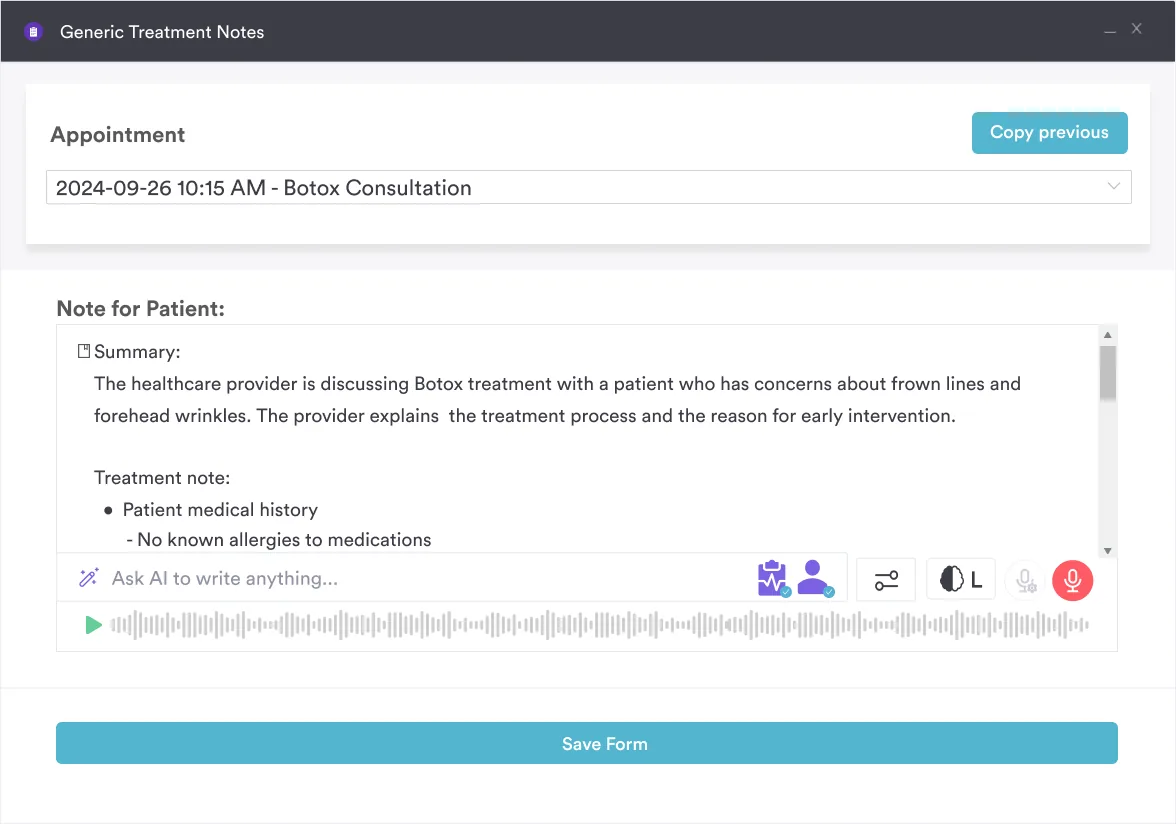

Pabau sends the worksheet as a digital form and keeps the completed copy in the patient record. Your session notes sit in the same place.

The worksheet earns its place when the patient leaves with one written plan and a date to review it. Pick a small problem first, and hold the review on the date you set. Let section 3 decide whether the plan targets the problem or how the patient copes.
The trade-off is speed. Six sections take longer than an informal chat, but they leave a record you can return to. If your practice wants that record kept in one system, see how Pabau for therapy practices handles forms and notes. Book a demo to see the worksheet sent, completed and reviewed in one workflow.

Facing an urgent risk concern? Crisis intervention strategies for clinicians outlines approaches for sessions where safety becomes the priority.
Need a structured assessment before planning treatment? Psychiatric evaluation template offers a framework for documenting the initial picture.
Is the patient torn between two options? Decisional balance worksheet weighs the costs and benefits of change before a solution is chosen.
Want the action plan to have measurable steps? SMART goals worksheet turns a broad goal into specific, time-bound targets.
Problem solving therapy (PST) is a structured psychological approach that teaches a repeatable method for handling a specific, practical problem. Clinicians use it to help patients define problems, generate options, choose a course of action and review the result. Its strongest evidence base is for depression.
Yes, the Pabau worksheet on this page is a free PDF download. Adults can often complete it alone, though you may want to review their first attempt together.
No, PST is a distinct protocol, although it shares cognitive and behavioral components with CBT. The choice depends on whether the patient’s main difficulty is a practical problem or a disorder-specific target.
No. The worksheet structures the work, but your assessment, risk screening and treatment decisions remain with you.