Tanja Lepcheska

Pabau vs Hyland OnBase: Healthcare document management software compared
Healthcare document management software captures, stores, and retrieves patient ...

Last Updated: Nov 2, 2026
Free PDF 1 page, print-ready Clinician-reviewed
A decatastrophizing worksheet is a structured CBT tool for testing a feared outcome.
It helps patients judge how likely the outcome is and weigh it against the evidence.
Catastrophic thinking sits at the center of many anxiety presentations. A practitioner-ready worksheet gives therapists a repeatable way to work on it in sessions. Pabau’s free printable PDF asks seven open questions, from the worry itself to what could ease the patient’s mind.
This guide explains what the worksheet covers, where it fits in a wider CBT plan, and how to adapt it for different patient groups.
This printable CBT worksheet takes one worry through seven open questions. It covers how likely the worry is, the most likely and worst outcomes, feelings, more positive outcomes, and what could ease the mind.
Start from scratch, or upload this PDF or any form you already use, and Pabau's AI Form rebuilds it with tick boxes, text fields and a signature. Attach it to the treatment once, and every patient gets it on time.
AI Form rebuilds the consent, history and aftercare forms you already use. You review each one, then publish.
Patients complete forms on their phone before they arrive, so the front desk stops retyping paper.
Every signed form is versioned and attached to the treatment record, ready when you need it.
Set how long a consent stays valid. Returning patients skip forms they have already signed.
Supports HIPAA and GDPR compliance AES-256 encryption 4.8 on G2 4.7 on Capterra Trusted by 4,000+ practices worldwide

A decatastrophizing worksheet helps patients test a feared outcome by asking how likely the worry is and what evidence supports it.
Patients should complete it with a therapist, not as unsupervised self-administered homework.
The most common error is rushing the likelihood question before the worst-case outcome is fully described.
NICE recommends CBT for adults with generalized anxiety disorder and panic disorder, so the worksheet fits a guideline-based plan.
Pabau’s decatastrophizing worksheet is a free printable PDF, ready to print for in-person sessions.
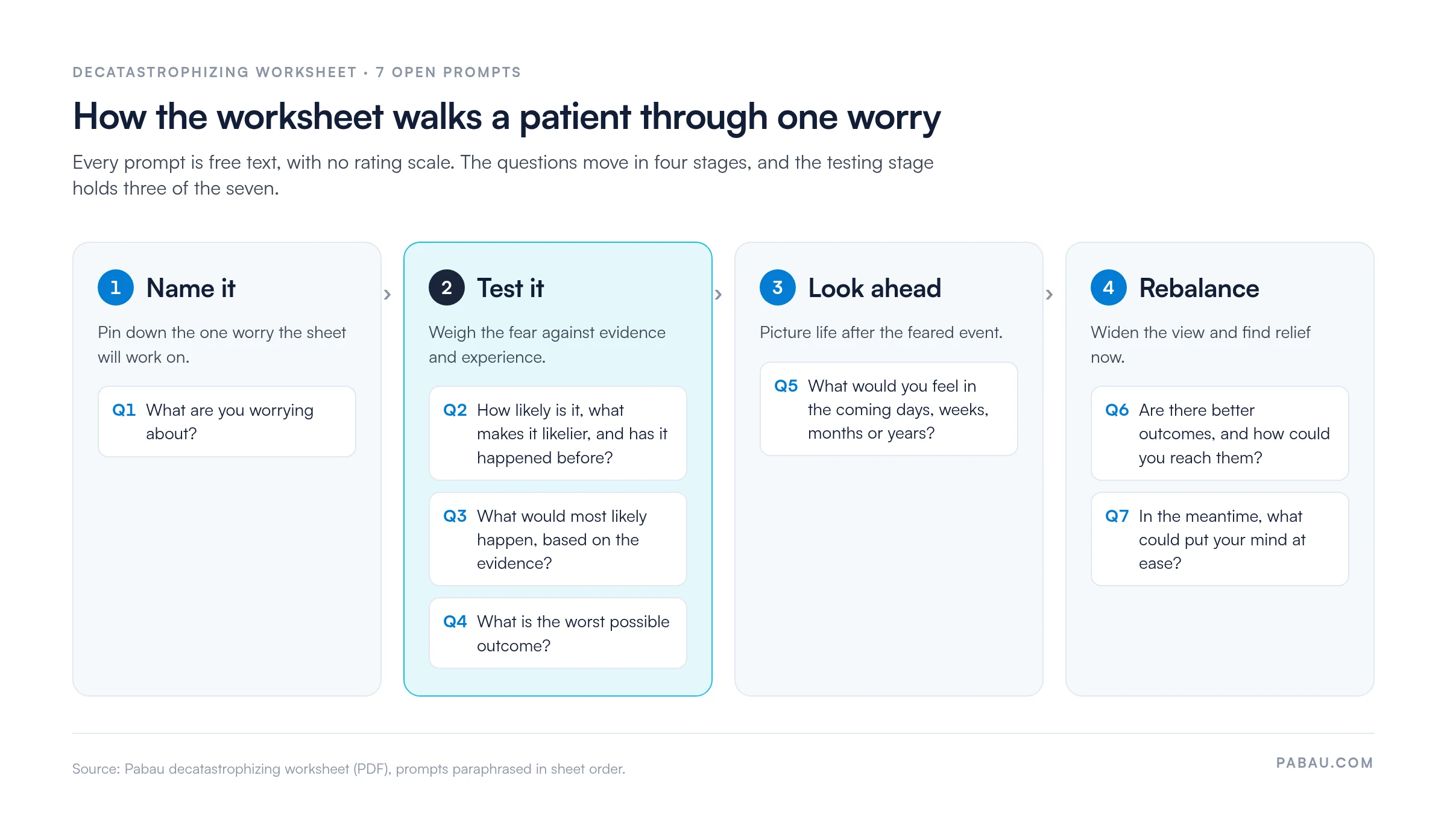
The sheet works through one worry at a time, with space for the patient’s name and the date at the top. Seven open prompts follow, in this order:
There’s no rating scale or scoring box anywhere on the sheet. Every answer is free text, so the conversation in the session does the testing.
The prompts move through four stages, from naming the fear to finding what eases it now.
Decatastrophizing is a recognized CBT technique rooted in the cognitive therapy tradition of Ellis and Beck. It suits patients whose anxiety centers on predicted disaster rather than on present danger.
NICE recommends CBT for adults with generalized anxiety disorder and panic disorder (NICE CG113), so the worksheet fits within a guideline-consistent treatment approach. It is a tool to support therapeutic intervention, not a treatment in its own right.
Get the worst case described in concrete, sensory detail before you work through the likelihood question, even though that question sits higher on the sheet. Vague catastrophes are hard to test.
The worksheet connects naturally to a dysfunctional thought record, where patients log automatic thoughts as they occur. Patterns from the thought record show which feared outcomes recur and deserve a full decatastrophizing exercise.
Clinicians can also pair the exercise with behavioral experiments, where the patient tests a prediction outside the session and records the result. That result then feeds the likelihood and most-likely-outcome questions on the next sheet.
Younger patients often need simpler language and fewer prompts. Add a 0 to 10 scale beside the likelihood question, and use a drawing or sentence-completion format for the worst outcome.
For patients with severe anxiety or OCD, reduce the number of prompts per session and focus on one feared event at a time. Confirm suitability with the patient’s treating clinician before use.
In many therapy practices, the printed sheet goes home with the patient and comes back a week later. Someone then summarizes the answers into the session notes by hand, and the paper copy ends up in a drawer.
Pabau, the therapy practice management platform we build, keeps digital forms and treatment notes in one patient record. You can rebuild the worksheet’s prompts as a digital form and send it before the session.
The patient’s answers then sit next to your notes, so the session starts from their own words. You can also compare this month’s likelihood answer with last month’s without leafing through paper.

Pabau’s digital forms put a patient’s worksheet answers in the same record as your treatment notes. Send the prompts before a session and review them in context.

A decatastrophizing worksheet earns its place when it slows the patient down. Describe the worst case fully, then test it with the likelihood and evidence questions, and the fear becomes something to weigh rather than a certainty.
Start with one recurring worry from a thought record and work through it together in session. Hand the sheet over as homework only once the patient can run it without you.
Book a demo to see how Pabau keeps your patients’ worksheet answers alongside your session notes.

Is the worry practical or hypothetical? The worry tree helps patients decide whether to act on a worry or set it aside.
Want a courtroom-style challenge? Putting thoughts on trial worksheet weighs the evidence for and against a single anxious thought.
Ready to build a balanced thought? Reframing negative thoughts worksheet turns a tested thought into a more balanced alternative.
Does the worry loop all day? Ruminating thoughts worksheet gives patients a structure for interrupting repetitive worry.
Is the fear about an upcoming event? Anticipatory anxiety worksheet focuses on dread that builds ahead of a specific situation.
A decatastrophizing worksheet is a CBT tool that asks a patient how likely a feared outcome is and what evidence supports it. It is used during therapy sessions as a structured way to challenge catastrophic thinking.
Patients should complete the worksheet with a therapist, at least for the first few attempts. Unsupervised use can leave the worst-case step vague or the evidence behind the likelihood answer unexamined.
Yes, Pabau’s decatastrophizing worksheet is a free printable PDF. It is ready to print for in-person sessions.