Monika Lazarevska

Anaphylaxis nursing care plan: Interventions and charting
What an anaphylaxis nursing care plan covers, start to finish An anaphylaxis nur...

2
Last Updated: Nov 2, 2026
Free PDF 3 pages, print-ready Clinician-reviewed
A preeclampsia nursing care plan links bedside assessment to nursing diagnoses, measurable goals, interventions, and an evaluation of how the patient responded. Preeclampsia is new hypertension after 20 weeks of pregnancy with proteinuria or signs of organ involvement, and it can worsen quickly.
A physician or midwife makes the diagnosis, but nurses run most of the repeat checks that show whether it is stable or escalating. A strong plan names the thresholds in advance. Every nurse on the unit then knows what to check, how often, and which finding means calling the physician now.
A printable care plan form with a patient information box, medical history, assessment, nursing diagnoses, goals, interventions, rationale, evaluation, and notes. It ends with the nurse's name, license number, and contact number.
Start from scratch, or upload this PDF or any form you already use, and Pabau's AI Form rebuilds it with tick boxes, text fields and a signature. Attach it to the treatment once, and every patient gets it on time.
AI Form rebuilds the consent, history and aftercare forms you already use. You review each one, then publish.
Patients complete forms on their phone before they arrive, so the front desk stops retyping paper.
Every signed form is versioned and attached to the treatment record, ready when you need it.
Set how long a consent stays valid. Returning patients skip forms they have already signed.
Supports HIPAA and GDPR compliance AES-256 encryption 4.8 on G2 4.7 on Capterra Trusted by 4,000+ practices worldwide

A preeclampsia care plan ties each assessment finding to a NANDA-I diagnosis, a checkable goal, and a documented response.
Severe range starts at a systolic of 160 mmHg or a diastolic of 110 mmHg, and either one alone needs escalation.
Severe-range blood pressure that persists for 15 minutes needs a fast-acting antihypertensive within 30 to 60 minutes, given per order and protocol.
Magnesium sulfate monitoring centers on deep tendon reflexes, respiratory rate, and urine output.
Preeclampsia can develop up to six weeks after delivery, so postpartum blood pressure checks belong in the plan.
The care plan is the nursing side of preeclampsia management. It turns physician orders and unit protocol into bedside actions that the whole team can follow and audit.
Diagnosis sits with the physician or midwife, using diagnostic criteria published by the American College of Obstetricians and Gynecologists (ACOG). Those criteria start with new hypertension after 20 weeks, plus proteinuria or other maternal organ involvement. The nurse’s job is to detect change early, escalate it, and record both.
Start with a full baseline at admission, then repeat it at the frequency the care team sets. Cover these five areas at every check.
Record each finding with a time and the value before it. An entry of “152/98” tells the next nurse very little. “152/98 at 14:00, up from 138/88 at 10:00, new headache since noon” tells them where the patient is heading.
A blood pressure pregnancy chart makes that trend visible across a shift. Fetal checks follow the same logic, whether the record is a heart rate strip or a nonstress test result.
NANDA International (NANDA-I) gives nurses a standard set of diagnosis labels, so plans read the same from unit to unit. The labels below are commonly used for preeclampsia. Choose only the ones the patient’s findings support.
Here’s a quick test before you commit to a diagnosis. Can you point to the assessment entry that supports it? If you can’t, the diagnosis is a guess, and an auditor will read it that way.
Each diagnosis needs an outcome the team can check by a set time. Tie the time frame to what the physician has agreed, and avoid goals that depend on factors outside nursing control.
Compare two versions of the same goal. “Blood pressure will stay stable” can’t be audited. A checkable version reads “Blood pressure is recorded at the ordered frequency, and any severe-range reading is reported at once.” A reviewer can confirm that one line by line.
Interventions turn the diagnoses into actions. Most are standard across units, but the frequencies and thresholds should follow your institution’s protocol.
Severe-range blood pressure that persists for 15 minutes or more is treated as a hypertensive emergency. The patient should receive a fast-acting antihypertensive within 30 to 60 minutes to lower the risk of maternal stroke.
First-line options are usually IV labetalol, IV hydralazine, or immediate-release oral nifedipine. The physician orders the drug, or the unit protocol sets it. The nurse confirms the reading, notifies the physician at once, and prepares or gives the drug per order and protocol. Recheck blood pressure at the intervals the protocol sets, and record each reading, dose, and time.
Magnesium sulfate is the drug of choice for seizure prophylaxis and eclampsia treatment in patients with severe features. Nurses give it according to the prescribed regimen and the institutional infusion protocol.
Check deep tendon reflexes, respiratory rate, and urine output at the frequency your protocol sets. Calcium gluconate is the recognized antidote for magnesium toxicity, so the protocol should state how and when it is given.
Keep padded side rails, a working call bell, suction, and oxygen at the bedside. Reduce light and noise where possible. If a seizure occurs, protect the patient from injury, maintain the airway, and call for help according to your emergency policy.
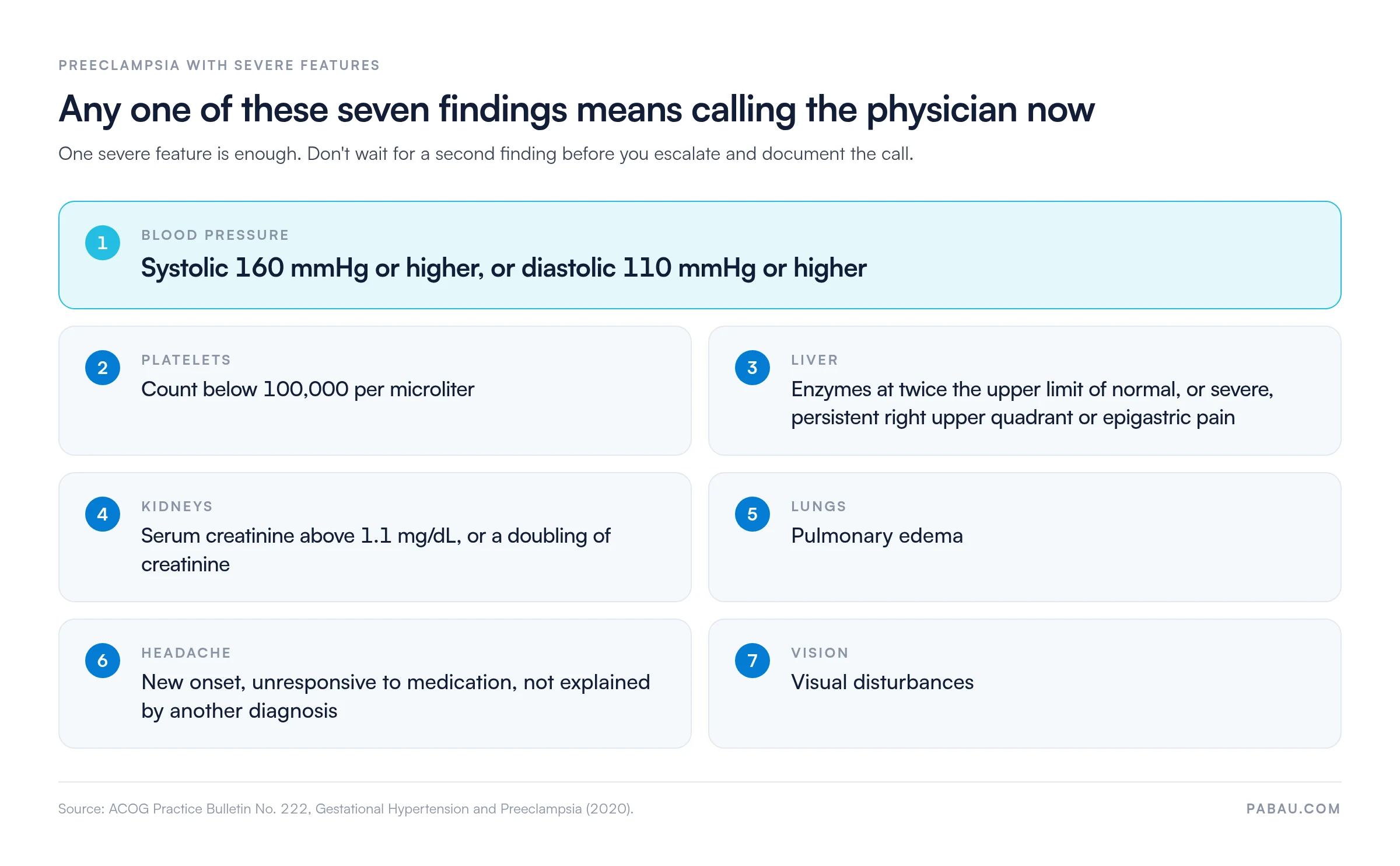
Severe features turn a monitoring plan into an escalation plan. ACOG lists seven severe features, and any one of them should prompt immediate physician notification.
Keep the list where the bedside team can see it, because one finding on its own is enough to escalate. A severe-range reading that persists for 15 minutes also starts the urgent treatment pathway. That means a fast-acting antihypertensive within 30 to 60 minutes, per order and protocol.
HELLP syndrome involves hemolysis, elevated liver enzymes, and low platelets. It can occur with or without marked hypertension. Expect extra laboratory monitoring and be ready for bleeding precautions. Differentiation and treatment decisions rest with the medical team.
Preeclampsia can develop up to six weeks after delivery. ACOG advises a blood pressure check within 72 hours for patients who had severe hypertension. Patients with other hypertensive disorders of pregnancy need one no later than 7 to 10 days postpartum. The care plan should continue past discharge from the labor and delivery unit.
A structured postpartum nursing assessment helps you catch these warning signs alongside routine recovery checks.
Discharge teaching is part of the nursing plan. Patients and families need clear warning signs and a clear follow-up schedule.
Cover home blood pressure checks if they are ordered, medication adherence, activity limits, and the date of the next review. Give written instructions the patient can keep. Then use teach-back to confirm they can name the symptoms that need an urgent call.
On a busy unit, the plan only works if it travels with the patient. Here is the usual path, step by step.
The plan stalls most often at handoff and at delivery. Trends get lost when the outgoing nurse reports single readings. Open diagnoses get dropped when the patient moves to a new form. If delivery is planned, carry the open problems into the labor and delivery plan instead of starting over.
Nursing students can use the same structure for care plan assignments, provided their educators confirm the required format.
The PDF follows the standard care plan order, from patient information through evaluation and additional notes. Four parts of it need a little extra handling at the bedside.
Most weak plans fail in the same few places. Each mistake below has a simple fix you can apply when you write or review one.
Run through this list before you sign and date the form beside your name, or hand it over.
Many practices still run care plans on paper, or on a PDF that lives outside the patient record. Each reassessment then sits on a separate sheet, and the trend is hard to see at handoff.
Pabau, the all-in-one practice management system we build, lets you turn the care plan into a digital form. Each completed form saves to the patient’s record alongside treatment notes and appointments. The next clinician opens one file and sees the full history.
For practices that run prenatal and postpartum care, Pabau’s EMR for OBGYN practices keeps these care plans next to scheduling and billing.

Pabau’s digital forms and Client records keep assessments, escalations, and follow-up notes in one patient file. See how it fits your practice.

A preeclampsia care plan earns its place when the thresholds are written down before anyone needs them. Set the baseline, link each diagnosis to a finding, and name the reading that triggers a call.
The cost is a few extra minutes at admission. Those minutes buy faster escalation later, cleaner handoffs, and a chart that shows what the team did and when.
Book a demo to see how Pabau keeps care plans, reassessments, and follow-up notes on one patient record for your practice.

Planning care through delivery? Labor and delivery nursing care plan carries the same assessment-to-evaluation structure into labor.
Moving on to postpartum checks? Nursing postpartum assessment walks through the recovery checks that sit alongside blood pressure follow-up.
Need a plan for after discharge? Postpartum care plan covers recovery goals and follow-up for the weeks after birth.
Documenting fetal status? Normal fetal heart rate template gives you reference ranges and a place to record readings.
Tracking readings across a pregnancy? Blood pressure pregnancy chart makes trends easy to spot from one visit to the next.
Both involve new high blood pressure after 20 weeks of pregnancy. Gestational hypertension has no proteinuria and no signs of organ involvement. Preeclampsia adds one or both, so it needs closer monitoring. Gestational hypertension can progress to preeclampsia, so blood pressure checks continue.
High-risk factors include preeclampsia in a past pregnancy, a multifetal pregnancy, chronic hypertension, diabetes before pregnancy, kidney disease, and autoimmune disease such as lupus. Clinicians often recommend low-dose aspirin for high-risk patients, usually started after 12 weeks.
Loss of deep tendon reflexes is usually the first sign. Respiratory depression and reduced urine output can follow, and very high levels affect the heart. Report any of these at once and follow your protocol, which may include stopping the infusion.
Yes. People who had preeclampsia face a higher lifetime risk of heart disease and stroke. Discharge teaching should encourage regular blood pressure checks with a primary care provider after the postpartum period.