Pabau GO app

The new Pabau GO is heredownload on the App Store

Download on the App Store
Book a demo Book a demo
Clinical guides

Labor and delivery nursing care plan

Key takeaways

Key takeaways

A labor and delivery nursing care plan turns assessment findings into NANDA diagnoses, measurable outcomes, and interventions you can hand to the next shift.

Five diagnoses cover most patients: acute pain, anxiety or fear, risk for infection, risk for fetal injury, and ineffective coping.

Assessment cadence drives the plan. Take vitals every 1 to 2 hours in the latent phase, then every 30 minutes once labor is active.

The printable template leaves the diagnosis field blank, so you write the priority labels yourself after the first full assessment.

Practice management software like Pabau stores the completed plan in the patient record, so every shift reads the same version.

Download your free labor and delivery nursing care plan

A printable care plan that runs from admission through to sign-off. It covers patient information, allergies and medications, subjective and objective assessment, diagnosis, goals, interventions with rationale, and evaluation.

Download template

A labor and delivery nursing care plan is a working document that guides assessment, diagnosis, planning, intervention, and evaluation through the intrapartum period. It gives every nurse on the unit the same language for what the patient needs. That matters most at handoff, when the incoming nurse has minutes to understand a labor already in progress.

The plan turns observation into documented care. A change in vital signs, a patient’s fear, and a fetal monitoring strip each become a named nursing diagnosis. Every diagnosis then carries its own interventions, its own rationale, and an outcome you can measure before the shift ends.

What is a NANDA nursing diagnosis in labor and delivery?

A NANDA nursing diagnosis is a standardized label for a patient response that nursing care can change. Medical diagnoses describe disease pathology. Nursing diagnoses describe what the patient is experiencing, and what the nurse can do about it.

The taxonomy is maintained by NANDA-I, short for NANDA International. In labor and delivery, its diagnoses focus on how the mother and the fetus respond to labor itself. They are not about the obstetric condition behind it.

Each diagnosis has three parts. There is the label, the related factors, and the defining characteristics. Written out, that becomes acute pain related to uterine contractions and cervical dilation. The defining characteristics follow: a pain score of 7 to 10 out of 10, muscle tension, and verbal reports of discomfort.

Core nursing diagnoses for labor and delivery

Five diagnoses appear in nearly every labor and delivery care plan.

  • Acute pain related to uterine contractions, cervical dilation, and perineal pressure. An acute pain care plan combines position changes, breathing techniques, analgesia, and emotional support. Pain intensity is the outcome you track.
  • Anxiety and fear related to the labor process, uncertain outcomes, and loss of control. The interventions in an anxiety care plan are therapeutic communication, presence, education on labor progress, and a support person in the room.
  • Risk for infection related to prolonged rupture of membranes, prolonged labor, and perineal trauma. Sterile technique, temperature checks, and perineal care reduce the risk of the puerperal sepsis coded as O85. Record when membranes ruptured, and the fever threshold that triggers a call to the provider.
  • Risk for fetal injury related to abnormal labor progress, placental insufficiency, or cord complications. Fetal heart rate monitoring is the core intervention, and a normal fetal heart rate baseline sits between 110 and 160 bpm. Nurses categorize patterns as I, II, or III under NICHD criteria and escalate the non-reassuring ones.
  • Ineffective coping related to labor demands and unexpected outcomes. This one covers the emotional responses that go past anxiety. It guides the support offered to the patient and her family through a difficult stretch.

What to assess, and how often

Assessment is the foundation of the plan. Nurses work through six domains, and the interval matters as much as the finding. A vital signs record and a numeric pain rating scale keep both consistent from nurse to nurse.

Assessment domain Key parameters Nursing action
Maternal vital signs Blood pressure, heart rate, respiratory rate, temperature, oxygen saturation Every 1 to 2 hours in the latent phase, every 30 minutes in active labor, and continuously during induction.
Cervical exam findings Dilation of 0 to 10 cm, effacement of 0 to 100%, station of -5 to +5, position, consistency Check every one to two hours or per protocol. Document station and position to track descent, and call the provider if labor arrests.
Uterine contraction pattern Frequency per 10 minutes, duration in seconds, intensity, resting tone Palpate or monitor electronically. Assess whether the pattern is adequate for progress, and document the response to oxytocin.
Fetal heart rate and pattern Baseline of 110 to 160 bpm, variability, accelerations, decelerations, category Keep electronic monitoring continuous during labor and induction. Interpret by NICHD category, document the trend, and escalate Category II or III.
Amniotic fluid status Color, odor, volume, membrane status, timing of rupture Record the time and characteristics at rupture. Watch for infection if rupture is prolonged, and for cord prolapse with variable decelerations.
Pain and emotional response Pain location and score out of 10, coping strategies, anxiety level, support at the bedside Ask every 30 minutes or on request. Offer an intervention before pain escalates, and adjust support as coping changes.

How priorities shift across the stages of labor

Priorities move as labor progresses, so the plan has to move with them.

  • Latent phase, 0 to 3 cm. Comfort, education, and early ambulation lead here. Pain is mild to moderate, so breathing techniques, position changes, and hydration usually carry it. Anxiety runs high because the patient does not yet know what labor will feel like.
  • Active phase, 3 to 7 cm. Contractions intensify and pain management becomes the priority. Pharmacologic options come into play, including intravenous analgesia and an epidural. Fetal monitoring tightens, and infection risk climbs with the length of labor.
  • Transition, 7 to 10 cm. Contractions peak in strength and frequency. Fear, self-doubt, and requests to stop are common at this point. The plan needs firm pain control and steady emotional support, with fetal monitoring unbroken.

Nursing interventions with rationale

Each diagnosis needs specific NIC interventions, short for Nursing Interventions Classification. Pairing every action with its rationale is what makes the plan teachable to a nurse new to the unit.

NANDA diagnosis NIC intervention Rationale
Acute pain related to contractions Position changes, breathing, relaxation, analgesia Position changes shift weight and ease pressure. Rhythmic breathing lowers pain perception. Analgesia by IV or epidural interrupts the pain pathway. Acting early prevents escalation and maternal exhaustion.
Anxiety related to the labor process Presence, reassurance, education on progress, a support person at the bedside A nurse in the room reduces fear. Accurate information corrects what the patient has been told elsewhere. A support person provides advocacy, and known coping triggers can be handled before they bite.
Risk for infection Sterile technique, temperature checks, perineal care, timing of membrane rupture Sterile exams keep pathogens out. Temperature trends catch infection early, and 100.4°F, or 38°C, is the point at which ACOG guidance has the team look further. Rupture timing decides when antibiotic prophylaxis is indicated.
Risk for fetal injury Continuous electronic monitoring, pattern interpretation, position changes, escalation Monitoring gives live data on fetal oxygenation. Category I is reassuring. Category II needs close observation, left lateral positioning, and IV fluids. Category III demands urgent action, so pattern recognition saves lives.

Extra monitoring for induced and augmented labor

Induction starts oxytocin from the outset. Augmentation adds it to strengthen contractions that have stalled. Either way, the care plan picks up monitoring requirements that a spontaneous labor does not have.

  • Initial assessment of cervical readiness by Bishop score, fetal maturity, and fitness for induction
  • A 20-minute baseline strip of fetal heart rate and contractions before oxytocin starts
  • Titration per facility protocol, usually 1 to 2 mIU/min increments every 15 to 30 minutes
  • A target of three contractions in 10 minutes, each lasting 40 seconds or longer
  • Watching for tachysystole, meaning more than five contractions in 10 minutes averaged over 30 minutes
  • Documentation of start time, doses, contraction response, fetal heart rate category, and maternal tolerance

The 2008 NICHD terminology, which ACOG adopted, retired the word hyperstimulation. Tachysystole is the current term, and it should always be qualified by the presence or absence of fetal heart rate decelerations.

An induced labor also picks up two diagnoses. Those are risk for uterine tachysystole and risk for maternal exhaustion from prolonged labor. The interventions center on catching complications early, and on telling the obstetric team when induction goals are not being met.

Applying clinical judgment at the bedside

The National Council of State Boards of Nursing publishes a Clinical Judgment Measurement Model. It describes how nurses think and act in the moment, which a written plan alone cannot capture. Clear nursing documentation records the six actions below as they happen.

  • Recognize cues. Notice trends in vital signs, contraction patterns, fetal heart rate changes, what the patient says and does, and the amniotic fluid.
  • Analyze the information. Connect what you have seen to the plan. Is pain outside the expected range? Does the fetal heart rate pattern support the risk for fetal injury? Is there a fever?
  • Prioritize hypotheses. Rank the diagnoses. Is acute pain the first problem, or is anxiety driving how the pain is felt?
  • Generate solutions. Use the plan as a reference, then adapt it. Standard pain management works, but this patient may do better with an epidural than with continuous support.
  • Take action. Reposition, notify the provider, or give the analgesia.
  • Evaluate outcomes. Did pain drop? Did the pattern improve? If not, go back and re-rank the problems, and change the plan while the labor is still running.

How to fill out the template, section by section

The downloadable form follows the nursing process from admission through to sign-off. Five steps get it filled in.

  1. Fill in the assessment first. Enter patient information, allergies, and current medications. Then work through the subjective fields for anxiety, coping, and pain, and the objective fields for vitals, contractions, fetal heart rate, and cervical findings.
  2. Write your priority diagnoses in the blank diagnosis field. The form does not list diagnoses for you to check off. Name the two or three your assessment supports, then add the related factors and defining characteristics for this patient.
  3. Set goals and outcomes. The form splits these into short-term and long-term. A short-term outcome might be pain reduced to 4 out of 10 within 30 minutes of an intervention.
  4. Record interventions and their rationale. These sit in two separate sections, so write the action in one and the reason it addresses the diagnosis in the other. Nothing is pre-filled, which keeps the plan specific to the patient in front of you.
  5. Evaluate, then reassess. At the end of each shift, or hourly in active labor, record whether each outcome was met. Update the diagnoses and interventions as labor moves on, then sign off with your name and license number.

The order is fixed, and each section belongs to a different moment in labor.
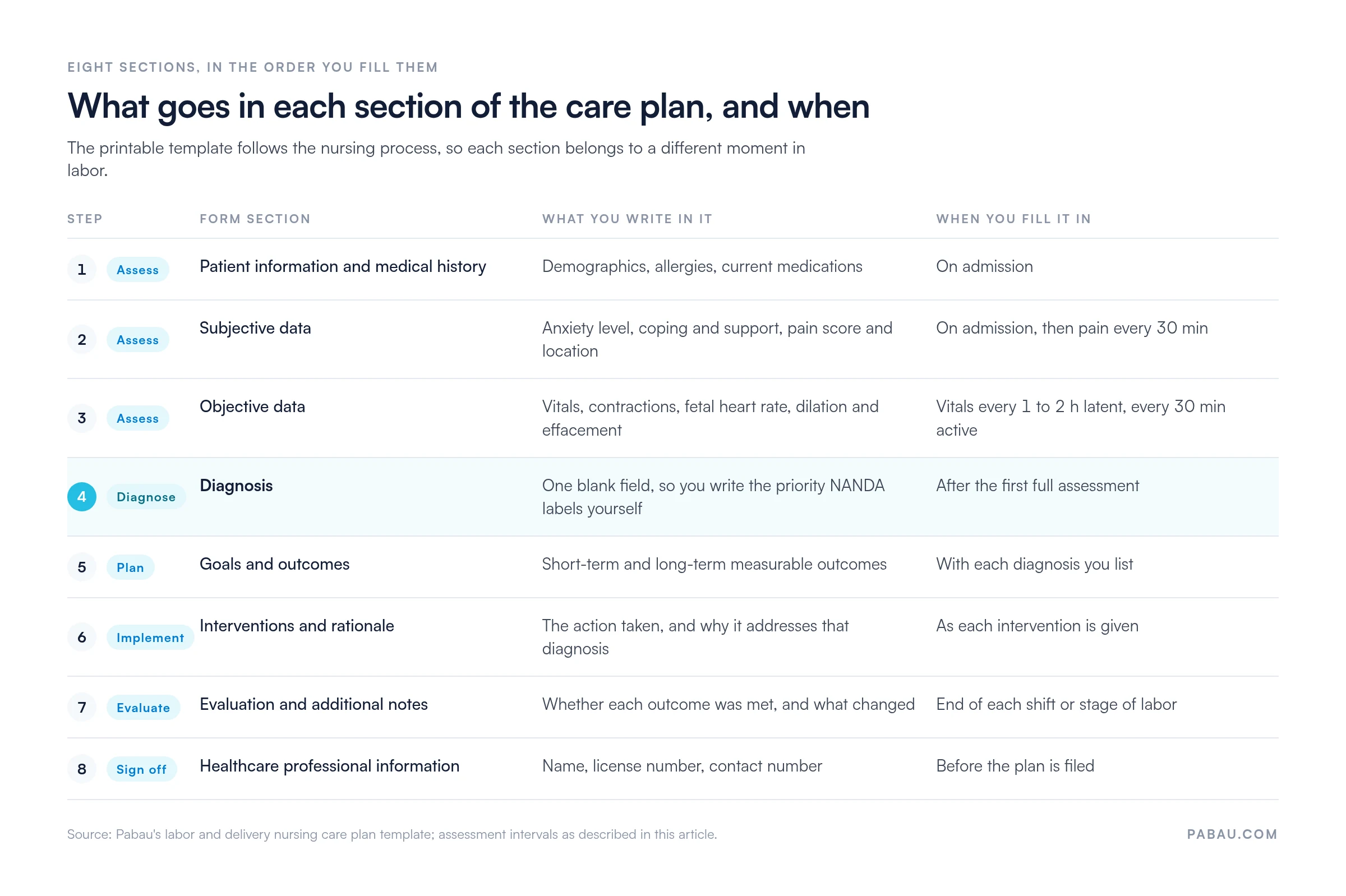
Table mapping the labor and delivery nursing care plan sections to the nursing process
The diagnosis field is the one section the form leaves blank, which is where the nurse’s judgment goes. Sections as published in Pabau’s template.

A plan filled in this way earns its keep at handoff and in review. No diagnosis is left implied, every intervention has a stated reason, and the outcomes can be checked by someone who was not in the room.

Patient education and discharge planning

The intrapartum plan runs into the immediate postpartum period, and a postpartum care plan picks up where it stops. Cover these points before discharge.

  • Normal lochia, and the warning signs. Those are soaking a pad in an hour, clots bigger than a golf ball, or a foul odor
  • Perineal care and pain control after delivery
  • Signs of infection, including fever, worsening pain, and drainage
  • Newborn feeding, safe sleep, and cord care, plus the newborn ranges on a pediatric vital signs chart
  • When to call the provider, which covers fever, heavy bleeding, severe pain, and emotional distress
  • The postpartum visit, scheduled at six weeks

How Pabau keeps the care plan with the patient record

On paper, the care plan lives on a clipboard. It gets photocopied, filed late, or written up from memory at the end of a shift. The nurse taking over reads whatever made it onto the page.

Practice management software like Pabau replaces that with digital forms that write into the patient record. The plan, the progress note, and the assessment history sit in one file, so any nurse with access opens the current version.

Pabau Scribe, our AI scribe, turns a consultation into a structured note, flags allergies as you talk, and drafts letters afterwards. It does not choose NANDA labels or NIC interventions for you. Those calls stay with the nurse.

The same records feed the reporting a maternity service needs, and the setup carries across specialties. Practices running OB-GYN EMR software or pelvic health software use the same forms for intake, consent, and follow-up.
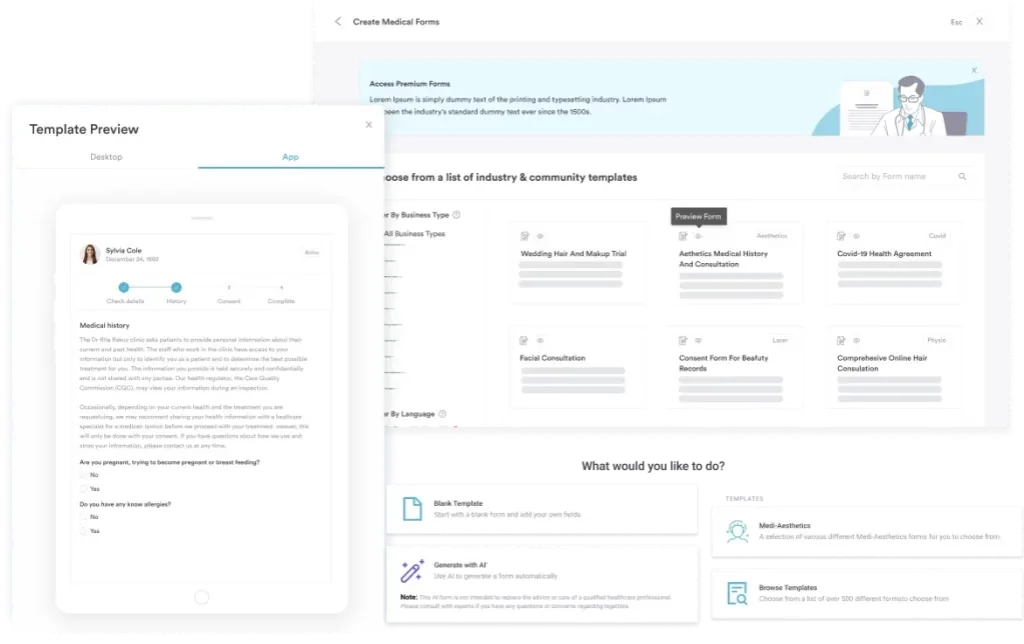

Pabau digital forms builder with a clinical form being completed inside a patient record
Pabau’s digital forms hold the completed care plan against the patient record, so the incoming nurse reads the same assessment the last one wrote.

Keep every care plan in the patient record

Pabau’s digital forms capture assessment, diagnoses, interventions, and outcomes in the patient record. Each shift then works from the current version instead of rewriting it from memory.

Pabau clinic management dashboard

Conclusion

The care plan is only as good as the assessment behind it. Get the intervals right, name the diagnoses your findings support, and the rest of the document more or less writes itself.

What is worth deciding before your next shift is where the finished plan lives. On paper it stops being useful the moment it leaves the room. In the patient record it keeps working, through handoff, discharge, and any review that follows.

Book a demo to see how Pabau keeps intrapartum assessments, diagnoses, and outcomes in one patient record your whole team can read.

Continue your research

Continue your research

Planning care for a newborn in respiratory distress? Ineffective breathing pattern nursing care plan sets out the assessment findings and interventions for compromised breathing.

Need a faster way to score pain? Pain scale 1-10 gives you a printable scale and the wording to use with a patient mid-contraction.

Covering triage as well as the birth suite? Emergency nursing assessment walks through a primary survey you can run in minutes.

Postpartum patient who cannot void? Nursing care plan for urinary retention maps the diagnoses, bladder scanning, and outcomes to document.

Something went wrong on shift? Incident form gives you a structured record to complete while the detail is fresh.

Frequently asked questions

What are the nursing diagnoses for labor and delivery?

Five NANDA diagnoses cover most labors: acute pain related to uterine contractions, anxiety or fear, risk for infection, risk for fetal injury, and ineffective coping. Each is supported by its own assessment findings, and each drives specific interventions and measurable outcomes for that patient.

What is included in a labor and delivery nursing care plan?

A complete plan holds the assessment, the diagnoses, the outcomes, the interventions, and the evaluation. The assessment covers vital signs, cervical exam, fetal heart rate, contraction pattern, amniotic fluid, and the patient’s pain and emotional state. Each diagnosis then carries its related factors, measurable outcomes, interventions with rationale, and a check at the end of the shift.

How do nurses use NANDA diagnoses in labor and delivery?

Nurses use them to turn observations into labels the whole team reads the same way. A pain score, a fever, or an abnormal fetal heart rate becomes a named diagnosis. That label then points to evidence-based interventions, so acute pain leads straight to positioning, analgesia, and breathing support with clear expected outcomes.

What is the nursing assessment for a patient in active labor?

Active labor assessment covers six domains. Those are maternal vital signs, cervical exam findings, contraction pattern, fetal heart rate and pattern, amniotic fluid status, and pain with emotional response. Vitals repeat every 30 minutes in active labor, cervical exams every one to two hours, and pain every 30 minutes or on request.

How does the clinical judgment model apply to labor and delivery nursing?

It overlays the written plan with the thinking behind it. The nurse recognizes cues, such as a fetal heart rate change or a fever spike. The nurse then analyzes what they mean and ranks which diagnosis is most urgent. From there comes a solution for this patient, an action, and an evaluation of whether it worked.
×