Anemia nursing care plan
An anemia nursing care plan is a structured document that guides a nurse from as...

1
Last Updated: Oct 9, 2026
A nursing postpartum assessment is the structured evaluation nurses perform after childbirth to catch complications early and support maternal recovery.
It follows the BUBBLE-HE framework and runs on a set schedule. Assessments start every 15 minutes in the first hour and ease to every few hours by discharge.
The CDC reports that hemorrhage and infection remain leading causes of preventable maternal death in the weeks after delivery. This guide covers each BUBBLE-HE component, assessment timing, vital sign thresholds, and discharge teaching. It is written for nurses and nursing students who want one reference for the whole sequence.

A nursing postpartum assessment follows the BUBBLE-HE mnemonic: Breasts, Uterus, Bladder, Bowel, Lochia, Episiotomy, Homan’s sign, and Emotional status.
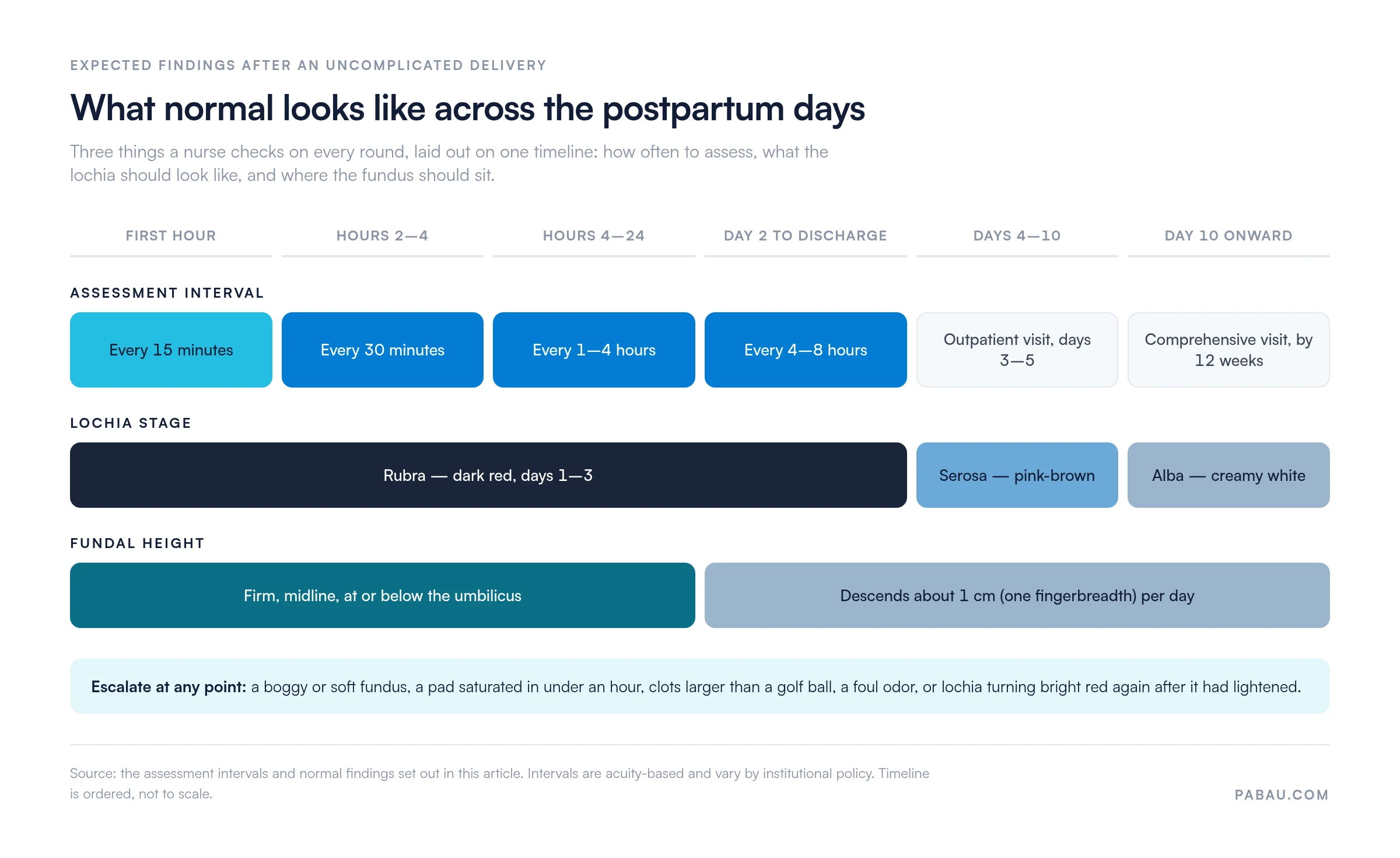
Assessment intervals widen over time. Expect every 15 minutes in the first hour, every 1 to 4 hours through 24 hours, then every 4 to 8 hours to discharge.
ACOG defines postpartum hemorrhage as cumulative blood loss of 1,000 mL or more, regardless of delivery route. Blood loss with signs of hypovolemia within 24 hours also qualifies.
Pabau’s digital assessment forms and automated care workflows help obstetric and maternity practices capture BUBBLE-HE findings consistently across care teams.
A nursing postpartum assessment is a systematic head-to-toe evaluation performed after the placenta is delivered. It covers the physical and emotional recovery of the birthing parent across the fourth trimester, which ACOG defines as the 12 weeks following birth.
The NCBI postpartum care reference places the start of that period immediately after placental delivery. The nurse is the primary clinician watching for complications through it, and the assessment repeats on a defined schedule until discharge.
Nurses working in hospital wards, fertility and maternity practices, and OB/GYN offices all work from a recognized mnemonic so each system gets checked.
The most widely used framework is BUBBLE-HE: Breasts, Uterus, Bladder, Bowel, Lochia, Episiotomy or laceration, Homan’s sign for the extremities, and Emotional status. Some institutions use BUBBLE-EE, replacing Homan’s with a second E for Extremities, or BUBBLE-LE.
The components stay the same across the variants. What changes is how the DVT check is labeled. This article uses BUBBLE-HE and flags the clinical caveats as they come up.
Each letter in BUBBLE-HE maps to a body system or clinical domain. The table below sets out what nurses assess, the expected normal finding, and the sign that calls for escalation.
Fundal assessment is the cornerstone of hemorrhage prevention. With the patient supine and her bladder emptied, the nurse places one hand just above the symphysis pubis to steady the uterus. The other hand palpates the fundus at the level of the umbilicus. A firm, contracted fundus is the expected finding.
A boggy or soft fundus signals uterine atony, the most common cause of postpartum hemorrhage. It calls for immediate fundal massage and escalation. The fundus should descend about 1 cm (one fingerbreadth) per day, so a fundus still at the umbilicus on day 3 warrants investigation.
Bladder distension pushes the fundus off midline, which is why bladder assessment always comes before fundal palpation. Recording fundal height and position the same way on every shift is what makes the trend readable.
Lochia assessment means checking color, amount, odor, and clots at every round. Lochia rubra is dark red through days 1 to 3. It gives way to lochia serosa, pink-brown, across days 4 to 10, then to creamy white lochia alba from day 10. Those ranges are approximate, and breastfeeding and activity level both shift them.
Four findings are abnormal and call for prompt assessment for hemorrhage or infection:
The REEDA scale gives nurses a reproducible way to score perineal wound healing. Redness, Edema, Ecchymosis, Discharge, and Approximation are each scored 0 to 3, and a total of 0 means optimal healing. Inspect the perineum under good lighting and document the REEDA score at every assessment.
Ice packs in the first 24 hours reduce edema. Sitz baths and topical analgesia support comfort and healing from day 2 onward. Purulent discharge, a fever above 38°C (100.4°F), or spreading erythema all call for immediate clinical review.
Homan’s sign — calf pain on dorsiflexion — appears in many nursing textbooks as a DVT screening step. Current evidence shows it has poor sensitivity and specificity.
The ACOG practice bulletin on thromboembolism in pregnancy recommends risk stratification and compression ultrasound for suspected DVT instead. In practice, assess for unilateral calf swelling, redness, warmth, and pain on palpation, then escalate through your institution’s DVT pathway.
The Edinburgh Postnatal Depression Scale (EPDS) is a validated 10-item self-report tool. ACOG and AWHONN both recommend it for perinatal depression screening. Cutoff scores vary by guideline, so follow your institution’s protocol for thresholds and escalation.
The EPDS separates postpartum baby blues from postpartum depression. Baby blues is transient tearfulness that settles within the first 2 weeks. Postpartum depression brings persistent low mood, anhedonia, and impaired bonding. Asking open questions about sleep, mood, and support during the assessment gives patients room to disclose symptoms.
ACOG defines postpartum hemorrhage (PPH) as cumulative blood loss of 1,000 mL or more, regardless of whether the delivery was vaginal or cesarean. Blood loss accompanied by signs or symptoms of hypovolemia within 24 hours of birth also meets the definition.
PPH is the leading cause of maternal morbidity worldwide and accounts for a large share of preventable maternal deaths in the US. Hemorrhage surveillance runs through the whole hospital stay, in every assessment after the first hour as well.
Primary risk factors to assess on admission:
Once bleeding starts, the cause decides the response.
Quantified blood loss (QBL) — weighing soaked pads and using calibrated drapes — gives a more accurate picture than visual estimation. The Joint Commission’s obstetric hemorrhage safety bundle recommends QBL as standard practice. Document cumulative blood loss at every interval and say the running total out loud at handoff.
Track cumulative blood loss on every chart entry, not just at the first assessment. A patient losing 250 mL an hour crosses the 1,000 mL threshold by the fourth hour, before any single reading looks alarming. Catching the trend early is what keeps it from becoming an emergency.
How often should a nurse perform a postpartum assessment? The schedule below reflects common institutional practice aligned with AWHONN standards. Actual intervals depend on patient acuity and institutional policy.
This schedule is a commonly cited framework. Defer to your institution’s postpartum care protocols, which tighten the intervals for high-risk patients, operative deliveries, and anyone with hypertension or diabetes.
Reading the interval alongside the expected findings for that day is what makes a deviation obvious. The timeline below puts all three on one axis.
A written plan keeps that schedule attached to the patient rather than to the shift. Our postpartum care plan template gives you a structured version to hand over at discharge.
Vital sign monitoring runs through every assessment interval. The table below gives expected postpartum ranges and the thresholds that need immediate escalation.
Postpartum hypertension can appear or worsen in the first 3 to 5 days after delivery, even when intrapartum readings were normal. Track the trend across readings rather than judging each value alone. A blood pressure pregnancy chart gives you the antenatal baseline those postpartum readings should be compared against.
A respiratory rate above 20 or an oxygen saturation below 95% both call for escalation. Start with a focused lung assessment, so the findings you hand over point the team toward pulmonary embolism or another cause.
Discharge teaching closes the assessment cycle. A patient who goes home without knowing the warning signs will present later than she should. Cover each of the items below before discharge, and confirm understanding with teach-back.
Documenting that discharge teaching happened, and that the patient said she understood, is both a clinical and a liability requirement. Record it against the patient record before discharge is authorized.
Use this consolidated checklist as a quick reference for each assessment encounter. Your institution’s policy still governs. The checklist is here to keep the round complete.
Turning a structured assessment into consistent documentation is where paper charts and disconnected systems fall down. BUBBLE-HE findings written by one nurse at shift change are not always visible to the next clinician at a glance.
Practice management software like Pabau can present each BUBBLE-HE component as its own field on a digital assessment form. Nurses complete them in sequence. Findings land in the patient record instead of a freehand narrative, and the next shift sees them without asking.

For OB/GYN EMR software users, the same record is open to the midwife, the OB, and the lactation consultant. Follow-up tasks, recall reminders, and patient instructions can be scheduled to fire at set intervals after delivery. The 3 to 5 day check then does not depend on somebody remembering it.

Pabau helps maternity and OB/GYN practices capture BUBBLE-HE assessments the same way on every shift and automate postpartum follow-up. Book a demo to see it working.

The BUBBLE-HE framework is easy to learn and easy to let slip when a unit is busy. Knowing the mnemonic matters less than running it at the right interval and recording what you found.
Pick one thing to tighten this month. If it is the cumulative blood loss total, every handoff should carry a number rather than an impression. That single change shortens the time between the first abnormal reading and the call for help.
Book a demo to see how Pabau keeps BUBBLE-HE findings, vital sign trends, and postpartum follow-up in one patient record.

Need a written plan to hand over at discharge? Postpartum care plan template gives you a structured version to work from.
Assessing the newborn as well? Apgar score template covers scoring the newborn at one and five minutes.
Advising on recovery nutrition? Postpartum diet plan covers nutrition guidance for healing and breastfeeding.
Planning a vaginal birth after cesarean? VBAC birth plan template documents the preferences and safety checks a VBAC needs.
A nursing postpartum assessment is a systematic clinical evaluation nurses perform after childbirth. It monitors maternal recovery, detects complications such as hemorrhage or infection, and supports breastfeeding and emotional well-being. It uses the BUBBLE-HE mnemonic to cover Breasts, Uterus, Bladder, Bowel, Lochia, Episiotomy, Homan’s sign, and Emotional status in sequence.
BUBBLE-HE stands for Breasts, Uterus, Bladder, Bowel, Lochia, Episiotomy or laceration, Homan’s sign (extremities), and Emotional status. Some institutions use BUBBLE-EE, where the second E stands for Extremities rather than Homan’s sign specifically, reflecting updated DVT screening guidance.
In the first hour after delivery, postpartum assessments typically occur every 15 minutes. From hours 2 to 4, they shift to every 30 minutes. They then move to every 1 to 4 hours through the first 24 hours, based on acuity. From day 2 to discharge, assessments run every 4 to 8 hours.
Key hemorrhage signs include a boggy or soft uterus, tachycardia above 100 bpm, and hypotension. Lochia saturating more than one pad an hour, or clots larger than a golf ball, are also red flags. ACOG defines postpartum hemorrhage as cumulative blood loss of 1,000 mL or more, regardless of delivery route.
Lochia progresses through three stages: lochia rubra (dark red, days 1-3), lochia serosa (pink-brown, days 4-10), and lochia alba (creamy white, day 10 onward). A foul odor, large clots, or a return to bright red flow after lochia has lightened are abnormal findings requiring assessment.
Discharge teaching should cover hemorrhage warning signs, wound care, and bladder and bowel management. It should also cover breastfeeding guidance, emotional health resources, activity restrictions, medications, and follow-up timing. Use teach-back to confirm the patient understood before she leaves.