Head to toe assessment cheat sheet: Printable nursing guide
A head to toe assessment cheat sheet gives you one fixed order at the bedside, s...

3
Last Updated: Oct 23, 2026

A patient care report is the clinical, legal, and billing record of an EMS patient encounter.
The free template on this page covers the narrative half of that record, laid out in CHART format.
Its sections run complaint, history, assessment, physical examination, diagnostic tests, treatment, transport, and conclusion.
The form has no patient demographics, insurance, or dispatch-time fields. Those stay on your run sheet or ePCR.
Practice management software like Pabau keeps assessments, treatment notes, and patient records on a single record.
A CHART-format narrative form covering chief complaint, history, assessment, physical examination, diagnostic tests, treatment, transport, and outcome. It is built for EMS crews and clinicians who write the clinical story alongside their agency run data.
Download templateA patient care report is the official record of an EMS patient encounter. It decides whether payers pay the claim and protects the crew if someone reviews the call later. It also tells the receiving hospital what has already happened. The narrative carries most of that weight, because it is where the clinical reasoning lives.
The free template above is that narrative section, laid out in CHART format. It does not collect patient demographics, insurance details, or dispatch times, so pair it with your run sheet or ePCR. This guide covers how to complete each section, what a full report needs beyond the narrative, and where NEMSIS fits.
A patient care report is a standardized document that captures the full story of a patient encounter. It records what brought the patient to seek care and what the provider found on assessment.
It also records the treatment given, how the patient responded, and where they went next. The report is clinical, legal, and financial at the same time.
US EMS agencies use paper reports, electronic reports (ePCRs), or a mix of the two. Both forms serve the same purpose and differ only in how crews capture, store, and transmit data. The receiving hospital needs to know what was done before arrival, so treatment continues without guesswork.
A paper patient care report is a handwritten form. It is portable, needs no hardware, and works anywhere. The trade-off is that handwriting is hard to read, data has to be keyed into billing by hand, and single copies get lost.
An ePCR is a digital form completed on a tablet or laptop. It pre-fills fields, connects to dispatch and hospital systems, submits to state registries, and leaves a searchable archive. Most ePCR vendors build only for EMS workflows and NEMSIS reporting.
A narrative template like the one above sits comfortably with either setup. Crews use it as the writing structure, whether the finished text is handwritten or typed into an ePCR narrative box.
The template is a nine-part narrative form. Each part is an open box you write into, so it suits calls that do not fit a checkbox:
The form leaves out two blocks you might expect. There is no patient identification section and no dispatch or call-time fields. Demographics, insurance, and times stay on your run sheet or ePCR. There is also no separate signature line, only a Prepared by name with a date and time.
Nor is there a dedicated Glasgow Coma Scale box. Neurological findings, including a GCS score, go into the free-text Neurological/Head field under Assessment. Write the score and its components there, so a reviewer can see how you reached it.
Those absences draw a clean line between the two halves of the record, as the split below sets out.
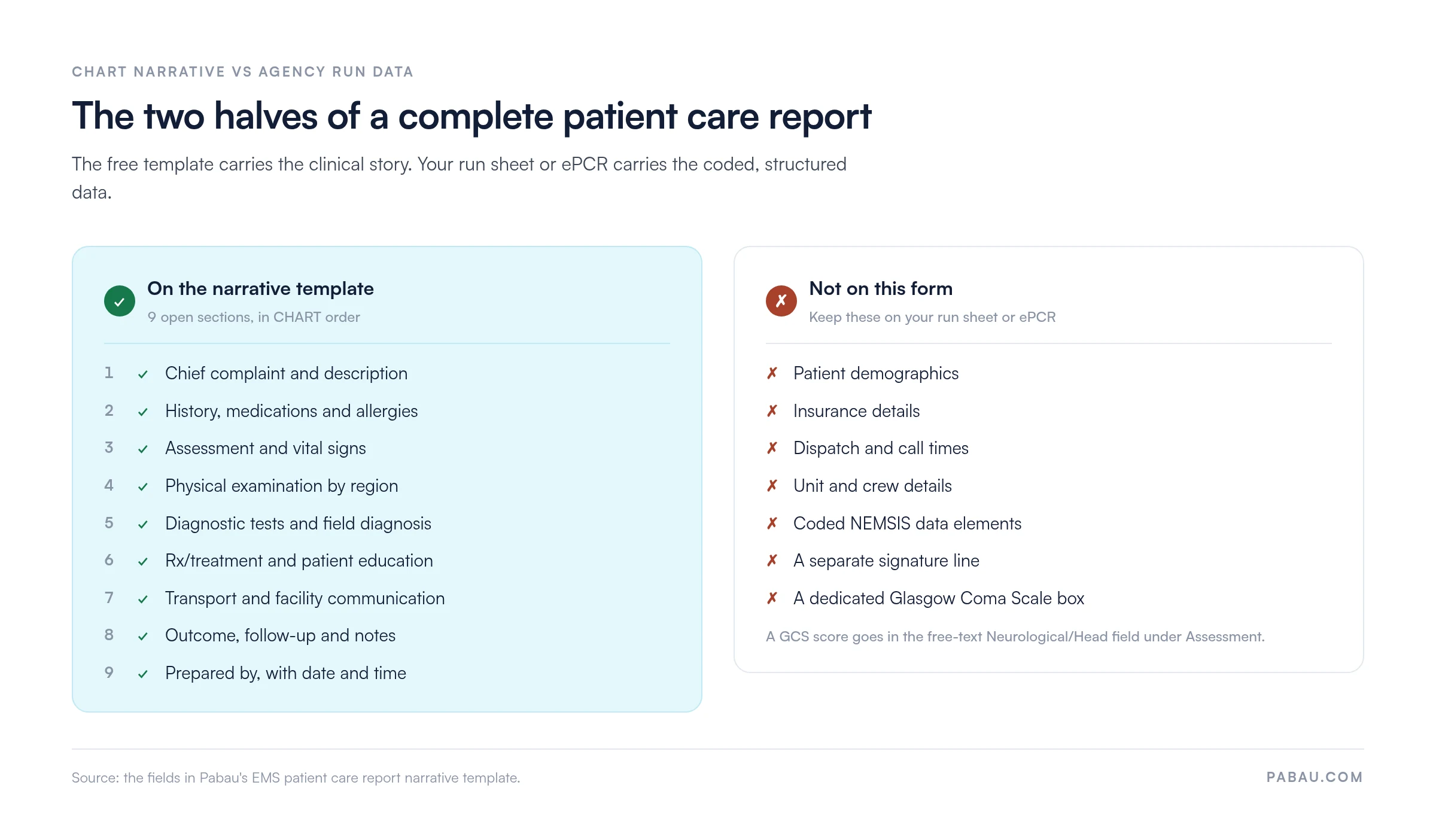
Work the narrative in the order the form lists it. That order follows the call itself, so you are writing forward rather than jumping between sections. It is the EMS CHART narrative pattern, with physical examination and diagnostic tests broken out as their own sections:
Before you hand the form over, check the four boxes that most often come back empty. Those are vital signs with times, medications with dose and route, the field diagnosis, and the receiving-facility communication line. Then confirm the Prepared by name, date, and time are filled in.
Patient care reports are standard in EMS agencies, fire departments, and ambulance services. Similar encounter documentation turns up in urgent care, private practice, and mental health settings. Primary care physicians, sports medicine clinicians, occupational therapists, and paramedics working privately all keep some version of it.
If you write up patient encounters and want a defensible structure, this narrative template gives you one. It prompts you for the clinical detail that reviewers and payers look for, and it stops the write-up from wandering.
Legal protection: a fixed set of headings means every narrative covers the same ground. A reviewer reading a report two years later can find the assessment, the treatment, and the handoff without hunting.
Faster write-ups: labeled sections remove the decision about what to write next. Crews finish sooner because the form already knows the running order.
Fewer claim denials: payers deny narratives that fail to show medical necessity. Prompting for a field diagnosis, medication times, and patient status during transport puts that evidence on the page.
Cleaner handoffs: a narrative written in the same order every time is quicker for receiving staff to read under pressure. An I-PASS handoff template gives the spoken report that same fixed order.
Usable quality review: consistent narratives can be audited. When every report answers the same questions, your QA team can compare calls rather than interpret each one from scratch.
The National EMS Information System (NEMSIS) is the national standard for EMS data collection. It defines the data elements a state EMS registry expects and the valid values for each one. It also sets out how records flow from agency to state to national level.
NEMSIS covers far more than the narrative. Its elements include dispatch and response times, patient age and sex, and chief complaint. They also cover vital signs, procedures, medications, cardiac rhythm, Glasgow Coma Scale for trauma, and transport disposition. Most of those are coded fields rather than prose.
So a narrative template on its own does not make an agency NEMSIS-compliant, and no template should claim it does. Your ePCR or run sheet supplies the coded, structured elements. The narrative explains the clinical reasoning behind them. Use this template for the second job, not the first.
NEMSIS is a data-reporting standard rather than a federal billing mandate. State EMS offices and Medicaid programs commonly tie their reporting rules, and sometimes reimbursement, to NEMSIS-compliant submission. Check what your state requires before you change how your crews document.
States also add their own rules. Some specify a narrative format, an approved abbreviation list, or extra state-only fields. HIPAA then governs how those records are stored, shared, and retained, whichever format your service uses.
Paper narratives create a second job. Someone keys the form into a billing system, then keys it again into the record that holds the clinical notes. The two copies drift, and the version an auditor reads is rarely the version the clinician wrote.
Practice management software like Pabau removes that second entry. A provider writes the assessment and treatment note straight into the client’s record. Billing, reporting, and compliance views then read from the same place. Pabau’s medical records management pre-fills known details and flags required fields left empty before a note is filed.
Pabau Scribe, our AI scribe, drafts the narrative from the consultation, so the clinician edits instead of composing from a blank box. Custom digital forms let you rebuild this template’s sections as structured fields, so your own documentation stays auditable.
There is one honest limit. Pabau is not an EMS ePCR, and it does not submit to state NEMSIS registries. For practices, urgent care, and private providers who document encounters, it removes the transcription step. You keep one version of the record.
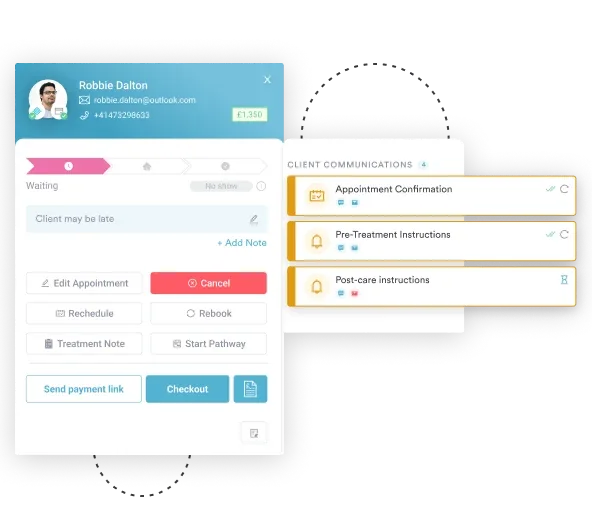

Pabau keeps assessments, treatment notes, and patient records on a single record, so nobody rekeys an encounter into a second system. Structured forms and Pabau Scribe, our AI scribe, cut the time a write-up takes.

The narrative is the part of a patient care report a reviewer reads closely. It is also the part no system can infer from checkboxes, which is why a fixed structure is worth adopting.
Use the template as your writing structure, and leave demographics, insurance, and call times where they already live. Treat the two halves as one record and the report holds up under audit. If your team is keying the same encounter into two systems, fix that before you change the form.
Book a demo to see how Pabau keeps clinical notes, billing, and patient records on one record instead of three.

Need a quick neurological check in the field? AVPU scale explains the four levels of responsiveness and how to record them in an assessment.
Documenting the examination in more detail? 12-point review of systems lists the body systems a full review is expected to cover.
Handing the patient over to inpatient staff? Bedside shift report shows what a receiving team expects to hear at the bedside.
Comparing systems for writing notes every day? Clinical documentation software weighs the options for practices that document every encounter.
A patient care report is the official legal and medical record of a patient encounter. It documents who the patient is, what care was provided, assessment findings, medications and procedures performed, and where the patient was transported. The report serves billing, legal, clinical continuity, and quality improvement purposes at once.
A complete patient care report has two halves. The run data covers patient demographics, insurance, unit details, and call times, and it usually comes from your ePCR or run sheet. The narrative covers chief complaint, history, assessment, physical examination, diagnostic tests, treatment, transport, and outcome. The free template on this page covers the narrative half.
Incomplete patient care reports trigger claim denials, most often for missing medication times, unattributed forms, or absent vital signs. They also invite regulatory audits and weaken your position if care is challenged. Receiving facilities may be left without detail they need to continue treatment. Review every report before you submit it.
No. The form starts at the chief complaint and carries no patient identification block, no insurance fields, and no dispatch or call times. Keep that data on your run sheet or ePCR. Use the template for the clinical narrative that sits alongside it.
It follows CHART. The sections run complaint, history, assessment, treatment, and transport, with physical examination, diagnostic tests, and a conclusion added. If your agency requires SOAP, the same content maps across and only the headings change.