Nursing narrative note template
A nursing narrative note template is a structured PDF that guides you through re...

3
Last Updated: Oct 21, 2026

On the pain scale 1-10, zero means no pain and 10 means the worst pain a patient can imagine.
Scores of 1 to 3 are mild, 4 to 6 moderate, and 7 to 10 severe, and each band prompts a different response.
A score only earns its place in the record when you log what the patient was doing and what you did next.
Practice management software like Pabau captures the score on a digital intake form, so it reaches the record without retyping.
Patients under age eight, non-verbal patients, and those with cognitive impairment need Wong-Baker FACES or FLACC instead.
Every score from 0 to 10 mapped to a severity band, a plain-language description, and a suggested clinical response. Print it for the treatment room, or load the wording straight into your digital intake forms.
Download templateThe pain scale 1-10 asks the patient for a single number: 0 for no pain, 10 for the worst pain they can imagine. It takes about five seconds to administer and needs no equipment, which is why it turns up in almost every care setting.
The number on its own, though, is close to useless in a record. A 6 recorded at rest and a 6 recorded during a straight-leg raise describe two different patients.
This page covers what each score means and when to reach for a different tool. It also shows how to write a pain entry that still reads clearly at the next visit. If you want the scale’s formal wording and scoring rules, the numeric pain rating scale page sets those out in full.
The pain scale 1-10, formally the Numeric Rating Scale (NRS), is a self-report measure of pain intensity. The patient picks a whole number between 0 and 10. That number becomes the quantitative anchor for the rest of your assessment, and the figure you compare against at the follow-up.
The International Association for the Study of Pain and Joint Commission both treat pain assessment as core care. A documented score is not an optional extra.
In practice that means three entries: a baseline score, the change after treatment, and the reasoning behind whatever you did about it. Those three entries are what make the scale useful in patient care workflows and defensible in an audit.
The catch is the self-report. A patient who cannot understand the question, or cannot answer it, cannot be scored on the NRS. Knowing where that line falls is as much a part of using the scale as the numbers themselves.
Patients rarely explain why they picked a number, so it helps to know what each score usually describes. The table below pairs every score with the severity band it sits in, the experience patients tend to report, and a typical clinical response.
Treat the response column as a starting point and replace it with your own protocol. The bands themselves are consistent across clinical guidelines, but the action attached to each score belongs to your setting.
A 7 after surgery is expected and managed on the ward. The same 7 in a long-standing back pain patient is a change in condition, and it needs a different conversation. On the period cramps pain scale, a 7 or above that persists across cycles points toward secondary dysmenorrhea and warrants investigation.
Ask the same question, in the same words, at the same point in every visit. Scores collected that way can be compared. Scores collected whenever someone remembers cannot. A number taken at the end of a physical exam is not the number the patient walked in with.
Put the score in a structured field alongside the vital signs, never buried in a paragraph of narrative. A number in a field can be graphed across visits and pulled up in seconds. A number in prose has to be hunted for, and it usually gets missed.
A pain entry that holds up later has four parts. Work through them in this order:
Written that way, the score slots neatly into SOAP notes under subjective, with your findings in objective and the change of plan below it.
Practice management software like Pabau can carry the score from the intake form into the note template, so nobody retypes it. For the wider habits that keep entries clean, our guide to safer clinical notes covers the ground.
Reach for another tool whenever self-report is unreliable or impossible. Forcing a number out of a patient who cannot give you one produces a figure nobody should act on.
Over telehealth consultations the NRS holds up well, since it needs nothing but a spoken number. Behavioral scales do not travel as easily down a video call, so plan the assessment before the appointment rather than improvising during it.
A chart on the wall does two jobs. It saves you explaining the scale from scratch. It also gives every patient the same reference point, so your numbers mean the same thing.
The template above is built for printing, and the same wording drops into digital intake forms on a tablet. Four things make it land:
The NRS travels across disciplines. Teams using physical therapy software track it session by session to show rehab is working. Practices on chiropractic software use it to justify a change in treatment frequency.
Mental health clinicians record it where pain sits alongside anxiety or trauma. Med spas screen with it before treatment, and primary care and emergency departments use it as the default.
Self-report is reliable from about age eight upward, which is the practical floor for the NRS. Younger children, non-verbal patients, and patients with significant cognitive impairment need Wong-Baker FACES or FLACC instead. If your patient list spans both groups, train the whole team on both, so nobody guesses a number to fill a field.
A consistent score gives you a number to argue from. Treatment response stops being a matter of impression. Insurers and reviewers can see the change you achieved, and two clinicians reading one chart reach the same conclusion.
There is a patient-facing benefit too. Being asked the same question every visit, and being shown the trend, tells someone their pain is being tracked rather than tolerated. That tends to keep people in a treatment plan long enough for it to work.
Fix the moment you ask, usually alongside vital signs, and give every staff member the same script. Scores taken at the same point in the visit can be compared across months. Scores taken whenever there is a spare minute cannot.
The scale measures one thing, and only when the patient can answer. Two people with the same injury can report a 4 and an 8. Tolerance, mood, culture and earlier painful experiences all shape the number. A patient’s 7 this week may not be last week’s 7.
It also says nothing about quality or location. A 6 could be a burning ankle or pain radiating up the leg, and the number cannot tell you which. Pair it with a description and a functional test every time. Between visits, a patient-kept pain journal catches the pattern that a single snapshot in the room always misses.
Some patients find their scores track the weather. A barometric pressure log sits alongside the journal, adding the day’s pressure reading next to each score.
In most practices the score is asked twice and stored once. A patient writes a number on a paper form, and someone at the front desk types it in later. The clinician then asks again, because the note has not caught up. By the follow-up, nobody can be sure which number came from which moment.
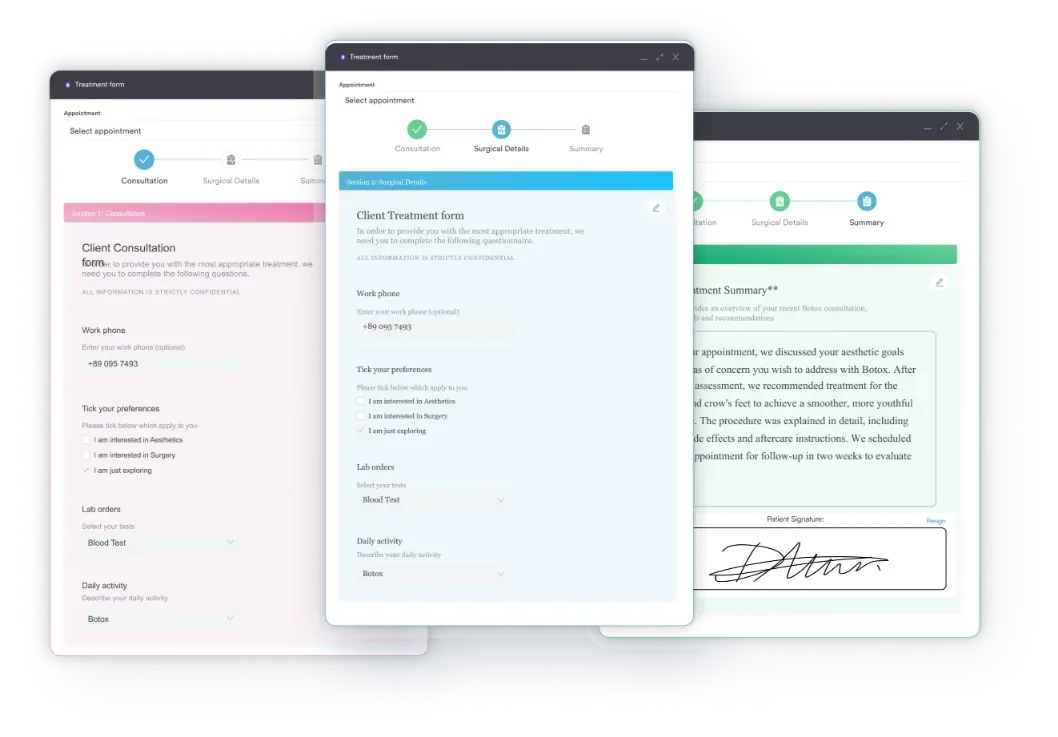
Practice management software like Pabau moves the question onto a digital form the patient completes before arriving. The answer lands in the client record as a field, ready to pull into the treatment note.
Pabau Scribe, our AI medical scribe, drafts the note from the consultation, so the score sits next to your reasoning without any retyping.
What you get is a pain history you can read at a glance. Every score is date-stamped against the visit that produced it. You can show a patient their trend on screen, or answer an auditor’s question in one click.

Patients enter their pain score on a digital intake form before the appointment, and it lands straight in the client record. You get a date-stamped pain history you can trend across visits.

The pain scale 1-10 is worth exactly as much as the context you record with it. Ask it the same way every time, write down what the patient was doing, and note what you changed as a result. Do that and the number becomes a trend line you can treat from.
Keep the limits in view as well. The NRS is a self-report tool with a floor around age eight, so keep FACES and FLACC within reach for the patients it cannot serve. Print the chart above, agree on one script for the whole team, and put the score somewhere it can be graphed. Book a demo to see how Pabau captures pain scores at intake and tracks them across every visit.

Documenting a neurological exam alongside the pain score? Deep tendon reflex exam sets out how to grade and record each response.
Checking for a wrist ligament tear? Fovea sign test explains the thumb-pressure technique for detecting TFCC and ulnotriquetral tears, plus its diagnostic accuracy.
Distinguishing between two forearm fractures? Galeazzi fracture vs Monteggia explains the key anatomical differences between these two forearm fracture-dislocation patterns and how to treat each.
Wondering what massage therapists earn? Massage therapist salary guide breaks down median massage therapist wages using the latest BLS data.
Assessing athletes before a season? Preparticipation physical evaluation form collects injury and pain history in one pass.
A 7 out of 10 sits in the severe band. The patient is telling you that pain now dominates their attention and most activity has stopped. Many practices treat a 7 as a trigger for same-day review of the pain plan. Read it in context, because a 7 two days after surgery is not the same as a 7 in long-standing back pain.
A 10 means the worst pain the patient can imagine, and it is rare in routine practice. It usually points to acute trauma, severe post-operative pain, or a sudden flare of a chronic condition. Treat it as an emergency. Assess the patient immediately and escalate pain relief rather than waiting for the next scheduled review.
No. Self-report on the Numeric Rating Scale is reliable from about age eight upward, in patients who can understand and answer the question. Infants, younger children, non-verbal patients, and patients with cognitive impairment need another tool, such as FLACC or Wong-Baker FACES.
The NRS uses spoken numbers from 0 to 10, which makes it the fastest option in routine care. The VAS uses a 10-centimeter line the patient marks, and it is used mostly in research. Wong-Baker FACES uses drawn expressions, which suits children and patients who cannot put a number on pain. All three measure intensity, but for different populations.
FLACC scores Face, Legs, Activity, Cry and Consolability by observation rather than self-report. It produces a 0 to 10 total for infants, young children, and patients who cannot communicate. Use it whenever a patient is unable to give you a number of their own.
Yes. Obstetric teams use it to track labor pain and to check whether pain relief is working during pregnancy complications. Pair the score with functional and clinical assessment, because intensity is only one part of labor management.