Free patient financial agreement template for practices
A financial agreement is the form a patient signs before treatment to confirm wh...

2
Last Updated: Oct 23, 2026

An LLC operating agreement sets out ownership percentages, profit distribution, voting rights, and management authority for every member.
Most states do not require one. Courts in some states will still disregard your liability shield when the rules are not written down.
A single-member agreement needs six core clauses. A multi-member LLC adds four more, and a licensed practice adds five on top of those.
Licensed practices need clauses on scope of practice, HIPAA, malpractice cover, and removal after a license suspension.
Practice management software like Pabau keeps the signed agreement, member records, and role permissions in one place.
A legal template covering membership structure, capital contributions, profit and loss distribution, voting rights, management authority, and dissolution. It downloads as a PDF you can print, fill in, and take to your attorney.
Download templateFiling articles of organization makes your LLC exist. The operating agreement decides how it runs. It records who owns what, who can sign a contract, how profits are split, and what happens when a member wants out.
An operating agreement template for LLC gives you that structure in writing without paying an attorney to draft one from scratch. This guide covers what the document contains, how single-member and multi-member versions differ, and the five steps to fill it in.
It also covers the five clauses a licensed practice needs and a generic legal form leaves out. Download the free PDF above, then work through each section below as you complete it.
An LLC operating agreement is a written contract between the members of a limited liability company. It sets ownership percentages, how profits and losses are allocated, who makes decisions, and the process for a member leaving or the company closing.
Articles of organization go to the state. The operating agreement stays with the members. It governs day-to-day decisions, and it is the document a court reads when two owners disagree about what they agreed to.
Without a written agreement, your state’s default LLC rules fill in the blanks. Those rules rarely match what the members had in mind. Courts in several states will also disregard a single-member LLC’s liability protection when no agreement documents how the company operates.
For a licensed practice, the document does more work. It records who holds which license, how HIPAA obligations are shared, and where clinical authority and liability sit between practitioners. Multi-member practices also need explicit voting rules for decisions on referrals, equipment, and clinical scope.
Key reasons to formalize an operating agreement:
Lenders usually want a forecast alongside the agreement, so a business plan template is a sensible next download if you are still raising money.
Most templates carry the eight clauses below. Each one needs customizing for your own practice rather than signing as written.
Two questions decide how many of those clauses you need. How many members do you have, and does any of them hold a professional license? The three layers below stack.
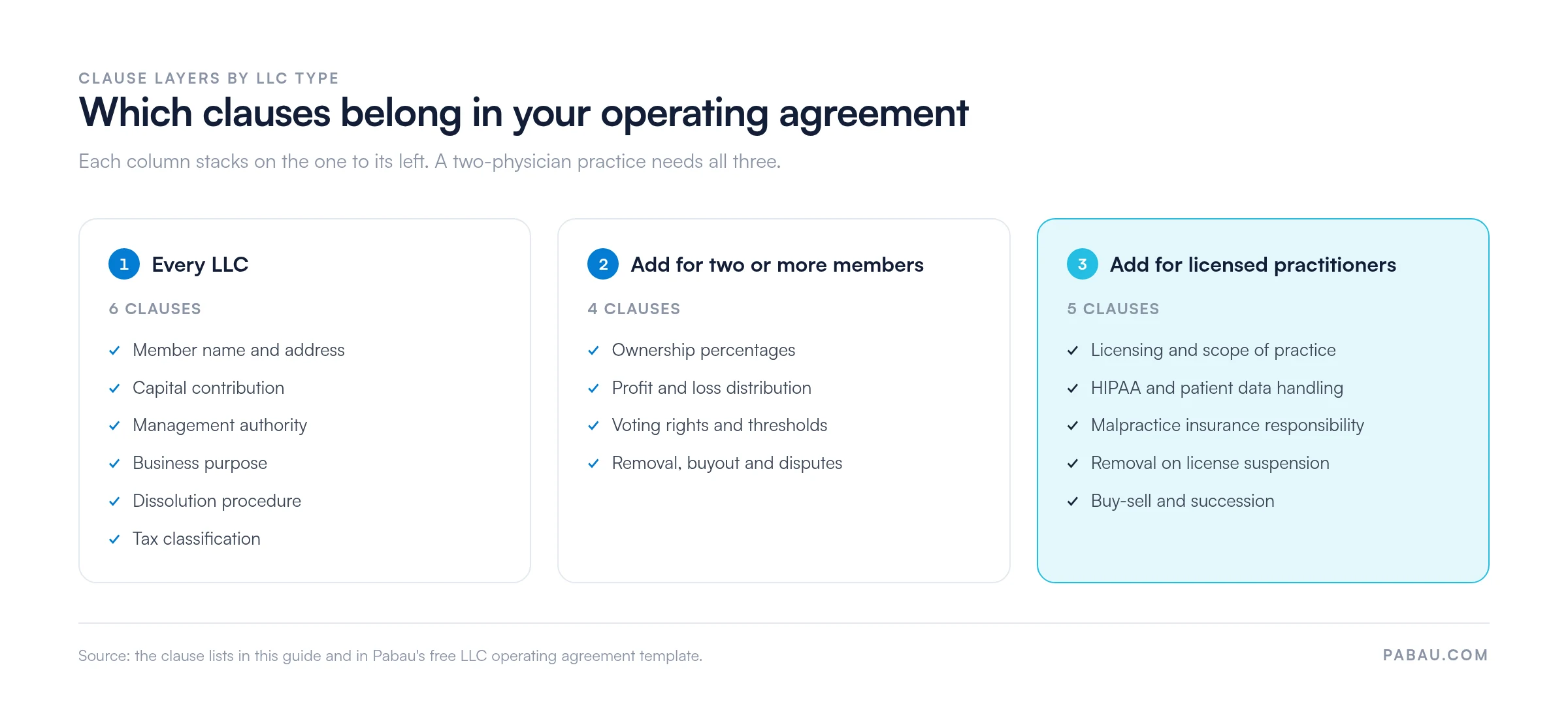
The number of owners decides how long the document runs and where the detail sits.
A single-member LLC has one owner, so there is nobody to fall out with. The agreement still matters, because courts in some states will not respect the liability shield without documented operating procedures.
The single-member version is short. It covers the member’s name and address, capital contribution, management authority, business purpose, dissolution, and the tax classification you want.
A multi-member LLC has two or more owners, and the agreement carries far more weight. It fixes ownership percentages, profit-sharing ratios, voting power, and how a deadlock gets broken.
Profit-sharing ratios do not have to match capital contributions. A practice where one physician funds the equipment and another brings the patient list often splits profits differently from ownership. Say so in writing, or your state’s default rules will say otherwise.
Work through the template in this order. Each step feeds the next.
Have every member sign and date the finished document. Notarization is not legally required in any state, though some attorneys recommend it as evidence of when the members signed.
Then store the signed agreement with the member schedule and the capital contribution record. Keeping them in one practice management app beats a shared drive nobody maintains, because a new manager can find them in a minute.
Management structure is the clause that changes daily life at the practice most, so it is worth reading both columns before you pick.
Practices often choose manager-managed so clinical leadership and business operations stay separate. Licensed practitioners keep their attention on patient care, while a business manager handles contracts and finances. It also draws a clearer line around who is liable for what.
Healthcare LLCs carry regulatory duties that a generic business template never mentions. Med spas, dental practices, physical therapy offices, and other licensed provider LLCs should add the five clauses below.
Several states also run a separate professional LLC, or PLLC, where every member must hold a license. Check your Secretary of State and your professional licensing board before you choose an entity type.
The permissions clause needs a software counterpart, or it only exists on paper. Match it in your team management software, so who can view notes, issue refunds, or change pricing reflects what the members signed.
Requirements vary by state. Most states do not mandate an operating agreement, and a handful either require one or expect it for particular LLC structures.
California, Delaware, New York, Maine, and Missouri either mandate operating agreements by statute or require them for certain structures. Check your state’s Secretary of State site and its Limited Liability Company Act for the current rule. The Small Business Administration provides guidance on LLC formation by state.
An agreement is not required, but it is still worth writing, especially for a multi-member practice. Where the rules are not documented, a court applies your state’s default LLC law. That default may not protect your liability shield or match what the members wanted.
Have a business attorney licensed in your state review the finished agreement against state LLC law and your professional licensing rules. The IRS website on LLC tax classification explains how a disregarded entity, a partnership, and an S-Corp election differ.
Most new practices sign the agreement, file the PDF somewhere, and never open it again. Then a member joins, a role changes, or an insurer asks who authorized a refund, and nobody can produce the answer quickly.
Pabau holds that record for you. Signed documents, member details, and capital contribution notes sit in the staff and client records. They stay searchable rather than buried in a shared drive.
Permissions follow the same document. You set which team members can open clinical notes, issue refunds, or change pricing. That is the working version of the management authority clause you just wrote. When a member leaves, you revoke that access in one place instead of chasing logins.

Pabau stores signed member documents, capital contribution notes, and role permissions alongside your client records. Your governance paperwork stays searchable, so a role change takes minutes rather than an afternoon.

The agreement is worth far more than the hour it takes to fill in. It decides what happens on the worst day your practice has. A member wants out, a license gets suspended, or two owners read the same profit split two different ways.
So fill in the template, have every member sign it, and send a licensed practice’s version to a business attorney in your state. Then store it where a new manager can find it, along with the permissions that put it into practice.
The trade-off is small and one-directional. An hour of drafting now replaces a dispute you cannot price later. Book a demo to see how Pabau keeps member records, signed documents, and role permissions in one place as your practice grows.

Still raising money for the practice? Medical practice business plan walks through the forecasts lenders ask for alongside your operating agreement.
Need the plan document itself? Business plan template gives you the sections to fill in for a new practice.
Your agreement requires member meetings. Meeting notes template keeps a record of who voted for what, and when.
Looking past year one? 5-year plan template maps growth targets against the milestones your members signed up to.
Not sure what the software side does? What is practice management software explains which practice records it holds and why.
Not in most states. California, Delaware, New York, Maine, and Missouri either require operating agreements or strongly recommend them. Courts will not always respect an LLC’s liability shield without a documented agreement. Multi-member practices should write one anyway.
No. A single-member agreement is short, because one owner cannot fall out with anyone. Multi-member agreements need ownership percentages, voting provisions, and a dispute process. Use the version of the template that matches your membership structure.
No state legally requires notarization of an operating agreement. Some attorneys still recommend signing before a notary and keeping a certified copy, because it evidences when the members signed if a dispute follows.
Yes. A template is enough to draft your own agreement for a straightforward LLC. A multi-member practice, a licensed provider LLC, or an unusual profit split needs more care. Have a business attorney licensed in your state review it before signing.
Your LLC falls back on your state’s default LLC law, and in some states a court may disregard the liability protection. Multi-member disputes over ownership, profits, and authority then have no documented resolution process, which usually means litigation.
Yes. Most agreements carry an amendment clause saying whether a change needs unanimous member approval, a majority vote, or manager approval. Put every amendment in writing and have each affected member sign it.