Scapular assistance test: Procedure, interpretation and free template
The scapular assistance test is a manual examination in which the clinician supp...

1
Last Updated: Oct 19, 2026
The Oldenburg Burnout Inventory (OLBI) is a 16-item questionnaire that measures work-related burnout on two subscales: exhaustion and disengagement from work. Practice owners and managers use it to screen for staff who may need support, not to diagnose anyone.
Burnout shows up on the schedule long before anyone names it. Exhausted clinicians make more errors, take more sick days, and are more likely to leave. The OLBI gives you a structured, repeatable way to check in with the team.
This guide covers the scale’s structure, its two subscales, how to score it, and how to read the results without over-reading them. It also shows what each pair of subscale scores asks a manager to do, which is where the follow-up decision sits.
A ready-to-use version of the 16-item scale, with the exhaustion and disengagement items, the 4-point response scale, and space to total each subscale. Built as an educational and reference resource for practice teams.
Download template
The OLBI measures burnout on two subscales, exhaustion and disengagement, across 16 items.
Responses use a 4-point scale, and the positively worded items are reverse-scored.
Score each subscale separately, because a single combined total hides which problem you have.
Read the two subscale scores as a pair, since each combination calls for a different follow-up.
Treat any result as a prompt for a conversation, never as a diagnosis.
The Oldenburg Burnout Inventory is a self-report questionnaire that assesses occupational burnout. Evangelia Demerouti and colleagues developed it, and it is one of the most widely used instruments in occupational psychology research.
The scale was designed for working adults across occupations, which is one reason it appears so often in workplace well-being research. It measures two dimensions that sit close to the core symptoms of clinical burnout, though they are not identical to them.
A high exhaustion score points to depletion, while a high disengagement score points to detachment. Both can appear in the same person, and they usually call for different responses from a manager.
The OLBI contains 16 items, split evenly between the two subscales. Respondents rate each statement on a 4-point scale, from strongly agree to strongly disagree.
Because some items are worded positively, respondents can answer on autopilot. Reading the items aloud, or checking a returned form for repeated answers, catches that before you score it.
Before scoring, check the form for skipped items and identical answers across every line. A quick review often catches rushed responses and saves you from drawing conclusions from unreliable data.
Scoring the OLBI means reverse-scoring the positively worded items, then summing each subscale. Confirm the exact reverse-scored item numbers against the published instrument before you score, since versions of the questionnaire differ in layout.
An OLBI result is the start of a conversation, not a verdict. Published cutoff scores vary by study, sector, and population, so treat any threshold as a reference point rather than a fixed line.
Read each subscale on its own first, then read the two as a pair. The combination carries more information than either number alone, and each of the four combinations points to a different follow-up.
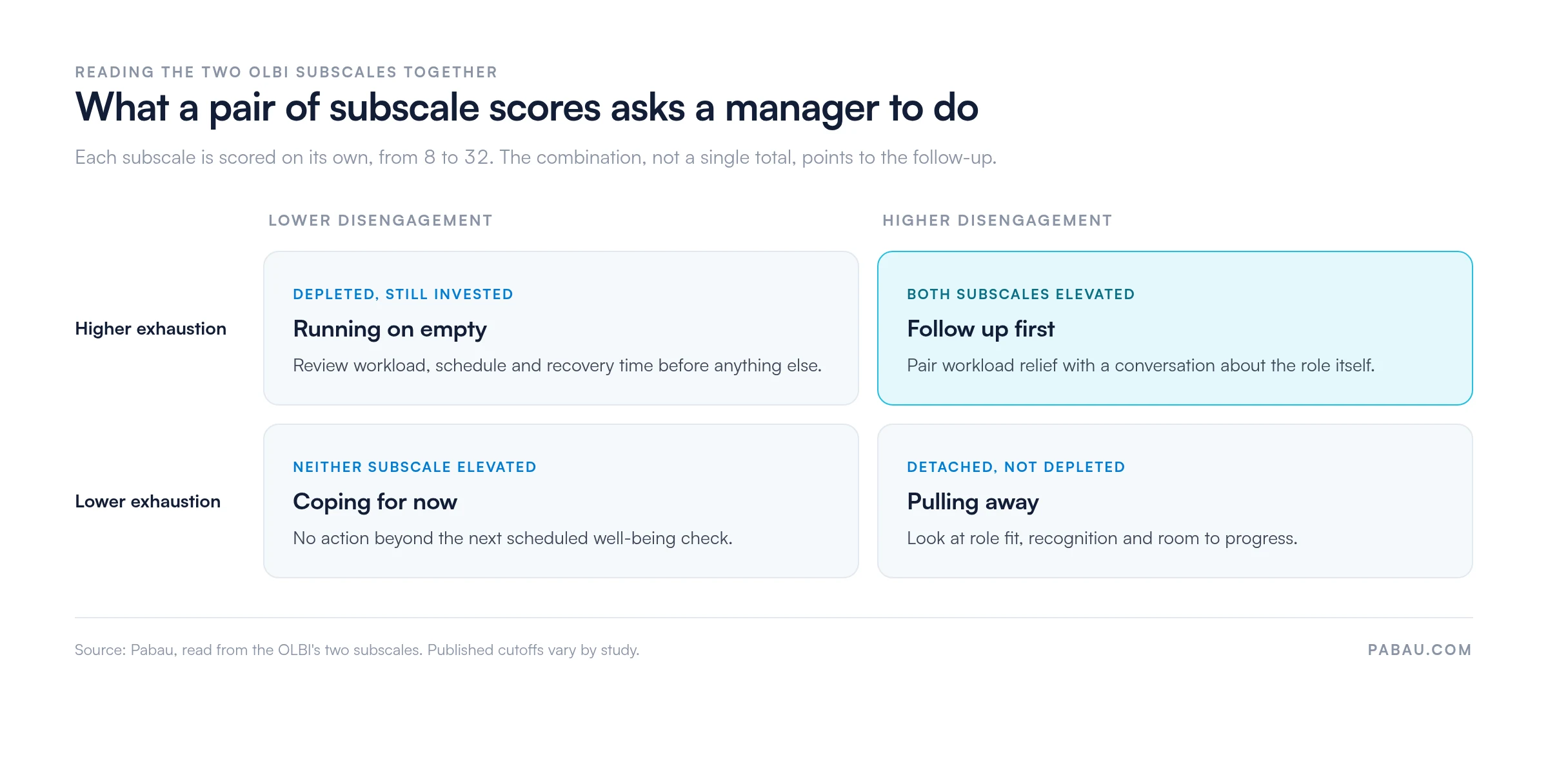
A high exhaustion score with a low disengagement score suggests a team member who is tired but still invested. That usually calls for a workload and schedule review. A high disengagement score with lower exhaustion points instead to role fit, recognition, or a lack of progression.
When both subscales come back high, act first and analyze later. Pair workload relief with a conversation about the role itself, and agree a date to measure again.
Use the result to plan follow-up, such as a supportive one-to-one or a workload check. Do not use the OLBI to make employment decisions about individuals. Where pressure outside work is also in play, a stress assessment questionnaire can sit alongside it.
Published studies report acceptable internal consistency for both subscales across several populations. The original validation work and later replications are the best places to check exact coefficients for your sample. Halbesleben and Demerouti (2005) is a common reference for the instrument’s psychometric properties.
Reliability and validity can differ by language version and population. Do not assume a published coefficient applies to your own staff group without checking it first.
The Maslach Burnout Inventory is the most common burnout measure, and it was built around human services work. The OLBI is positioned for occupational use across sectors, and it uses a different subscale structure.
Choose the instrument based on your population and the reporting you need. Both are validated tools, and each has its own scoring logic. If you are weighing the two, the Maslach Burnout Inventory template sets out its subscales in full.
Practice managers can run the OLBI as part of an annual or quarterly well-being check. Keep participation voluntary, explain how the results will be used, and store the responses securely.
Mental health and therapy teams tend to run these checks most often, since burnout is already part of their clinical vocabulary. Software for therapy practices keeps scheduling and record-keeping off the manager’s desk, which leaves room to act on what a check finds.
Burnout is also not the only strain worth measuring in a care team. A compassion fatigue test covers the toll of sustained exposure to patient distress, which the OLBI does not separate out.
A student version of the OLBI exists for academic settings. Its items are adapted to study rather than work, so it measures a different context from the occupational version. Use the version that matches your population.
Most practices run the survey, total the scores in a spreadsheet, and then lose the thread. The findings sit in one file while the schedule, the leave calendar, and the caseload sit somewhere else, so the working week never actually changes.
Pabau, the practice management platform we build, keeps the scheduling side of that in one place. You can see how shifts, caseloads, and leave are spread across the team, which is usually what an exhaustion score is pointing at.
Our team management software shows staff schedules, working hours, and time off together. A workload review then takes minutes instead of an evening with a spreadsheet. Agree the change, make it in the schedule, then re-measure at the next check.

Pabau brings staff schedules, working hours and leave into one view. A workload review after a burnout check then takes minutes instead of an evening.

The OLBI earns its place in a practice because it separates two problems that look identical from the outside. Someone who is depleted needs a lighter week. Someone who has checked out needs a different conversation entirely.
Run it on a fixed cycle, keep it voluntary, and resist the urge to turn a subscale total into a label. The score’s job is to start the one-to-one you would otherwise keep postponing.
Acting on what you find usually means reworking schedules and caseloads, and that part should be the easy part. Book a demo to see how Pabau keeps staff schedules, hours, and leave in one place for your team.

Measuring stress from outside work too? The Holmes and Rahe stress scale scores the life events that add to the load your staff already carry.
Want a shorter pulse check? Perceived stress scale gives a quick read on how unpredictable and overloaded someone feels right now.
Planning what happens after the scores? Self-care worksheet helps a team member turn a one-to-one into a few concrete habits.
Checking how well someone copes under pressure? Coping self-efficacy scale measures confidence in handling stress, which the OLBI does not capture.
Rebuilding a team after a hard stretch? Resilience worksheet gives structure to the follow-up once the immediate pressure has eased.
The Oldenburg Burnout Inventory is a 16-item self-report questionnaire that measures occupational burnout through exhaustion and disengagement. It is a screening tool, not a diagnostic test.
The template on this page is free to download for educational and reference use. Licensing for formal or large-scale clinical use should be confirmed directly with the instrument’s publisher before you rely on it.
A high score indicates more exhaustion or disengagement on that subscale. It signals a need for conversation and follow-up, not a diagnosis.
Yes, a student version exists, adapted for academic contexts. Use the version that matches your population.