Maja Popovska
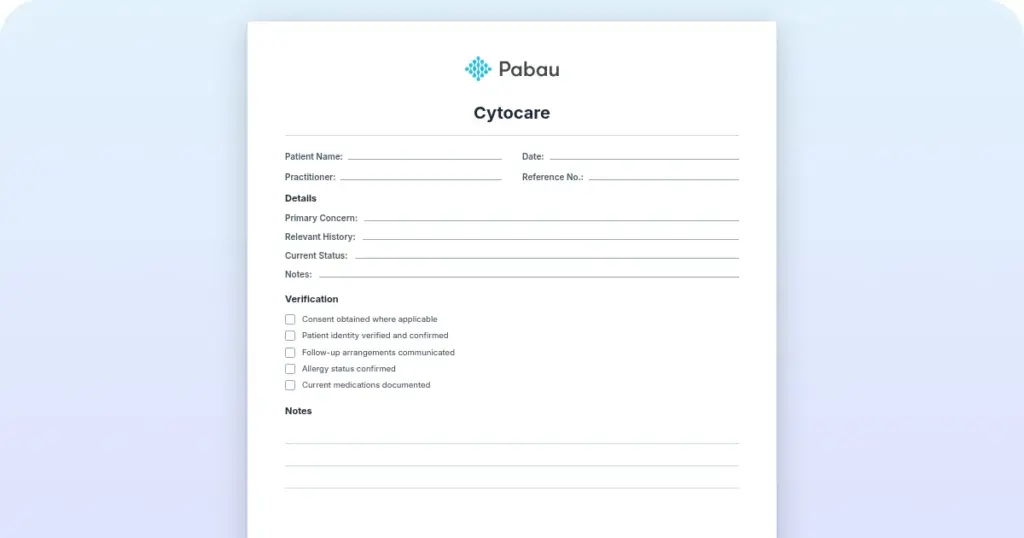
Cytocare consent form
Cytocare is a hyaluronic acid-based mesotherapy skin booster from Revitacare, in...

2
Last Updated: Oct 27, 2026
Free PDF 2 pages, print-ready Clinician-reviewed
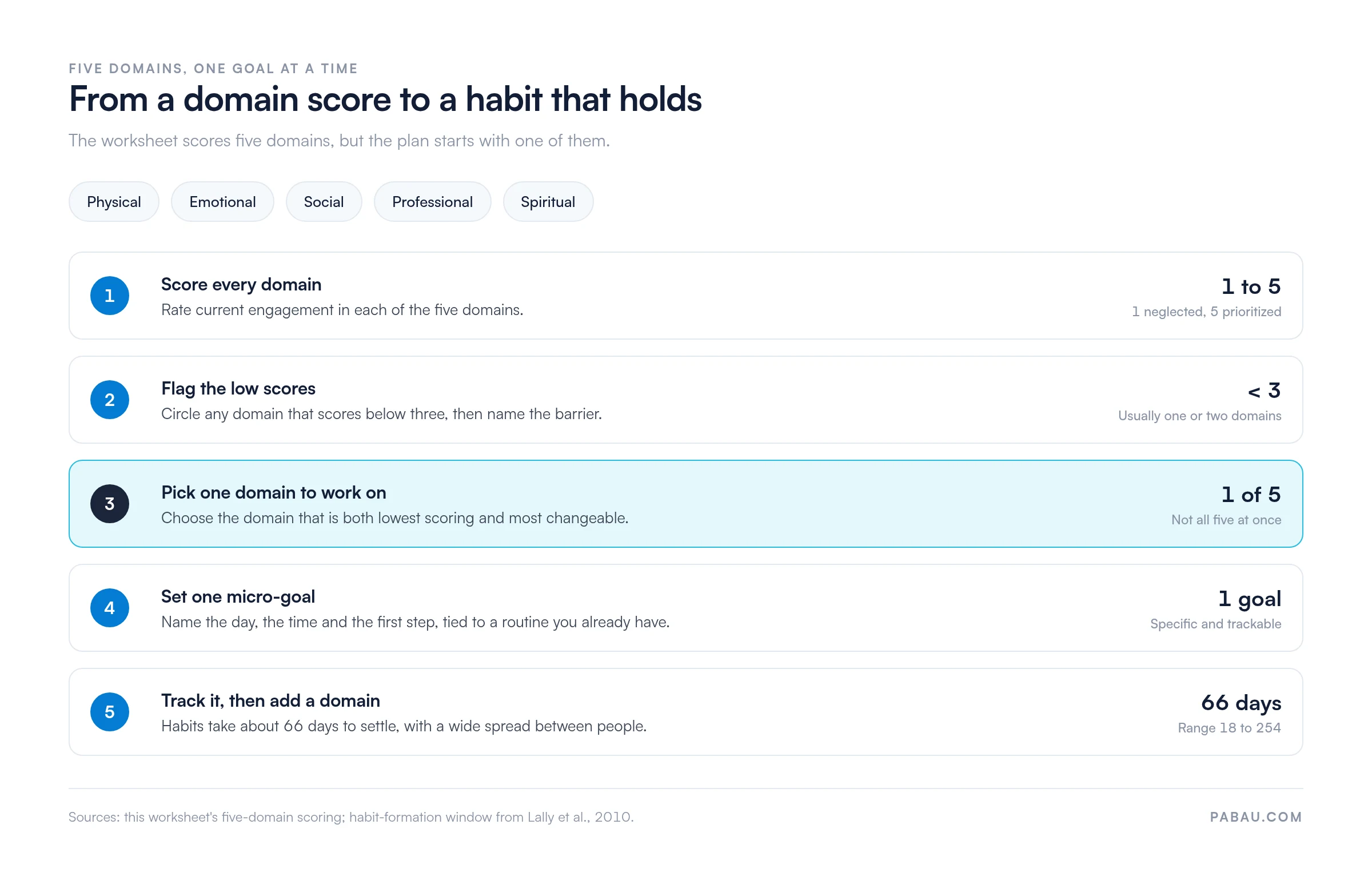
A self-care worksheet asks you to score five parts of your life, then act on the lowest one. Rate physical, emotional, social, professional, and spiritual self-care from one to five. Write down what is blocking the low scores. Then set one goal you can actually keep.
Scoring is the easy half. The harder half is choosing a single domain to start with, then tracking it long enough for the habit to hold. Therapists, counselors, and practice owners can use the form with clients, or on themselves.
Client details, a one-to-five rating for each of the five domains, reflection prompts, space to name the barrier, and one goal per domain. Print it, or send it out before the appointment.
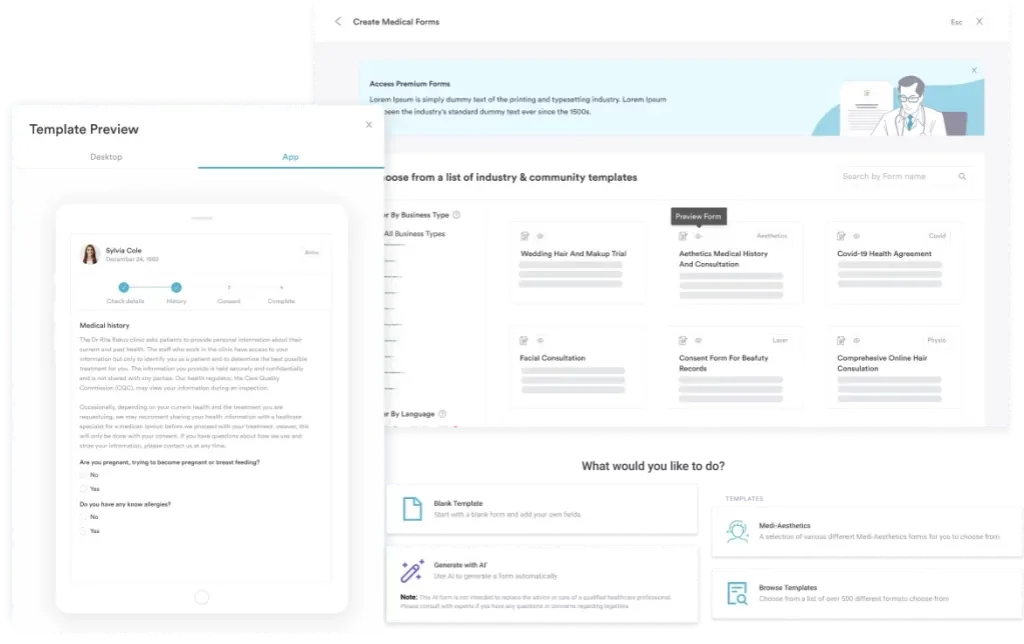
Start from scratch, or upload this PDF or any form you already use, and Pabau's AI Form rebuilds it with tick boxes, text fields and a signature. Attach it to the treatment once, and every patient gets it on time.
AI Form rebuilds the consent, history and aftercare forms you already use. You review each one, then publish.
Patients complete forms on their phone before they arrive, so the front desk stops retyping paper.
Every signed form is versioned and attached to the treatment record, ready when you need it.
Set how long a consent stays valid. Returning patients skip forms they have already signed.
Supports HIPAA and GDPR compliance AES-256 encryption 4.8 on G2 4.7 on Capterra Trusted by 4,000+ practices worldwide

A self-care worksheet scores five domains of wellbeing, from physical and emotional to social, professional, and spiritual.
Scoring gives supervision something concrete to discuss, instead of a vague sense that someone is running low.
The five-domain framework is the split used across therapy, counseling, and wider healthcare settings.
Pick the domain that scores lowest and feels most changeable, then set one goal for it.
Practice management software like Pabau can send the worksheet before the appointment and file the answers in the client record.
A self-care worksheet is a structured guide for reviewing how well someone is looking after themselves. It swaps general advice for a rating, a written barrier, and a specific next action. The five areas it covers are physical health, emotional wellbeing, social connection, professional boundaries, and spiritual practice.
Therapists, counselors, and wellness coaches use it with clients as an assessment tool. It does two jobs at once. It shows which areas are being neglected, and it points the client toward habits they can sustain. Filed in the client record, it also gives you a baseline to compare against later.
Burnout is common in clinical work. The National Academy of Medicine reports that 35% to 54% of US nurses and physicians have substantial symptoms of burnout. Compassion fatigue follows a similar pattern in therapy and counseling, where the emotional load is the work itself.
Reviewing your own self-care also models the behavior you ask clients to adopt. Complete the form, set a goal, and the exercise stops looking like homework you hand out but never do. The early signs of therapist burnout are easier to name once you have scored them.
Every version of this form is built on the same five domains, the split used across therapy, counseling, and university wellness services. The point of splitting it up is coverage. Rating all five stops one strong domain from hiding a weak one.
Most people score high in one or two domains and low in the rest. That imbalance is the finding, not a failure. A clinician might invest in professional development for years while skipping exercise entirely, and never connect the two.
Five steps take you from a blank form to a written plan.
Complete the form together in session, or set it as homework and review it at the next appointment. That review is what turns the form into a plan rather than a one-off exercise. If a client wants more prompts before scoring, the self-care inventory works through the same domains item by item.
Handing over the form is the start of the work, not the end of it. The clinical value sits in the conversation it opens about barriers, values, and what the client believes is possible. When someone writes “I never exercise because I am too tired after work,” you have something specific to work with.
Review the worksheet at each appointment. Ask what shifted, what felt manageable, and what quietly dropped off. Many practitioners keep the first sheet as a baseline and reassess six to 12 months later. Slow progress is hard to feel and easy to see on paper.
A common failure looks like this. Someone scores all five domains, sets five ambitious goals, and drops all of them by week three. Sustainable goal-setting works by constraint, and the path from a score to a habit is shorter than it looks.
Recording the goal where you record the rest of the care keeps it in view. A digital forms setup can hold the worksheet, the goal, and the progress notes in one client record.
Treat a completed worksheet as clinical documentation. If it records mental health struggles, substance use, or isolation, it belongs in a HIPAA-compliant system with proper access controls. Store it where only the client and authorized staff can reach it.
In the UK and EU, worksheet responses that contain health data fall under GDPR. Clients can ask to see, correct, or delete them. Tell people how their answers will be stored before they fill the form in. Say whether the answers will be used for anything beyond their own care.
The person most likely to skip this exercise is the practitioner handing it out. Completing your own sheet once or twice a year makes it easier for a team to say when the load has become too heavy. Mental health practice software can store those reviews alongside caseloads and schedules, so the check-in has a home.
The American Psychological Association treats self-care as an ethical responsibility, calling for ongoing self-monitoring and self-appraisal rather than a single scheduled review. A worksheet is a simple way to make that monitoring routine.
If the load is already showing, a compassion fatigue test is a more targeted starting point than a general review.
A worksheet is a starting point. Sustained change usually needs the environment around it to change too. At the practice level, that means protected breaks, realistic caseloads, normalized supervision, and a schedule that does not depend on someone skipping lunch.
Administrative work is what usually eats the time. Software for therapy practices that automates reminders, notes, and rebooking hands hours back to the clinical day. That is where self-care has to fit, because it will not happen after a 10-hour shift.
Most practices hand out a self-care worksheet on paper. It gets filled in at reception, photographed, emailed, or filed in a folder nobody opens at the next appointment. The scores exist, but they are not where the clinician is looking.
Practice management software like Pabau turns the same form into a digital intake form. You build the five-domain scoring once, then send it out ahead of the appointment. The client completes it on their phone, and the answers land in their record with the rest of their history.
Because the responses sit in the record, a reassessment can be compared against the first score without hunting for paper. Automated reminders chase whoever has not filled it in yet. Every Pabau subscription includes the forms, the reminders, and the reporting, so none of this sits behind a higher tier.

Pabau’s digital forms send your self-care worksheet ahead of the visit and file the answers in the client record. Reminders chase whoever has not completed it yet.

The value of this worksheet is in what happens after the scoring. Five ratings tell you where you stand. One goal, in one domain, tracked past the three-week mark, is what changes the picture.
Expect the first attempt to be too ambitious, and cut it down rather than drop it. If you are handing this to clients, fill one in yourself first. The conversation lands differently when you have written your own barrier down. Book a demo to see how Pabau sends the worksheet and keeps a client’s self-care plan next to their notes.

Want more prompts before scoring? Self-care inventory works through the same five domains item by item, which suits clients who freeze on a blank rating scale.
Worried the load has gone past self-care? Compassion fatigue test gives practitioners a more targeted read than a general wellbeing review.
Seeing the early signs in your team? Therapist burnout signs, causes and prevention covers what to watch for and what actually helps.
Need a scored measure of stress? Perceived stress scale is a short questionnaire you can file in the client record alongside this worksheet.
Prefer writing to rating? Self-reflection worksheet uses open prompts instead of scores, which works better for some clients.
A self-care worksheet is a structured assessment that scores wellbeing across five domains, from physical and emotional to social, professional, and spiritual. It then turns the low scores into goals.
Introduce it in session, rate each domain from one to five, then discuss the barriers behind the low scores. Set one goal, write the first step, and review it at the next appointment.
Physical (sleep, nutrition, exercise), emotional (stress management, resilience), social (relationships, community), professional (boundaries, development), and spiritual (meaning, purpose, values).
Once or twice a year suits a general review. Practitioners under acute strain often repeat it quarterly. Clients working on a goal review the same sheet at each appointment.
Only in a HIPAA-compliant system with encryption, access controls, and audit trails. Consumer cloud services such as Gmail and Dropbox are not compliant. Use practice management software or a secure client portal.
Yes. Adding the five-domain scoring to your digital intake form sets a baseline before the first session. Later reassessments then have something to be measured against.