Antipsychotic medication list
An antipsychotic medication list is a structured reference that organizes psychi...

2
Last Updated: Oct 13, 2026

A stress assessment questionnaire measures perceived stress with a validated instrument such as the Perceived Stress Scale or the Holmes-Rahe inventory.
The PSS-10 is the standard clinical version, with 10 items on a 5-point scale and a 0 to 40 total.
Items 4, 5, 7 and 8 are reverse-scored before you add the responses up.
Scores of 0 to 13 mean low stress, 14 to 26 moderate, and 27 to 40 high stress that warrants referral.
Practice management software like Pabau can send the form, score it automatically, and trigger the follow-up the result calls for.
A ready-to-use clinical form carrying the 10-item Perceived Stress Scale and its response options. It also includes the reverse-scoring key for items 4, 5, 7 and 8, the interpretation bands, and the Holmes-Rahe life event checklist.
Download templateA stress assessment questionnaire turns a vague clinical impression into a number you can document, compare, and act on. The Perceived Stress Scale (PSS) measures how stressful a person judges their own circumstances to be. It does that with 10 items scored on a 5-point scale.
This guide covers the PSS and its three versions, the scoring procedure, and the interpretation bands. It also covers the Holmes-Rahe inventory, and where the questionnaire fits in a workflow built on patient intake software.
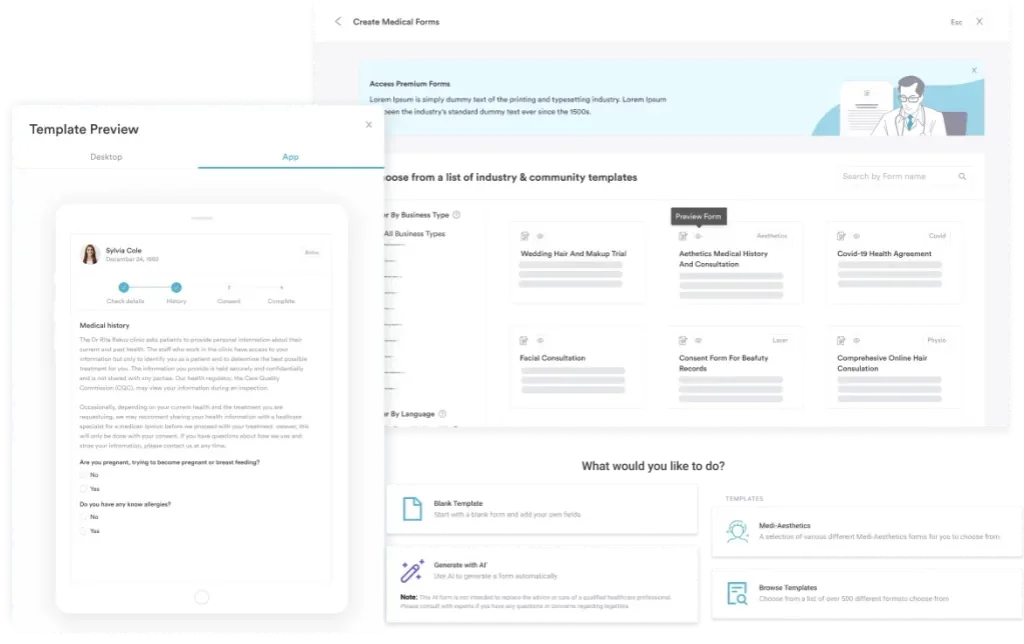
A stress assessment questionnaire is a validated clinical tool that measures how much psychological stress a person perceives. Standardized questions and a fixed scoring procedure produce a number. That number can be tracked over time and compared across patients.
These instruments do two clinical jobs. They screen for elevated stress as a risk factor for mental and physical illness. They also document a baseline before treatment or a lifestyle intervention begins.
Practitioners in mental health, primary care, wellness, and occupational health use them to shape care plans and measure improvement. Stored digitally in software for therapy practices, the results sit in the medical record and comply with HIPAA and GDPR.
Administering a stress questionnaire follows a short, repeatable workflow:
Digital administration removes the manual steps. The patient completes the form on a tablet or through the client portal, and the score calculates itself.
Automated workflows software then creates the follow-up task when a score crosses into the high band. The clinician reviews a result instead of remembering to chase one.
Sheldon Cohen published the Perceived Stress Scale in 1983, and it remains the most widely used instrument for measuring perceived stress. The PSS asks how stressful a person appraises their own circumstances to be. It measures subjective appraisal rather than a count of objective life events.
The PSS-10 dominates clinical use because it balances depth against the time a patient will spend on a form. Practices running a mental health EMR usually standardize on it for that reason.
The 14-item version is listed among the National Cancer Institute’s evaluated behavioral research measures. That is a research listing rather than an endorsement for clinical use.
Scoring takes four steps. Digital administration handles them automatically, but you still need the manual procedure to explain a result or spot a scoring error.
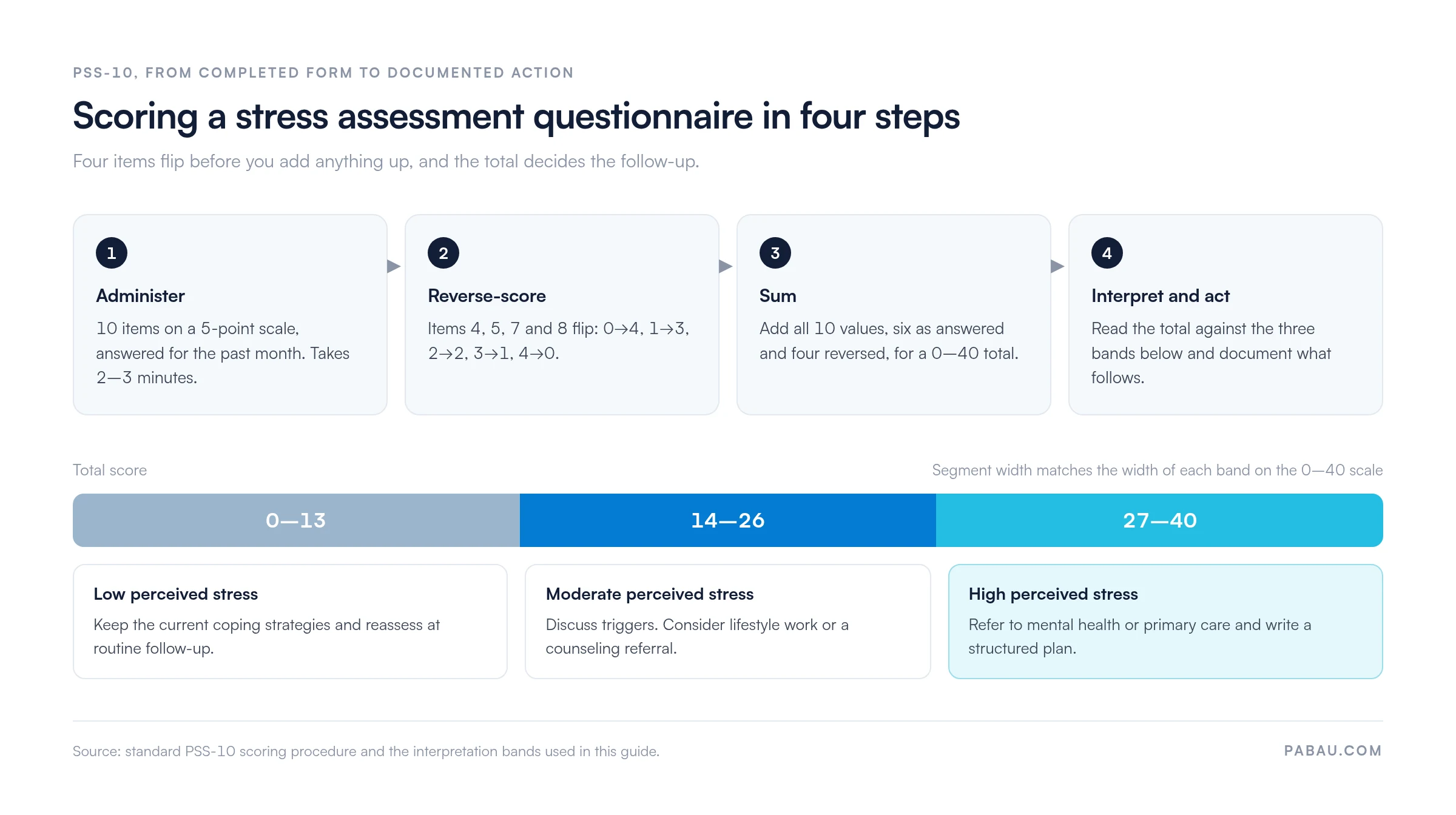
Items 4, 5, 7 and 8 are phrased positively, such as “felt confident”. Flip each of those four responses before you add anything up, so 0 becomes 4, 1 becomes 3, 3 becomes 1, and 4 becomes 0. A response of 2 stays as it is.
Add the values for all 10 items, six of them as answered and four reversed. The total runs from 0 to 40.
A high score does not diagnose a mental health condition. The questionnaire screens, and an elevated total flags perceived stress as a risk factor worth acting on. Patients in the high band usually need a referral and a written stress management plan.
Low and moderate totals say the patient is coping with current demands. Record the score as a baseline so later readings mean something. Reassess after a major life event, a treatment change, or a completed intervention.
The Holmes-Rahe Life Stress Inventory measures stress exposure instead of perception. It lists 43 major life events, each carrying a point value. The total predicts the risk of stress-related illness over the following year.
The two instruments answer different questions. The PSS captures how a patient feels about their circumstances right now. Holmes-Rahe counts what has happened to them, including bereavement, marriage, job loss, and relocation.
Many clinicians run both, then read them together. A psychiatric evaluation template is the usual place to record the pair, alongside history and mental status findings.
A validated questionnaire carries published psychometric evidence for reliability and validity. Reliability means the items hang together. Validity means the instrument measures what it claims to measure. For the PSS, reported Cronbach’s alpha typically falls between 0.78 and 0.91 across populations.
That evidence matters at the point of a decision. A standardized score is comparable across patients and across time, which is what justifies a referral in the notes. It also supports documenting medical necessity on a claim.
Treat the high band as a trigger, not a label. When a PSS-10 total comes back at 27 or above, have the form itself create the follow-up task and the reassessment date. The clinician then reviews a result rather than remembering to chase one.
Run the PSS on paper and the work lands after the appointment. Someone scores it by hand, types the total into a note, and adds a reminder to a list. Hand scoring is where the reverse-scored items go wrong, and the list is where the follow-up gets lost.
Practice management software like Pabau moves all of that in front of the appointment. The questionnaire goes out as a digital form before the visit. The patient completes it on a phone, a tablet, or the client portal, and the reverse-scoring runs on submission.
The total writes itself into the client record, next to the appointment and the treatment note. An automated workflow reads the band and acts on it. That might be a referral letter, a follow-up task, or a reassessment booked twelve weeks out.
So a practice screening for stress across a whole caseload can report on it, instead of hunting for totals in scanned paperwork.

Pabau’s digital forms send the PSS-10 before the appointment, calculate the total, and write it into the client record. Automated workflows then raise the referral or the reassessment that the score calls for.

The instrument is the easy part. The PSS-10 is free, public domain, and takes three minutes, so the measurement itself is not the barrier. What decides whether stress screening earns its place is what happens to the number afterwards.
A score filed in a note and left there adds little. A score that triggers a referral, a plan, and a reassessment date changes the patient’s care. The second version only survives a busy schedule if the scoring and the follow-up happen without anyone chasing them.
Download the template above and use it at your next intake. Book a demo to see how automated scoring and follow-up keep stress screening running across a full caseload.

Need to measure depression and anxiety alongside stress? Depression Anxiety Stress Scale (DASS-21) covers all three subscales on one form, with its own scoring key.
Want a faster check-in between full assessments? Stress thermometer template gives the patient a single-scale rating you can chart visit by visit.
Screening for anxiety in the same appointment? GAD-7 anxiety assessment template pairs with the PSS to separate generalized anxiety from situational stress.
Building the intake pack these forms sit inside? Mental health intake template collects history, presenting problem, and risk before the first session.
A stress assessment questionnaire is a validated clinical tool that measures how much psychological stress a person perceives. The Perceived Stress Scale (PSS) and the Holmes-Rahe Life Stress Inventory are the two most widely used instruments in clinical practice.
The Perceived Stress Scale (PSS-10) is the most commonly used stress questionnaire in clinical and research settings. It carries 10 items scored on a 5-point scale, takes two to three minutes to complete, and produces a total from 0 to 40.
Reverse-score items 4, 5, 7 and 8, then sum all 10 response values for a total between 0 and 40. Totals of 0 to 13 are low stress, 14 to 26 moderate, and 27 to 40 high perceived stress.
A total of 27 to 40 on the PSS-10 indicates high perceived stress and a raised risk of stress-related health problems. Patients in that band usually benefit from a mental health referral, stress management counseling, or lifestyle work recorded in their care plan.
Yes. The Perceived Stress Scale is in the public domain and free to use clinically. The PDF above carries the complete 10-item questionnaire with scoring instructions, ready to hand to a patient.
Clinicians administer the form at intake or during a visit, record the total in the patient record, and discuss it with the patient. The result then informs referral decisions and treatment planning. Digital forms handle the scoring and the follow-up triggers automatically.