Maja Popovska

Values exploration worksheet
Download your free values exploration worksheet A two-page printable form that o...

2
Last Updated: Nov 6, 2026
Free PDF 2 pages, print-ready Clinician-reviewed
A medical case study template is a fill-in form that records one patient's case in a fixed order, from objectives to outcome. Clinicians use it to write up unusual or instructive cases for teaching, audit and research. This free PDF opens with a title and three learning objectives, then moves through history, examination, assessment, treatment and follow-up. It closes with teaching questions, references and a patient consent section. A shared template keeps case records consistent across a team, so the next reader finds every section in the same place.
A fill-in PDF with spaces for the case title, three learning objectives, the patient summary, history, examination, assessment and treatment. It closes with follow-up, three teaching questions, conclusions, references and a patient consent section.
Start from scratch, or upload this PDF or any form you already use, and Pabau's AI Form rebuilds it with tick boxes, text fields and a signature. Attach it to the treatment once, and every patient gets it on time.
AI Form rebuilds the consent, history and aftercare forms you already use. You review each one, then publish.
Patients complete forms on their phone before they arrive, so the front desk stops retyping paper.
Every signed form is versioned and attached to the treatment record, ready when you need it.
Set how long a consent stays valid. Returning patients skip forms they have already signed.
Supports HIPAA and GDPR compliance AES-256 encryption 4.8 on G2 4.7 on Capterra Trusted by 4,000+ practices worldwide

A medical case study template is a fixed-order record of one clinical case, from learning objectives to outcome.
Writing the objectives first decides which history, findings and results the case needs to include.
Consent and anonymization must be settled before a case is shared outside the practice.
The assessment and intervention sections should record the reasoning as well as the final decision.
Pabau, our practice management platform, links clinical notes, consent and forms to the patient record, so case data isn’t re-typed.
The free template has 13 sections, and they follow the order in which a teaching case is written up. It starts with why the case matters and ends with what a reader should learn from it.
Grouped by the question each part answers, the sections fall into five stages.
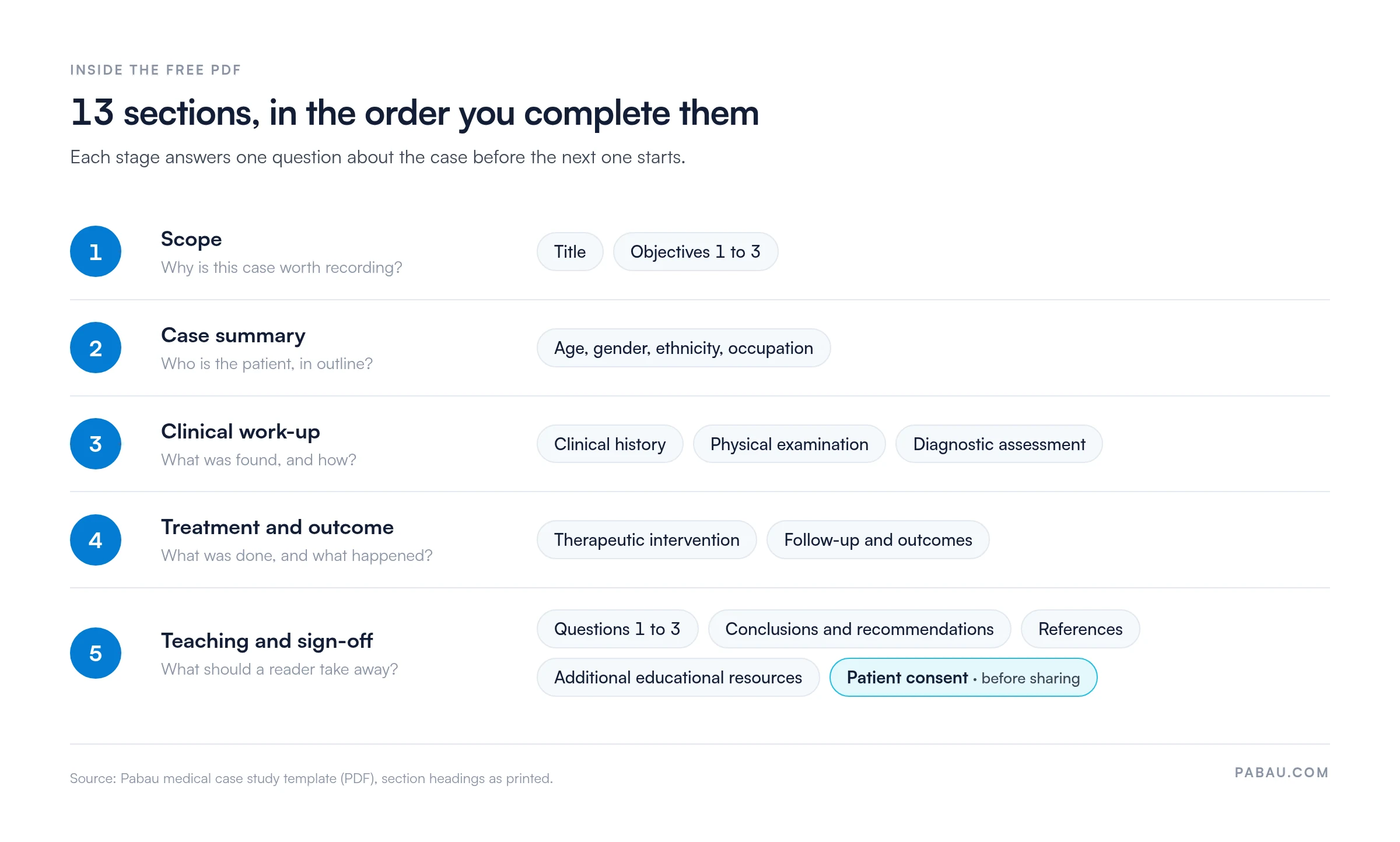
Write the objectives before anything else. A case meant to teach a missed diagnosis needs a different history from one that shows an unusual drug reaction. Keep the case summary to the four fields the form asks for. If an exact age could identify the patient, record it as a range.
Open the history with the presenting complaint, in the patient’s own words where possible. Then cover the timeline of symptoms, what has already been tried and the relevant background. A patient history form completed at intake gives you most of this before you start writing.
Group examination findings by system so a reader can scan them quickly. Stop at what changes the clinical picture.
Pair each investigation with its date and result. Note any test that was pending or not done, because a missing result often matters as much as an abnormal one. Record the working diagnosis, the differential and the final diagnosis, with the reason each alternative was ruled in or out.
The intervention section should state what was given, at what dose or setting, and why that option was chosen over the others.
Record follow-up at fixed intervals rather than only at discharge, so the outcome shows a trend. The three question boxes turn the record into teaching material. Write questions that a reader can answer from the case itself, then use the conclusions to say what you’d do differently next time.
The template works best when it’s completed as the case unfolds, not reconstructed at the end. Fill in the history and examination on the day, then add results and outcomes as they arrive.
Keeping the template alongside your case notes avoids copying the same facts twice. Store the finished record with the consent form, and keep identifying details to the minimum its purpose requires.
Patient consent is required before a case is published or shared outside the care team. Journals that follow the ICMJE recommendations typically ask for written consent for identifiable details. Many ask for it even when the case is anonymized. If the case feeds a research study, an ethical consent form records the participant’s agreement to the study itself.
Removing names is not always enough. Age, location, occupation and rare presentations can identify a patient. How the record is stored and shared falls under HIPAA in the United States. In Europe, the GDPR in the EU and UK GDPR in the UK apply. In the UK, the Data Protection Act 2018 applies alongside UK GDPR, so check the rules that match your location.
A medical case study template is an internal documentation tool, while a clinical case report is a formal write-up for publication. The structure overlaps, but the expectations differ.
Neither one replaces a report written for a referrer or an insurer. For that job, a medical report template captures the assessment, diagnosis and plan in the order they expect.
The examples below are illustrative and fully anonymized. They show how the same sections read across different settings.
A standalone template still needs someone to copy data into it. The history comes from one file, the results from another, and the signed consent from a scanned PDF in a shared folder.
Pabau keeps clinical notes, consent forms and custom forms inside the patient record, so the facts for a case already sit in one place. Its digital intake forms capture consent at the point of care and store it against the patient. Clinical notes can be structured for each consultation, and medical records management keeps history, treatments and follow-up together.
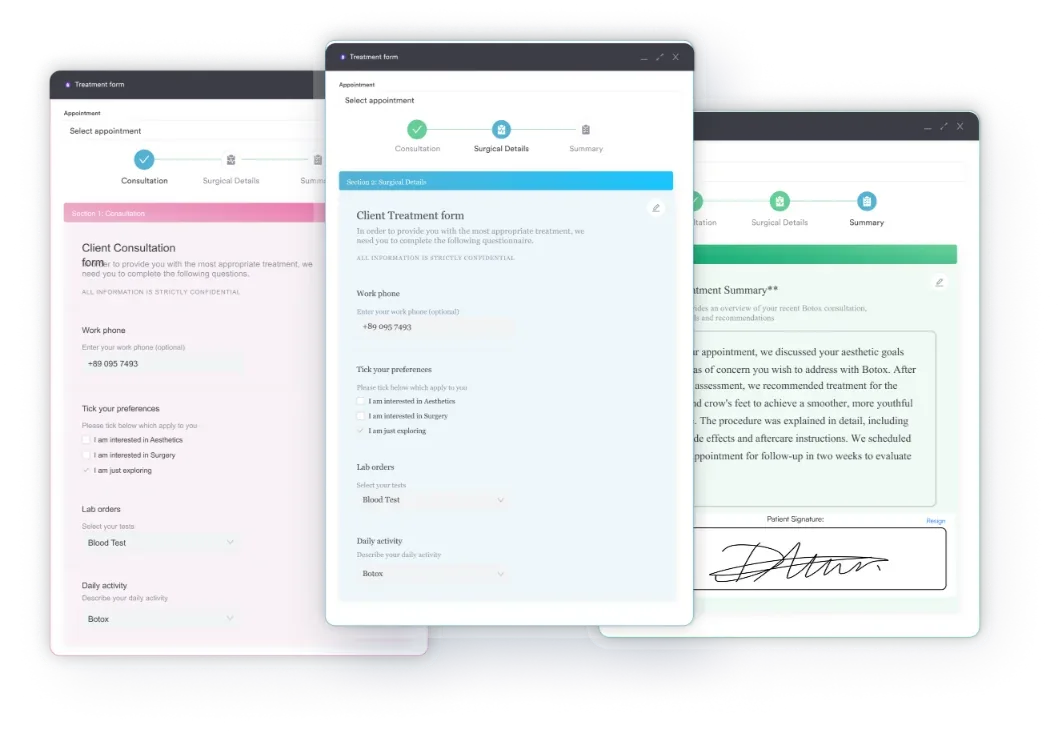
When it’s time to write up a case, the history, findings and outcome are already dated in the record. You spend the time on the objectives and the discussion, which is where the teaching value lies.

Pabau stores clinical notes, signed consent and custom forms against each patient record. Write up a case study from data you’ve already captured, with consent on file before it’s shared.

A case study is only as useful as its objectives. Set them before you write, and the rest of the template tells you what to keep and what to leave out.
The trade-off is detail against privacy. Every extra identifier makes a case easier to follow and harder to share, so settle consent early rather than at the point of publication.
Start with the next case that surprised you, and complete the template as it unfolds. Book a demo to see how Pabau keeps the notes and consent behind every case study in one patient record.

Need a digital intake record? Digital forms capture consent and intake data at the point of care.
Want the clinical record in one place? Medical records management keeps history, treatments and follow-up together.
Collecting history before the first visit? Medical history questionnaire gives patients a form to complete ahead of the consultation.
Choosing a system for clinical notes? Best clinical documentation software compares the options for practices.
A medical case study template is a fixed-format document for recording one clinical case from learning objectives to outcome. It keeps records consistent so cases can be taught, audited or reviewed.
It should include a title, learning objectives, a case summary, clinical history, examination, diagnostic assessment, intervention and follow-up. Teaching questions, conclusions, references and patient consent complete it.
A case study template is used for internal documentation and teaching, while a case report is a formal write-up for publication. Journal requirements define the case report format.
This template is a PDF, suited to printing and sharing; copy the sections into Word if you want to edit it.