Slocum test: How to perform, interpret and record it
The Slocum test is a knee drawer test performed with the tibia rotated. It check...

3
Last Updated: Oct 21, 2026

The jerk test assesses posteroinferior labral tears and posterior glenohumeral instability in the shoulder.
The examiner stands behind the seated patient, with the affected arm at 90° abduction and internal rotation.
An axial load through the elbow, held during horizontal adduction, is what reproduces the posterior subluxation.
A sudden clunk, the patient’s familiar pain, or apprehension during the maneuver counts as a positive result.
Reported sensitivity is 72-73% and specificity is 97-98%, so a positive finding rules the tear in.
The form prints the eight-step procedure alongside blank fields for the complaint, your clinical evaluation, the findings, and your recommendation. Print it, or attach it to the patient record.
Download templateThe jerk test is one of the most specific orthopedic screening maneuvers for posterior shoulder instability. A positive result carries an 88% positive predictive value for a posteroinferior labral tear. Physical therapists, sports medicine clinicians, and orthopedic practitioners use it to decide who needs imaging and who does not.
This guide covers the procedure, the interpretation criteria, and the published accuracy figures. It also shows how to record the result so it still means something at the next visit.
The jerk test is a clinical special test for the posteroinferior labrum and posterior glenohumeral instability. The labrum is a cartilaginous rim that deepens the glenoid socket and steadies the shoulder joint. When it tears at the posteroinferior corner, the humeral head can subluxate backward.
That partial dislocation produces pain, a sense of instability, and lost function. Posterior labral tears turn up most often in overhead athletes, repetitive throwers, and patients with a history of shoulder dislocation. The maneuver screens for them chairside, with no imaging and no equipment, which is why sports medicine practices run it at a first evaluation.
Technique decides the result here. Small variations in patient position, or in how the load is applied, produce false negatives. Follow the sequence below.
Seat the patient upright on the treatment table or a chair, with their back supported and their shoulders relaxed. Position the affected arm at 90° of shoulder abduction, level with shoulder height. Bring it to 90° of internal rotation, so the palm faces down or slightly backward. Keep the elbow flexed to roughly 20-30°.
Stand behind the patient. Cup their elbow in one hand, so you can drive load along the arm toward the shoulder socket. Use your other hand to hold the scapula still. Apply gentle axial compression through the elbow for 2-3 seconds to load the glenohumeral joint.
Hold that load and horizontally adduct the arm, carrying it across the patient’s body toward the opposite shoulder. Keep the motion slow and controlled. The jerk you are looking for comes from the joint, never from your hands. The aim is to reproduce the patient’s symptoms or feel the humeral head subluxate posteriorly.
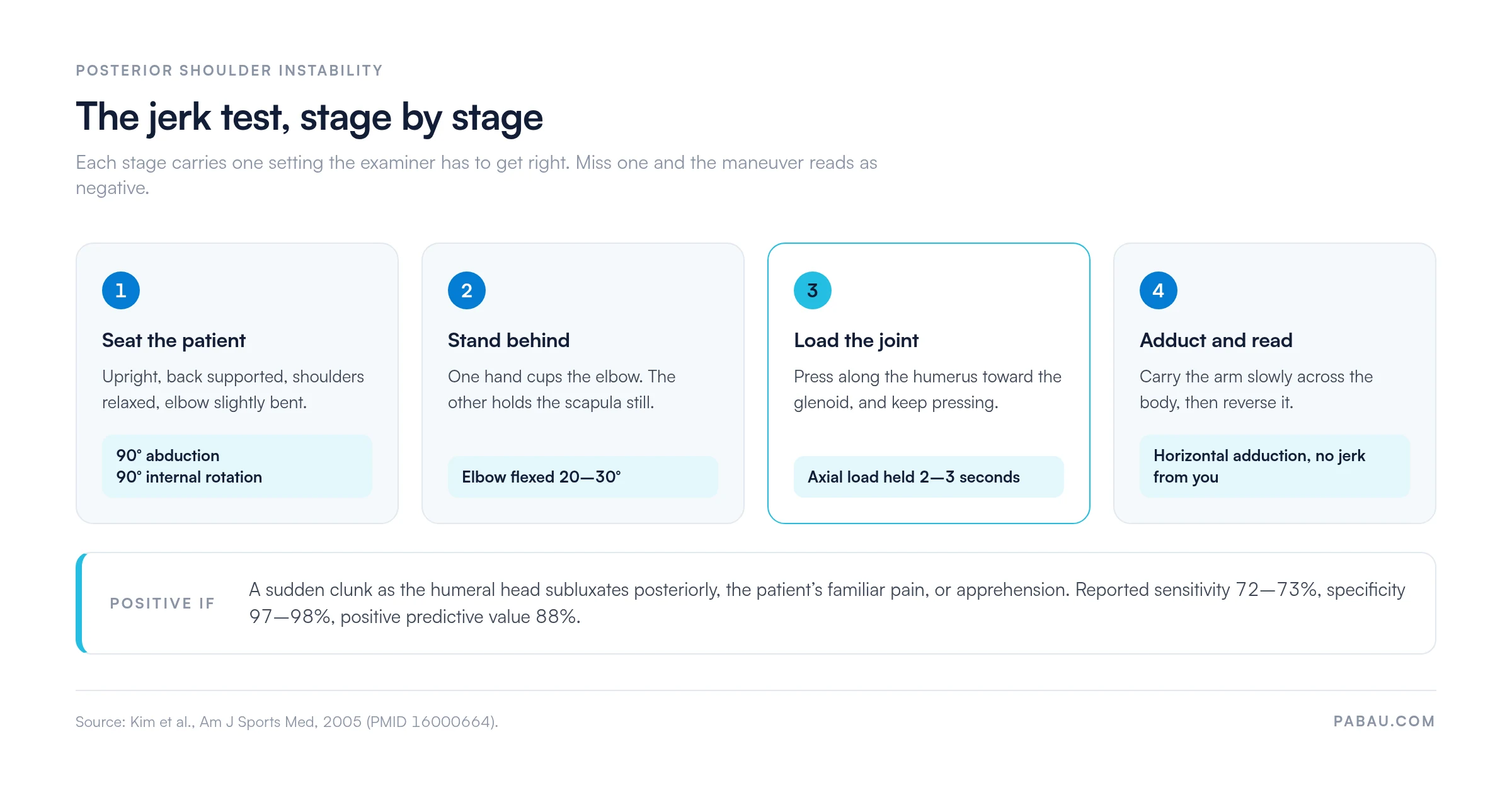
A positive jerk test shows up as one or more of the following findings:
Document the exact location and character of the pain. Note whether the symptoms appeared during loading or during horizontal adduction, and record the patient’s own words.
A negative test does not rule out posterior labral pathology, though it does lower the odds. Capture the detail in digital intake forms rather than free text, so the record holds up months later.

Published accuracy figures for the jerk test come from the orthopedic and sports medicine literature. Here are the metrics that matter at the bedside:
These figures come from Kim et al., 2005 (PMID 16000664), which measured the jerk test against arthroscopic findings. The high specificity and the strong positive likelihood ratio make a positive result a dependable rule-in finding. A negative result settles far less. Read it alongside the history, and send the patient for imaging where the picture stays unclear.
The jerk test is one part of a shoulder examination. Clinicians pair it with related tests to build diagnostic confidence and rule out other pathology:
The Kim test is the one worth running alongside this maneuver. In the 2005 comparison study it reached 80% sensitivity on its own. Run both, and sensitivity for a posteroinferior labral lesion rises to 97%. That is the single cheapest accuracy gain available in a shoulder examination.
The knee jerk test and the shoulder jerk test share a name and little else. They belong to different examinations and answer different questions.
Keep the context clear in your notes. Knee jerk belongs to neurology, while jerk test on its own refers to the shoulder. Documentation templates should separate reflex testing from special test findings, or the chart will not read cleanly later.
Most teams still record special tests as free text, which makes them impossible to compare between visits. Recording them in physical therapy practice software keeps each finding in a fixed field. The next clinician can then see at a glance whether the clunk is still there.
The downloadable template walks through the components worth capturing:
AI clinical documentation speeds this up. It drafts the note from the consultation and prompts for the fields a shoulder assessment needs, which cuts charting time without cutting detail.
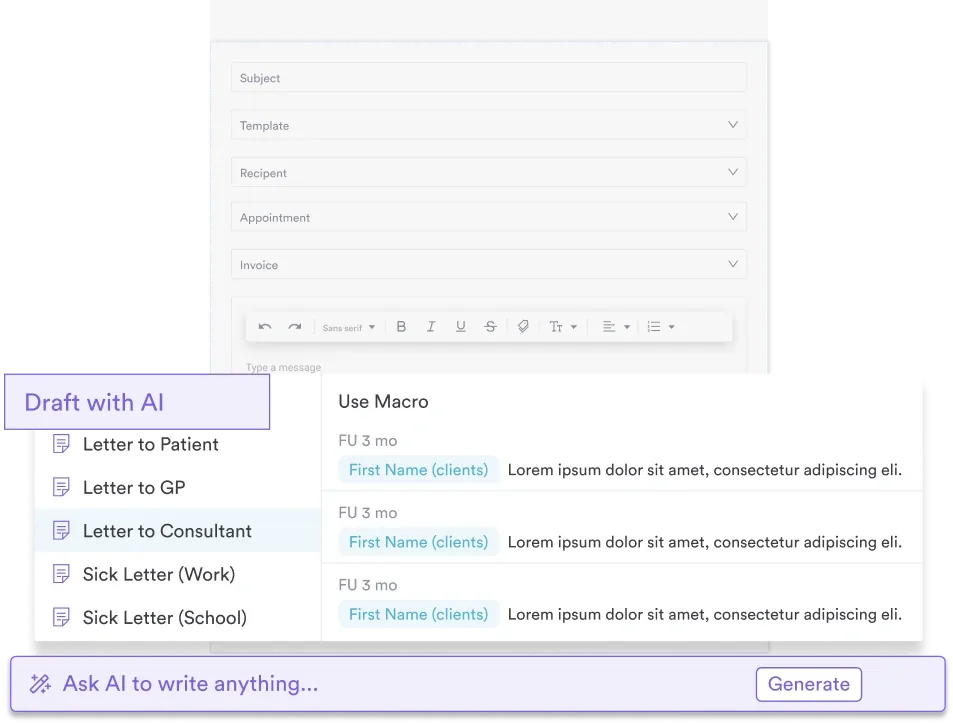
Right now a shoulder assessment usually lands in three places. The test results go into a free-text note, the printed form goes into a folder, and the imaging referral gets typed out again from scratch. Nobody can pull the last five posterior instability screens to see whether a patient is improving.
Practice management software like Pabau keeps the whole assessment in the client record. You build the jerk test form once, and every clinician completes the same fields in the same order. Pabau Scribe, our AI scribe, drafts the note from the consultation, so findings are recorded while they are fresh.
Because the form is structured, the results are searchable. You can pull every posterior instability screen from the last quarter, see which patients went on to imaging, and check whether the referrals were justified. Follow-up reminders and the referral letter run from the same record, so nothing waits on a second system.

Pabau’s digital forms and AI note-taking capture special test findings, diagnoses, and treatment plans in one client record. Your whole team then works from the same assessment, at every visit.

A positive jerk test is worth acting on. With 97-98% specificity and an 88% positive predictive value, a clunk under axial load is strong enough to justify imaging. A negative result settles much less, so keep the history and the rest of the examination in play.
The larger win is consistency. Run the same sequence every time, record it in the same fields, and your findings become comparable across clinicians and across visits. That is what turns a special test from an opinion into evidence.
Download the jerk test assessment template and use it at your next shoulder evaluation. Book a demo to see how Pabau keeps every special test finding in one searchable client record.

Need a second labral test to run alongside this one? Clunk test screens the same labrum with the patient supine, which suits anyone who cannot sit upright comfortably.
Suspect the tear sits at the superior labrum instead? Biceps load test isolates SLAP lesions and is easier to read than the crank test.
Want a quick screen before you commit to a full battery? O’Brien’s test covers superior labral and acromioclavicular pain in a single maneuver.
Recording range of motion at the same visit? Shoulder range of motion template gives you a printable chart for both shoulders side by side.
Ruling out a rotator cuff tear first? Drop arm test takes seconds and flags a full-thickness supraspinatus tear.
A positive jerk test means a sudden clunk, a reproduction of the patient’s familiar pain, or apprehension during the maneuver. It points to a posteroinferior labral lesion or posterior glenohumeral instability. The positive predictive value is 88%, so a positive result usually justifies imaging and a specialist referral.
Seat the patient and stand behind them. Set the arm at 90° abduction and internal rotation, then apply a gentle axial load through the elbow. Hold that load and horizontally adduct the arm slowly across the body. A clunk or jerk as the humeral head subluxates posteriorly is a positive result.
They target different parts of the labrum. The jerk test uses 90° abduction with internal rotation and an axial load to detect posteroinferior labral lesions and posterior instability. The crank test elevates the arm to about 160° in the scapular plane, then rotates the humerus under load. It screens for superior labral (SLAP) tears.
Use it when a patient reports posterior shoulder pain, instability symptoms, a history of dislocation, or heavy overhead activity. It is most valuable in throwers and swimmers. Pair it with the Kim test, the load-and-shift test, and the sulcus sign for a fuller picture.
Reported sensitivity is 72-73% and specificity is 97-98%. The positive likelihood ratio of 24-25 means a positive result rules a posteroinferior labral tear in with confidence. A negative result is less useful, because roughly one tear in four is missed.
No. The knee jerk reflex test is a neurological examination of the patellar reflex arc at the L3-L4 level, performed with a reflex hammer. The shoulder jerk test is an orthopedic special test for labral integrity and joint stability. Name the test explicitly in your notes so the two never get confused.