GLP-1 diet plan
A GLP-1 diet plan is a structured eating framework for patients taking semagluti...

2
Last Updated: Oct 13, 2026
The Moberg pick-up test is a timed hand assessment that measures tactile gnosis, the ability to recognize and handle small objects by touch alone. A patient picks up nine to twelve metal objects twice, once with eyes open and once with eyes closed. You record the seconds each trial takes.
The eyes-closed time on the affected hand is the number that matters. A monofilament cannot give you that. It reports what the fingertip detects, not what the patient can do with it.
Since small protocol differences break serial comparison, the sections below pin down the equipment, the sequence, the norms, and the note you write afterward.

The Moberg pick-up test measures tactile gnosis, the ability to identify and handle objects by touch rather than simply detect a stimulus.
Administration uses 9 to 12 small metal objects under two conditions, eyes open for motor speed and eyes closed for functional sensibility.
Scoring is the time in seconds per hand per condition, compared against the unaffected side and against published norms.
The Dellon modification adds an object identification score to the timing, which separates patients whose completion times look alike.
Reported test-retest reliability runs from 0.624 to 0.918, so a change has to clear measurement error before it counts as recovery.
The Moberg pick-up test assesses tactile gnosis, the integrated ability to identify and manipulate objects by touch without looking. That is a different question from the one a threshold test asks.
Two-point discrimination and monofilaments measure whether a stimulus registers at a given resolution. A patient can pass both and still fail to lift a coin off a table with their eyes shut.
Erik Moberg made exactly that case in his original 1958 paper in the Journal of Bone and Joint Surgery. Detection, he argued, tells you very little about whether a hand can be used purposefully.
The test taps three narrow constructs. Fingertip cutaneous sensibility sits mostly in median nerve territory. It works alongside precision pinch mechanics and the ability to build a tactile picture of an object.
Median nerve lesions at wrist or forearm level impair all three, which is why the test tracks so closely with recovery after nerve repair. Where you also want a motor screen for the same nerve, the anterior interosseous nerve test covers the deep motor branch.
What it does not do is worth stating plainly. The test is not diagnostic, and it will not locate or name a nerve lesion. It reports functional sensory output, so it belongs inside a wider hand assessment.
That assessment normally includes static and moving two-point discrimination, monofilament testing, grip and pinch dynamometry, and a clinical history.
Reach for the Moberg pick-up test whenever functional hand sensibility is the question you need answered. That covers nerve repair follow-up, carpal tunnel before and after surgery, median nerve laceration, neuropathy monitoring, and a baseline taken before hand rehabilitation starts.
The American Occupational Therapy Association treats standardized sensory assessment as core to occupation-based hand evaluation.
The test asks for precision pinch. That rules it out where there is severe joint contracture, acute pain on movement, or an open wound across the fingertips. It is also less informative in ulnar nerve lesions.
The median nerve supplies the thumb, index, middle finger, and radial half of the ring finger. Those digits do most of the work here. In a suspected carpal tunnel workup, pair it with a provocative screen such as the hand elevation test. That screen answers a different question in under a minute.
Equipment is cheap, portable, and close to standardized. The core set is 9 to 12 small solid metal objects of similar size and differing shape. Published protocols vary a little in the exact contents, and the list below is the most commonly cited version.
You also need a shallow tray about the size of a sheet of paper, a stopwatch or digital timer, and a blindfold or vision-occluding drape. The tray and the timer are the two items most likely to drift between practices. Standardize both across your service so serial measurements stay comparable.
Administration follows the same sequence under both conditions. Run the eyes-open trial first, then the eyes-closed trial. Test the unaffected hand first, or the dominant hand where there is no injury. The patient then learns the task on the side you care about least.
The eyes-open trial measures motor speed and gross coordination. The eyes-closed trial isolates tactile gnosis by removing the visual compensation most patients use without noticing. The clinical value sits in the ratio between the two times.
A patient whose eyes-closed time is only marginally slower has good functional sensibility. One who is substantially slower, or who keeps dropping objects, is leaning hard on vision.
Patients with median nerve injuries often show near-normal eyes-open performance alongside a dramatically longer eyes-closed time on the affected hand.
That discrepancy documents the functional cost of sensory loss more clearly than any threshold test. It is also the figure that carries weight in return-to-work decisions.
Scoring is simply the time in seconds for each trial. Record four values: eyes open unaffected, eyes closed unaffected, eyes open affected, eyes closed affected.
Compare the affected hand against the unaffected side, then against published normative data for the patient’s age and sex.
A 2024 normative study in the American Journal of Occupational Therapy reported population-stratified reference values for adults in an Israeli cohort.
The table below gives indicative ranges drawn from the published literature. Values shift with object set, tray size, and protocol version, so interpret results against norms collected the same way you collect yours.
Plot those dominant-hand windows on one scale and the pattern is hard to miss.
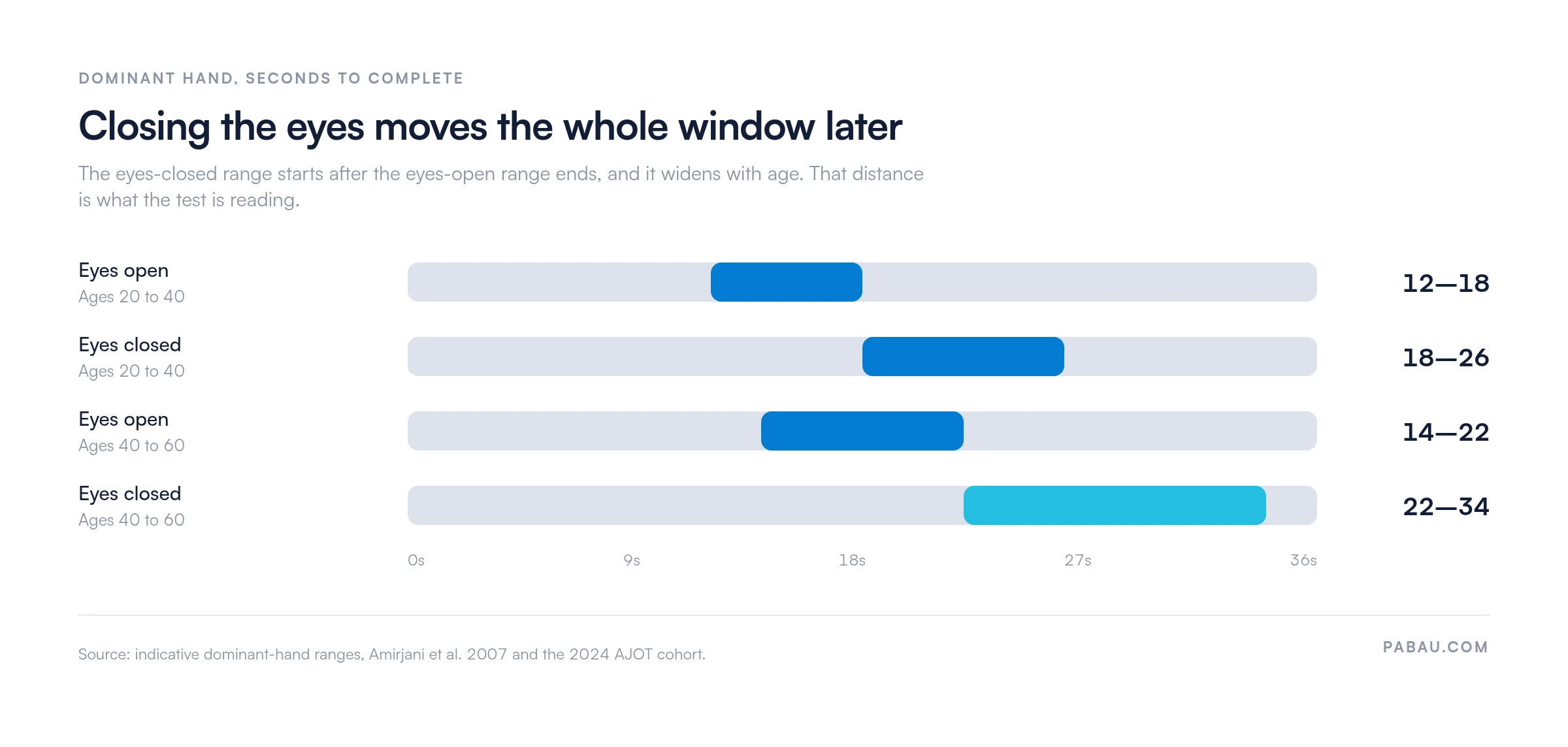
Treat these ranges as indicative rather than definitive. Use age-matched and sex-matched norms where you have them, and build your own service baseline over time. Your own data, collected with one protocol, will always beat a borrowed table.
The Dellon-modified Moberg pick-up test keeps the original timed protocol and adds a second score. During the eyes-closed trial the patient names each object as they lift it.
The examiner records how many were identified correctly out of the full set. You end up with two parallel measures, motor speed and tactile object recognition.
The modification earns its extra minute in three situations. It separates two patients whose pick-up times look alike but whose sensory recovery does not.
In research it adds a discrete variable alongside the continuous timing variable. And in medicolegal work, object identification is harder to manipulate deliberately than a completion time.
Do not apply the Dellon modification retrospectively to historical scores. The two protocols differ enough that they are not interchangeable in serial measurement. Choose one at baseline and hold it for the whole episode of care.
Reliability for this test is solid rather than spectacular. A 2026 psychometric study in Healthcare examined adults with hemophilia and reported test-retest intraclass correlation coefficients between 0.624 and 0.918, a moderate to excellent spread.
Inter-rater reliability holds up well when examiners follow the same administration sequence. For the motor side of the same assessment problem, a timed dexterity test answers a related but separate question.
Construct validity rests on expected correlations with other hand measures, including monofilament scores and two-point discrimination. In the same cohort the test correlated moderately with the Duruöz Hand Index, a self-reported measure of hand function, at r = 0.410.
A moderate relationship with self-reported function is what you would expect from a functional test rather than a threshold test.
Minimal detectable change and minimally clinically important difference values have been investigated, but they vary by population. Where a study reports minimal detectable change for your patient group, use that figure to judge whether an observed change exceeds measurement error.
Without one, a shift of 4 to 5 seconds on the eyes-closed condition is generally treated as meaningful in nerve injury populations.
The Moberg pick-up test occupies a narrow slot in the hand assessment toolkit. Choosing between it and something like the Jebsen-Taylor Hand Function Test comes down to the question you need answered.
Knowing what each tool measures also stops you running two tests that report the same construct.
The Jebsen-Taylor Hand Function Test covers a wider functional range, takes considerably longer, and does not isolate sensory function. The two are complementary.
Use the Moberg pick-up test when sensory recovery is the question, and the Jebsen-Taylor when overall hand performance is the outcome you are reporting.
Run the Moberg pick-up test at every formal reassessment, not only at discharge. Comparing eyes-closed times on the affected hand across those points is the most objective record of sensory recovery you will produce. Each run costs under 10 minutes.
Most assessment guides stop at the score, which leaves out the part that costs clinicians time. One clean entry has to serve medicolegal records, treatment planning, team handover, and insurance reporting at once.
How easily you can do that depends on whether the numbers land in a connected physical therapy EMR or in free text nobody can search.
In a SOAP note the results belong in the Objective section. A fixed format cuts transcription errors and makes serial comparison legible at a glance.
Written out, a single visit reads like this. MPUT, standard 9-object protocol. Left eyes open 14s, eyes closed 22s. Right (affected) eyes open 13s, eyes closed 45s. Affected eyes-closed time is 2.0 times the unaffected side, down from 2.4 at initial assessment. Ulnar-biased grip substitution on three objects.

Most services type hand assessment times into the body of a progress note, or into a spreadsheet one therapist quietly maintains. Both work until somebody needs the trend.
Six months on, the figures are scattered through free text, and rebuilding the sequence takes longer than the assessment ever did.
Practice management software like Pabau handles it differently. You build the assessment once as a digital form, with dedicated fields for the four time values. Every clinician then captures the same data in the same places.
Those fields feed outcome measure tracking, so eyes-closed times plot as a line across the treatment episode instead of sitting in paragraphs.
The payoff shows up at reassessment and discharge. The trend is already drawn and the qualitative notes sit beside it. A report for the referrer or the insurer takes minutes rather than an afternoon of scrolling.

Pabau lets hand and occupational therapists capture timed assessment scores in structured form fields, then chart them across the episode of care. See how it fits your documentation workflow.

The Moberg pick-up test earns its place because it answers a question no threshold test can. Ten minutes and a tray of hardware tell you whether a hand still works once vision stops helping. The eyes-closed time on the affected side is the number worth defending, and it only means something while the protocol behind it holds still.
So pick one object set, one sequence, and one recording format, then keep all three for the length of the episode. That consistency is what turns four numbers into evidence of recovery. Book a demo to see how Pabau keeps every score, form, and clinical note in the same patient record.

Need a structured sensory assessment framework? Sensory Profile 2 scoring and interpretation walks through standardized sensory evaluation and what the quadrant scores mean.
Scoring a visual-motor assessment next? Beery VMI scoring and interpretation covers raw scores, standard scores, and the reporting conventions clinicians get asked about.
Looking for occupational therapy practice management? Pabau’s occupational therapy software covers digital forms, outcome tracking, and clinical records built around OT workflows.
Any clinician trained in hand assessment can administer it, and no certification or license is required. Occupational therapists, hand therapists, physical therapists, and physicians all use it. What matters is consistency of technique, so most services nominate one written protocol and train everyone against it.
Yes, from roughly age five, once a child can follow the instruction and name the objects reliably. Adult norms do not transfer. Compare the affected hand against the child’s own unaffected hand, or against pediatric reference data collected with the same object set.
No CPT code names the Moberg pick-up test specifically. Therapists usually capture it inside the evaluation or a standardized test and measurement code, following the payer’s own rules. Document the protocol version and all four time values, because that detail supports whichever code you choose.
Stop the trial, record what happened, and report the attempt rather than a completion time. Note how many objects were transferred, which ones defeated the patient, and why the trial ended. A partial result with that detail is far more useful at reassessment than an inflated time.