Maja Popovska

The clinical audit cycle: Stages, challenges, and how to complete it
The clinical audit cycle is a repeating process for measuring care against an ag...

Last Updated: Nov 10, 2026
Free PDF 3 pages, print-ready Clinician-reviewed
A high conflict parenting plan is a written co-parenting agreement with fixed schedules, exchange rules, communication limits and a dispute process. It suits parents who can't cooperate day to day, because it leaves far fewer decisions open to argument. This page gives you a free template, sample clauses and a step-by-step guide to filling it in. A plan becomes binding only once a court enters it, so check your state's rules before you file.
A six-part fill-in plan covering the parties, custody and visitation schedule, communication and dispute steps, financial responsibilities, high conflict provisions and review terms. It ends with signature and date lines for both parents.
Start from scratch, or upload this PDF or any form you already use, and Pabau's AI Form rebuilds it with tick boxes, text fields and a signature. Attach it to the treatment once, and every patient gets it on time.
AI Form rebuilds the consent, history and aftercare forms you already use. You review each one, then publish.
Patients complete forms on their phone before they arrive, so the front desk stops retyping paper.
Every signed form is versioned and attached to the treatment record, ready when you need it.
Set how long a consent stays valid. Returning patients skip forms they have already signed.
Supports HIPAA and GDPR compliance AES-256 encryption 4.8 on G2 4.7 on Capterra Trusted by 4,000+ practices worldwide

A high conflict parenting plan replaces open-ended co-parenting with specific, written rules for time, exchanges, messages and decisions.
Choose a schedule by its exchange count, and route weekday exchanges through school so the parents rarely meet.
Limit communication to one co-parenting app, with response windows and brief, child-focused messages.
Use a dispute-resolution ladder before any court filing, and name a parenting coordinator in the plan.
A plan becomes binding only once a court enters it, so confirm the terms with a family lawyer.
A high conflict parenting plan is a parenting agreement that adds structure, limits and escalation steps for families where parents struggle to agree. It differs from a standard plan because it assumes routine disagreement and writes the disagreement process into the document.
A standard plan can say “the parents will agree on summer vacation” and trust them to do it. A high conflict plan names the dates, the deadline to request them, and who decides if the request is refused. Every open question becomes a written answer.
Courts and mediators often ask for more detail in these cases, because vague wording tends to generate further conflict. The child’s well-being sits at the center of the plan, and each provision should be traceable to that goal.
This page explains the template and how to fill it in. It isn’t legal advice, so check your state’s rules before you file.
Parents need a high conflict plan when ordinary conversations about the child keep turning into arguments the child can see or hear. The label describes how the parents interact, and it carries no clinical diagnosis of either one.
These signs suggest a standard plan will not hold:
Where there is a history of domestic violence, abuse or threats, a parenting plan is not enough on its own. Speak to a family law attorney or a local domestic violence advocate about protective orders and supervised arrangements first.
Parallel parenting is an arrangement in which parents minimize direct contact and handle their own time with the child independently. Co-parenting assumes the adults can share decisions and communicate with reasonable cooperation.
Many high conflict plans work as parallel parenting plans in practice. Each parent runs their own household rules during their own time, and the plan covers the few points where the two homes meet. If you want a lower-contact version from the start, our parallel parenting plan template is built around that model.
Parents who can cooperate on most issues but clash on a few may do better with a standard co-parenting agreement plus a dispute clause. The high conflict template suits families where cooperation fails across the board.
The template is a six-part, fill-in form that ends with signature and date lines for both parents. Each part leaves space for your own wording rather than prescribing terms.
The form has no separate boxes for exchanges, decision-making or the right of first refusal. Write those clauses into the “Agreed-upon restrictions” field, or attach them as a numbered addendum. Both parents should sign and date each extra page.
A usable high conflict parenting plan covers the same core areas every time. Work through the template against this list before you sign.
A parenting time schedule states which days each parent holds the child, how holidays rotate, and how vacations are requested. Scheduled time is specific, while open time is negotiated case by case. Supervised time involves a third party present throughout.
In a high conflict plan, leave no open time at all. Three common equal-time patterns work well, and each suits a different age and level of conflict:
The handoff count is the figure to compare, because each exchange is a point where the parents’ conflict can reach the child. The chart below counts them over the two weeks each pattern takes to repeat.
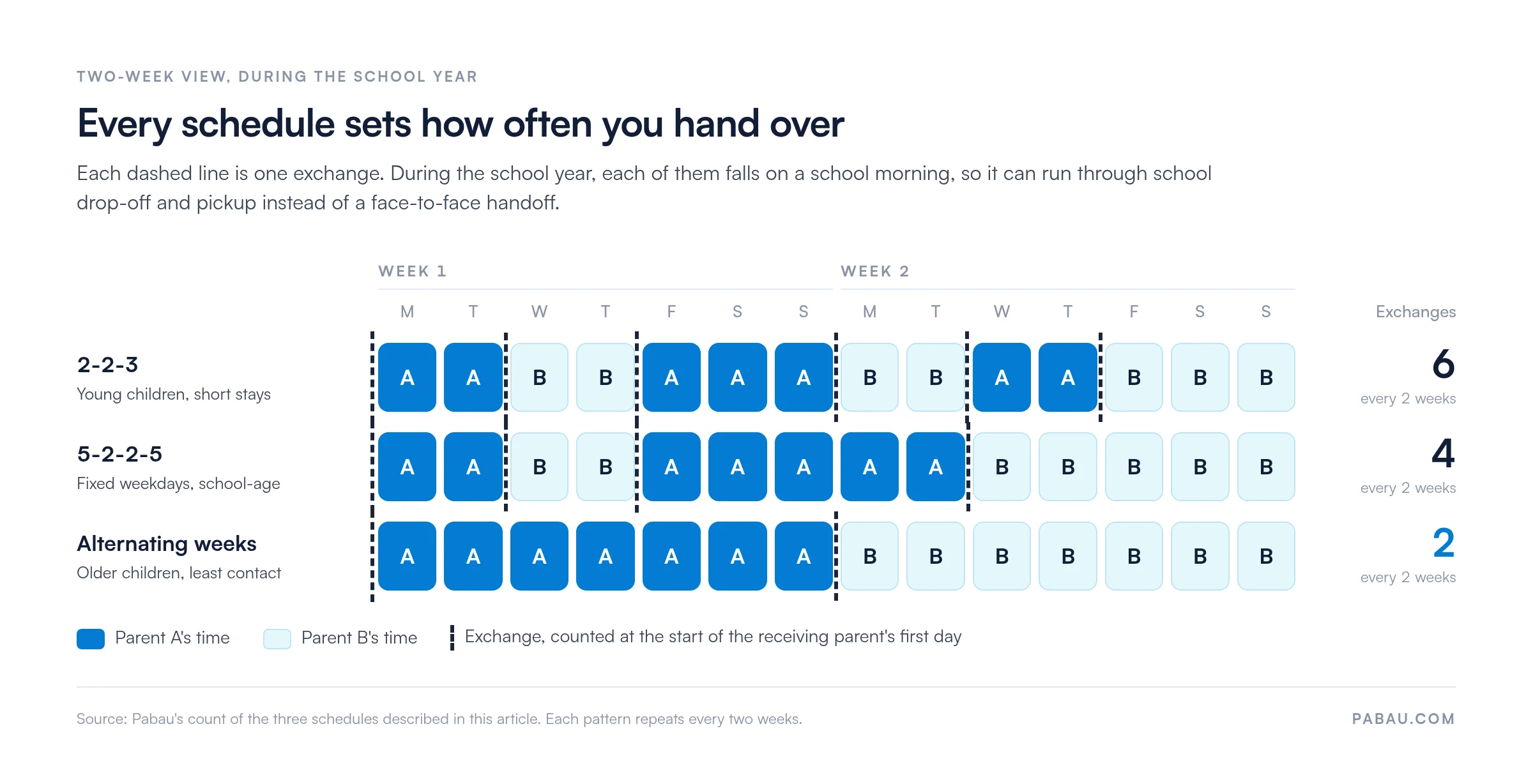
Schedule exchanges on school days wherever you can. One parent drops the child at school, and the other collects them at the end of the day. The parents never meet, and the child never watches a tense handoff.
Summer and school breaks remove that buffer, so write a separate exchange location for days with no school.
Holiday terms override the regular schedule, so write them in full. Disputes cluster around holidays because the stakes feel higher and the dates move each year.
Name a neutral exchange location such as a school entrance or police station lobby. Record who attended and the time of each exchange, so both parents share one account of events.
Then set the rules for that location. Typical terms include the following.
When even curbside handoffs turn hostile, move to supervised exchanges. A supervised visitation or exchange center staggers arrival times so the parents never see each other. The Supervised Visitation Network keeps a directory of member providers. Write the trigger into the plan, for example “two missed or disrupted exchanges in 60 days.”
Written-only communication through a dedicated app keeps records in one place. Set response windows, for example 24 hours for routine messages, and list topics that stay out of the channel.
Co-parenting apps such as OurFamilyWizard, TalkingParents and AppClose time-stamp each message and let you export the history. Pick one, name it in the plan, and agree that it replaces texts, calls and social media for routine matters.
Add norms for how messages are written, not only where. The BIFF method from the High Conflict Institute asks for replies that are brief, informative, friendly and firm. In practice, a message covers one topic, states a fact or a request, and ends with a clear next step.
State whether decisions are joint or sole for each area: Health, education, religion and extracurricular activities. Where parents cannot agree, name who decides and what process applies.
Each parent still makes day-to-day decisions during their own time. Add a consultation step before any major decision. The deciding parent sends the proposal in writing and waits a fixed period, such as seven days, for comments. Either parent may still consent to emergency medical treatment, and must notify the other within a set number of hours.
A right of first refusal gives the other parent the first chance to care for the child before a babysitter is called. Without limits, it turns into constant check-ins, so define three points.
The template’s financial section records the child support arrangement and how shared costs are split. Child support itself follows your state’s guidelines and any court order, so copy those figures rather than negotiating new ones here.
For shared costs, list the categories, such as uninsured medical bills, school fees and agreed activities. Then set the percentage split, the receipt rule and a repayment deadline, for example 30 days from the receipt.
A dispute resolution ladder is a fixed sequence of steps that parents follow before going to court. The order runs from app message, to a wait period, to a parenting coordinator, and finally to the family court.
Each rung filters out disputes that do not need a judge. The ladder below shows who handles each step and what closes it.
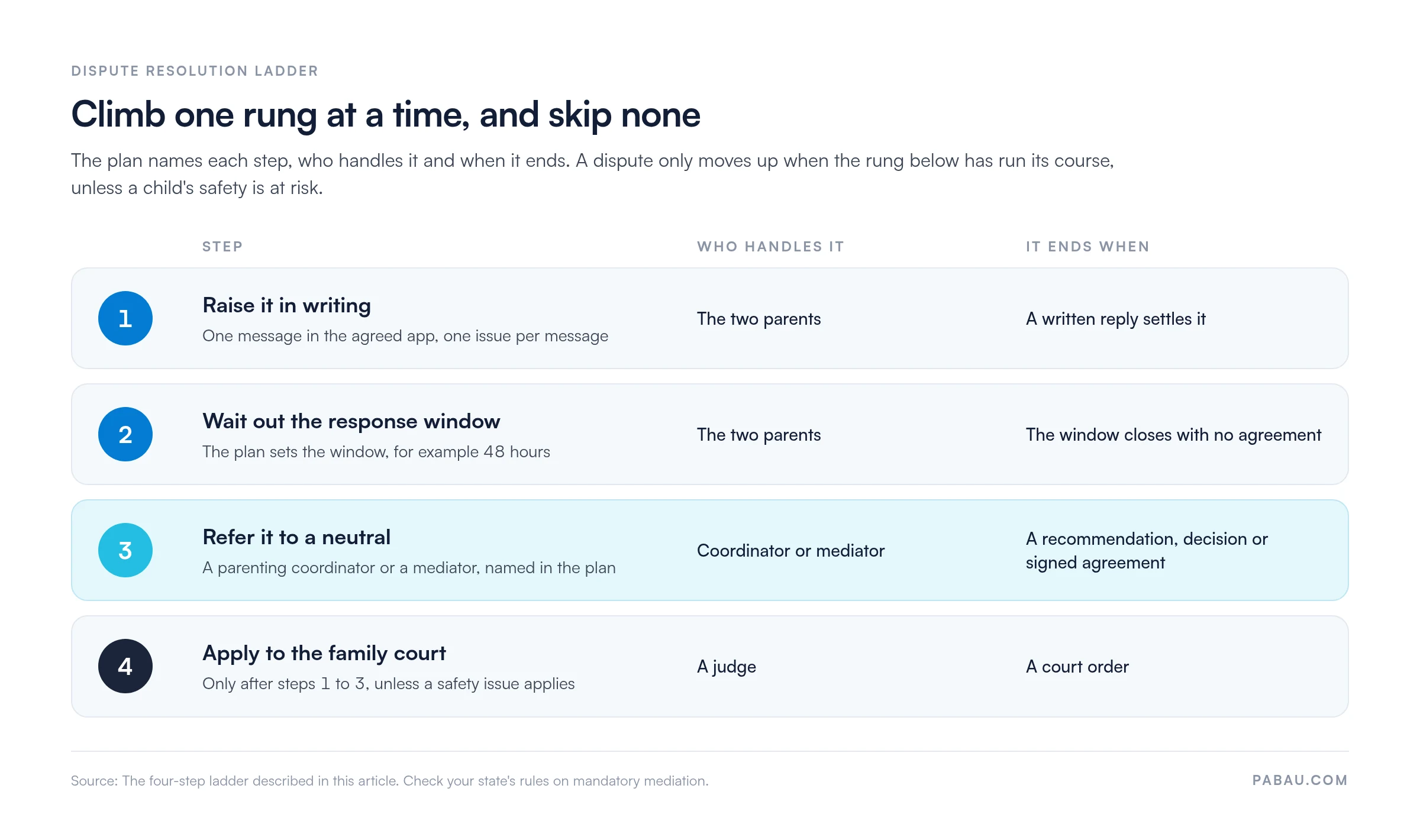
Write a safety exception into the ladder. A parent who believes the child is in danger can contact police or child protective services right away. They can also apply for an emergency order without climbing the earlier rungs. Check your state’s rules for mediation requirements before you rely on this sequence.
A parenting coordinator is a neutral professional who helps high conflict parents put their plan into practice. Most are mental health professionals or family law attorneys with mediation training.
The Association of Family and Conciliation Courts (AFCC) practice guidelines describe a child-focused role. A coordinator helps parents resolve disputes, teaches communication skills and, where the court or parents allow it, makes decisions within a set scope. A coordinator does not change legal custody or make major changes to the plan.
Use the template’s parenting coordinator field to name the coordinator, the fee split, the issues they may decide and the term of the appointment. States differ on whether courts can appoint coordinators, so confirm the rule where you live.
Child-focused clauses shift attention from the adults’ disagreements to the child’s routine and safety. Common provisions include the following.
The template’s therapy or counseling field belongs here too. Record who the child sees, who books and pays for sessions, and that both parents keep the child’s appointments during their own time. Enforceability of these clauses varies by jurisdiction, so confirm wording with a family lawyer before filing.
Audit each clause for vague words such as “reasonable” or “as needed”. Replace them with a time, place, or named action so both parents can follow the plan without interpreting it.
The wording below shows the level of detail a high conflict plan needs. Adapt the names, times and places, then have a family law attorney check it against your state’s requirements.
If one parent has narcissistic traits or a pattern of control, our narcissist parenting plan template covers clauses aimed at that dynamic.
The most frequent error is vague language. A clause that says “reasonable notice” gives each parent a different meaning, and the dispute returns to the same place.
Unstructured right-of-first-refusal terms are a second common problem. Without a notice period and a response deadline, the offer becomes a source of argument rather than a safeguard.
Use the template as a clause-by-clause starting point rather than a finished order. Each section asks you to fill in a specific fact, such as an exchange address or a response window.
Adapt wording to your state’s statutes, since each US state sets its own parenting plan requirements. Some states publish their own parenting plan forms, such as the Washington State parenting plan, and a court may expect you to use them.
A high conflict parenting plan becomes binding when a court reviews it and enters it as an order. A template alone does not give legal effect, and this page is not legal advice.
Consult a family law attorney before filing, particularly where domestic violence, mental health or supervised visitation is involved. If the parents cannot agree on a plan at all, each may submit their own proposal, and the judge decides.
You modify a court-ordered plan by agreeing on new terms and asking the court to approve them, or by filing a motion to modify. An informal side agreement is hard to enforce if one parent later backs out.
Use the template’s review and modification section to set a routine check-in, for example once a year or when the child changes schools. Courts generally expect a significant change in circumstances before they alter a plan without both parents’ consent.
Keep a dated record while the plan runs. Exchange logs, app messages and coordinator notes show which clauses work and which keep failing. That record is what supports a request for change.
Family therapists and counselors help parents follow a high conflict plan, but they do not enforce it. Their work sits alongside the plan and turns its rules into habits.
Keep roles clear. Many professional ethics codes separate treating a family from evaluating it for court. A child’s therapist therefore rarely acts as the parenting coordinator or custody evaluator in the same case. Therapists can use tools such as our divorce worksheet to structure sessions around separation.
For the practice, these cases bring heavy documentation. Intake forms, consents for each parent, release-of-information forms and session notes all need careful handling. Records may be subpoenaed, so dated, consistent notes protect both the family and the practitioner. Practices that see many of these families often choose therapy practice management software to keep those records in one place.
Many practices still run these cases on paper intake packets, emailed PDFs and notes saved in separate folders. When a parent disputes what was agreed, staff search inboxes and filing cabinets for the right signed copy.
With practice management software like Pabau, each parent completes intake and consent forms online before the first session. Signed forms, treatment notes and appointment history sit together on the patient record, with a date on each entry. Online booking lets each parent book their own sessions without contacting the other.
When a court or coordinator asks for records, the dated file is ready, and your team spends less time chasing signatures.

Pabau collects intake and consent forms online and stores them with session notes on each patient record. Your practice can produce a dated, organized file whenever a court or coordinator asks.

A high conflict parenting plan earns its keep by taking day-to-day decisions out of the parents’ hands. Pick the schedule with the fewest exchanges your child’s age allows, then route those exchanges through school.
Put every remaining contact point in writing, with a deadline and a named fallback. The trade-off is flexibility, and in a high conflict family that loss is usually worth it. Have an attorney check the final wording, then let the plan carry the decisions the parents can’t make together.
If your practice supports these families, keep their forms and notes as organized as the plan itself. Book a demo to see how Pabau keeps intake forms, consents and session notes in one dated record for each family.

Need a calmer way to work through disputes in session? Conflict resolution worksheet gives parents a structured way to break one disagreement into steps.
Coaching parents on routines and boundaries? Parenting skills worksheets cover the everyday skills a parallel parenting setup leans on.
Supporting a couple before they separate? Trial separation checklist covers ground rules, finances, custody and the legal steps of a trial separation.
Helping a parent build steadier routines at home? Parenting worksheet tracks progress on routines and the parent-child relationship.
A high conflict parenting plan is a written co-parenting agreement with detailed schedules, communication rules, exchange procedures and an escalation path for disputes.
Include the parenting time schedule, exchange procedures, communication protocols, decision-making authority, dispute resolution steps and child-safety provisions. Add a right of first refusal, shared-cost rules and a review date.
Parallel parenting is an arrangement in which parents limit direct contact and manage their own time with the child separately.
Yes, a plan can limit communication to a written channel and set response windows, subject to the rules of your state.
No single schedule suits every family, but schedules with fewer exchanges usually cause less friction. Alternating weeks needs two exchanges every two weeks, compared with six for a 2-2-3 schedule. Younger children may need shorter stretches away from each parent, so weigh age against exchange count.
A parenting coordinator is a neutral professional who helps high conflict parents follow their plan. They help resolve disputes, coach communication and, where the court or parents allow it, decide limited issues.
Yes. Parents can agree on new terms and ask the court to approve them, or one parent can file a motion to modify. Courts generally look for a significant change in circumstances first.
BIFF is a method from the High Conflict Institute for replying to hostile messages. A BIFF reply is brief, informative, friendly and firm, and it closes the topic without inviting more argument.