Mental health self-care checklist
A mental health self-care checklist is a structured daily tool for tracking the ...

6
Last Updated: Oct 20, 2026

Parenting skills worksheets are structured tools that help a clinician and a parent name a parenting pattern before trying to change it.
This worksheet runs in five sections: parenting style, emotional regulation and communication, secure attachment, behavior and boundaries, then self-reflection and a weekly goal.
The order matters. Assess the parent’s style first, teach one skill, rehearse it at home, then record the goal the parent chose.
Pabau’s digital forms send the worksheet before the appointment and file the parent’s answers straight into the client record.
A five-section printable worksheet covering parenting style awareness, emotional regulation and communication, secure attachment, behavior and boundaries, and self-reflection. It closes with a weekly parenting skill goal the parent sets themselves.
Download templateParenting skills worksheets give a session the structure that conversation alone rarely holds.
Each section takes one competency — style, regulation, attachment, boundaries — and turns it into questions a parent can answer in writing.
That written answer is the part worth having. A parent will describe the same argument three ways across three sessions. A completed worksheet fixes their account of it, so you both work from the same starting point next time.
Below you’ll find what each section of the download surfaces, and which stage of treatment it suits. Then comes the session sequence, and what belongs in the client note afterward.
Parenting skills worksheets are structured clinical tools that assess and build parenting competencies. They cover communication, discipline, emotional management, and co-parenting coordination. Therapists, family counselors, and parent coaches use them in session and as homework between appointments.
Unlike general parenting advice, a worksheet gives the parent a systematic way to examine one challenge at a time. It surfaces strengths alongside problems. And it ends in a strategy the parent picked, which they defend far better than one you prescribed.
These tools do two jobs at once. They assess where a parent currently stands, and they intervene to move them. A parenting style questionnaire helps a client recognize their default approach. The four styles come from Diana Baumrind and later researchers: authoritative, authoritarian, permissive, and uninvolved.
The American Psychological Association and the American Association for Marriage and Family Therapy both treat parenting skills work as an evidence-based part of family therapy. Written worksheets are what make that work repeatable, across sessions and across clinicians in the same practice.
The worksheet opens with the parent’s name, the child’s name and age, and the date. Then it moves through five sections, each with two or three open questions and a short explanation the parent reads first.
You do not have to work through all five in one sitting, and most families shouldn’t. The sections map onto the stages of a course of parenting work, which is what the grid below sets out.
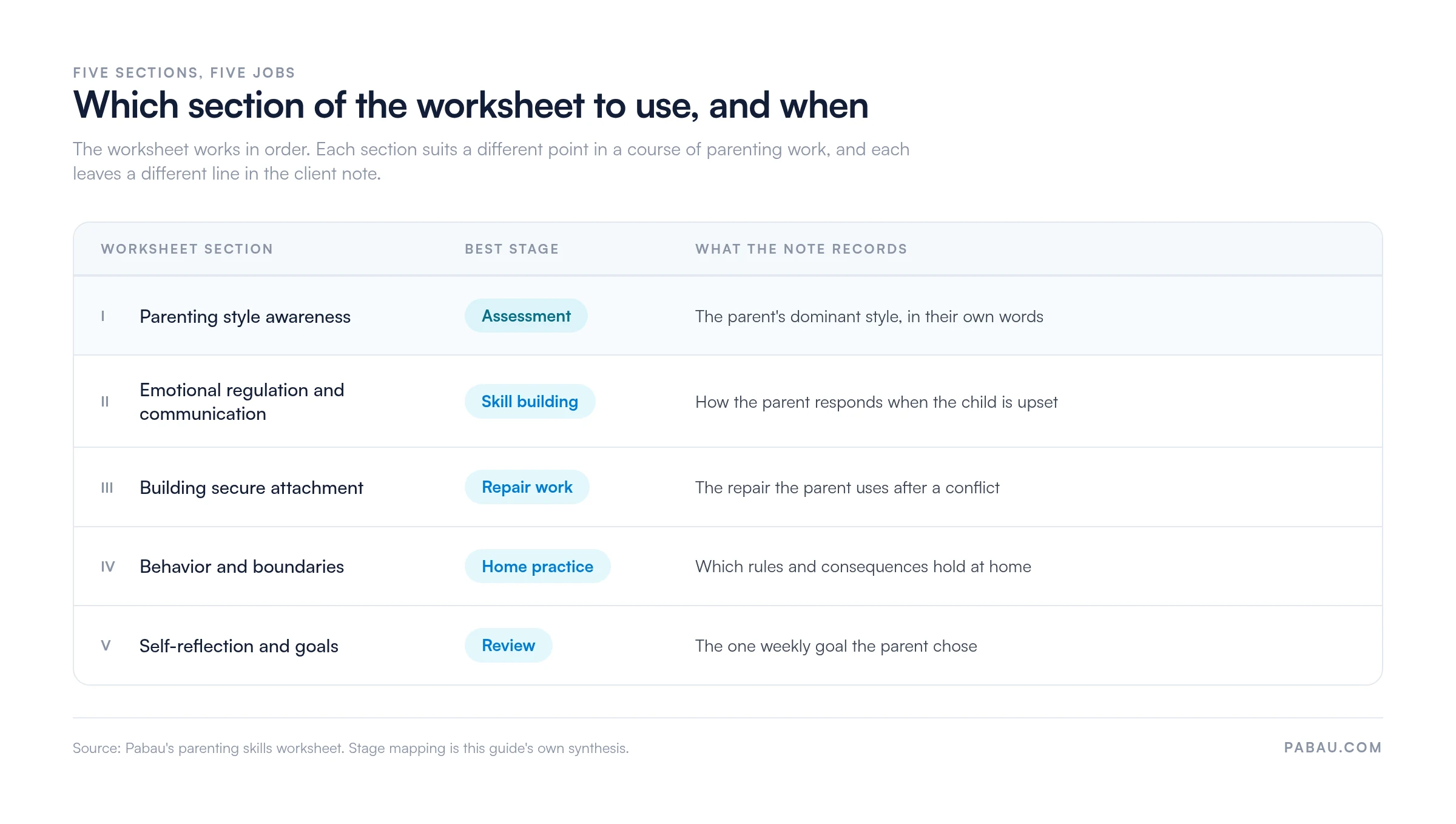
Handing over section IV in week one is the most common way this work stalls. A parent writes a set of consequences they have not yet learned to hold to. They miss them by Wednesday, and read that as proof they are failing.
This worksheet is a general assessment. Once it points you at a specific problem, a narrower form usually does the follow-up work better.
The sequence is short. Name the purpose, complete the first section together, discuss what surfaced, set one home task, and write it up.
The same worksheet does a different job depending on who hands it over.
Most practices email the worksheet as an attachment and then wait. The parent prints it, fills it in, photographs it, and sends it back. Or forgets. The completed form ends up in somebody’s inbox instead of the client file.
Practice management software like Pabau turns the worksheet into a digital form instead. You send it from the client’s record. The parent completes it on their phone before the appointment, and the answers land back in that record automatically. Nothing gets rekeyed.
You can edit the wording of any section and add your practice’s branding. You can also set a form to send itself a few days before each appointment. Every Pabau subscription includes the digital forms, the client portal, and the reporting, so none of it sits behind a higher tier.
The payoff is a client file a colleague can read. They can see which section went out, what came back, and what the parent committed to between visits — without opening a single email thread.

Pabau’s digital forms send a parenting worksheet before the appointment and file the parent’s answers against their record automatically. Your notes stay complete without anyone chasing paper.

Match the section to where the family actually is, not to the complaint they arrived with. A parent who has not yet seen their own default style will fill in a discipline plan and keep the same habits at home.
These forms are cheap to hand out and easy to lose track of. When completed worksheets sit in an email thread, the progress they document never reaches the file, and the next review starts from scratch.
Get the order right and keep the paper in the record. A course of parenting work then reads as a documented intervention rather than a run of good conversations. Book a demo to see how Pabau sends parenting worksheets and files the answers against each client record.

Need to pin down a parent’s default style first? Parenting style questionnaire scores the four styles, so you open the conversation with a result rather than a hunch.
Working with the whole family, not just one parent? Family dynamics worksheet maps roles, alliances and communication patterns across the household.
Need the boundaries section to hold for a full week? ABC behavior chart records antecedent, behavior and consequence, so a pattern becomes visible.
Is the parent’s own regulation the sticking point? Emotional regulation checklist gives them steps to follow in the moment, not a reflection to write afterward.
Supporting a family managing an ADHD diagnosis? ADHD handout for parents explains the diagnosis in language a parent can take home and reread.
Start with parenting style awareness. It gives you the parent’s dominant approach in their own words. The four later sections all read differently once that pattern is on the page.
Introduce the section that matches the presenting problem, complete it together or assign it as homework, then process the answers next session. That structure creates accountability and documents progress over time.
Yes. Practice management platforms including Pabau let you reword questions, add your branding, or drop items that do not fit your clinical model. That keeps the form aligned with how you already work.
Parenting skills interventions are among the most studied components of family therapy. The APA, the AAMFT and the CDC all recognize them as effective for reducing child behavioral problems and improving family relationships.
Families managing child behavioral challenges, ADHD, oppositional defiant disorder, anxiety, or general parenting stress. Separated parents coordinating care benefit too, as do parents who want to shift a style they recognize as inherited.