HIPAA compliant texting: What you can send patients & how to communicate securely
HIPAA compliant texting is possible when a text holds no protected health inform...

Last Updated: Oct 16, 2026
The VAK learning styles self-assessment questionnaire is a 30-question form that shows whether someone prefers to take in information by seeing, hearing, or doing. Each question offers three answers, one for each style. The style a person picks most often is their preferred way to learn.
In a practice, the result works best as a communication note. It tells you whether a new hire wants a written protocol or a demonstration, and whether a patient wants aftercare explained or illustrated. Treat it as a preference, not a fixed trait, because research doesn’t support teaching people only in their preferred style.
A three-page PDF with 30 everyday questions, each offering a visual, an auditory and a kinesthetic answer, plus fields for name and completion date. Score it with the three steps in this guide to find a learner’s preferred style.
Download template
The VAK model sorts learning preferences into three styles: visual (seeing), auditory (hearing and discussion), and kinesthetic (doing and hands-on practice).
This template has 30 questions with three answers each, and the style you choose most often is your dominant preference.
Research does not support matching teaching to a single style, so use the results as a communication preference rather than a rule.
In a practice, the results help you choose how to deliver staff onboarding, consent conversations, and aftercare instructions.
Pabau’s digital forms can collect the questionnaire at intake and save the answers to the patient record, so every team member sees the preference.
A VAK learning styles self-assessment questionnaire is a short self-report tool that measures which sensory channel a person prefers when learning. VAK stands for visual, auditory, and kinesthetic.
The model comes from educational psychology and is closely related to VARK, which adds a fourth read/write category. In practices, trainers and clinicians use it to tailor onboarding, consent discussions, and patient education to how each person likes to receive information.
The questionnaire works as both a self-discovery tool and a practical guide for communication. Once you know a team member or patient leans visual, auditory, or kinesthetic, you can adapt your approach. That might mean diagrams for visual learners, verbal walkthroughs for auditory learners, and hands-on practice for kinesthetic learners.
Each style describes a different preference for how information is received and retained. The table below sums up what each type of learner tends to prefer and which teaching methods suit them.
Most people are multimodal learners. They combine preferences from two or three styles rather than relying on one. The questionnaire shows how strong each preference is, and whether someone leans hard on one style or switches easily between them.
Filling out the VAK questionnaire takes about five to 10 minutes and needs no training or special tools.
The completed form is a starting point for a conversation, not a verdict. Many teams use the results to decide how they deliver staff onboarding, patient education, and consent discussions.
Scoring comes down to two numbers: your highest total, and how far it leads the next one. The diagram below walks through the whole tally, from a single answer to a final profile.
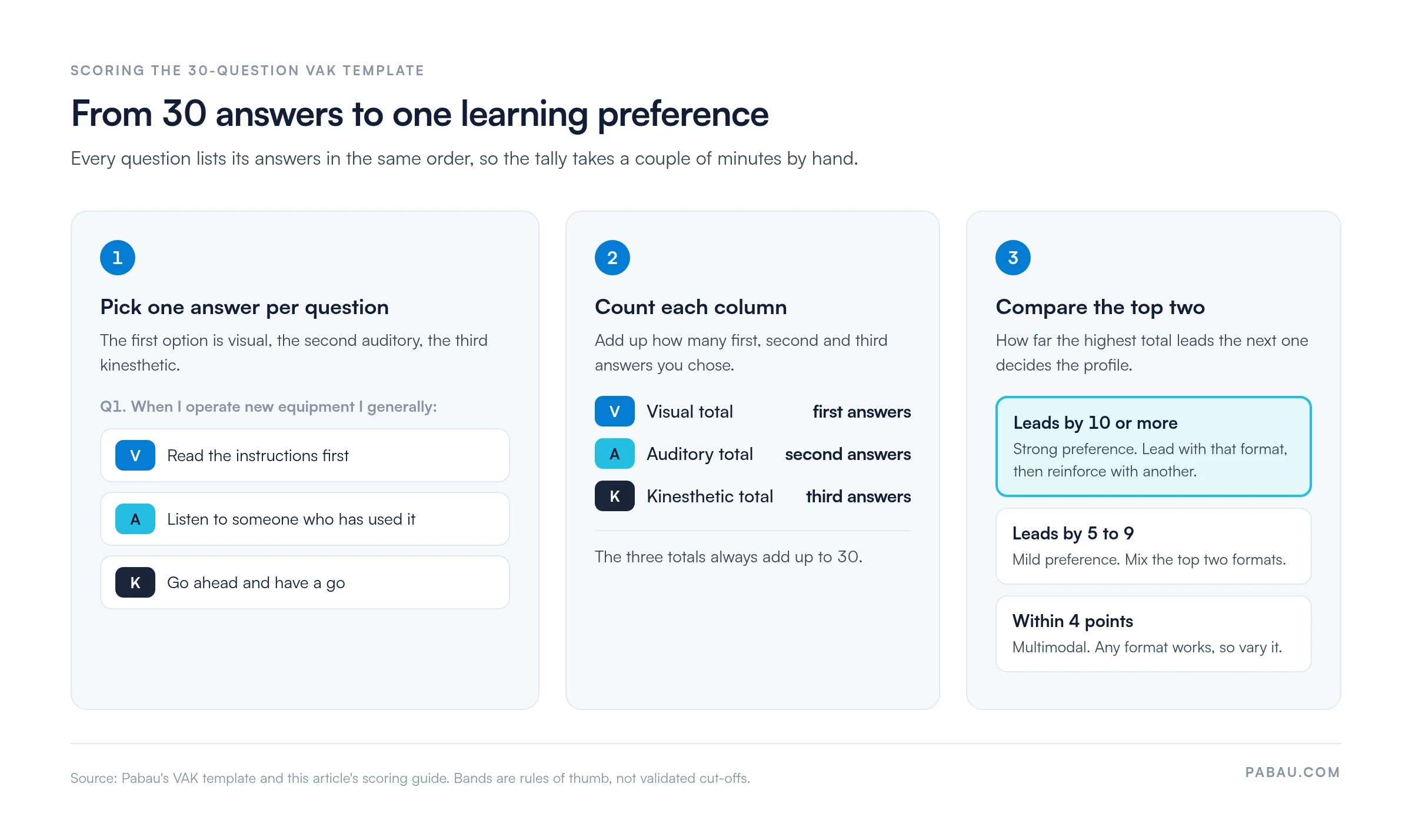
Use the lead between your top two totals to read the profile. These bands are practical rules of thumb, not validated cut-offs.
Healthcare professionals often score as multimodal. Clinical work demands constant switching between reading notes, listening to colleagues, and performing procedures. Your profile reflects a natural baseline, and you can usually learn well in more formats than any single score suggests.
The results are most useful where clear communication directly affects patient care and team competence.
If you’re building structured learning for nursing or clinical students, pair the results with an ATI active learning template. It gives each learner a consistent way to work through a clinical concept, whatever their style.
VARK extends the VAK model with a fourth style, read/write. Neil Fleming introduced it in 1987. VARK (visual, aural, read/write, kinesthetic) recognizes that some learners prefer to take in and express information through reading and writing.
A visual learner prefers diagrams and charts, while a read/write learner prefers textbooks and written lists. Both rely on the eyes, but the processing differs. One favors graphics and space, and the other favors language.
For most practice uses, the three-style VAK model is enough. Teams running more detailed learning assessments often choose VARK to capture the extra distinction. You can read more on the official VARK website.
The VAK model is widely used, but the evidence behind it has clear limits. A major 2008 review by Pashler and colleagues, Learning Styles: Concepts and Evidence, tested the “meshing hypothesis.” That’s the idea that teaching in someone’s preferred style improves their results. The authors found no adequate evidence to support it.
People learn well across many formats. Sticking rigidly to one style can even limit exposure to teaching methods that would help.
Best practice treats VAK results as one input among many, alongside prior knowledge, motivation, task complexity, and subject matter. The tool still helps improve patient engagement and clarity of communication. It just shouldn’t suggest that visual learners can’t learn by listening, or that kinesthetic learners can’t learn from reading.
In a practice, the value lies in awareness. Knowing a patient’s or colleague’s preference shapes how you communicate, even with the model’s scientific caveats. Adaptability matters more than rigid labels.
A few practical habits make the assessment more useful and prevent misuse.
On paper, a completed questionnaire usually ends up in a folder. The next clinician then explains aftercare their usual way, whatever the patient said they preferred.
Practice management software like Pabau lets you send the questionnaire as one of your digital forms before the first visit. The answers are saved to the patient record, so anyone treating that patient can see how they like information delivered.
From there, you can match delivery to the preference. Written aftercare instructions go out automatically after each appointment for patients who want something to read. During the consultation, Pabau Scribe, our AI scribe, transcribes and summarizes the conversation. Your verbal explanation lands in the notes without extra typing.

Pabau’s digital forms collect the questionnaire before the visit and save the answers to the patient record. Your team can then explain treatment and aftercare in the format each patient prefers.

The VAK questionnaire earns its place when the answers change what you do next. Scoring takes minutes. The payoff comes when a nervous patient gets a diagram instead of a wall of words. It also shows when a new hire practices a procedure before reading the protocol.
Keep the research caveat in view, too. Use the result to choose a starting format, then add a second one and check understanding. Don’t box anyone into a single style.
Download the template above and try it with your next new hire or patient. Book a demo to see how Pabau stores each patient’s preferences, so every clinician explains care in the format that patient prefers.

Setting up intake paperwork? New patient questionnaire template covers the details to collect before a first visit.
Need a fuller intake process? Intake assessment and evaluation template helps you structure a patient’s first assessment.
Moving forms off paper? Best clinical documentation software compares tools that keep forms and notes on the patient record.
It’s a short self-report tool that shows whether a person prefers to learn by seeing (visual), hearing (auditory), or doing (kinesthetic). This version has 30 questions with three answers each. Trainers and clinicians use the results to tailor training, patient education, and team communication.
Most versions have around 30 questions, including this template. Each question describes an everyday situation and offers three answers, one for each style. You pick the answer that fits you best, which takes about five to 10 minutes.
VARK adds a fourth style, read/write, to the visual, auditory, and kinesthetic styles in VAK. It separates people who prefer written words from those who prefer diagrams and charts. VARK gives a more detailed profile, while VAK is quicker to run.
No. A major 2008 review by Pashler and colleagues found no adequate evidence that teaching in someone’s preferred style improves their results. The model is still useful for understanding communication preferences, as long as you combine it with other teaching strategies.
Use it to guide how you ask for training and information. Visual learners can request diagrams and written guides, and auditory learners can ask for verbal explanations. Kinesthetic learners can ask for demonstrations or hands-on practice. Share your preference with trainers, managers, or healthcare providers so they can adjust their explanations.
Yes. Preferences can shift with expertise, context, and the type of material. A newly trained clinician may rely on visual protocols and step-by-step demonstrations. An experienced clinician might pick up new information faster through brief written updates or peer discussion. Reassessing periodically captures these shifts.