HIPAA compliant texting: What you can send patients & how to communicate securely
HIPAA compliant texting is possible when a text holds no protected health inform...

Last Updated: Oct 16, 2026
A human resource compliance checklist is a structured list of the records and legal duties your practice owes as an employer, from hiring to termination. This one covers eight areas: personnel files, hiring, payroll, training, benefits, safety, anti-discrimination and offboarding.
Healthcare practices carry extra duties on top of standard employment law. Clinical licenses need verifying, HIPAA training needs recording, and inspectors expect every personnel file to be complete. Work through the checklist at a quarterly review, so problems surface before an audit or a claim does.
An eight-section checklist covering personnel files, onboarding, payroll, training, benefits, OSHA safety, EEO practices and offboarding. Tick off each item at your quarterly review and file the signed copy.
Download template
A human resource compliance checklist covers eight areas: personnel files, hiring, payroll, training, benefits, safety, anti-discrimination and termination.
The Department of Labor can fine up to $2,515 per violation (2025 rate) for willful or repeat minimum-wage or overtime breaches. Discrimination claims, state labor board action and, in the UK, CQC findings add to that exposure.
Quarterly reviews against the checklist catch missing documents early and leave a written record of good-faith compliance.
Practice management software like Pabau keeps staff contracts, qualifications and DBS checks on each staff profile, alongside timesheets and task due dates.
Healthcare employers carry heavier compliance duties than most industries. Standard employment law already covers the Fair Labor Standards Act (FLSA), equal employment opportunity laws and state labor codes. Practices also answer to HIPAA, staff credentialing rules and mandatory clinical training. Many face state medical board oversight too, or CQC registration in the UK.
The stakes are concrete. The Department of Labor can fine up to $2,515 per violation (2025 rate) for willful or repeat minimum-wage and overtime breaches. Penalties are usually counted per employee, so they add up fast. EEOC discrimination claims can end in settlements above $100,000, and state labor boards issue stop-work orders for safety violations.
In the UK, a CQC inspection can suspend registration when personnel files lack required documents. A staff management system that holds every record in one place gives you evidence to hand over when an auditor asks.
Every employee file must contain a defined set of documents. Federal rules require you to keep Form I-9, W-4 tax withholding records and payroll records, most for at least three years. Many practices keep performance, discipline and termination documents for seven years. That timeline lines up with statute-of-limitations windows for wrongful-termination claims.
Healthcare practices should also keep clinical credentials, training certificates, background-check clearance letters, and any scope-of-practice documents issued by state medical boards or credentialing bodies.
Storing these files digitally, in one searchable location, means you can produce any document in minutes when an inspector or attorney asks for it.
Pre-employment screening and first-day procedures must follow a consistent sequence. The Immigration Reform and Control Act (IRCA) requires I-9 verification within three business days of the start date. The Fair Credit Reporting Act (FCRA) requires written applicant consent before a background check. Equal employment laws also bar interview questions about protected characteristics.
Healthcare practices must also verify professional licenses through state licensing boards. Get criminal-history clearance, or a DBS check in the UK, before the employee sees patients or handles health information. If you bill Medicare or Medicaid, screen every new hire against the OIG exclusion list too, since employing an excluded person can bring civil penalties.
Build these steps into an automated onboarding workflow and staff get an alert when their step is due. That keeps new hires from starting work with paperwork still outstanding.
The FLSA sets minimum wage, overtime and record-keeping rules. Misclassifying an employee as exempt when they qualify for overtime is one of the most common and costly violations. Take a salaried clinician with no overtime tracking. If their duties fail the professional exemption test, they may be owed back pay for hours over 40 a week.
Payroll compliance also requires accurate wage-and-hour record retention, timely final paychecks, proper payroll tax deposits, and year-end W-2 and 1099 filings.
Mandatory compliance training must be documented in each employee’s file with the completion date and certificate. That covers harassment prevention, HIPAA privacy, safety protocols and clinical credentialing updates. Many states require annual harassment prevention training, and OSHA requires safety training before employees work in hazardous areas. Most healthcare employers also run an annual HIPAA refresher.
Complete training records show due diligence in an investigation and protect the practice during regulatory audits.
Employers with 50 or more full-time equivalent employees must offer health coverage and file Affordable Care Act (ACA) reports, or face penalties. COBRA requires written notice to employees who lose coverage through termination or reduced hours. Notices must go out within 44 days of the qualifying event.
State-mandated benefits, such as disability insurance and family leave, vary by location and need tracking separately. Keep a benefits calendar with renewal dates, compliance deadlines and open-enrollment windows.
OSHA requires many employers to keep an injury and illness log (Form 300) and retain it for five years. Employers with 10 or fewer staff, and many physician and dental offices, are partially exempt, so check OSHA’s list for your industry.
Practices with exposure to bloodborne pathogens need a written exposure control plan. Exposed employees must be trained and offered the hepatitis B vaccine at the employer’s expense. Keep safety data sheets (SDS, formerly MSDS) for every chemical used on site, and train staff on hazard communication.
Several federal laws prohibit employment decisions based on protected characteristics. Title VII of the Civil Rights Act covers race, color, religion, sex and national origin. The Age Discrimination in Employment Act (ADEA) protects workers aged 40 and over, and the Americans with Disabilities Act (ADA) covers disability.
State laws often add more protected groups. The Equal Employment Opportunity Commission (EEOC) enforces the federal laws and investigates complaints filed by employees.
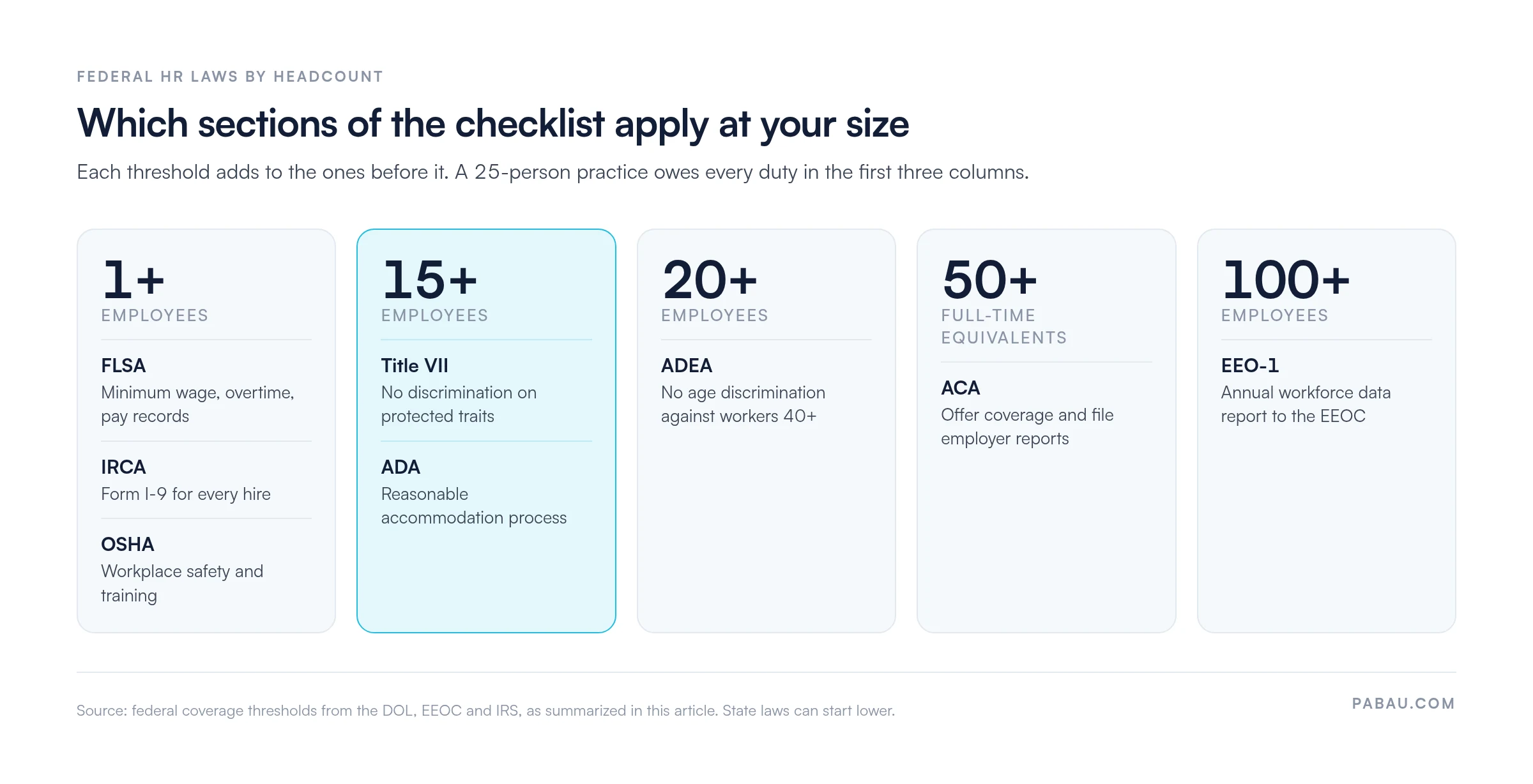
Which of these laws apply depends on headcount. Title VII and the ADA start at 15 employees, and the ADEA at 20. Employers with 100 or more employees also file an annual EEO-1 report on workforce demographics by job category. The chart below maps every federal threshold in this checklist.
Documentation matters here. Keep written performance reviews, disciplinary records and the reasons behind every termination decision in each file. A standard employee counseling form puts each written warning in the same format, which makes the record easier to defend.
If an employee requests a reasonable accommodation, such as a flexible schedule for a disability or time for religious observance, document the request. Record the interactive process too, plus the final accommodation or denial with written reasons.
Final paychecks are due on the last day of work or within the timeframe set by state law, often the next regular payday. Some states, including California, require payout of accrued, unused vacation, while others follow your written policy.
If the employee had health insurance, send the COBRA continuation notice within 44 days of termination. Document the return of company property, such as keys, badges and equipment. Keep the complete personnel file for three to seven years after termination in case of a later dispute or government investigation.
Start by assigning ownership and a review calendar. Your HR manager, or the practice manager if you have no dedicated HR person, leads the quarterly reviews. Then give each section an owner. Payroll might sit with your accountant, hiring with the HR manager and staff training with the clinical director.
Roll it out in five steps.
An annual third-party HR audit or legal review is worth the cost after growth or restructuring. An outside reviewer spots issues your team has stopped noticing, and the report documents your due diligence if a dispute comes up later.
Many practices still run HR compliance from paper files, spreadsheets and email reminders. When an inspector asks for a clinician’s license or DBS check, someone has to go hunting for it.
With all-in-one practice management software like Pabau, contracts, qualifications, insurance certificates and DBS checks upload straight to each staff profile. Timesheets log clock-ins, breaks and hours as they happen, which gives you the wage-and-hour records the FLSA expects.
Role-based permissions control what each team member can see, so front-desk staff can’t open clinical records they don’t need. Follow-ups sit on a task board with a named owner and a due date, and a chase appears when that date passes.
On the patient side, Pabau’s compliance tools add audit trails and field-level access controls that support HIPAA. Come audit day, you pull each record up in minutes instead of spending a week chasing paper.
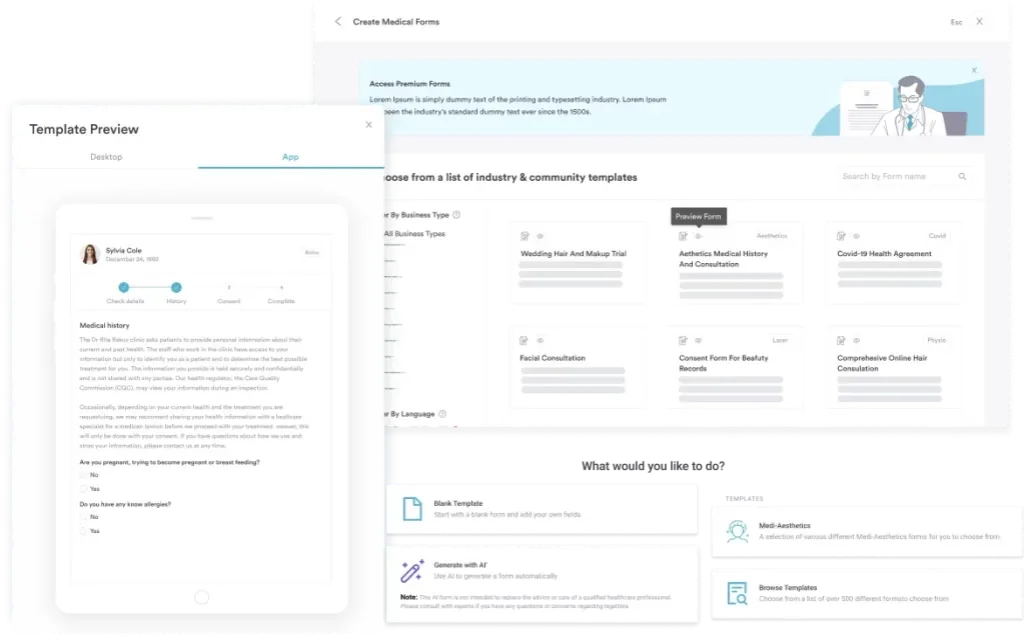

Pabau stores staff contracts, qualifications and DBS checks alongside timesheets and task due dates, so each personnel file is ready when an inspector asks.

Most HR compliance trouble traces back to small lapses: a missing I-9, an untracked overtime hour, or a license that lapsed before anyone checked.
The checklist only works when someone owns each section and the reviews happen on schedule. Pick your owners this week and book the first quarterly review before the month ends.
The trade-off is an hour or two each quarter against fines of up to $2,515 per willful or repeat violation. Book a demo to see how Pabau keeps staff records, timesheets and follow-ups ready for your next audit.

Choosing a payroll tool? Best healthcare payroll software compares payroll platforms built for healthcare practices.
Building out personnel files? Employee information form template gives you a ready-made form for the contact and role details each file needs.
Documenting performance? Annual review template for healthcare practices keeps the performance reviews in every file in one consistent format.
Adding restrictive clauses to contracts? Physician non-compete agreements explains how non-compete clauses work in physician employment contracts.
An HR compliance checklist covers eight areas: hiring, employee records, payroll, training, benefits, workplace safety, anti-discrimination and termination. Each area lists the documents and deadlines the law requires, such as I-9 forms, overtime records, COBRA notices and OSHA logs. Healthcare practices should add clinical credential verification and HIPAA training records.
Review HR compliance quarterly. That catches missing items early and leaves time for corrective action before an audit or regulatory visit. Many practices also book an annual third-party HR audit, especially after major staffing changes or expansion.
A compliance review is an internal check. Your team uses the checklist to confirm that hiring, payroll, training and records meet legal standards. An HR audit is usually run by an outside HR consultant or attorney, who tests your practices against current law and recommends changes. The audit report documents your due diligence if a legal dispute arises.
Yes. The checklist above is free to download. Adapt it to your practice size, location and clinical specialty. The Department of Labor’s compliance assistance resources and your state labor board’s website make useful supplements.
Wage-and-hour violations, such as misclassified employees and unpaid overtime, carry the largest penalties. Missing I-9 paperwork, skipped notices (COBRA, harassment prevention training) and poor record retention also draw frequent federal investigations. For healthcare employers, missing credential checks or DBS checks can lead to regulatory action.
Most employers, whatever their size, must follow the FLSA (minimum wage and overtime), IRCA (I-9 verification) and OSHA (safety). Employers with 15 or more employees must also follow Title VII and the ADA, and the ADEA applies from 20 employees. Employers with 50 or more full-time equivalents face ACA reporting requirements. State and local laws vary, so check with your state labor board for mandates such as paid leave, harassment prevention training and local wage rules.