Nursing narrative note template
A nursing narrative note template is a structured PDF that guides you through re...

2
Last Updated: Oct 21, 2026

A DM medication list organizes every major diabetes drug by class, with generic and brand names, mechanism of action, and monitoring requirements.
Metformin is first-line oral therapy for most type 2 patients. Insulin stays the foundation of type 1 care and of advanced type 2 disease.
GLP-1 receptor agonists and SGLT-2 inhibitors now lead second-line choice, and most type 2 patients end up on combination therapy.
Every entry needs a monitoring line as well as a dose, since B12, eGFR, and A1C intervals are what reviews are built on.
Practice management software like Pabau stores the regimen in the patient record, then brings each patient back for the review that checks it.
A DM medication list is the single reference that sets out every diabetes drug by class, with its dose range, mechanism, and monitoring requirements.
The classes it covers are insulin, biguanides, GLP-1 receptor agonists, SGLT-2 inhibitors, DPP-4 inhibitors, sulfonylureas, thiazolidinediones, meglitinides, alpha-glucosidase inhibitors, and fixed-dose combinations. Metformin is first-line oral therapy for most type 2 patients, and insulin remains the foundation of type 1 care.
New approvals arrive and dosing parameters shift, so the list needs a review cadence of its own. This guide covers how each class works and gives an A1C-to-intensification table. It also sets out the fields every entry should record, and how to run a review from it.
A ready-to-use clinical reference covering insulin types, oral agents, injectable non-insulin agents, and fixed-dose combination products. Each entry carries the generic name, brand name, mechanism of action, typical dosing notes, and the monitoring points that belong in the record.
Download templateA DM medication list is a clinical reference that consolidates the major diabetes medications into one scannable document, organized by drug class. It saves switching between sources to check a brand-name equivalent, a dose range, or which agents carry cardiovascular and renal benefits.
Take a new type 2 patient with chronic kidney disease and an A1C of 8.2%. The clinician needs to know which second-line agents are safe in renal impairment, what dose adjustments apply, and which drugs protect the kidney. Without a list, that means searching three separate sources mid-consultation.
Practices also use the list for clinical documentation, patient education, and medication reconciliation at reviews. The same document supports an audit of the medication record, confirming that drug selection and monitoring were both appropriate.
Every diabetes medication sits in a class with its own mechanism, target population, and clinical context. Knowing the categories is what makes a logical treatment sequence and a sensible combination regimen possible.
Insulin remains the foundational therapy for type 1 diabetes and advanced type 2 disease. Modern regimens combine rapid-acting insulin (lispro, aspart, glulisine), short-acting regular insulin, intermediate-acting NPH, and long-acting basal insulin (glargine, degludec, detemir).
Onset, peak, and duration all vary by formulation. They also vary by route, whether that is subcutaneous injection, an insulin pump, or inhaled rapid-acting insulin.
Metformin is first-line oral therapy for most type 2 patients, working through hepatic glucose suppression and improved insulin sensitivity. Standard dosing runs 500 to 2,550 mg daily in divided doses, and extended-release formulations allow once-daily dosing.
It is contraindicated below an eGFR of 30 mL/min/1.73 m², and starting it between 30 and 45 is not recommended. Gastrointestinal upset is the common side effect, and gradual titration keeps it manageable.
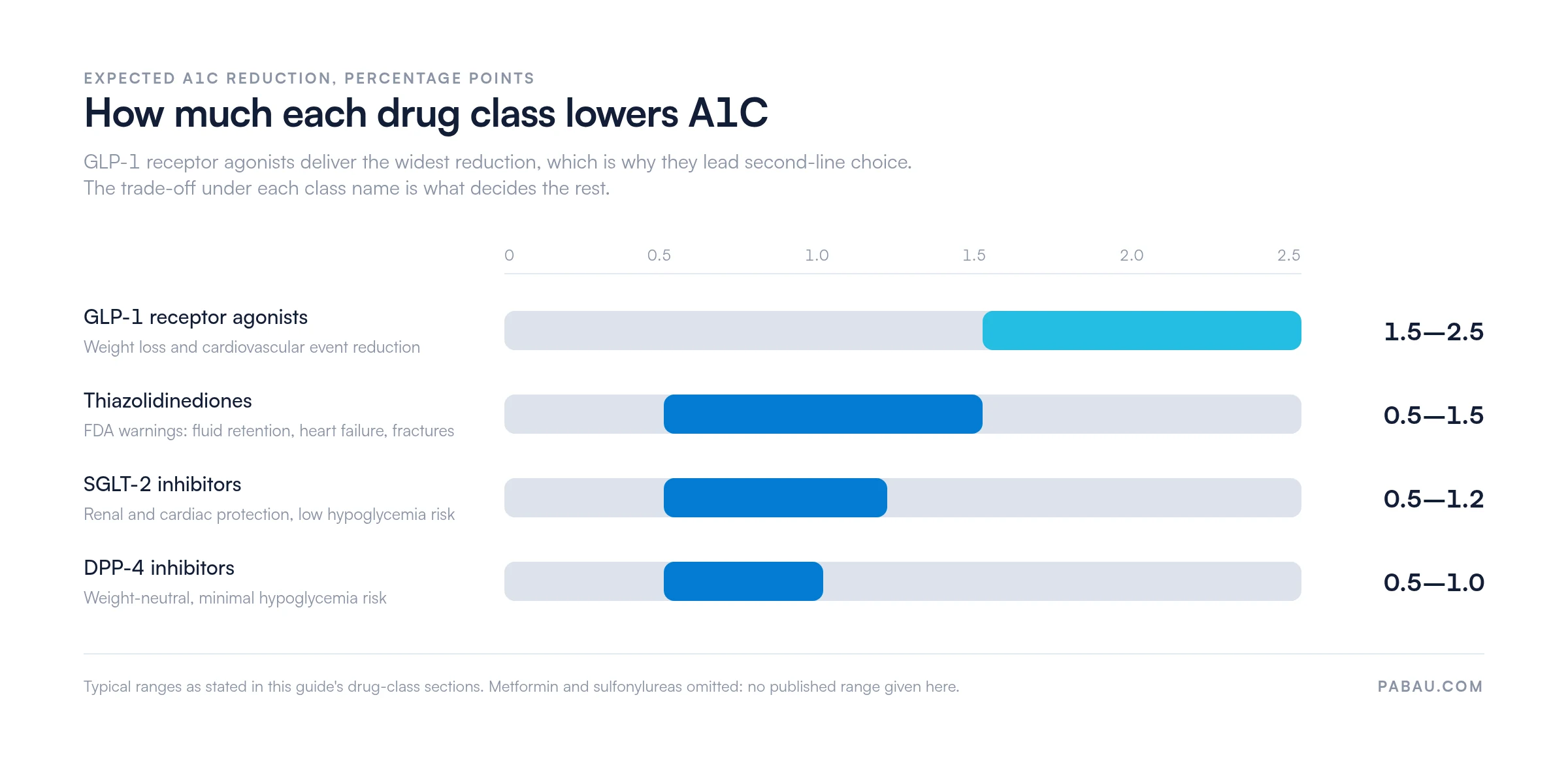
GLP-1 receptor agonists (semaglutide, tirzepatide, liraglutide, dulaglutide) enhance postprandial insulin secretion and slow gastric emptying. They deliver strong A1C reduction of roughly 1.5 to 2.5%, alongside cardiovascular event reduction and weight loss. That combination matters most in patients with obesity.
Ozempic and Mounjaro are approved for glycemic control, while Wegovy and Zepbound are approved for weight management. Dosing is subcutaneous, once weekly or once daily depending on the agent.
SGLT-2 inhibitors (empagliflozin, dapagliflozin, canagliflozin) promote urinary glucose excretion, through a mechanism that does not depend on insulin secretion. They give A1C reduction of about 0.5 to 1.2%, modest weight loss, and lower blood pressure.
The cardiovascular and renal protection matters most, and it is documented in the EMPA-REG OUTCOME, CREDENCE, and DAPA-CKD trials. These are oral tablets, well tolerated, with low hypoglycemia risk.
DPP-4 inhibitors (sitagliptin, saxagliptin, linagliptin) prolong glucagon-like peptide-1 activity by blocking its breakdown. They offer modest A1C reduction of 0.5 to 1%, stay weight-neutral, and carry minimal hypoglycemia risk. Dosing is oral, once or twice daily depending on the agent.
Sulfonylureas (glipizide, glyburide, glimepiride) stimulate pancreatic beta cells to release insulin directly. These older agents reduce A1C substantially, but they carry hypoglycemia risk and modest weight gain. They are usually reserved for patients who cannot tolerate or afford newer agents, or where glycemic control is needed quickly.
Thiazolidinediones (pioglitazone, rosiglitazone) improve insulin sensitivity at tissue level. They carry FDA warnings for fluid retention, worsening heart failure, and higher fracture rates with long-term use. A1C reduction is modest, at roughly 0.5 to 1.5%. That risk profile is why they are prescribed less often now.
Meglitinides (repaglinide, nateglinide) trigger a rapid, short-lived insulin release and are taken before meals, mainly for postprandial hyperglycemia. Alpha-glucosidase inhibitors (acarbose, miglitol) slow carbohydrate absorption in the small intestine and blunt the same post-meal spikes. Both classes are less potent than first-line agents.
The A1C reduction each class delivers varies widely, and the trade-off attached to it usually decides the prescription.
Fixed-dose combinations consolidate a multi-agent regimen into one product, which makes adherence easier for the patient. Common products pair metformin with a sulfonylurea (Metaglip) or a DPP-4 inhibitor (Janumet). Others pair a GLP-1 agonist with basal insulin (Xultophy), or an SGLT-2 inhibitor with a DPP-4 inhibitor (Glyxambi).
Each one turns several pills into a single formulation while still allowing dose titration. Record the combination product and its components, so the next clinician can see both.
American Diabetes Association guidelines recommend an individualized A1C target, typically 7% for most adults. Aim higher for patients with limited life expectancy or high hypoglycemia risk, and lower for motivated younger patients.
An A1C conversion chart is useful where the patient tracks estimated average glucose instead. The table below maps A1C ranges to intensification steps and the agents preferred in each clinical context.
This framework follows the ADA Standards of Care. Medication choice rests on A1C alongside cardiovascular disease, chronic kidney disease, body weight, hypoglycemia risk, and cost. A companion cardiovascular medication list records the heart and blood pressure drugs already in the regimen. Practices running medication verification workflows can record those factors in the treatment plan the patient takes home.
Key clinical insight: GLP-1 receptor agonists and SGLT-2 inhibitors have changed how type 2 diabetes is sequenced. They are now the preferred add-on for patients with established cardiovascular disease, heart failure, or chronic kidney disease. The evidence behind that is the demonstrated reduction in mortality and hospitalization.
A medication list is only useful at the point of care if every entry carries the same fields. The template uses seven, and each one answers a question that comes up during a review.
Monitoring is the field that keeps a review honest, and it is the easiest one to omit. A metformin entry without a B12 line is a deficiency nobody looks for until the patient reports numbness.
Reviews should run every three to six months for patients on a new regimen, and at least annually for stable patients. Patients often arrive on drugs from other specialties, so a reference for overactive bladder medications keeps that part of the regimen documented. Work through the list in the same order each time.
Reading the patient’s blood glucose log alongside the A1C shows whether the problem is fasting or postprandial. That distinction points to a different agent than the A1C number alone would. A home medication tracker shows which doses were taken or missed between visits, so adherence gets checked before the regimen changes.
Practices that book the next review before the patient leaves catch side effects and non-response earlier. Automated reminders cut the number of missed follow-ups.
Record the monitoring interval next to the dose, not in a separate note. Metformin needs a periodic vitamin B12 check and an eGFR check, and both are easy to lose between visits. Storing the due date with the drug turns a monitoring requirement into a booked appointment.
Most practices keep the regimen in one place, the monitoring dates in another, and the A1C history in a third. Reconciliation then happens from memory during a ten-minute appointment.
Practice management software like Pabau holds all three in the patient record. Digital medication intake forms capture medication history, allergies, and contraindications at every visit. The list the clinician reads is the one the patient just confirmed.
Pabau Scribe, our AI scribe, writes the medication summary into the note as the consultation happens. Practices running diabetes care alongside weight management often standardize on weight loss clinic software that holds both programs in one record.
The template can be attached to that record as a reference document, so the whole team works from the same version. The outcome is a shorter review that produces a better record, with the next monitoring date already booked.

Pabau captures medication history at intake, stores the monitoring due for each drug, and brings the patient back on the right day. Your team reviews the regimen from one record instead of three.

A structured DM medication list is the reference a diabetes care program runs on. Whether the patient has type 1, type 2, or gestational diabetes, the clinician needs mechanisms, dose ranges, contraindications, and monitoring in one place.
Download the free template above and adjust it to the agents and dosing conventions your practice prefers. The one field worth guarding is monitoring, because that is what turns a drug list into a care plan.
The list earns its keep once it lives inside the record rather than beside it. Book a demo to see how Pabau supports diabetes care from intake through to the next review.

Want the prescribing context behind the GLP-1 surge? GLP-1 statistics collects the prescribing, adherence and outcome figures in one place.
Patients asking what to eat alongside the drugs? Type 2 diabetes diet food list gives them a printable list to take home.
Screening before diabetes is established? Insulin resistance levels chart sets out the thresholds that decide when to treat.
Deciding between lifestyle change and a prescription? Lifestyle vs pharmacologic interventions works through when each one is the better first move.
Metformin is the preferred first-line oral agent for most type 2 diabetes patients. The best second agent depends on the patient. GLP-1 receptor agonists and SGLT-2 inhibitors are preferred where there is cardiovascular disease or chronic kidney disease. DPP-4 inhibitors are weight-neutral, and sulfonylureas are usually kept for cost-limited cases because of hypoglycemia risk.
The most widely prescribed agents include insulin glargine, metformin, semaglutide, sitagliptin, liraglutide, empagliflozin, dapagliflozin, glimepiride, linagliptin, and pioglitazone. Rankings shift with the healthcare system, insurance coverage, and patient population. The DM medication list template gives the full reference, organized by mechanism and clinical use.
GLP-1 receptor agonists are the most effective for weight loss in diabetes patients, including semaglutide (Ozempic, Wegovy), liraglutide (Saxenda), and tirzepatide (Zepbound). Trial averages range from around 5% to 20% of body weight, depending on the agent and the dose. They also improve glycemic control and reduce cardiovascular events. SGLT-2 inhibitors give more modest weight loss of 2 to 3 kg, with renal and cardiac benefits alongside.
Yes. Most type 2 diabetes patients need combination therapy to reach their A1C target. Common pairings include metformin with a GLP-1 agonist, metformin with an SGLT-2 inhibitor, and insulin with one or two oral agents. Fixed-dose products such as Metaglip, Janumet, and Xultophy simplify the regimen and improve adherence.
Gastrointestinal upset is the most common, including nausea, diarrhea, and abdominal discomfort, especially while the dose is being escalated. Gradual titration and extended-release formulations reduce it. Long-term use is associated with vitamin B12 deficiency, so periodic monitoring is recommended. Lactic acidosis is rare but serious, which is why metformin is contraindicated below an eGFR of 30 mL/min/1.73 m². Starting it between an eGFR of 30 and 45 is not recommended, and treatment is held before iodinated contrast imaging in at-risk patients.