Patient financing: How to offer it and stay compliant
Patient financing lets patients spread the cost of treatment over weeks or month...

Last Updated: Oct 7, 2026

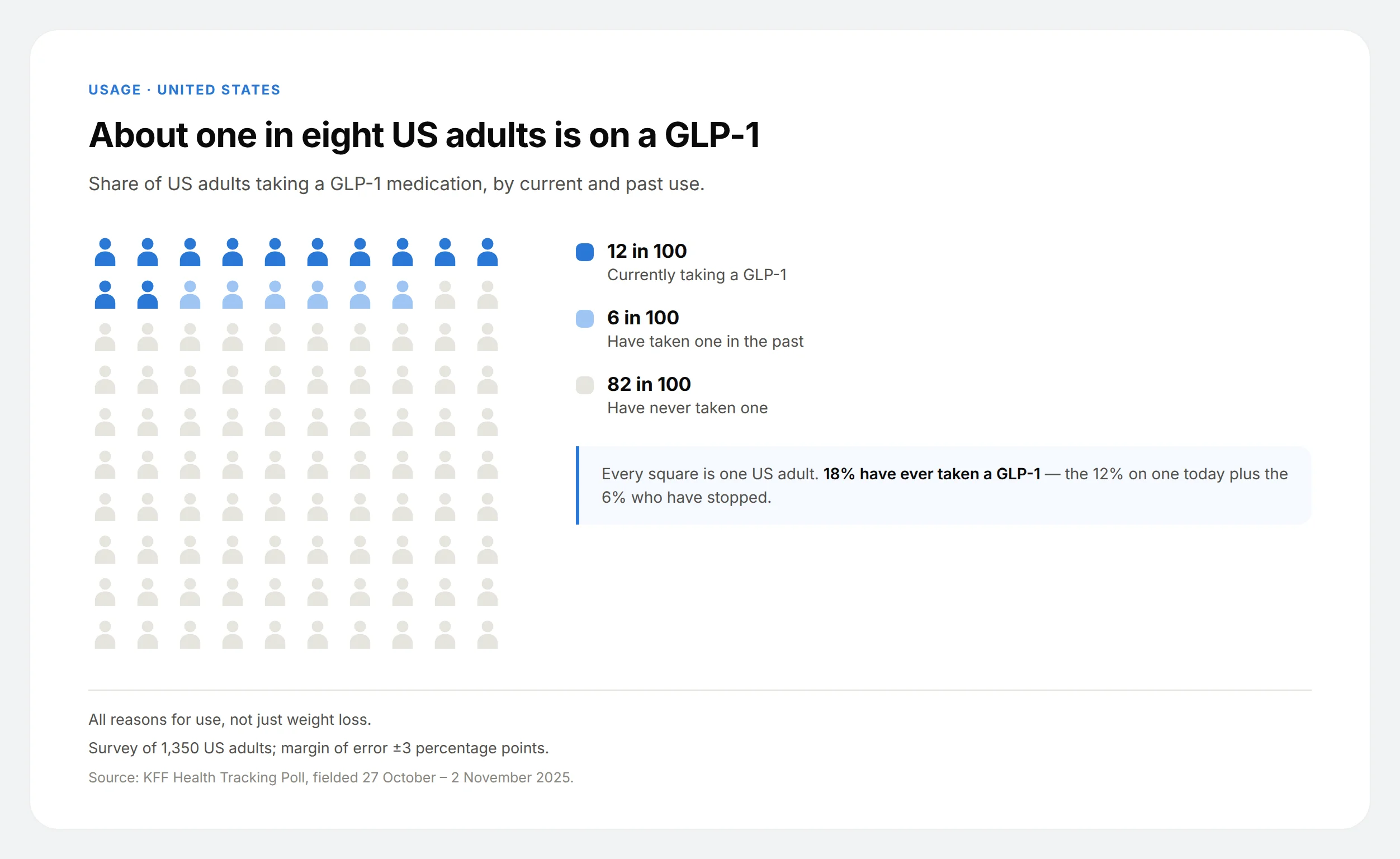
12% of US adults are currently taking a GLP-1, and 18% have taken one at some point.
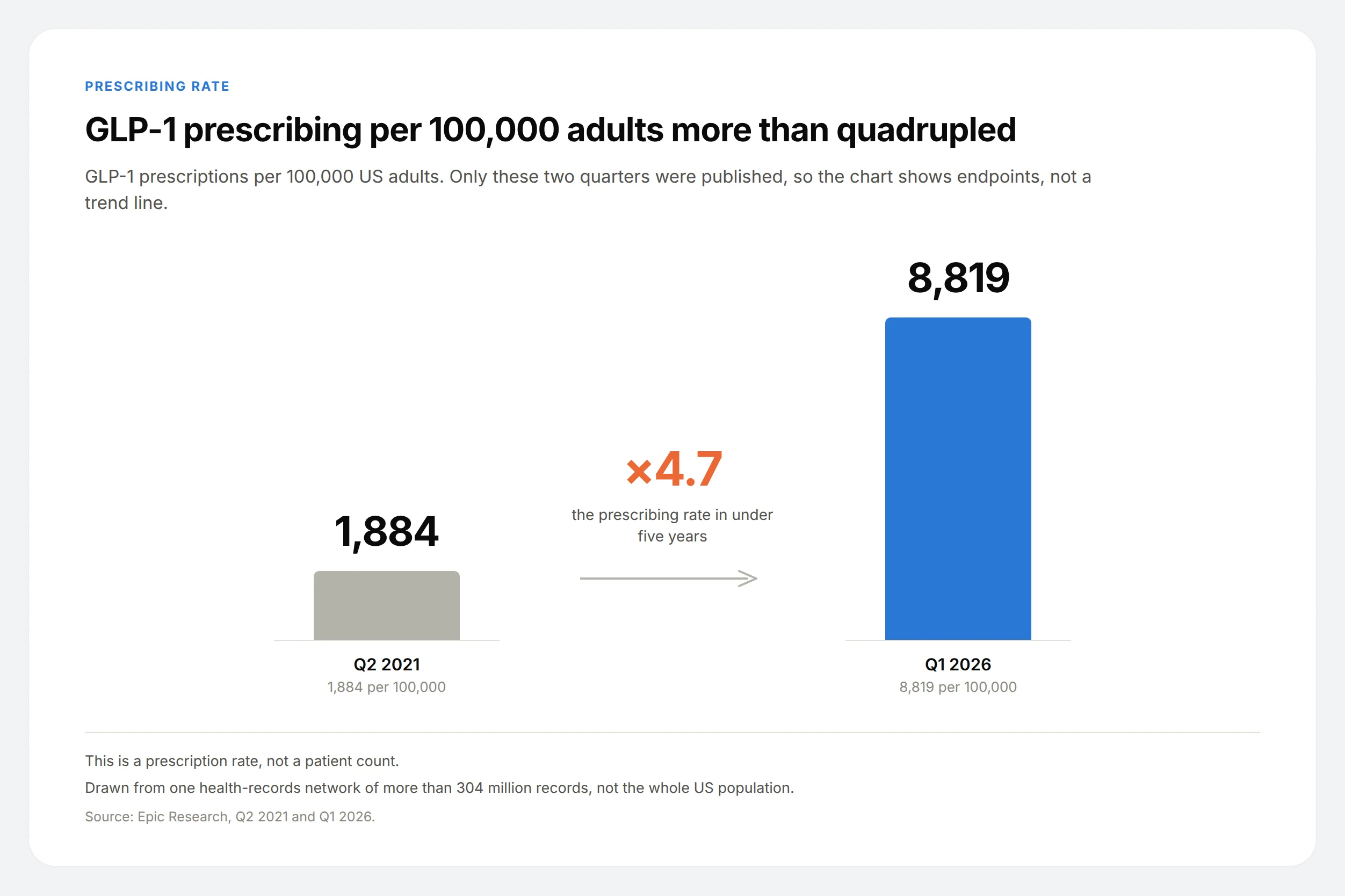
GLP-1 prescribing per 100,000 US adults more than quadrupled between 2021 and 2026, from 1,884 to 8,819.
Tirzepatide beat semaglutide head to head, with 20.2% average weight loss against 13.7% over 72 weeks.
85% of people who start a GLP-1 for weight loss are no longer taking it two years later.
Mounjaro and Zepbound together made $27.7 billion in the first half of 2026.
Medicare’s negotiated semaglutide price is $274 a month from January 1, 2027, which is 71% below the previous list price.
How many Americans are on Ozempic? According to our GLP-1 statistics, about one in eight US adults, or 12%, is currently taking a GLP-1 medication like Ozempic or Mounjaro1. Prescribing has more than quadrupled in under five years3, and the two leading brands earned $27.7 billion in six months28. Whatever corner of healthcare you work in, these drugs are reshaping it.
Below, you’ll find 65 GLP-1 statistics that not only tell the story of an industry, but of millions of people struggling with obesity and diabetes across the United States.
We’ll cover how many people take these drugs, their results, and how many people stop. We’ll also discuss what the medications cost and who pays, as well as the impact on the US med spa market.
A note on the facts: Every figure comes from a reputable and verified source. That means federal agencies, the survey houses that fielded the polls, peer-reviewed trials, and audited company results. The numbers are current as of August 2026.
Every statistic below sits in one of 11 sections. Use the list to jump straight to the number you need, or read on for the full picture.
GLP-1s look like an overnight success, but the science behind them is nearly a century old. Researchers proposed in 1932 that the gut releases hormones that amplify insulin, and named them incretins45. In 1964, two research teams proved it. Glucose taken by mouth triggered far more insulin than the same dose injected into a vein45.
The hormone itself surfaced in the 1980s, when scientists decoding the proglucagon gene identified GLP-145. In 1987, Dr. Svetlana Mojsov had shown it stimulates insulin only when blood sugar is high45. That glucose-dependence explains why the class causes so little hypoglycemia, and it made the hormone worth turning into a drug.
However, one obstacle stalled the field for years: the body destroys natural GLP-1 in under two minutes45. The fix came from the desert. In 1992, Bronx-based researcher John Eng isolated exendin-4 from Gila monster venom, a natural GLP-1 mimic the body couldn’t break down45. A synthetic version became Byetta, the first GLP-1 medicine, in 200524.
GLP1 technology has since evolved at a rapid pace. Daily injections became weekly ones, then pills. The target widened from diabetes to obesity, then to the heart, kidneys, liver and even sleep apnea.
The timeline below draws its approval dates from FDA records, its discovery history from the scientists’ own peer-reviewed account, and its 2023 milestone from Science24,45,46.
| Year | Milestone |
|---|---|
| 1932 | The incretin concept is proposed: gut hormones that amplify insulin after a meal |
| 1964 | The incretin effect is proven. Oral glucose triggers more insulin than intravenous glucose |
| 1983–1987 | GLP-1 is identified from the proglucagon gene and shown to stimulate insulin |
| 1992 | John Eng isolates exendin-4, a durable GLP-1 mimic, from Gila monster venom |
| 2005 | Byetta, the first GLP-1 medicine, is approved for type 2 diabetes |
| 2010 | Victoza brings once-daily dosing |
| 2014 | Trulicity makes dosing once weekly. Saxenda becomes the first GLP-1 approved for weight loss |
| 2017 | Ozempic is approved for type 2 diabetes |
| 2019 | Rybelsus becomes the first oral GLP-1 |
| 2021 | Wegovy is approved for weight management. Demand quickly outruns supply |
| 2022 | Mounjaro, the first dual GIP and GLP-1 agonist, is approved. Shortages begin |
| 2023 | Zepbound is approved. Science names GLP-1 drugs its Breakthrough of the Year |
| 2024 | Zepbound becomes the first drug approved for sleep apnea. The first generics arrive. The tirzepatide shortage ends |
| 2025 | The semaglutide shortage ends. The Wegovy pill is approved. Self-pay prices fall to $350 |
| 2026 | Foundayo, the first small-molecule GLP-1 pill, launches. Medicare’s $50 GLP-1 Bridge begins |
| 2027 (ahead) | Medicare’s $274 negotiated price and a $675 list price take effect. A retatrutide filing is planned |
The top-line GLP-1 usage statistics come from three key sources, though each study follows a different methodology. The table below clarifies what each source measures, because the three headline figures answer different questions.
| Source | What it measures | Field dates | Sample | Figure |
|---|---|---|---|---|
| KFF | Current GLP-1 use, all reasons | Oct 27 to Nov 2, 2025 | 1,350 adults | 12% |
| Gallup | Current GLP-1 use for weight loss only | May 28 to June 5, 2026 | 5,065 adults | 11% |
| Epic Research | Prescriptions per 100,000 adults, health records | Data to Q1 2026 | 304 million+ records | 8,819 per 100,000 |
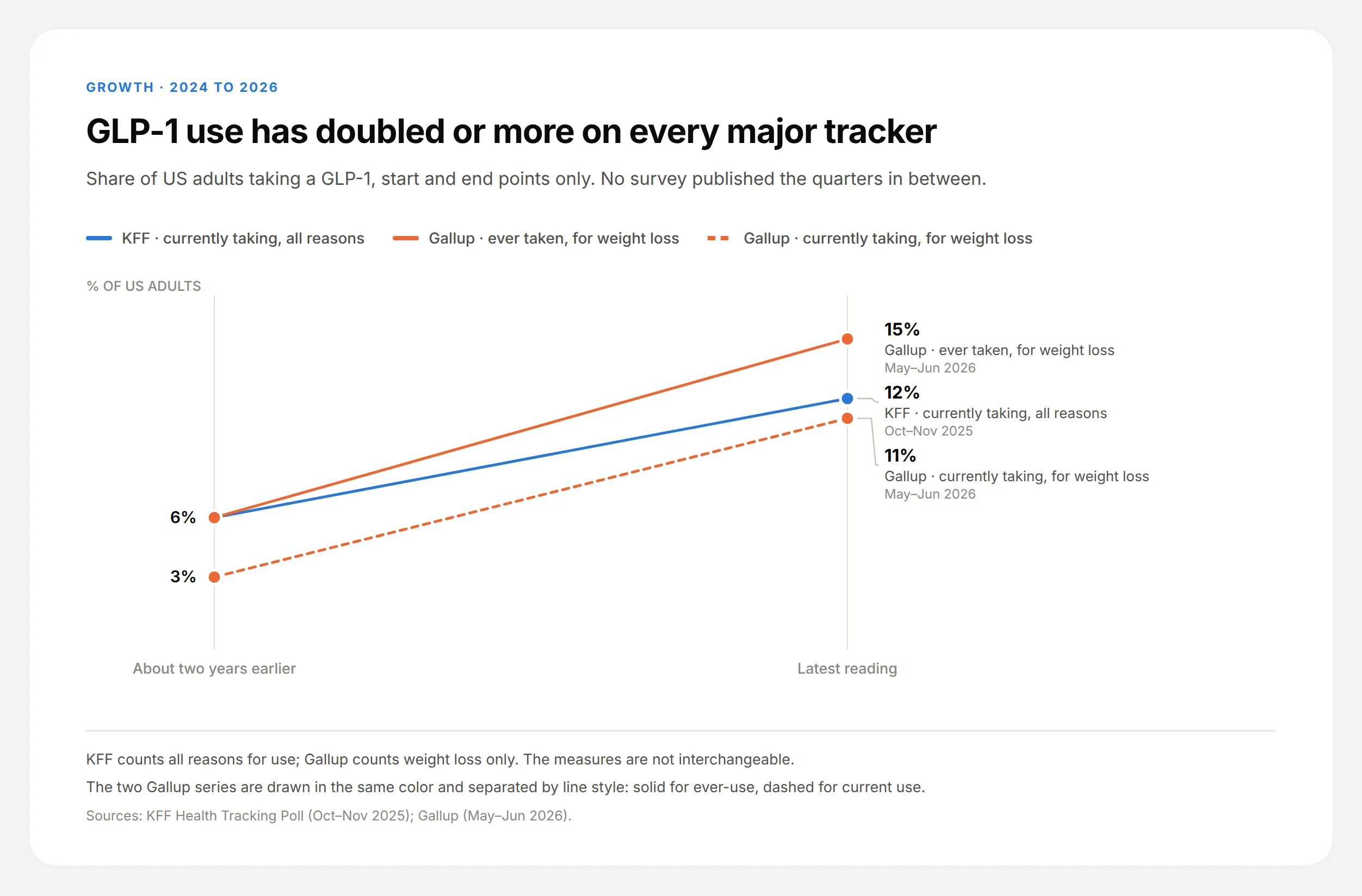
According to a KFF poll of 1,350 Americans, 12% of US adults currently take a GLP-1, and 18% have taken one at some point1.
Importantly, there has been massive growth in the past two years. Current use is up six points from 6% just 18 months earlier1. In plain terms, the number of users doubled in 18 months. Very few prescription categories in modern medicine have ever grown that fast.
11% of US adults currently take a GLP-1 for weight loss, up from 3% two years earlier2. Gallup surveyed 5,065 adults between May 28 and June 5, 2026, with a margin of error of plus or minus 1.5 points.
Ever-use for weight loss tells the same story. 15% of US adults have used a GLP-1 for weight loss at some point, up nine points in two years2. Set that against the 11% still taking one, and 4% of adults have tried a GLP-1 and stopped. The discontinuation numbers later in the article explain why.
GLP-1 prescribing rose from 1,884 per 100,000 US adults in Q2 2021 to 8,819 in Q1 20263. The figure comes from a health-records dataset holding more than 304 million patient records.
Keep in mind, though, that this is the prescription rate, not a patient count. However, even with that caveat, a quadrupling in under five years signals a change in prescribing culture, not just patient demand. About three in four patients got their GLP-1 from a primary care doctor or specialist1, so many refills and follow-ups run through primary care software.
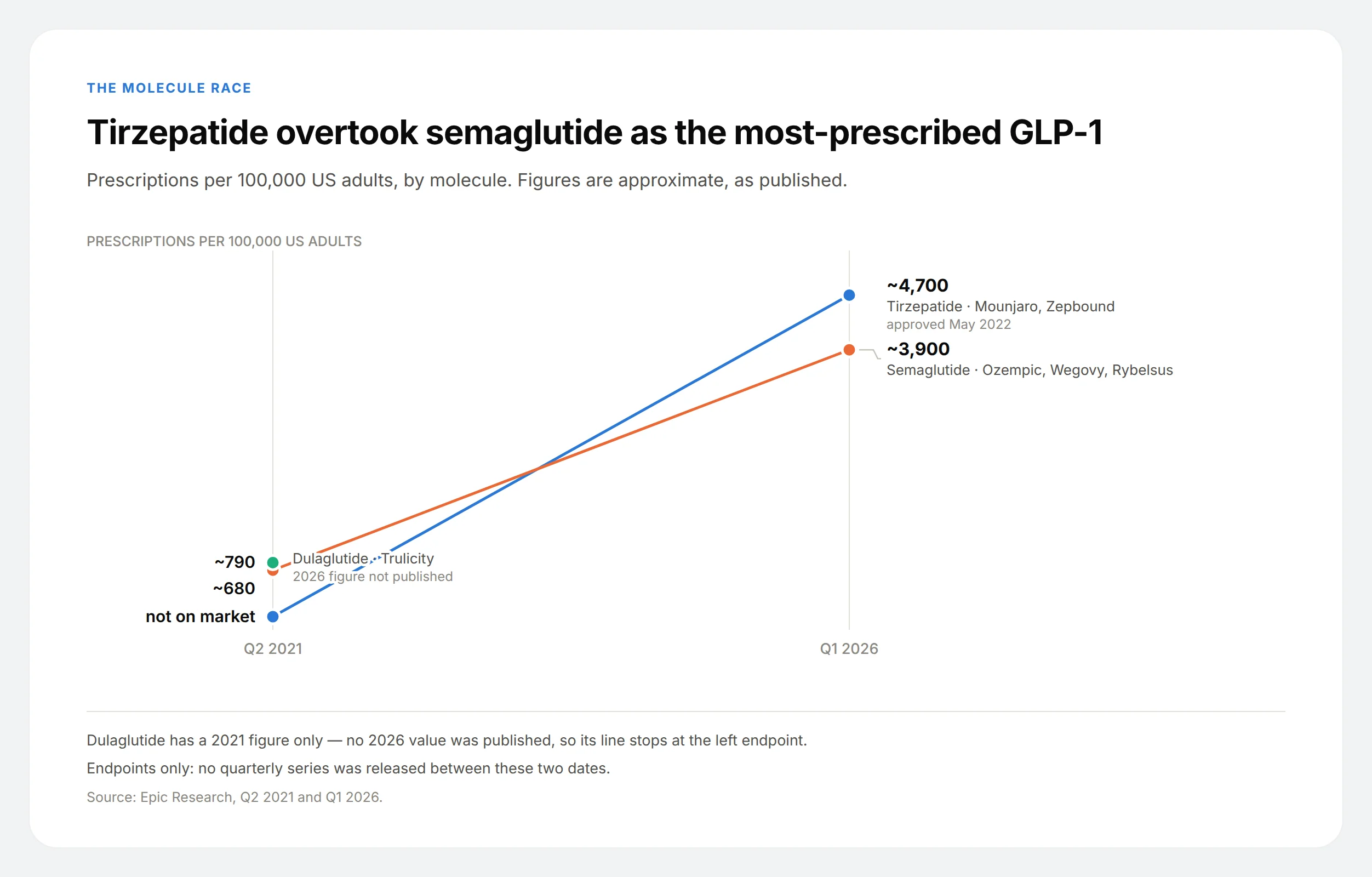
Tirzepatide ran at roughly 4,700 prescriptions per 100,000 adults in Q1 2026, against about 3,900 for semaglutide3. By contrast, five years earlier, the leaders were dulaglutide at around 790 and semaglutide at around 680. Neither of today’s leaders was on the market five years ago. Prescribers clearly follow the efficacy data, and the head-to-head trial below shows what convinced them.
The brand names map like this. Tirzepatide is sold as Mounjaro and Zepbound, while semaglutide is sold as Ozempic, Wegovy, and Rybelsus.
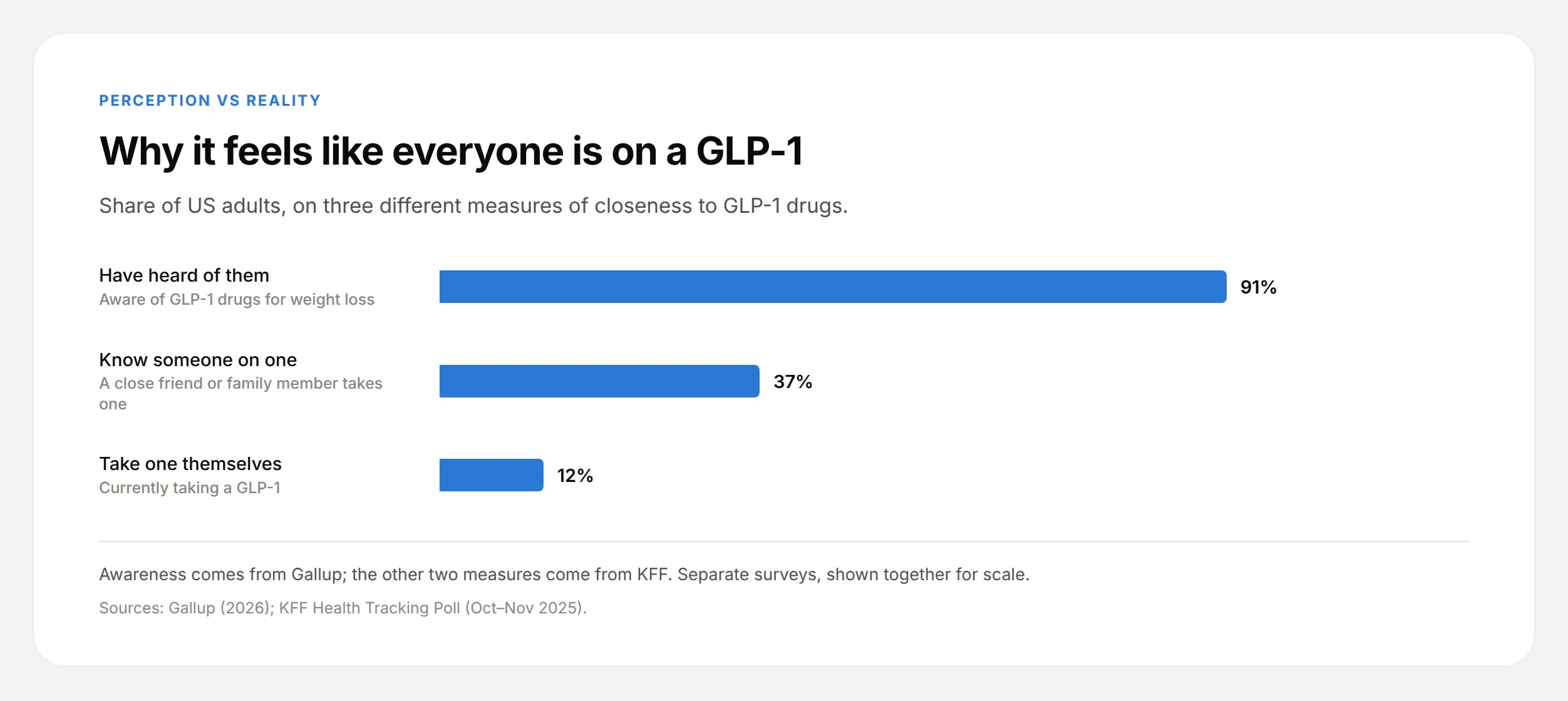
91% of US adults are now aware of GLP-1 drugs for weight loss, up from 80% two years earlier2. The category is mainstream, not emerging, and that awareness is part of why the prevalence figures keep moving. For med spas, that awareness shifts medical aesthetics marketing from explaining the drugs to explaining the program around them.
At the same time, 37% of US adults say a close friend or family member uses a GLP-11, which is probably why you get that feeling that everyone is on Ozempic. Set that against the 12% who actually are, and the arithmetic explains the perception on its own.
12% of American adults are currently on a GLP-1, which works out to roughly one in eight1. The percentage of Americans on GLP-1s varies sharply by age, diagnosis, and insurance, so the sections below break the population apart.
Two data families run through this section, and they measure different things. KFF surveys all US adults. The CDC’s most recent data brief surveys only adults with diagnosed diabetes. Each figure below names which one it comes from.
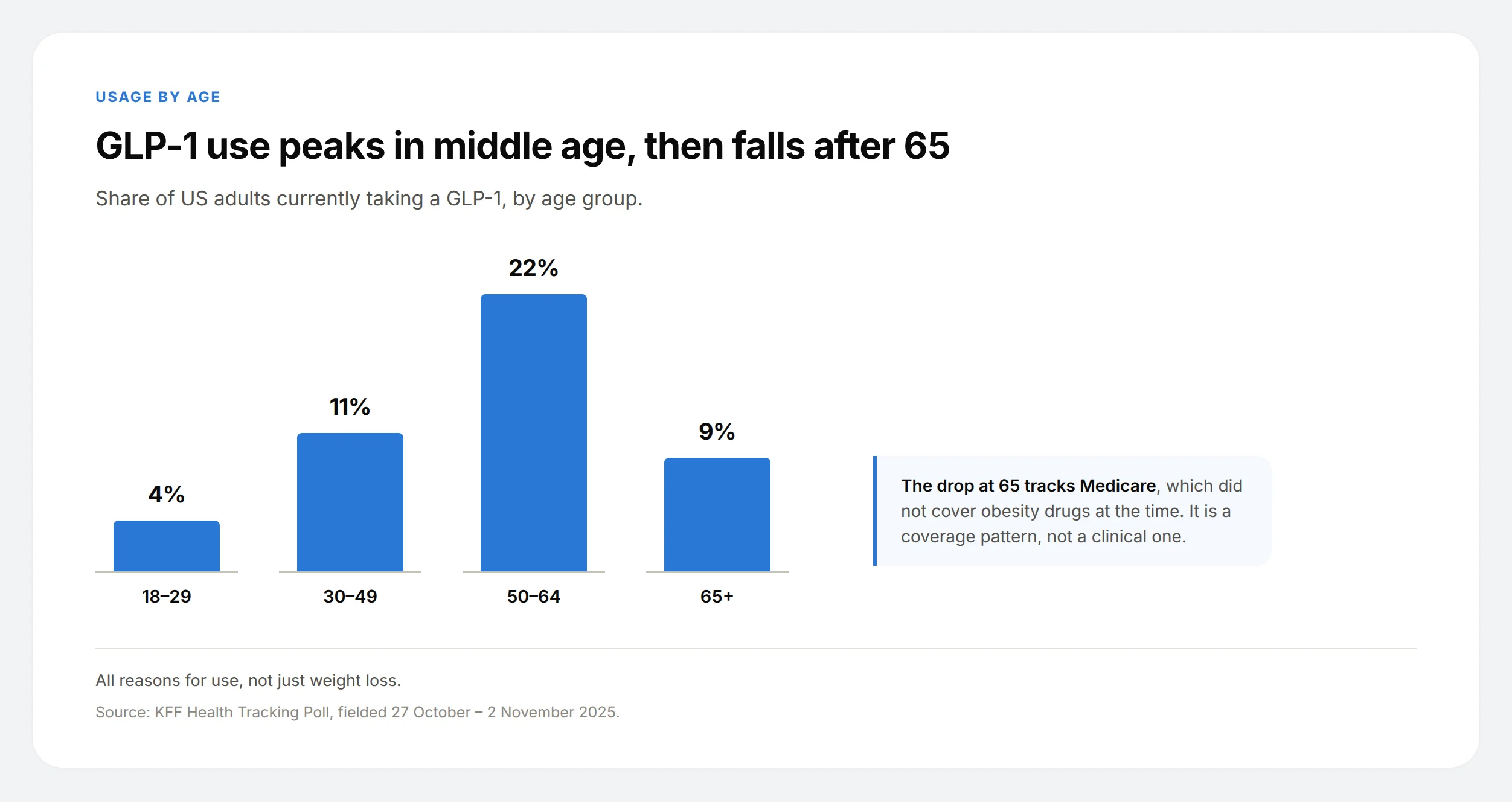
22% of adults aged 50 to 64 currently take a GLP-11. That compares with 11% at ages 30 to 49, 9% at 65 and over, and 4% at 18 to 29. This is the group most likely to have both a qualifying diagnosis and employer coverage, and the usage data reflects it.
The drop after 65 is the first hint of the Medicare coverage story. The cost section further down picks it up in full.
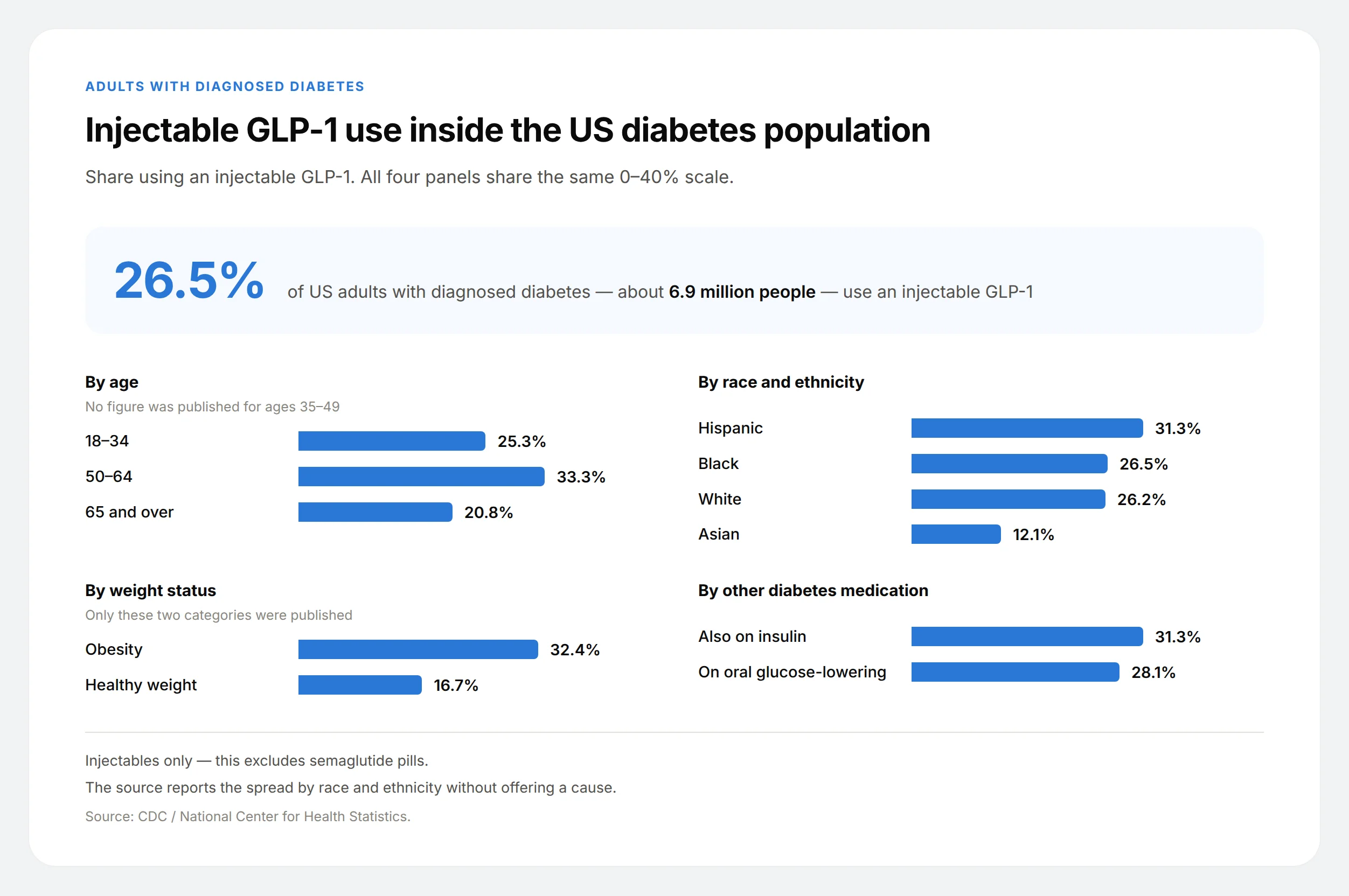
More than one in four adults with diagnosed diabetes, 26.5%, used an injectable GLP-1 in the CDC’s most recent national survey4. That works out to about 6.9 million people. It is the only federal count in this article that converts a percentage into a headcount. Note it covers injectables only, which excludes the semaglutide pills.
By contrast, KFF’s survey asks a broader question and finds even higher rates. 45% of adults with a diabetes diagnosis take a GLP-1, alongside 29% of those with heart disease1.
Within the diabetes population, injectable use runs 25.3% at ages 18 to 34 and peaks at 33.3% at 50 to 644. It then drops to 20.8% at 65 and over. The fall at 65 lines up with the move onto Medicare, which did not cover obesity medicines at the time.
Use also varies by race and by weight. Among adults with diagnosed diabetes, injectable GLP-1 use was 31.3% in Hispanic adults and 26.5% in Black adults4. It was 26.2% in White adults and 12.1% in Asian adults. The source reports the spread without offering a cause. Use tracks BMI too, from 16.7% at a healthy weight to 32.4% with obesity4. A standard BMI assessment remains the entry point most payers use to judge GLP-1 eligibility.
One more pattern matters for practices. 31.3% of diabetes patients on insulin also used an injectable GLP-1, as did 28.1% of those on oral glucose-lowering medication4. In practice these are combination therapies, not replacements. Practices coordinating both drug classes often work from a DM medication list to track which diabetes medications pair safely with an injectable GLP-1.
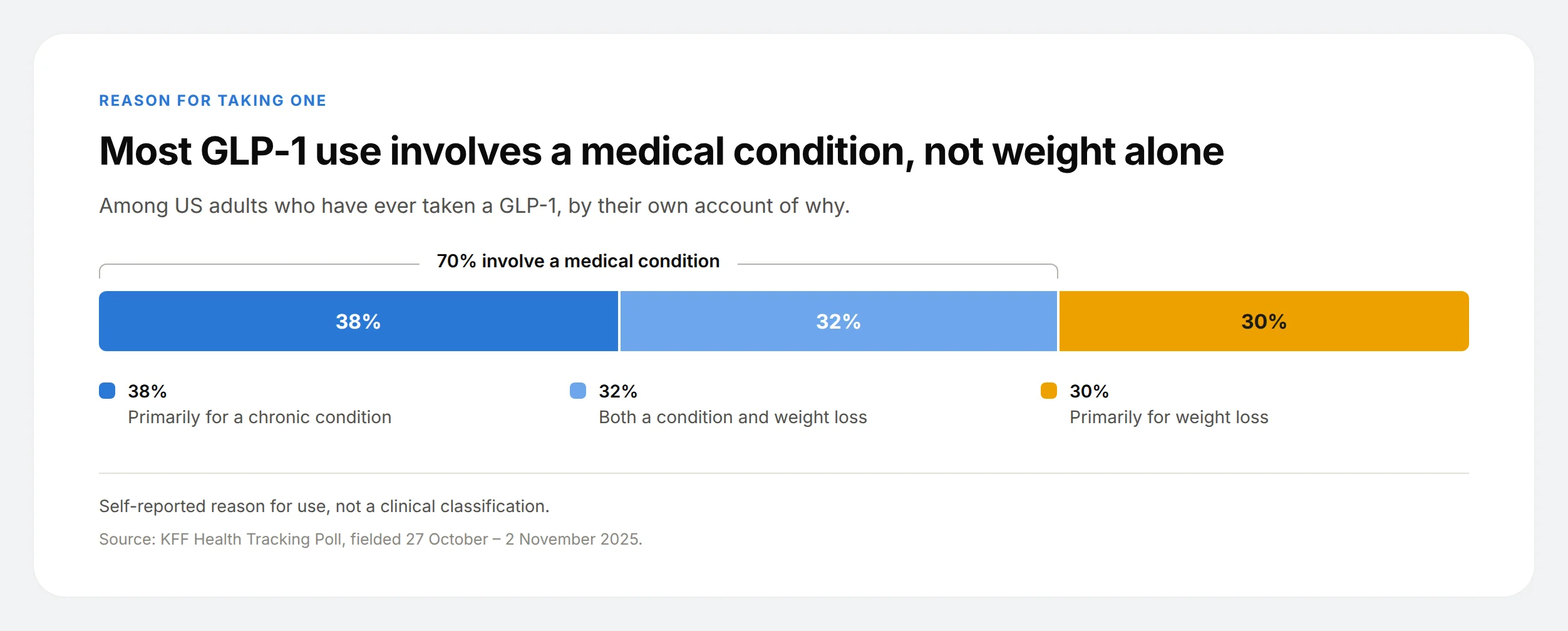
Among US adults who have ever taken a GLP-1, 38% took it primarily for a chronic condition1. Another 32% took it for both a condition and weight loss, and 30% primarily for weight loss. By the patients’ own account, the category is majority medical.
Meanwhile, 15% of people who have taken a GLP-1 have no diagnosis of diabetes, heart disease, or obesity1. That is one user in seven. The survey does not ask why, so the figure stands on its own.
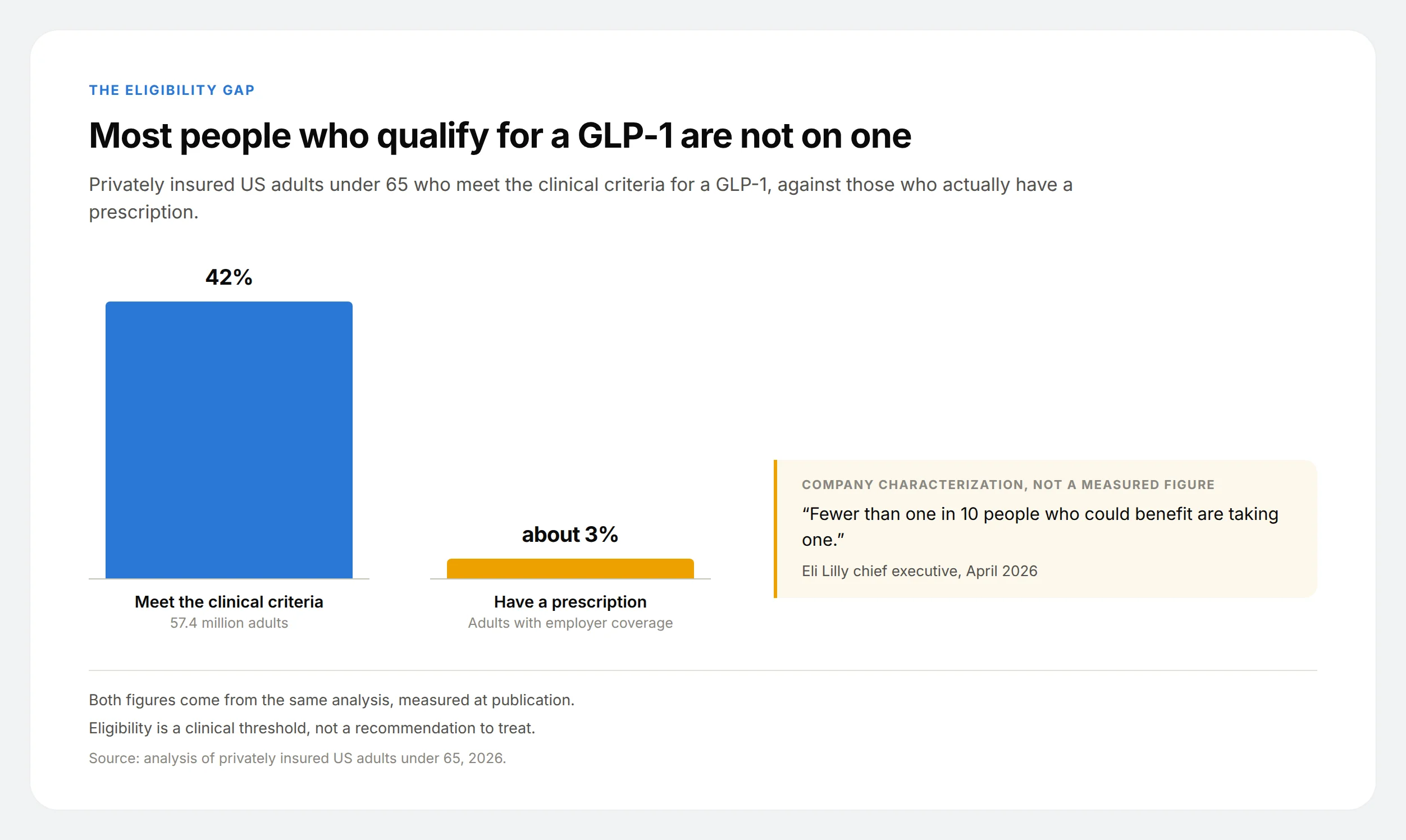
42% of adults under 65 with private health insurance, 57.4 million people, meet the clinical criteria for a GLP-15. The same analysis notes only about 3% of adults with employer coverage had a GLP-1 prescription when it was published5. There’s a surprising gulf between those numbers, but it would appear growth in this category is limited by price and coverage, not by appetite for the drugs.
The industry reads the shortfall the same way. Eli Lilly’s chief executive David A. Ricks put it plainly in April 2026: fewer than one in 10 people who could benefit are taking one6.
22% of adults not currently taking a GLP-1 are interested in one for weight loss1. That rises to 43% among adults who have been told they are overweight or obese. It splits 27% of women against 18% of men. This bears out in our internal data as well, which shows women are more likely to seek GLP-1 treatments at med spas. Med spas planning for that demand can compare the best medical spa software on consults, charting, and follow-up.
Average weight loss on GLP-1 medications ranges from about 12% to about 21% of body weight in the pivotal trials, depending on drug and dose. The table compares the trials side by side. Every figure is a trial result, which assumes supervised dose escalation and adherence. The persistence numbers in the next section show what happens without that. Outside a trial, practices supply that supervision themselves, and medical spa scheduling software can book each dose-review visit in advance.
| Drug and dose | Trial | Duration | Mean weight change | Placebo |
|---|---|---|---|---|
| Semaglutide 2.4 mg (Wegovy) | STEP 1 | 68 weeks | -14.9% | -2.4% |
| Tirzepatide 15 mg (Zepbound) | SURMOUNT-1 | 72 weeks | -20.9% | -3.1% |
| Tirzepatide 10/15 mg vs semaglutide 1.7/2.4 mg | SURMOUNT-5 | 72 weeks | -20.2% vs -13.7% | None (head to head) |
| Oral semaglutide 25 mg (Wegovy pill) | OASIS 4 | Not stated in release | -16.6% if adhered | Placebo-controlled |
| Semaglutide 7.2 mg (Wegovy HD) | STEP UP | Not stated in report | Up to -20.7% | Placebo-controlled |
| Orforglipron, highest dose (Foundayo) | ATTAIN-1 | Not stated in release | -12.4% on treatment | -0.9% |
| Retatrutide 12 mg (investigational) | TRIUMPH-1 | 80 weeks | -28.3% | -2.2% |
| CagriSema (investigational in the US) | REDEFINE 1 | 68 weeks | -22.7% if adhered | -2.3% |
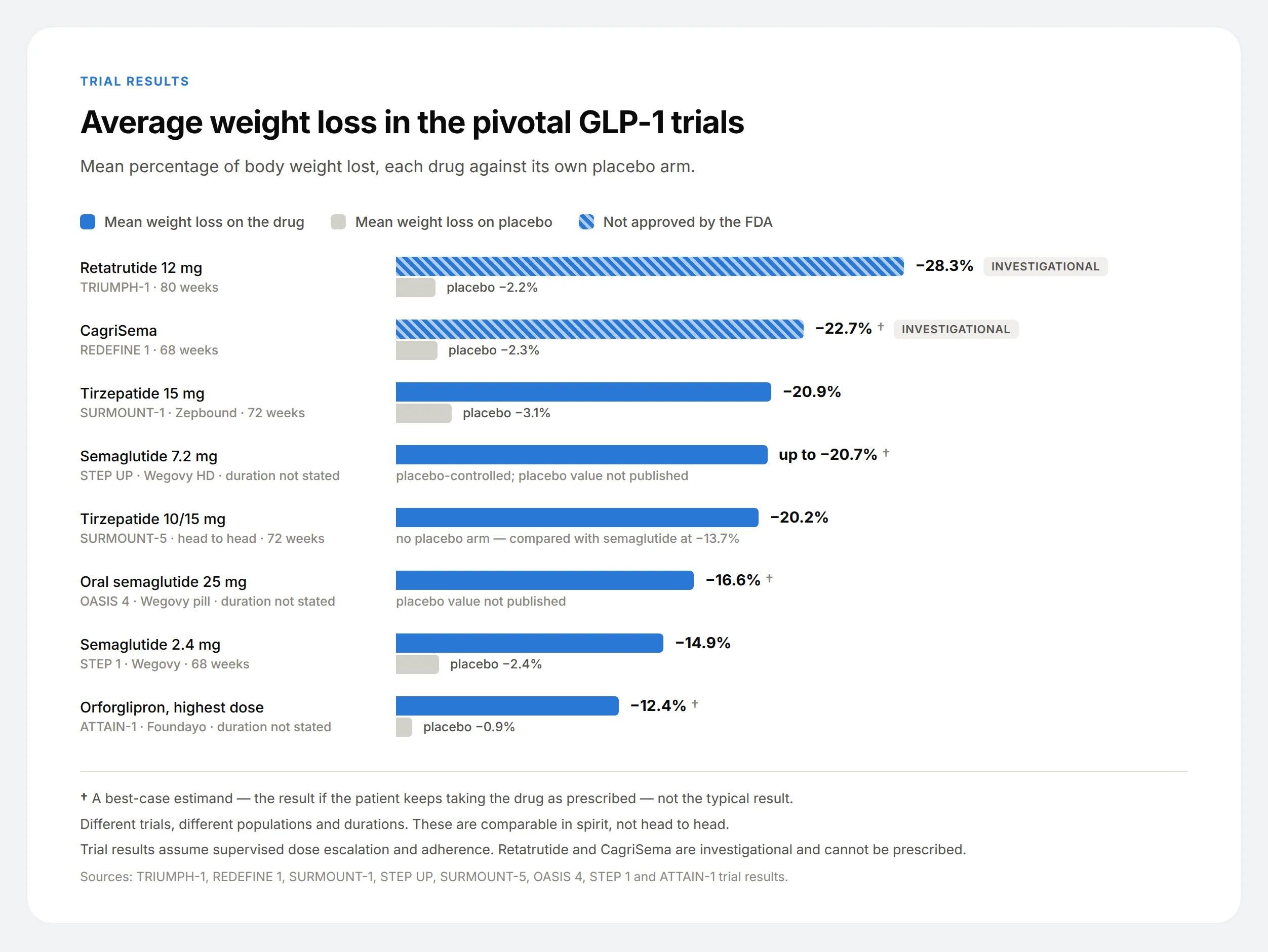
Adults on semaglutide 2.4 mg lost an average of 14.9% of their body weight over 68 weeks in STEP 1, against 2.4% on placebo7. The trial enrolled 1,961 adults with overweight or obesity and no diabetes. In absolute terms that was 15.3 kg against 2.6 kg. The trial was funded by Novo Nordisk, the drug’s maker.
This is the number most often quoted as average weight loss on Ozempic, but this is a misattribution. The drug is semaglutide, and the brand approved for weight management is Wegovy.
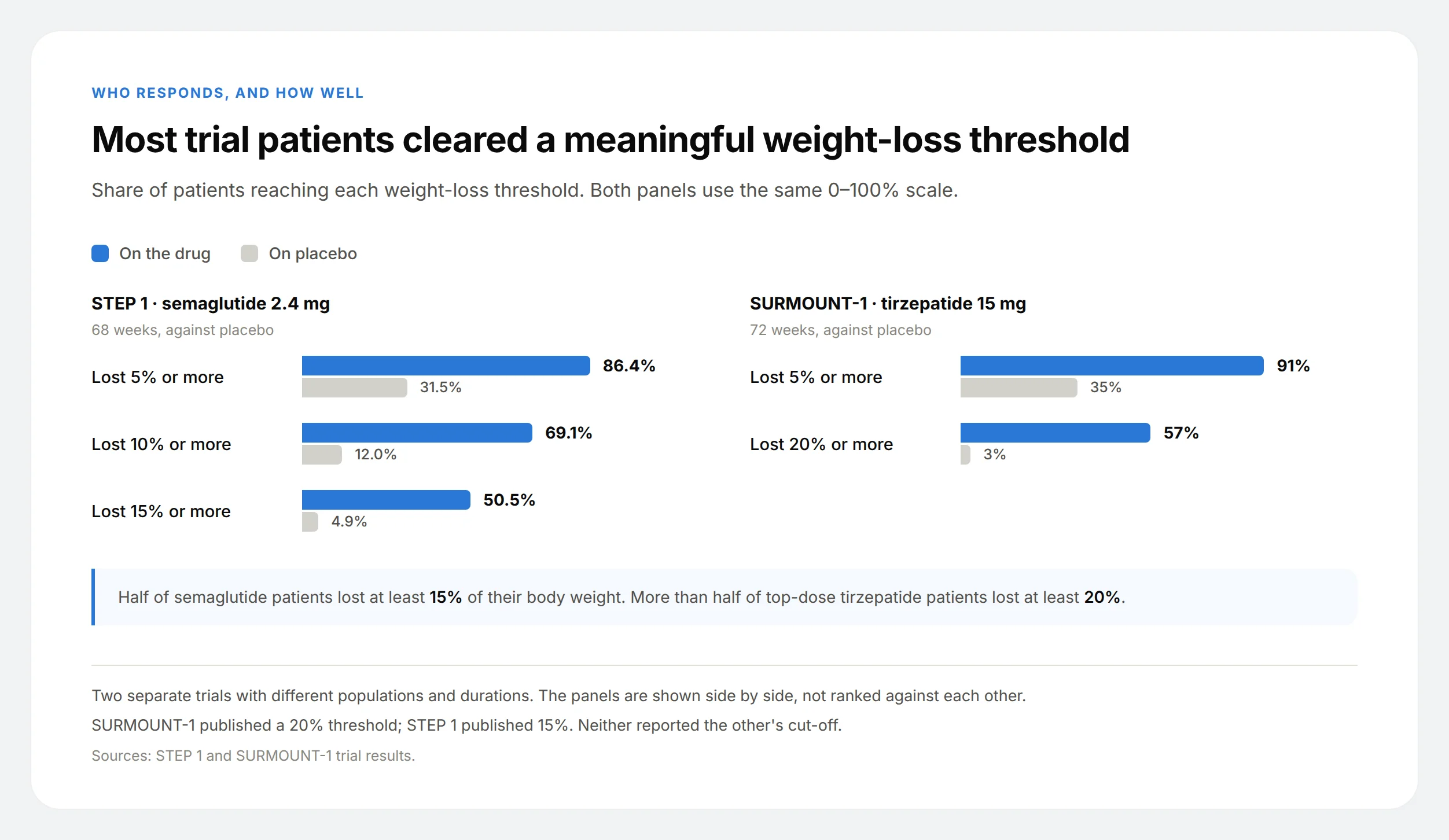
The averages hide the spread, so the threshold figures matter. In STEP 1, 86.4% of semaglutide patients lost at least 5% of their body weight and 69.1% lost at least 10%7. Half, 50.5%, lost at least 15%. Placebo ran 31.5%, 12.0%, and 4.9%.
Tirzepatide produced average weight loss of 15.0% at 5 mg, 19.5% at 10 mg, and 20.9% at 15 mg over 72 weeks in SURMOUNT-18. Placebo ran 3.1%.
The trial enrolled 2,539 adults with obesity and no diabetes, with a mean starting weight of 104.8 kg. It was funded by Eli Lilly, the drug’s maker. Tirzepatide is called Zepbound when used for weight management and Mounjaro for type 2 diabetes.
At the top dose, 91% of participants lost at least 5% of their body weight and 57% lost at least 20%8. Placebo ran 35% and 3%. Losing a fifth of body weight is the result that separates this class from everything before it.
At week 176 of SURMOUNT-1, participants still on tirzepatide 15 mg were down 19.7%, against 1.3% on placebo9. The lower doses held at 12.3% and 18.7%. This is the longest randomized weight-maintenance evidence in the class.
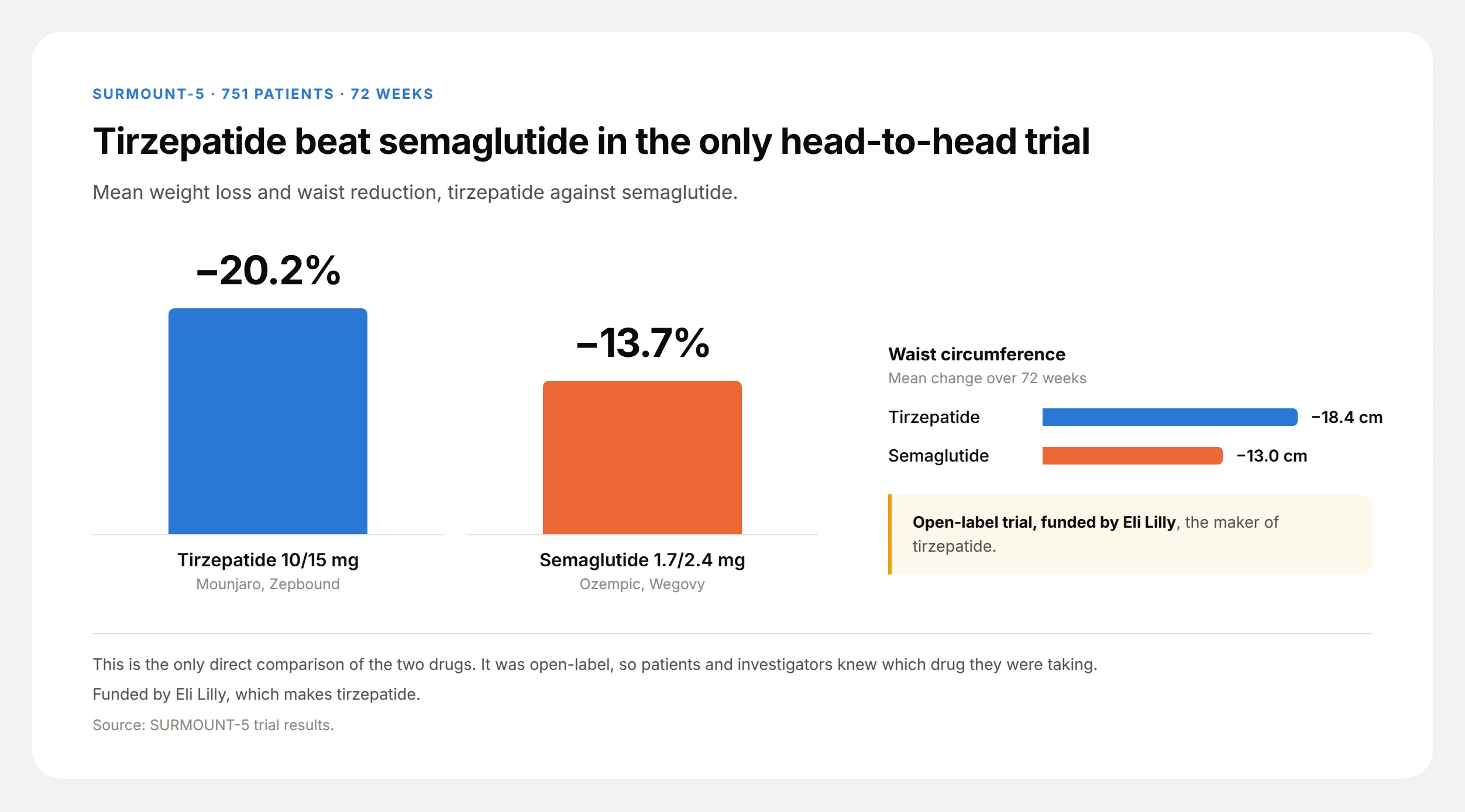
If you’re asking which GLP-1 is best for weight loss, the only direct comparison says tirzepatide. In SURMOUNT-5, tirzepatide 10 or 15 mg produced 20.2% mean weight loss over 72 weeks, against 13.7% for semaglutide 1.7 or 2.4 mg10. The trial enrolled 751 adults with obesity and no diabetes.
Waist circumference fell 18.4 cm against 13.0 cm10. The trial was open label, and it was funded by Eli Lilly, tirzepatide’s maker, which means there may be some bias in the interpretation of the numbers.
Oral semaglutide 25 mg, the Wegovy pill, delivered 16.6% mean weight loss in the OASIS 4 trial11. It was approved on December 22, 2025. The 16.6% is the if-treatment-adhered estimand. Novo Nordisk describes the result as similar to the 2.4 mg injection. The release did not state the sample size or duration.
The higher 7.2 mg injectable dose, Wegovy HD, produced up to 20.7% mean weight loss in the STEP UP trial12. “Up to” is the trial’s best-case estimand, not the typical result. This dose also carries a new safety signal, covered in the side effects section below.
Adults on the highest dose of orforglipron, sold as Foundayo, lost an average of 27.3 lb, or 12.4%, if they stayed on treatment6. Across everyone randomized in the ATTAIN-1 trial, the loss was 11.1%, or 25 lb. Placebo ran 0.9% and 2.1% on the same two estimands. Any quote of this trial should say which estimand it means.
Retatrutide is investigational and not approved anywhere, but its trial numbers explain the attention. The 12 mg dose produced 28.3% mean weight loss, or 70.3 lb, at 80 weeks in TRIUMPH-114. That approaches a third of total body weight, a scale of loss no approved medication has ever produced.
45.3% of participants lost at least 30% of their body weight. In the blinded extension, participants starting at a BMI of 35 or more were down 30.3% at 104 weeks14. A US submission is planned for early 2027.
The same trial moved most participants out of the obesity range. 65.3% of those on retatrutide 12 mg fell below a BMI of 30 at 80 weeks, from a mean starting BMI of 40.014. That included 37.5% of those who started with class 3 obesity. Again: this drug is investigational and cannot be prescribed.
CagriSema, also investigational in the US, produced 22.7% weight loss at 68 weeks against 2.3% on placebo in REDEFINE 112. More than 40% of its 3,417 participants lost a quarter of their body weight. In a separate head-to-head trial it came in at 15.2% against 15.8% for tirzepatide 15 mg, non-inferior on weight but not on blood sugar control12.
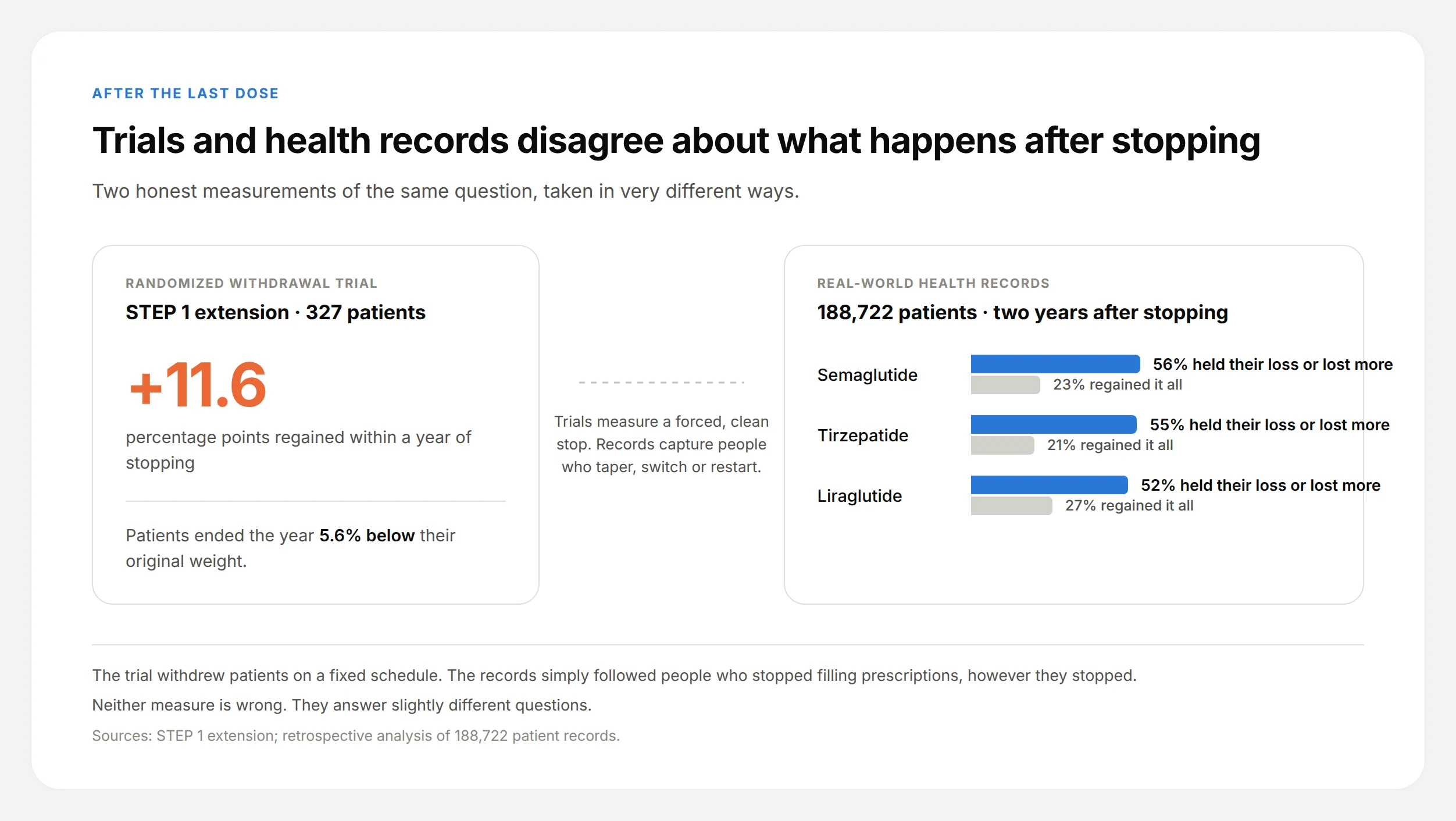
In the key withdrawal study, patients regained about two thirds of their lost weight within a year of stopping semaglutide15. Real-world data is more forgiving, and the disagreement between the two is the honest finding.
Two different questions hide inside this one. What happens to weight when treatment stops, and how many people stop at all. Randomized withdrawal trials answer the first. Pharmacy claims answer the second, by counting refills rather than outcomes. Each figure below says which kind it is.
327 STEP 1 participants followed for a year off treatment regained 11.6 percentage points of the weight they had lost15. They ended 5.6% below their starting weight at week 120. The cardiometabolic improvements reversed alongside the weight. This single study sits behind almost every “people regain two thirds” claim in circulation.
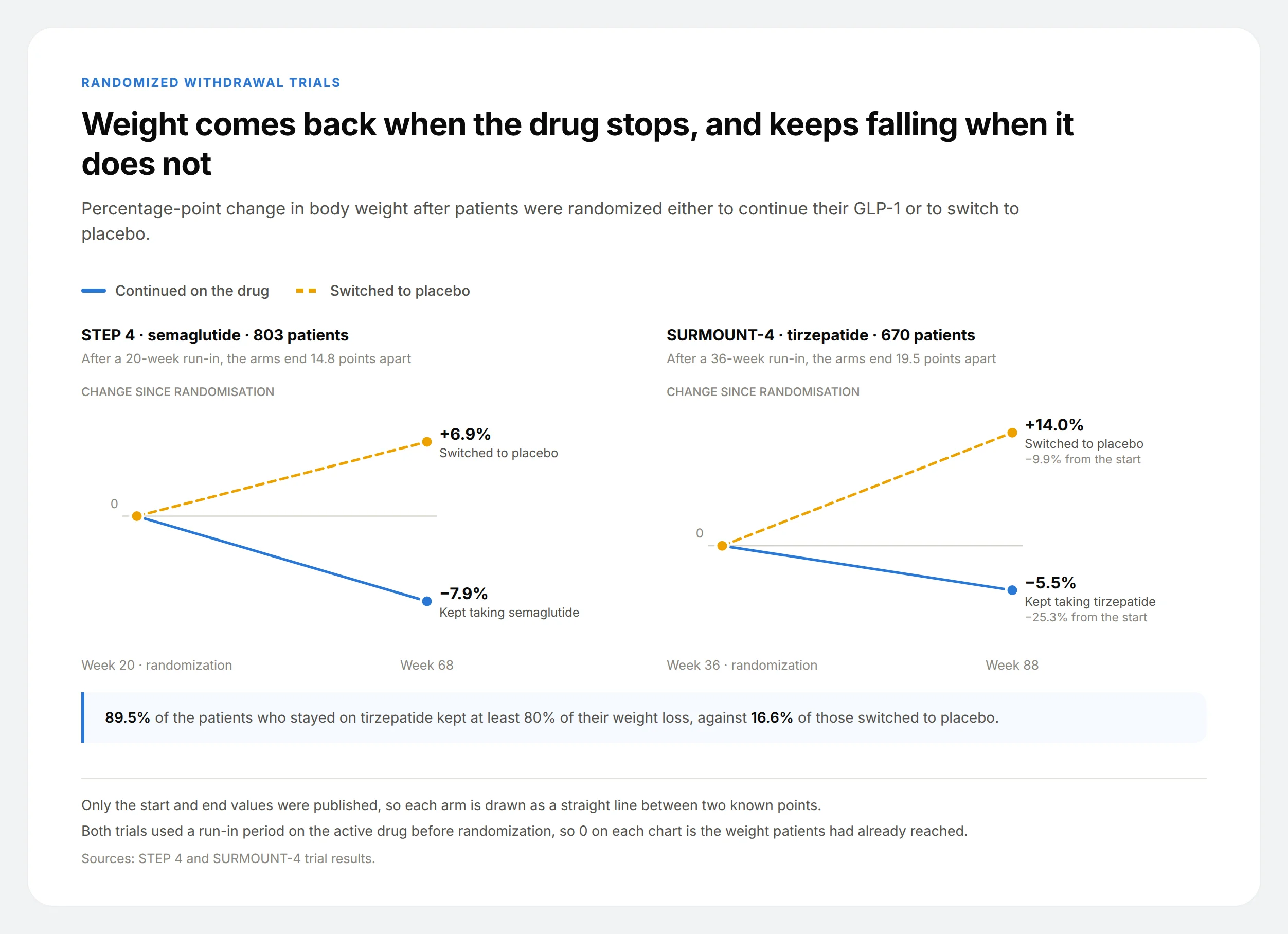
The STEP 4 withdrawal trial shows the same fork in the road. After a 20-week run-in, 803 adults were randomized to continue semaglutide or switch to placebo for 48 weeks16. Continuing produced a further 7.9% loss. Switching produced a 6.9% regain. The two arms diverge by nearly 15 points from the same starting point.
670 adults were randomized after a 36-week tirzepatide lead-in and followed to week 8817. Those who continued reached 25.3% total loss from the start. Those withdrawn to placebo regained 14.0% and landed at 9.9%. The regain is larger than in the semaglutide trials, consistent with the larger loss being maintained.
89.5% of people who stayed on tirzepatide kept at least 80% of their initial weight loss, against 16.6% of those switched to placebo17. That is the clearest maintenance figure in the class.
A health-records analysis followed 188,722 patients who stopped a GLP-1 after at least 90 days on treatment18. Two years later, 56% of semaglutide patients, 55% of tirzepatide patients, and 52% of liraglutide patients had held their loss or lost more. This is the most optimistic real-world regain figure available. It covers patients who lost at least 5 lb on treatment.
The same dataset shows the other tail. Complete weight regain within two years occurred in 23% of semaglutide patients, 21% of tirzepatide patients, and 27% of liraglutide patients18. Weight trajectories stabilized after 12 months, so the one-year picture largely sets the two-year one.
This data disagrees in tone with the withdrawal trials above. Naming that disagreement is more useful than resolving it. Trials measure a forced, clean stop, whereas records capture people who taper, switch, or restart.
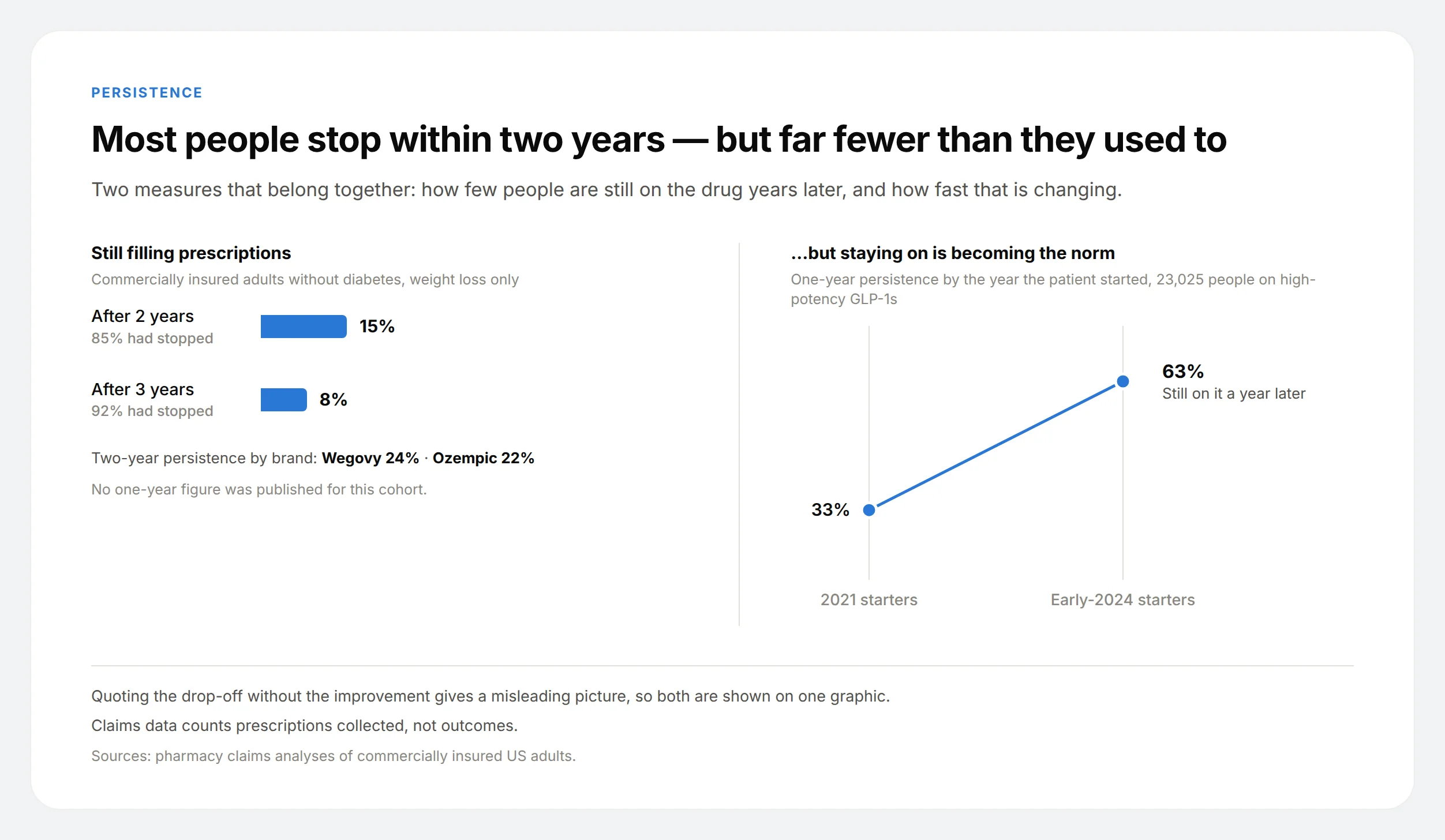
Pharmacy claims research on commercially insured members without diabetes found only 15% still filling GLP-1 prescriptions at two years19. Wegovy had the highest two-year persistence at 24%, with Ozempic at 22%. Claims data measures refills collected, not outcomes.
At three years, the same research group found only 8% of people, one in 12, still on a GLP-1 for obesity20. The cohort was 5,780 individuals without diabetes, mean age 47 and about 80% female.
Persistence rose to 14% for the high-potency products Wegovy and Zepbound. For a practice running a weight-loss program, this is the number to build around. Nearly every patient who starts will, at some point, need a reason to stay. Patient management software can flag a missed check-in before the patient drops out.
Across 23,025 individuals on high-potency GLP-1s, one-year persistence rose from 33% for 2021 starters to 63% for early-2024 starters20. This is the counterweight to the 85% and 8% figures above, and leaving it out would make them misleading.
Staying on treatment is becoming the norm rather than the exception. Falling prices, wider employer coverage, and better side-effect management are the likeliest drivers, and all three are still improving. Patients who stay on treatment longer need more check-ins, so follow-up takes a bigger share of private practice management.
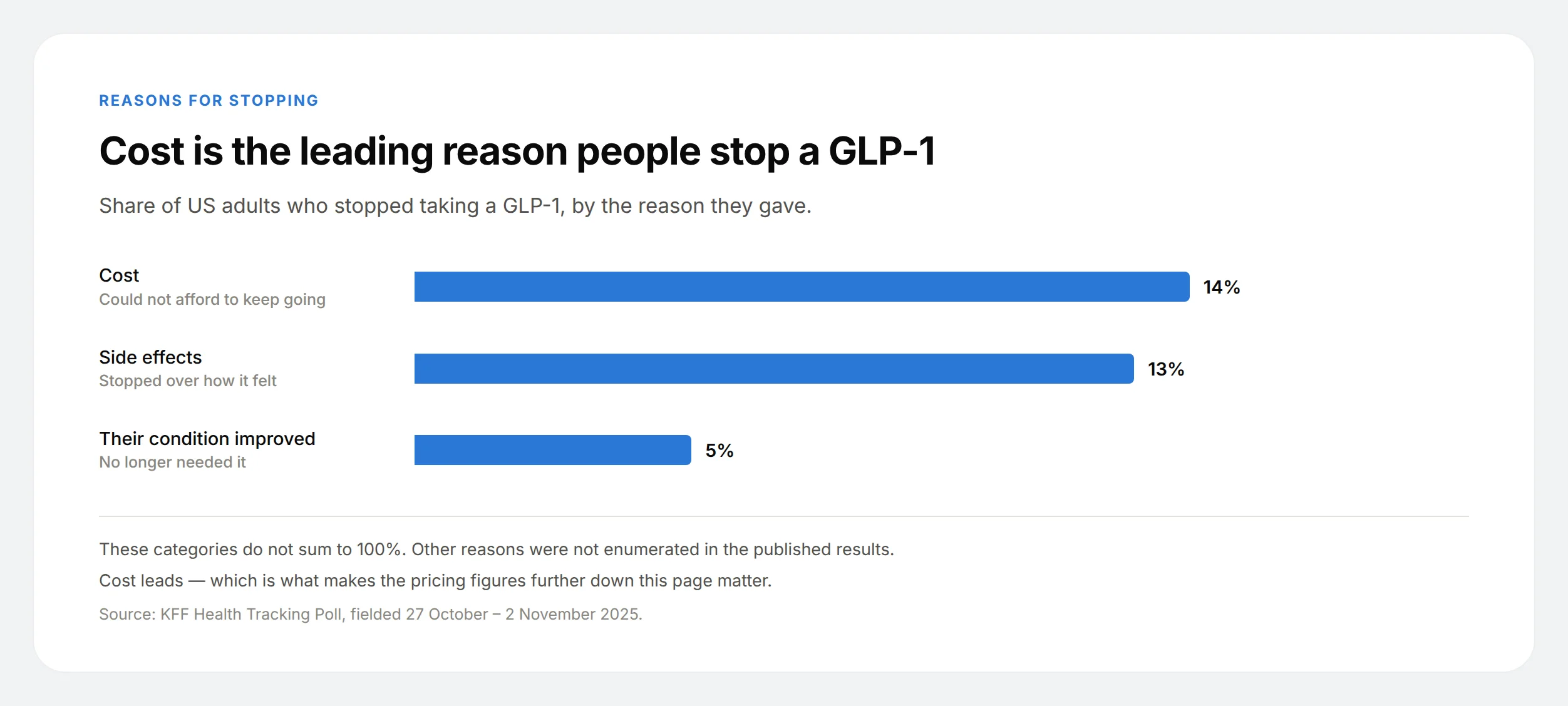
Among US adults who stopped taking a GLP-1, 14% cited cost and 13% cited side effects1. Only 5% stopped because their condition improved. Cost being the leading reason is what makes the pricing section below more than a list of numbers.
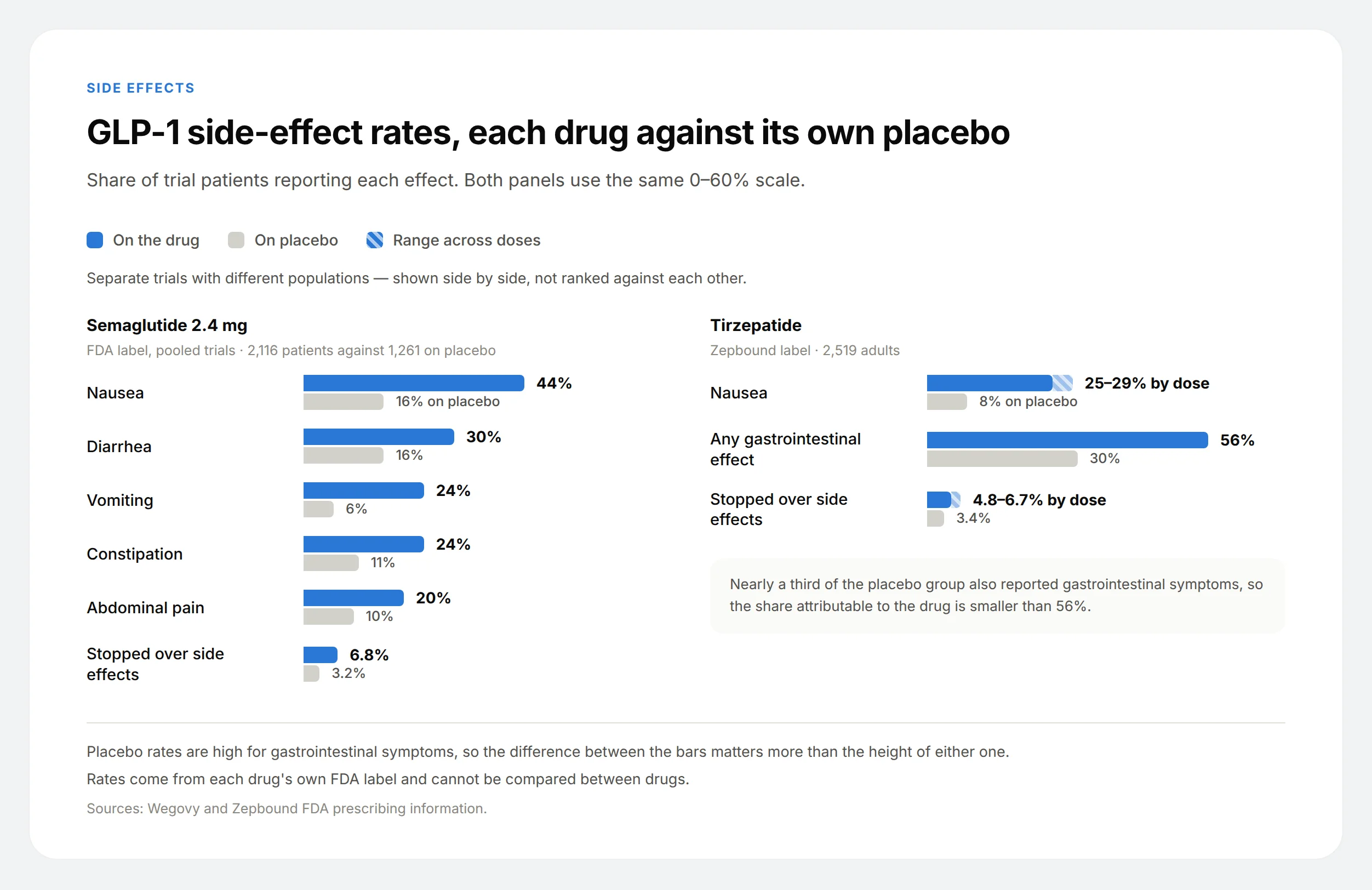
The most common GLP-1 side effects are gastrointestinal: nausea, diarrhea, vomiting, and constipation. Every rate below comes from the FDA-approved prescribing information or a peer-reviewed trial, and each sentence names which. The rates for different drugs come from separate trials with different populations, so they are shown side by side, not ranked. Anyone weighing these numbers should talk to their prescriber.
| Side effect | Semaglutide 2.4 mg | Its placebo group | Tirzepatide (by dose) | Its placebo group |
|---|---|---|---|---|
| Nausea | 44% | 16% | 25% to 29% | 8% |
| Diarrhea | 30% | 16% | Included in GI total | — |
| Vomiting | 24% | 6% | Included in GI total | — |
| Constipation | 24% | 11% | Included in GI total | — |
| Any gastrointestinal effect | — | — | 56% | 30% |
| Stopped over side effects | 6.8% | 3.2% | 4.8% to 6.7% | 3.4% |
44% of people on semaglutide 2.4 mg reported nausea, against 16% on placebo, in the pooled weight-management trials on the FDA label21. The pooled set covered 2,116 treated patients against 1,261 on placebo. The same data gives diarrhea at 30% against 16% and vomiting at 24% against 6%. Constipation ran 24% against 11%, and abdominal pain 20% against 10%. A soft diet food list can ease these symptoms while patients adjust to a new dose.
6.8% of people on semaglutide 2.4 mg stopped treatment permanently because of side effects, against 3.2% on placebo, per the FDA label’s pooled trials21. The most common reasons were nausea at 1.8%, vomiting at 1.2%, and diarrhea at 0.7%. The 13% who told KFF they stopped over side effects is higher because trials support patients through dose escalation1.
Longer exposure raises the number. In the SELECT trial, which followed 17,604 patients for a mean of 34 months, 16.6% discontinued permanently for adverse events against 8.2% on placebo23. That is the best long-duration discontinuation figure in the class.
Gallstones affected 1.6% of adults on semaglutide 2.4 mg against 0.7% on placebo, per the FDA label21. Gallbladder inflammation ran 0.6% against 0.2%. Rates were higher in adolescents, where gallstones occurred in 3.8% of treated patients and none on placebo.
Nausea affected 25% of patients at 5 mg, 29% at 10 mg, and 28% at 15 mg of tirzepatide, against 8% on placebo22. The figures come from the pooled weight-reduction trials in the current Zepbound prescribing information, covering 2,519 adults.
Gastrointestinal side effects overall hit 56% of people on tirzepatide at every dose, against 30% on placebo22. Note that nearly a third of the placebo group also reported GI symptoms. The treatment-attributable share is therefore smaller than the raw 56% suggests. Discontinuation for adverse reactions ran 4.8% to 6.7% by dose, against 3.4% on placebo. Some practices introduce a FODMAP food list during dose escalation, when gastrointestinal symptoms are most likely to flare.
Every GLP-1 label carries a boxed warning for thyroid C-cell tumors, and the warning is based on rodent studies21. The drugs are contraindicated in people with a personal or family history of medullary thyroid carcinoma or MEN 2. A med spa offering GLP-1s should record that history at intake, where medical spa EMR software keeps it on the chart.
The label publishes no human incidence rate, so no GLP-1 cancer percentage exists to quote. The warning, its basis, and the contraindication are where the evidence stops.
On approving Wegovy HD in March 2026, the FDA identified skin sensitivity, pain, or burning as a common reaction at the 7.2 mg dose13. The agency said it is still investigating. The reaction generally resolved on its own or with a dose reduction. This is the newest safety signal in the class.
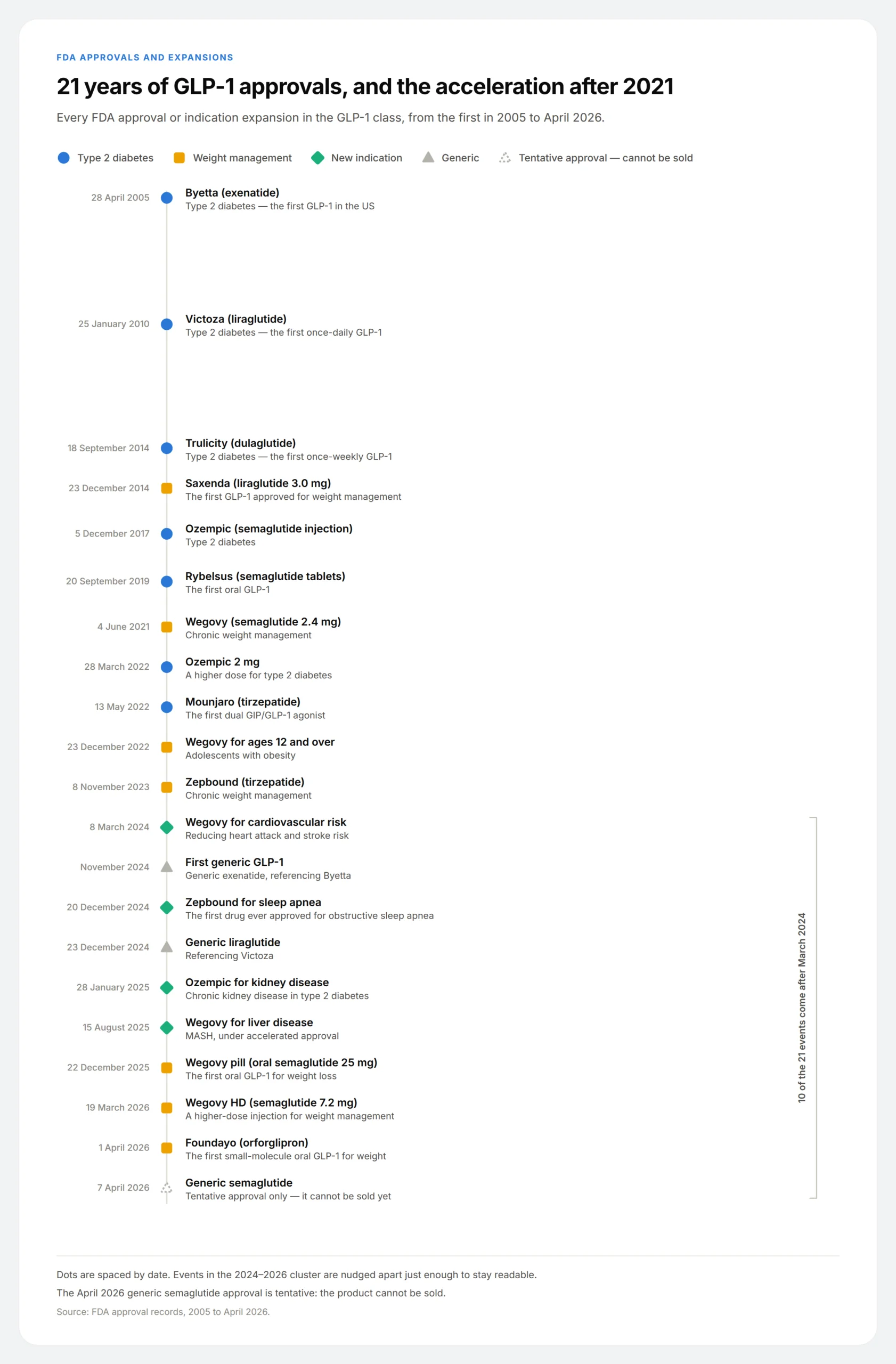
Ten branded GLP-1 medicines have been approved in the US, spanning seven molecules, plus two generics referencing the older drugs. The FDA has approved or expanded a GLP-1 medicine 21 times since 2005, counting new approvals, indication expansions, and generics together24. The full record is below.
| Approval date | Brand | Molecule | What was approved |
|---|---|---|---|
| Apr 28, 2005 | Byetta | Exenatide | Type 2 diabetes, the first GLP-1 medicine in the US |
| Jan 25, 2010 | Victoza | Liraglutide | Type 2 diabetes, first once-daily GLP-1 |
| Sep 18, 2014 | Trulicity | Dulaglutide | Type 2 diabetes, first once-weekly GLP-1 |
| Dec 23, 2014 | Saxenda | Liraglutide 3.0 mg | First GLP-1 approved for weight management |
| Dec 5, 2017 | Ozempic | Semaglutide (injection) | Type 2 diabetes |
| Sep 20, 2019 | Rybelsus | Semaglutide (tablets) | Type 2 diabetes, first oral GLP-1 |
| Jun 4, 2021 | Wegovy | Semaglutide 2.4 mg | Chronic weight management |
| Mar 28, 2022 | Ozempic 2 mg | Semaglutide | Higher dose for type 2 diabetes |
| May 13, 2022 | Mounjaro | Tirzepatide | Type 2 diabetes, first dual GIP and GLP-1 agonist |
| Dec 23, 2022 | Wegovy (ages 12+) | Semaglutide 2.4 mg | Extended to adolescents with obesity |
| Nov 8, 2023 | Zepbound | Tirzepatide | Chronic weight management |
| Mar 8, 2024 | Wegovy (heart) | Semaglutide 2.4 mg | Reducing cardiovascular death, heart attack and stroke risk |
| Nov 2024 | Exenatide (generic) | Exenatide | First generic GLP-1, referencing Byetta |
| Dec 20, 2024 | Zepbound (sleep apnea) | Tirzepatide | First drug ever approved for obstructive sleep apnea |
| Dec 23, 2024 | Liraglutide (generic) | Liraglutide | First generic referencing Victoza |
| Jan 28, 2025 | Ozempic (kidney) | Semaglutide | Chronic kidney disease in type 2 diabetes |
| Aug 15, 2025 | Wegovy (liver) | Semaglutide 2.4 mg | MASH with moderate-to-advanced fibrosis, accelerated approval |
| Dec 22, 2025 | Wegovy pill | Oral semaglutide 25 mg | First oral GLP-1 for weight loss |
| Mar 19, 2026 | Wegovy HD | Semaglutide 7.2 mg | Higher-dose weight management |
| Apr 1, 2026 | Foundayo | Orforglipron | First small-molecule oral GLP-1 for weight management |
| Apr 7, 2026 | Semaglutide (generic) | Semaglutide injection | TENTATIVE approval only, not available to patients |
One row needs flagging. The generic semaglutide holds a tentative approval, which means it meets the standard but cannot be sold. It is not available to patients yet. Practices prescribing across several of these brands often keep a GLP-1 medication list at hand, covering dosing schedules and approved indications for each one.
Mounjaro was approved on May 13, 2022, so it has been on the market just over four years as of August 202624. Zepbound followed on November 8, 2023, making it under three years old. Wegovy was approved on June 4, 2021, five years ago. The Wegovy pill arrived on December 22, 2025, and Foundayo, the first small-molecule oral GLP-1, on April 1, 2026.
The class is older than its fame. Byetta was the first US GLP-1 in April 2005, for type 2 diabetes, and Saxenda became the first approved for obesity in December 201424. Across those two decades the FDA has approved or expanded a GLP-1 medicine 21 times24.
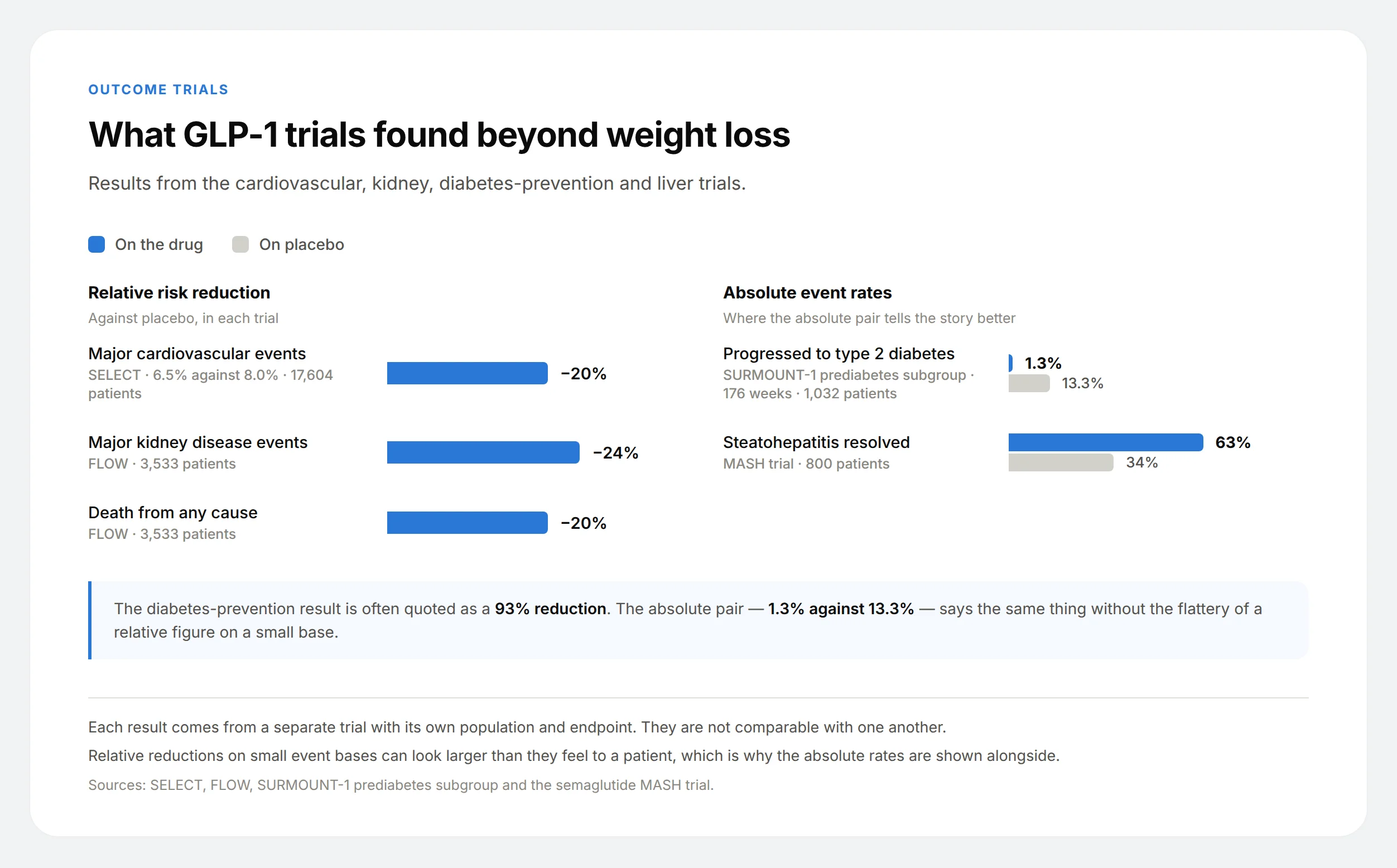
In the SELECT trial, 6.5% of patients on semaglutide had a major cardiovascular event against 8.0% on placebo, a 20% relative reduction23. The trial followed 17,604 patients aged 45 and over with obesity and heart disease but no diabetes, for a mean of 39.8 months. This result earned Wegovy its cardiovascular indication in March 202426.
The kidneys followed. In the FLOW trial of 3,533 patients with type 2 diabetes and chronic kidney disease, semaglutide cut major kidney disease events by 24%27. All-cause death fell 20%. The trial was stopped early because the benefit was already clear.
In the SURMOUNT-1 prediabetes subgroup of 1,032 participants, 1.3% developed type 2 diabetes over 176 weeks, against 13.3% on placebo9. After 17 weeks off treatment the difference narrowed but held, at 2.4% against 13.7%. Twelve points of absolute difference over three years is the clearest prevention result in the class. Clinicians can confirm that prediabetes diagnosis with a glucose tolerance test, one of the standard diagnostic options before starting treatment.
63% of patients with MASH, a serious fatty liver disease, saw their steatohepatitis resolve without worsening fibrosis at 72 weeks, against 34% on placebo21. The trial covered 800 adults with moderate to advanced fibrosis. Fibrosis improved without worsening steatohepatitis in 37% against 22%. The indication was granted accelerated approval in August 2025, so confirmatory data is still pending. In practice, clinicians often monitor that fibrosis with an elastography test rather than a repeat liver biopsy.
The same trial produced 10.5% average weight loss against 2% on placebo21. Weight was a secondary endpoint here. The indication rests on liver histology.
Zepbound was approved for moderate to severe obstructive sleep apnea on December 20, 2024, the first drug treatment for the condition of any kind25. The approval rested on two 52-week trials in 469 adults with sleep apnea and obesity. Measured on the apnea-hypopnea index, more patients reached remission or mild disease than on placebo.
The GLP-1 market’s two makers reported tens of billions of dollars in obesity and diabetes medicine sales in the first half of 2026 alone. Every figure in this section is audited and dated.
All of them come from Eli Lilly’s Q2 results of August 5, 2026, or Novo Nordisk’s half-year report of August 4, 2026. One rule holds throughout. Novo reports in Danish kroner and Lilly in US dollars, so the two are never added together here.
| Product | Company | Period | Revenue | Change |
|---|---|---|---|---|
| Mounjaro | Eli Lilly | Q2 2026 | $9,943 million | +91% |
| Zepbound | Eli Lilly | Q2 2026 | $4,928 million | +46% |
| Foundayo | Eli Lilly | Q2 2026 (first quarter on sale) | $98 million | New launch |
| Ozempic | Novo Nordisk | H1 2026 | DKK 59,200 million | -2% at constant rates |
| Wegovy (injectable) | Novo Nordisk | H1 2026 | DKK 37,719 million | Part of +19% division growth |
| Wegovy pill | Novo Nordisk | H1 2026 (from Jan 5 launch) | DKK 5,474 million | New launch |
| Saxenda | Novo Nordisk | H1 2026 | DKK 871 million | -54% at constant rates |
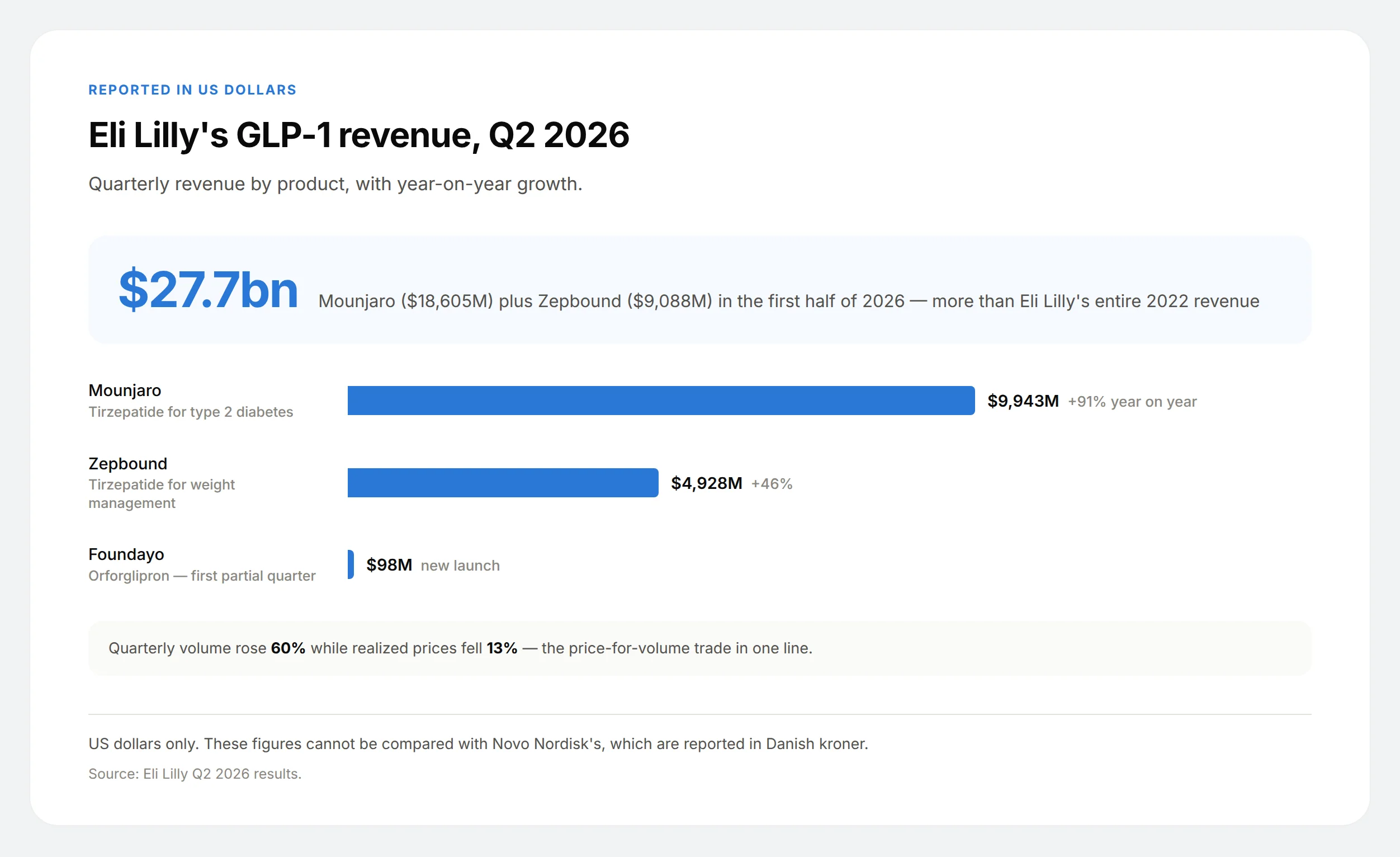
Mounjaro’s $18,605 million plus Zepbound’s $9,088 million comes to $27,693 million for the first half of 202628. That sum, added here from the two reported product lines, is more than the company’s entire 2022 revenue.
The quarterly detail is just as striking. Mounjaro alone brought in $9.94 billion in Q2 2026, up 91% year on year28. That works out to about $109 million in sales every single day of the quarter. Revenue outside the US rose 172%, helped by China adding tirzepatide to its reimbursement list. Zepbound reached $4.93 billion, up 46%28.
Tirzepatide drove Lilly’s total revenue up 48% to $23.0 billion in the quarter28. Volume rose 60% while realized prices fell 13%, the clearest illustration of the price-for-volume trade running through this market. Foundayo added $98 million in its first partial quarter, a useful scale check against the billions above28.
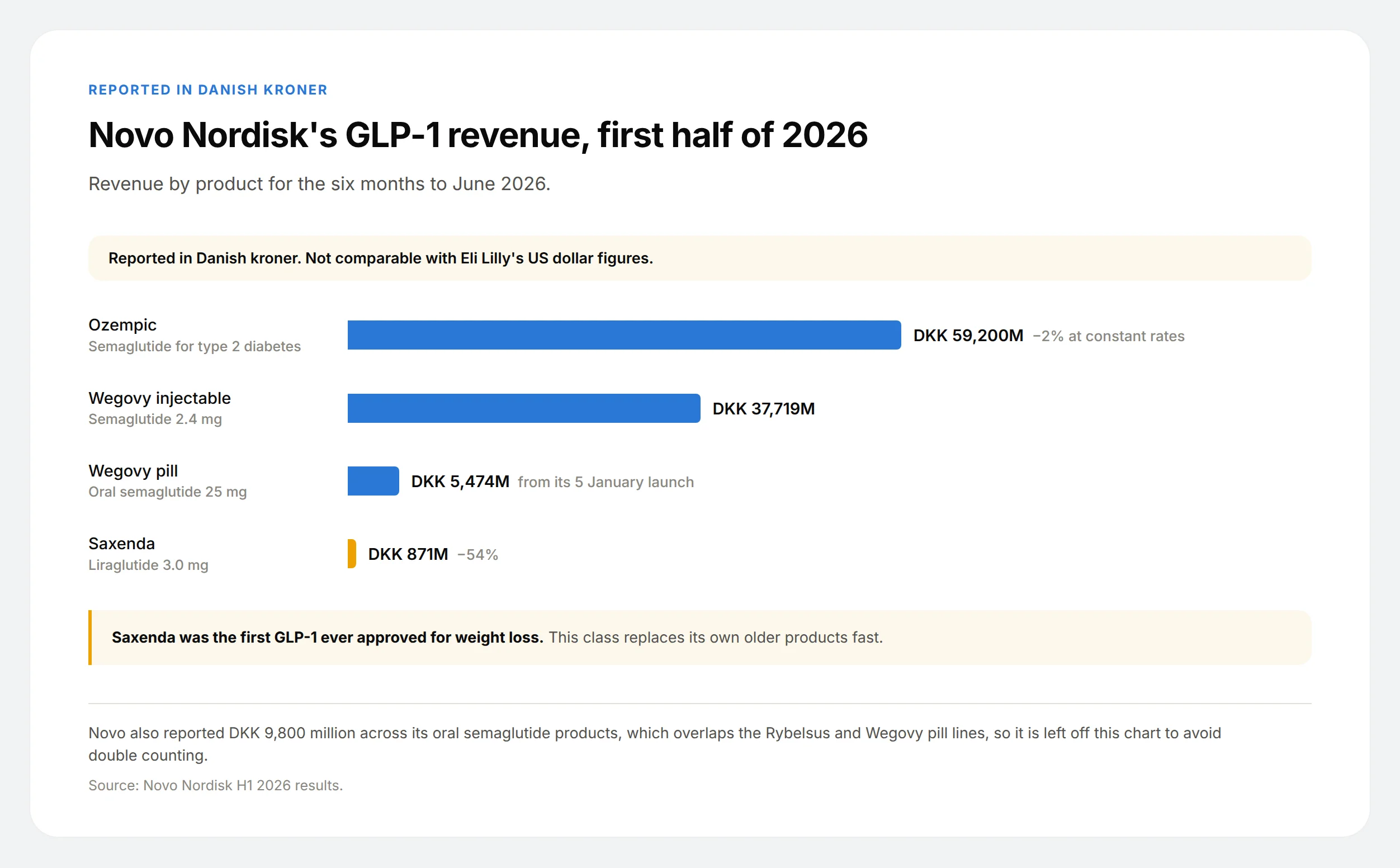
Novo Nordisk’s obesity care division sold DKK 44,064 million of medicine in the first half of 2026, up 19% at constant exchange rates12. The figure is reported in Danish kroner, so it is left in kroner here.
Wegovy injectable generated DKK 37.7 billion of that, and the Wegovy pill DKK 5.5 billion12. The pill launched on January 5, 2026, so its number covers a partial half-year. Meanwhile Saxenda, the first GLP-1 ever approved for weight management, collapsed 54% to DKK 871 million12. This class replaces its own older products fast.
Ozempic revenue reached DKK 59,200 million in the first half of 2026, with the oral semaglutide products adding DKK 9,800 million12. Ozempic sales fell 2% at constant exchange rates as US prices came down. A falling revenue number here does not mean falling volume.
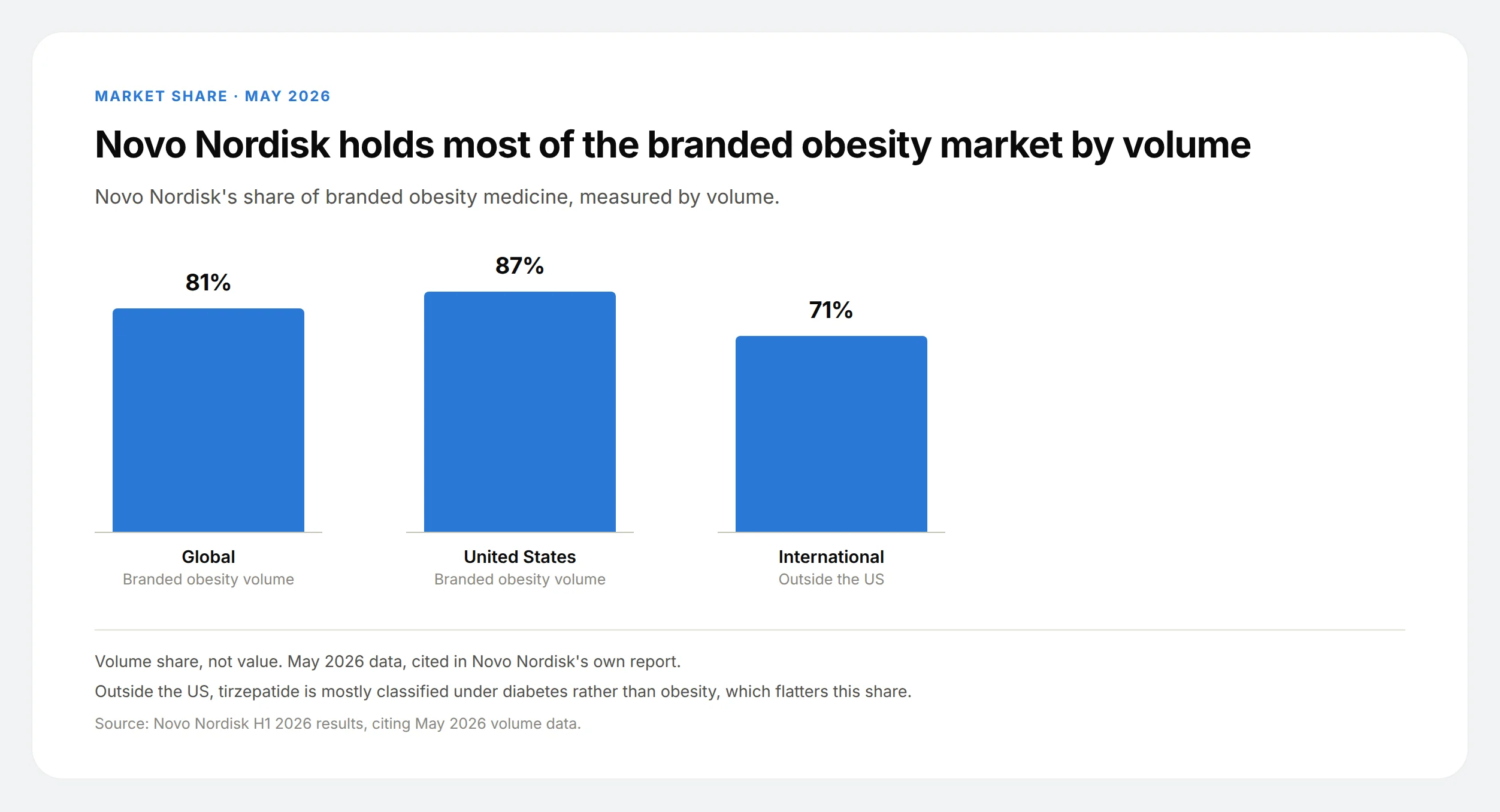
Novo Nordisk holds 81% of the global branded obesity market by volume, on May 2026 market data cited in its own report12. Its US share is 87% and its international share 71%. One caveat matters here. This is volume share, not value. Also, in most non-US markets tirzepatide is classified under diabetes, which flatters the obesity share.
For patient reach rather than market share, Novo says its medicines treated 4.9 million people with obesity in the first half of 202612. Another 41.6 million of its patients were living with diabetes. That is one company’s own patient count, not the size of the market. No organization publishes a global patient total for the class.
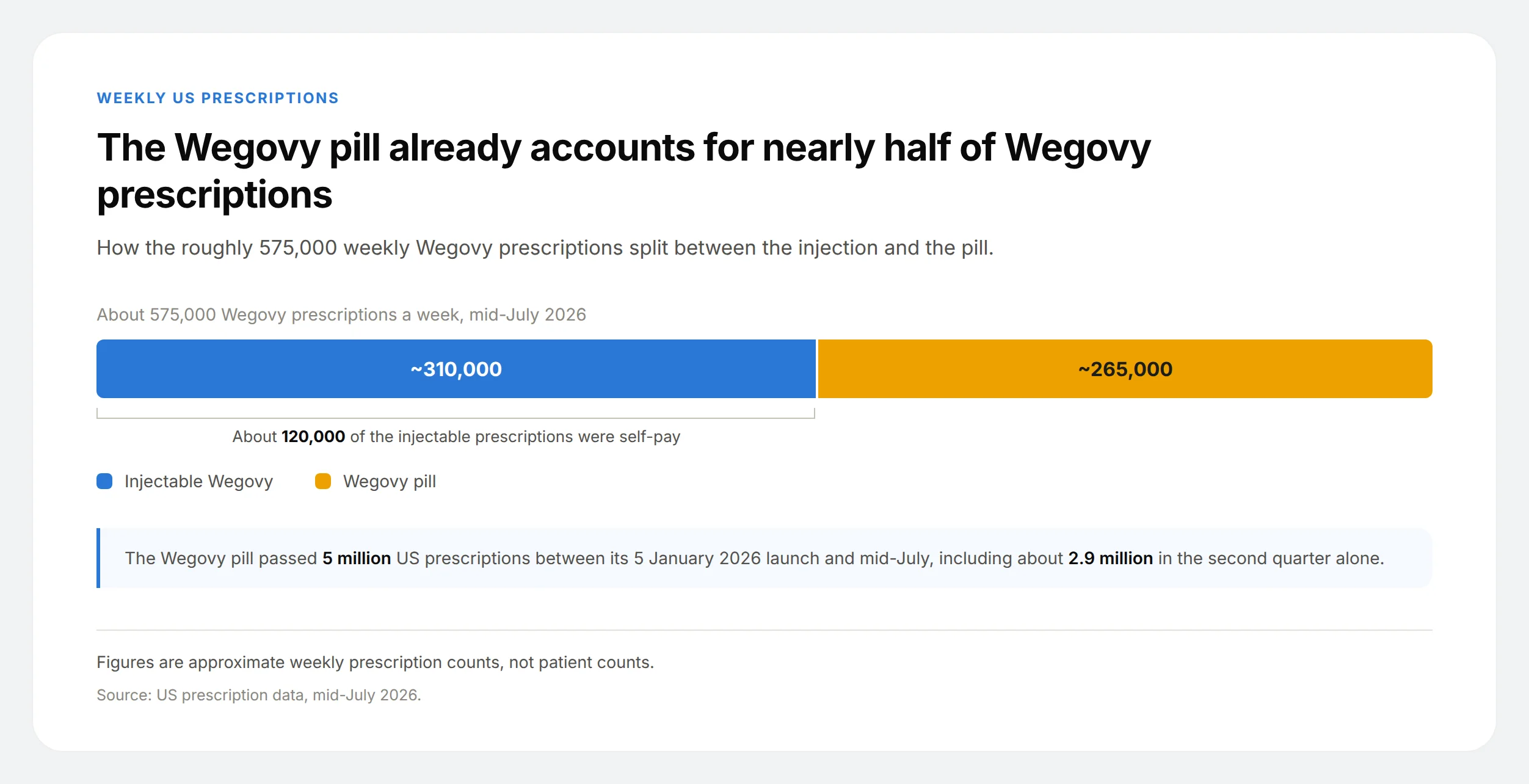
The Wegovy pill passed five million US prescriptions between its January 5, 2026 launch and mid-July, with about 2.9 million in Q2 alone12. Novo calls it the strongest GLP-1 volume launch the US has seen, a claim that belongs to Novo rather than to neutral data.
Total weekly Wegovy prescriptions ran at about 575,000 in mid-July 2026, split roughly 310,000 injectable and 265,000 pill12. About 120,000 of the injectable scripts were self-pay, which connects this figure to the pricing section below.
Wegovy is launched in around 60 countries as of mid-202612. No organization publishes a country-by-country GLP-1 patient count, so launch footprint is the closest verifiable proxy. Pair it with the 71% international volume share above, remembering that tirzepatide sits under diabetes in most non-US markets.
The average cost of a GLP-1 without insurance now runs from $149 to $499 a month through the manufacturers’ direct channels. List prices used to top $1,000. US GLP-1 prices moved repeatedly across 2025 and 2026, and several changes are dated into the future. Every price below carries its effective date, because a GLP-1 price without a date is meaningless.
| Product | Price type | Price | Effective from | Who pays |
|---|---|---|---|---|
| Wegovy | List price, pre-agreement | $1,350 / month | As at November 2025 | List benchmark |
| Ozempic | List price, pre-agreement | $1,000 / month | As at November 2025 | List benchmark |
| Ozempic / Wegovy | Direct-to-consumer | $350 / month | November 2025 agreement | Self-pay via TrumpRx |
| Zepbound / orforglipron | Direct-to-consumer | Average $346 / month | November 2025 agreement | Self-pay via TrumpRx |
| Zepbound single-dose vials | Self-pay program | $299 to $449 by dose | December 1, 2025 | Self-pay via LillyDirect |
| Wegovy pill | Self-pay | $149 to $299 by dose | As at H1 2026 | Self-pay, retail and pharmacy |
| Foundayo | Self-pay | From $149 / month | April 1, 2026 | Self-pay via LillyDirect |
| GLP-1s (eligible) | Medicare copay | $50 / month | July 1, 2026 to December 31, 2027 | Medicare beneficiaries |
| Ozempic / Rybelsus / Wegovy | Medicare negotiated price | $274 / 30 days | January 1, 2027 | Medicare Part D |
| Wegovy / Ozempic / Rybelsus | New list price | $675 / month | January 1, 2027 | List benchmark |
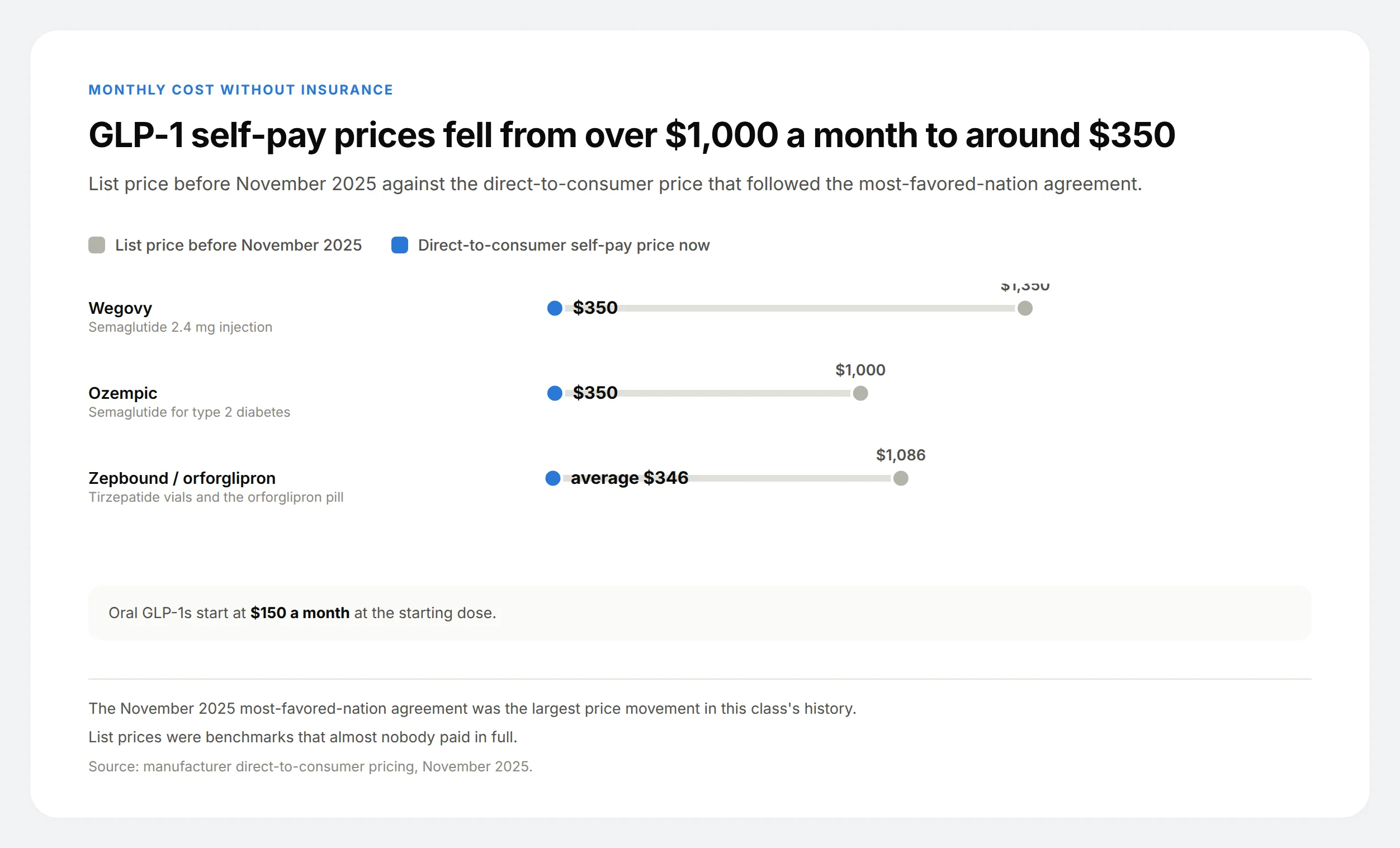
Wegovy’s US list price stood at $1,350 a month, Ozempic’s at $1,000, and Zepbound’s at $1,086, as of November 202529. These are the federal government’s stated benchmarks, and every later cut is measured against them. They are list prices, which almost nobody paid in full.
Under the November 2025 most-favored-nation agreement, Ozempic went from $1,000 to $350 a month and Wegovy from $1,350 to $350 in the direct-to-consumer channel29. Zepbound and orforglipron went from $1,086 to an average of $346.
For Wegovy, that is a 74% cut, effectively overnight. Oral GLP-1s start at $150 a month at the starting dose. This is the single largest price movement in the class’s history.
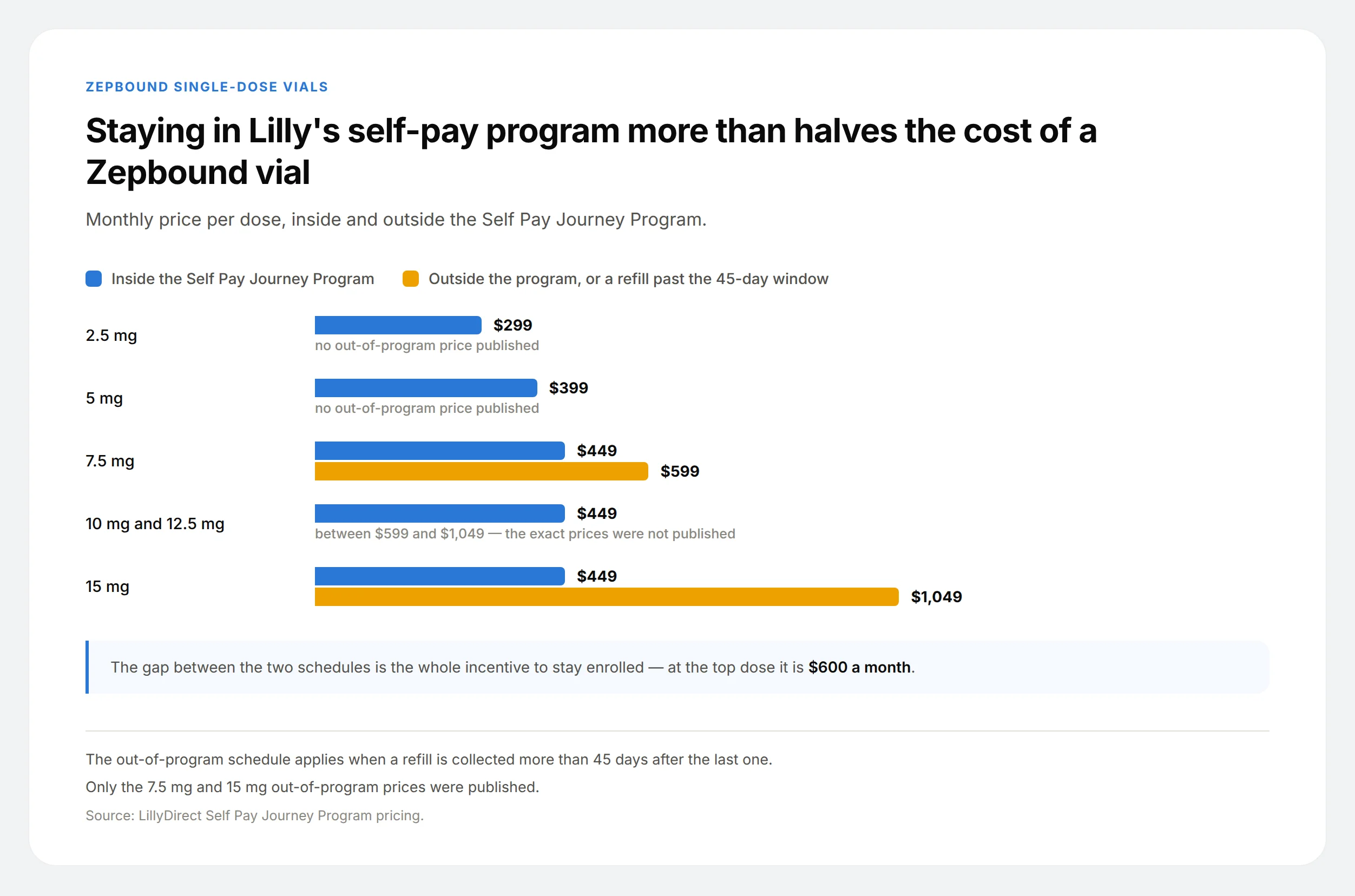
The average cost of Zepbound without insurance is $299 to $449 a month in vial form, from December 1, 202530. Inside the Self Pay Journey Program, the 2.5 mg dose is $299, the 5 mg is $399, and all other doses are $449.
Outside the program, a refill past the 45-day window runs $599 for 7.5 mg up to $1,049 for 15 mg30. The difference between the two schedules is the whole incentive to stay enrolled.
The Wegovy pill self-pays at $149 to $299 a month by dose, through retail and the maker’s own pharmacy12. Set that against the five million prescriptions in six months from the market section. The price and the volume explain each other.
Foundayo shows how many prices one product can have. It starts at $149 a month self-pay at the lowest dose6. Commercially insured patients pay as little as $25 with the savings card. Eligible Medicare patients pay $50 a month from July 1, 2026. That is three prices for the same pill.
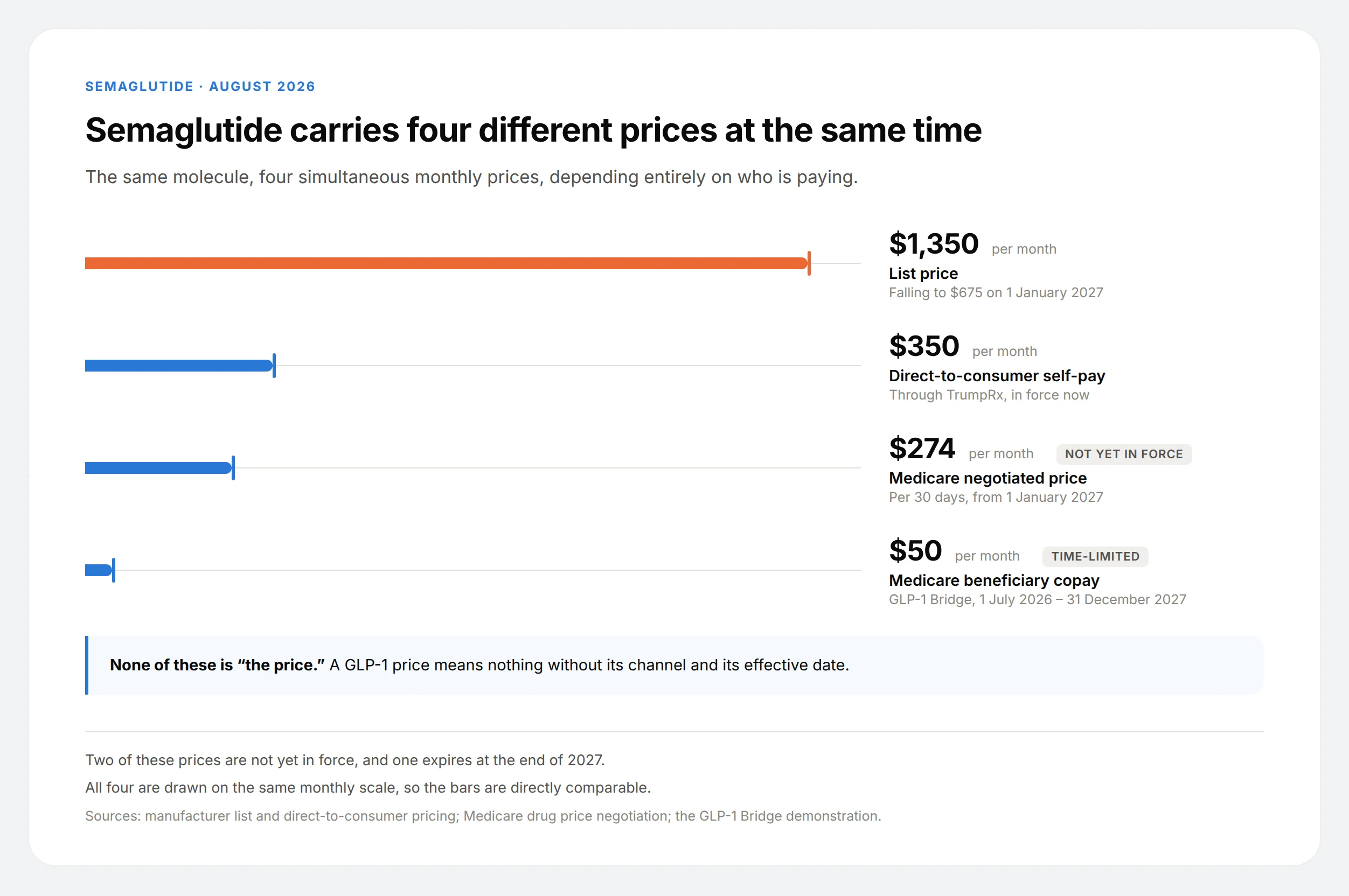
Medicare’s negotiated price for semaglutide will be $274 for a 30-day supply from January 1, 2027, 71% below the earlier $959 list benchmark31. The maximum fair price applies across Ozempic, Rybelsus, and Wegovy. It takes effect next year and is not in force as this article publishes.
The list price is falling too. Novo Nordisk will cut the US list price of Wegovy, Ozempic, and Rybelsus to $675 a month from January 1, 202732. That is roughly a 50% cut for Wegovy and 35% for Ozempic. It helps people whose out-of-pocket cost is tied to list price, such as high-deductible plans, and leaves self-pay prices unchanged.
Semaglutide as of August 2026 carries four different prices at once:
None of them is “the price” of the drug. A quoted figure means nothing without its channel and its effective date.
GLP-1 insurance coverage is widest through large employers and Medicare, and thinnest through state Medicaid programs. This section runs from private coverage through what patients actually pay, then to the public programs whose spending numbers are the largest in this article.
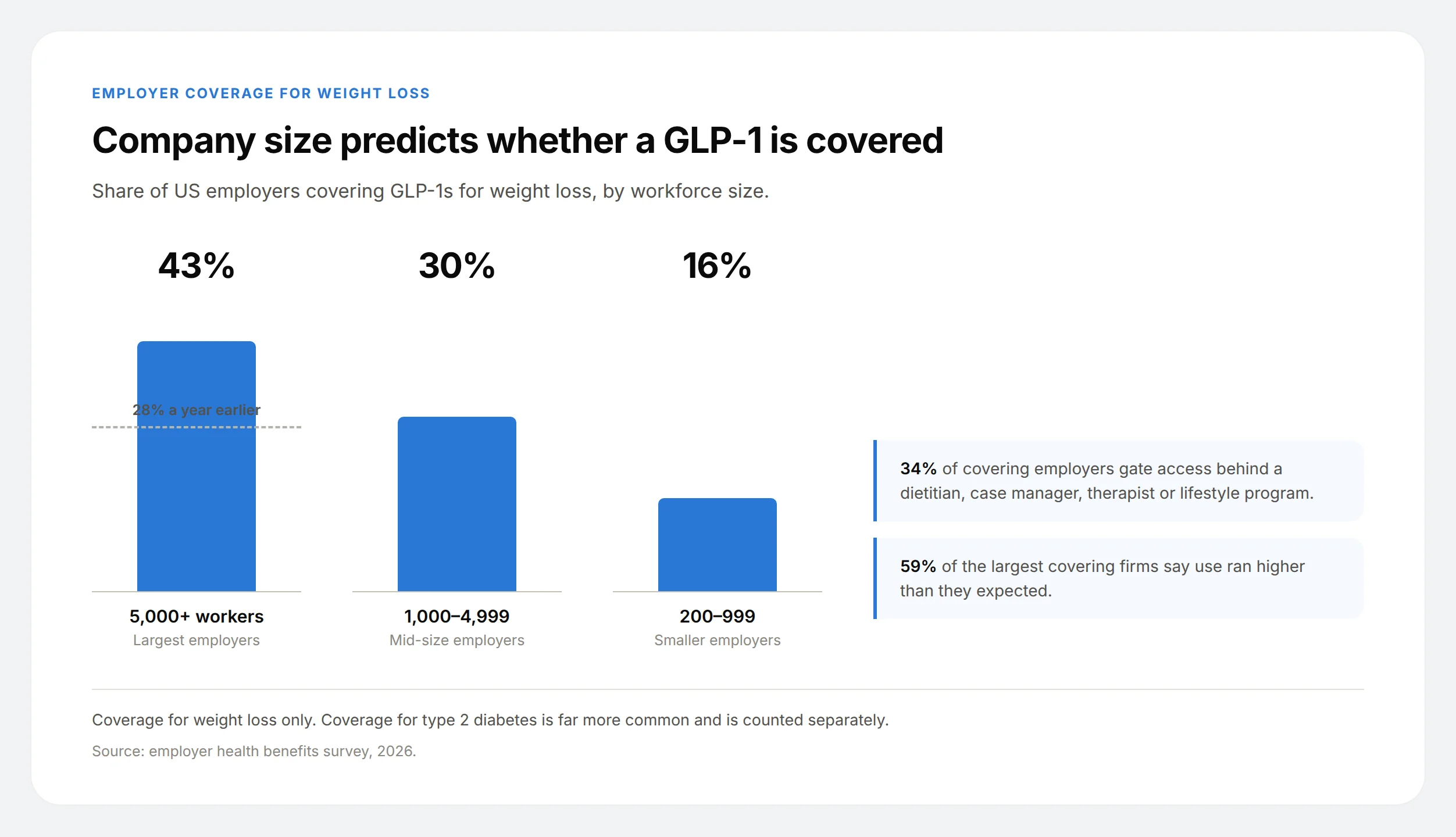
43% of US firms with 5,000 or more workers now cover GLP-1s for weight loss, up from 28% a year earlier34. Coverage falls to 30% at firms with 1,000 to 4,999 workers and 16% at 200 to 999. Company size is the strongest predictor of whether a GLP-1 is covered.
Coverage existing and coverage being reachable are different things. 34% of covering employers require employees to see a dietitian, case manager, or therapist, or join a lifestyle program, before they qualify34. Each requirement adds a referral or visit for the prescribing practice, and medical practice management software keeps them on one timeline.
The demand also caught employers off guard. 59% of the largest covering firms say use ran higher than they expected34. Next to the 57.4 million eligible privately insured adults, that surprise was arithmetic waiting to happen.
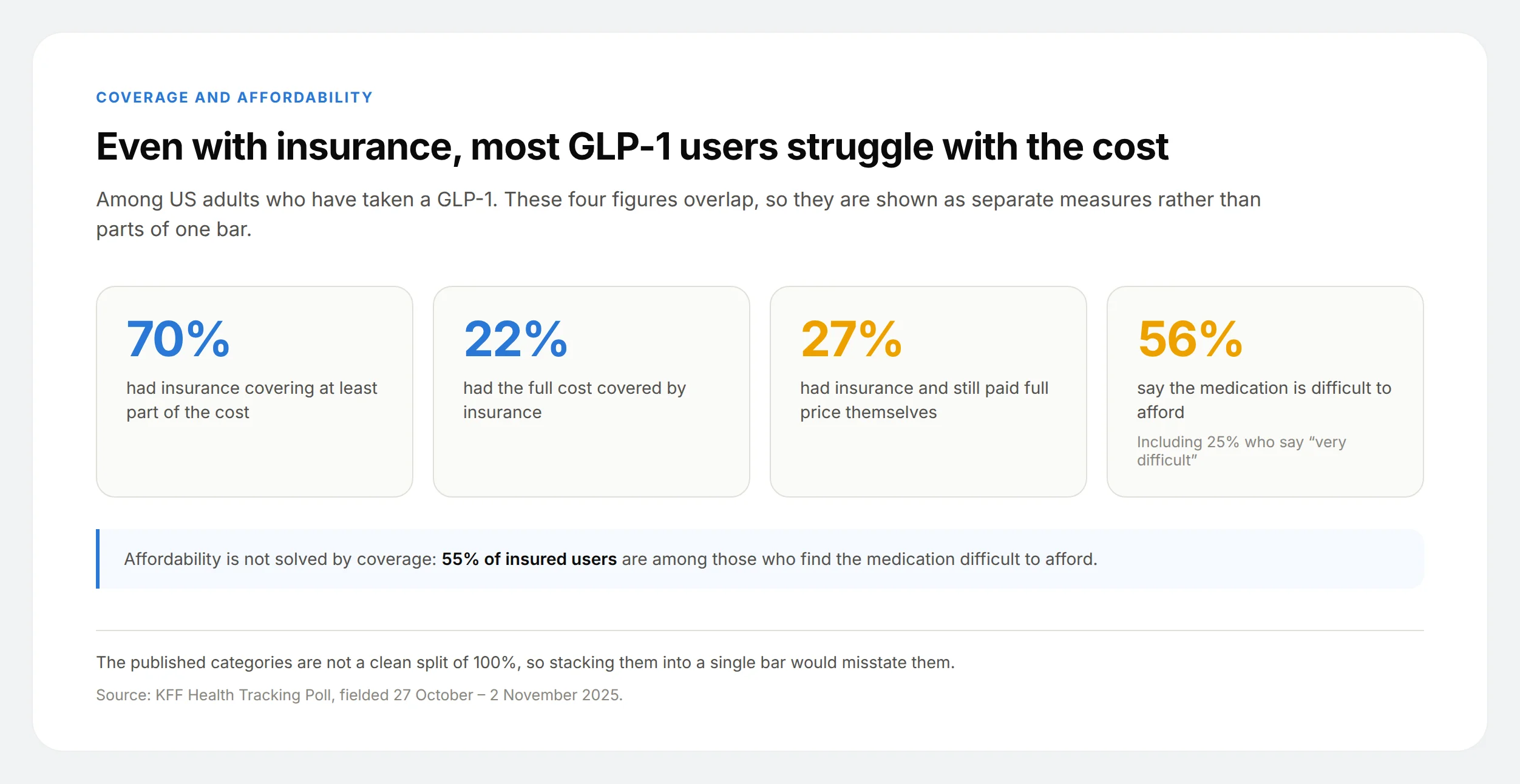
70% of GLP-1 users had insurance that covered at least part of the cost, and 22% had it covered in full1. Yet 27% had insurance and still paid the full price themselves. Having coverage and having the drug covered are not the same thing.
56% of people taking a GLP-1 say it is difficult to afford, and a quarter say it is very difficult1. That includes 55% of insured users. Affordability is the mechanism behind the persistence figures earlier in this article, where cost was the leading reason for stopping.
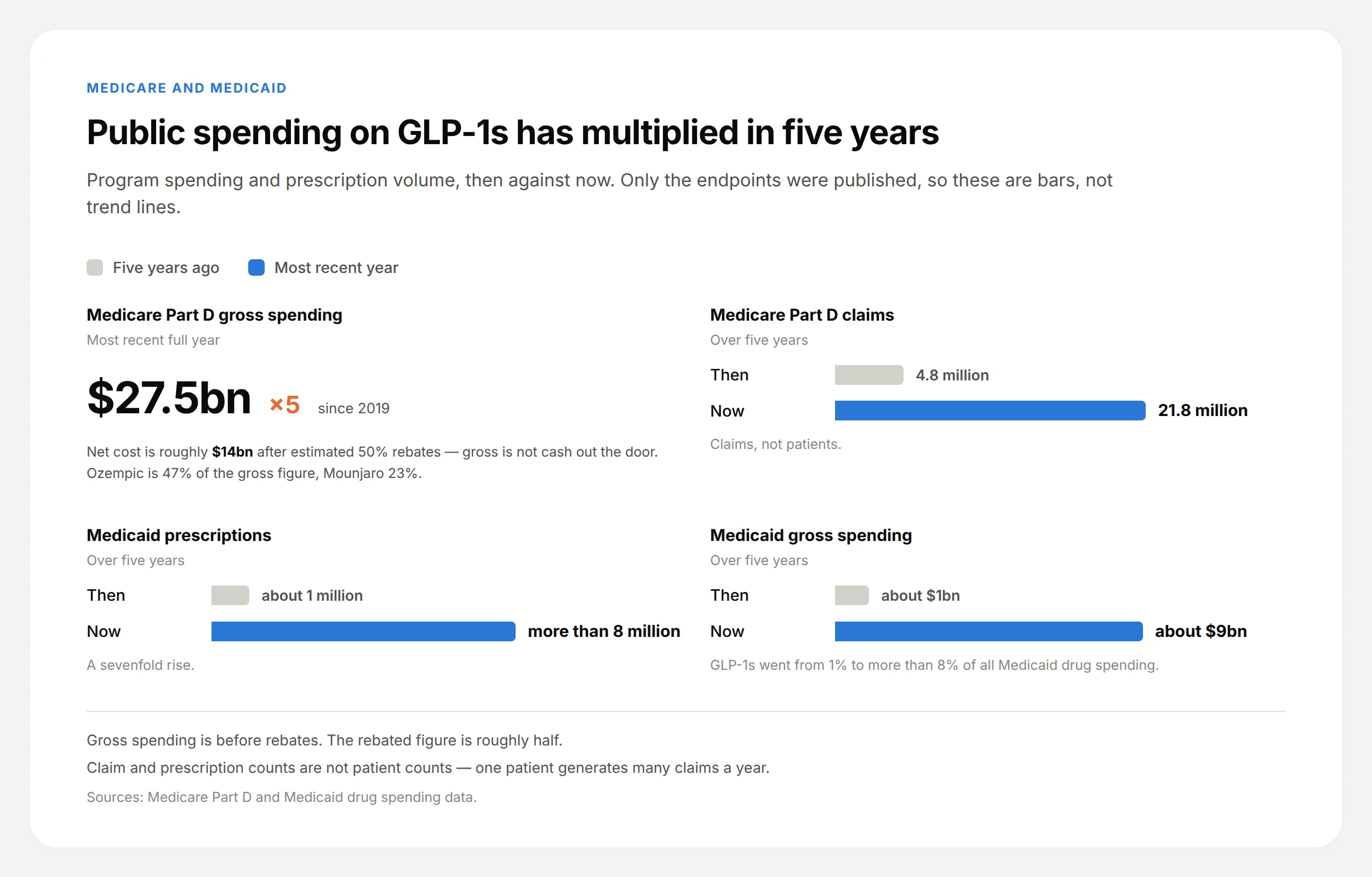
Gross Medicare Part D spending on GLP-1s reached $27.5 billion in the most recent full year of data, five times its 2019 level35. Analysts estimate net spending at around $14 billion assuming 50% rebates, so the gross figure is not cash out the door.
Ozempic accounted for 47% of that gross spending and Mounjaro 23%. A program built around far cheaper chronic medicines is now absorbing a $1,000-a-month class at scale. That pressure is exactly what produced the negotiated 2027 price covered earlier.
Semaglutide alone cost the program $15.2 billion gross across its three brands, covering 2,282,000 enrollees31. That is more than any other drug selected for Medicare price negotiation. On the volume side, Part D GLP-1 claims rose from 4.8 million to 21.8 million over five years35. Those are claims rather than patients, since one patient on year-round treatment generates many.
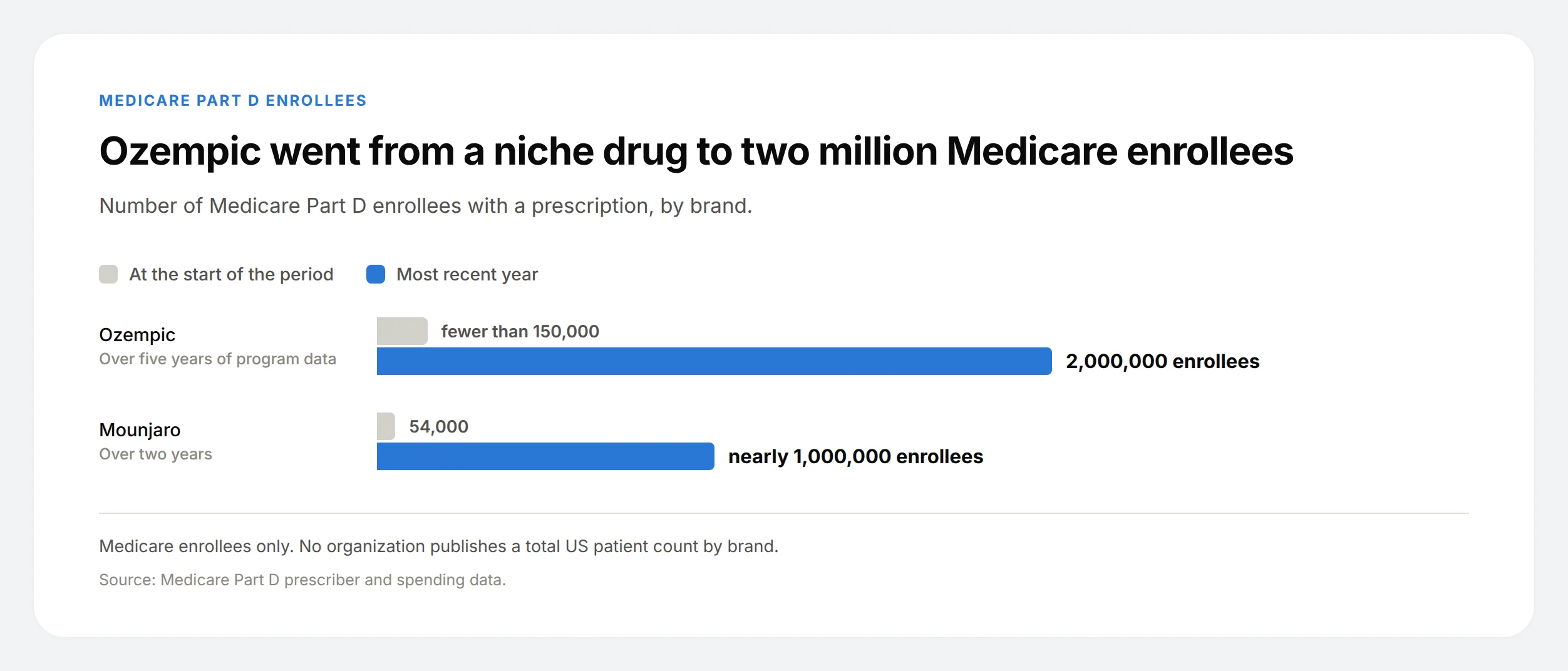
Ozempic went from fewer than 150,000 Medicare Part D enrollees to 2 million over five years of program data35. Mounjaro went from 54,000 to nearly 1 million in two. These are Medicare enrollees, not a national total. No organization publishes a total US patient count by brand.
Medicaid GLP-1 prescriptions rose sevenfold over five years, from about one million to more than eight million36. Gross spending went from about $1 billion to almost $9 billion over the same period36. GLP-1s moved from 1% of all Medicaid drug spending to more than 8%. That works out at roughly $1,000 per prescription before rebates.
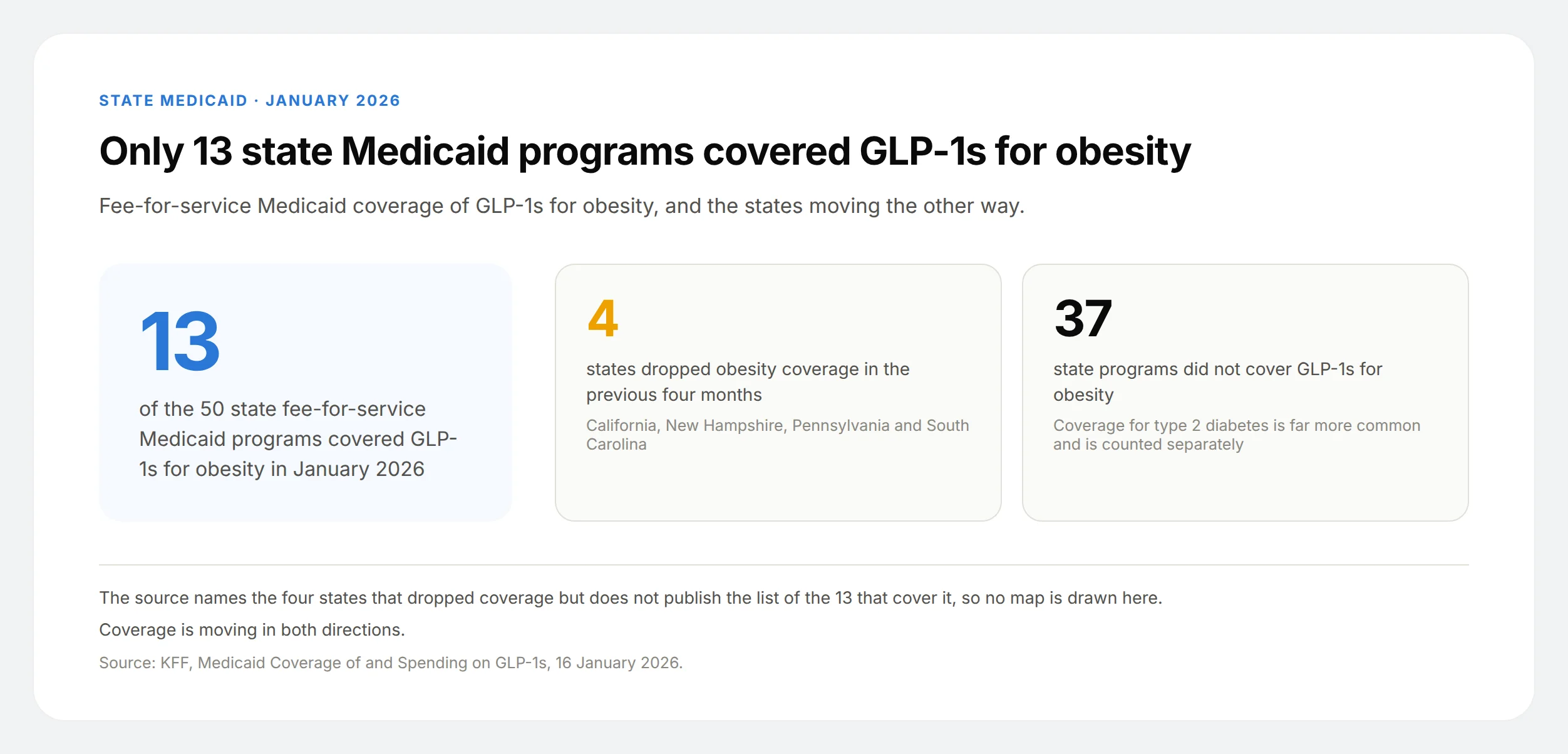
Only 13 state Medicaid programs covered GLP-1s for obesity under fee-for-service as of January 202636. Four states dropped coverage in the preceding four months: California, New Hampshire, Pennsylvania, and South Carolina. Coverage is moving in both directions at once, not along a single trend.
The Medicare GLP-1 Bridge gives eligible Part D beneficiaries GLP-1s for $50 a month, from July 1, 2026 to December 31, 202733. It is a time-limited demonstration, not permanent coverage. The November 2025 agreement that set Medicare’s underlying price at $245 with a $50 copay is what made covering obesity medicines viable at all29.
Most GLP-1 patients get their prescription from a doctor, but online providers and med spas hold a measurable share. This section covers the channels, the compounded market, the shortage that created it, and the state of generics.
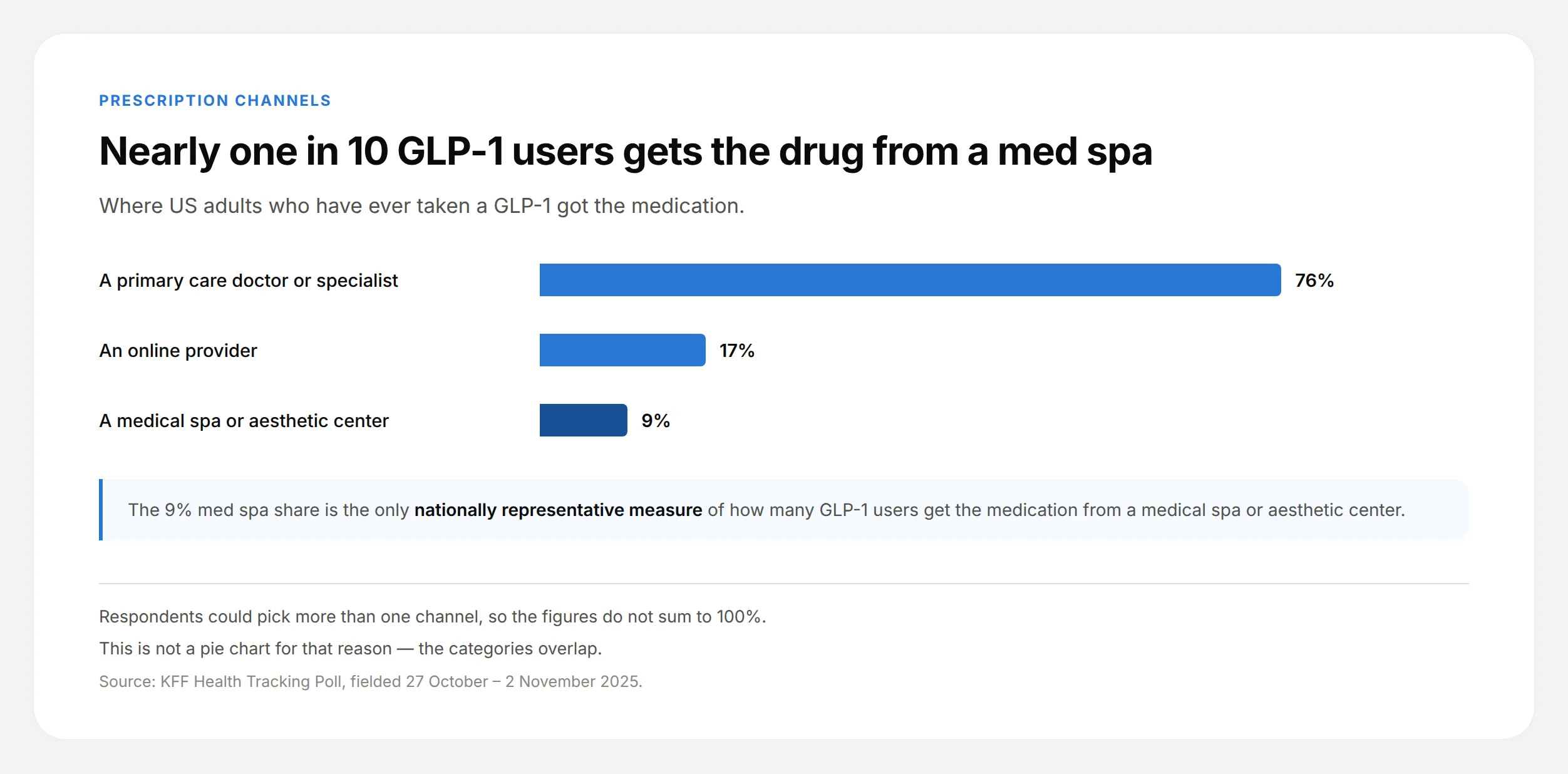
Among US adults who have ever taken a GLP-1, 76% got it from a primary care doctor or specialist1. Another 17% used an online provider, and 9% a medical spa or aesthetic center. Respondents could pick more than one channel, so the figures don’t sum to 100. This is the only nationally representative measure of the med spa share of GLP-1 supply. Practices entering this market compare the best aesthetic clinic software to manage those patients.
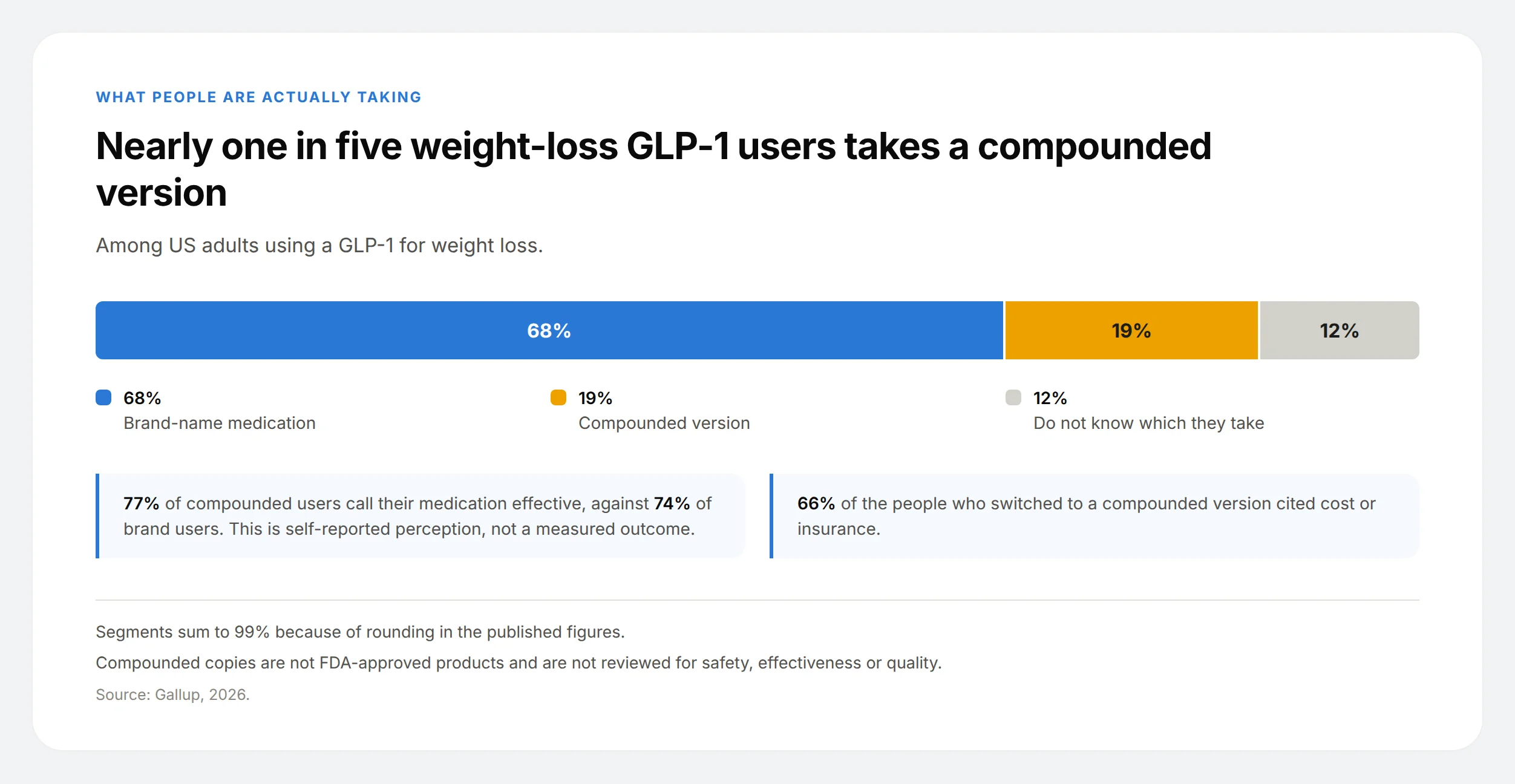
68% of weight-loss GLP-1 users are on a brand-name product, 19% on a compounded version, and 12% don’t know which they have2. Compounded use persists well after the shortage exemption that allowed it ended, which the next section explains.
Compounded users are no less satisfied. 77% call their medication effective or extremely effective, against 74% of brand-name users2. That is self-reported perception, not a measured outcome comparison. Cost drives the traffic: 66% of people who switched to a compounded version cited cost or insurance2.
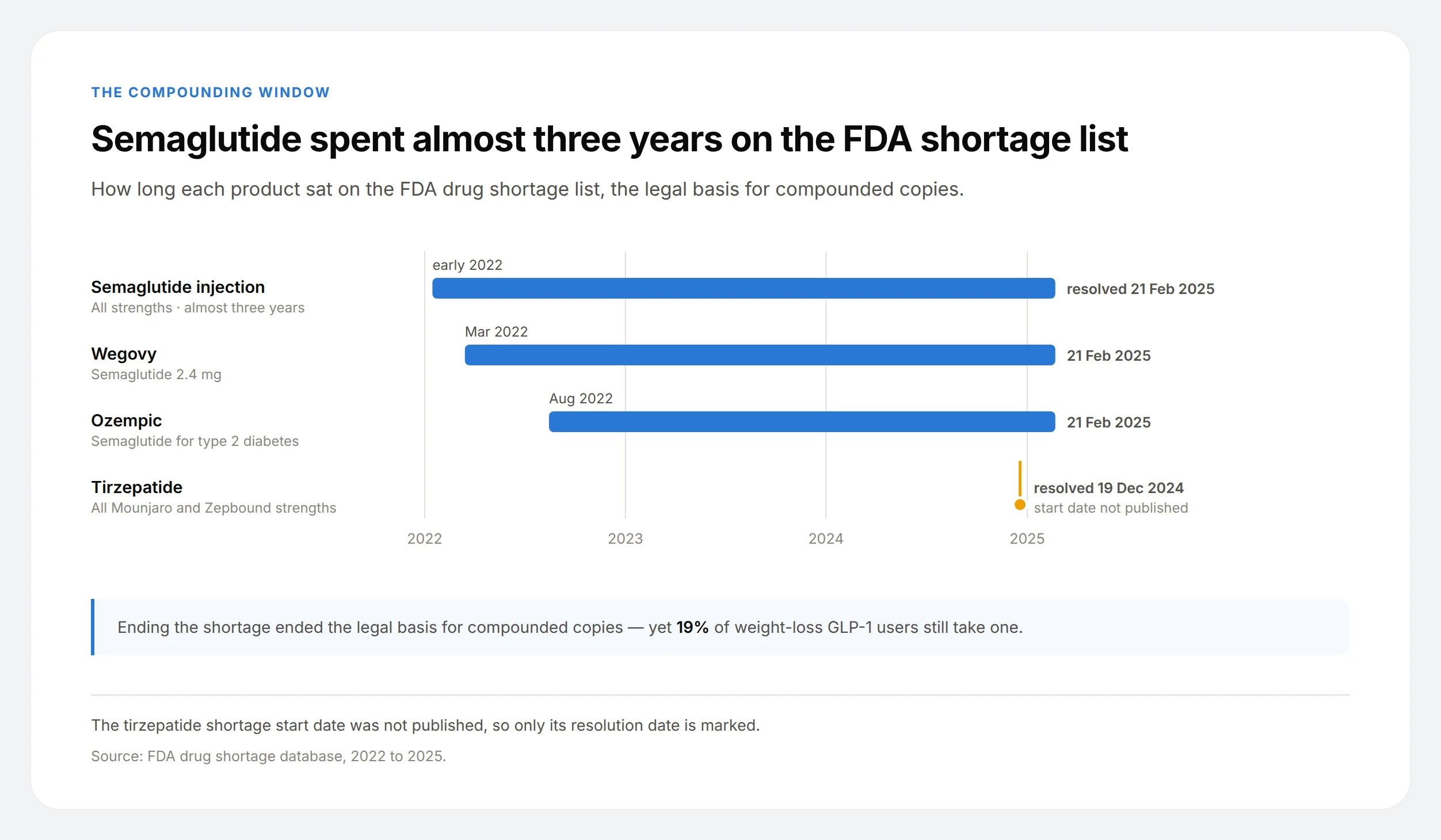
Semaglutide injection sat on the FDA’s shortage list from early 2022 until the shortage was declared resolved on February 21, 202537. Wegovy was listed from March 2022 and Ozempic from August 2022. Ending the shortage ended the legal basis for compounding copies, which is why the compounding figures above matter.
The tirzepatide shortage resolved two months earlier, on December 19, 2024, covering all six Mounjaro and all six Zepbound strengths38.
The first generic GLP-1s were approved in late 2024: a generic exenatide referencing Byetta in November, and a generic liraglutide referencing Victoza on December 2339. Both reference older GLP-1s. No generic semaglutide or tirzepatide is marketed in the US.
A generic semaglutide exists on paper but cannot be sold. Apotex received tentative FDA approval on April 7, 2026 for three strengths24. Tentative approval means the product meets the standard but cannot be marketed, usually for patent or exclusivity reasons. It should never be described as available.
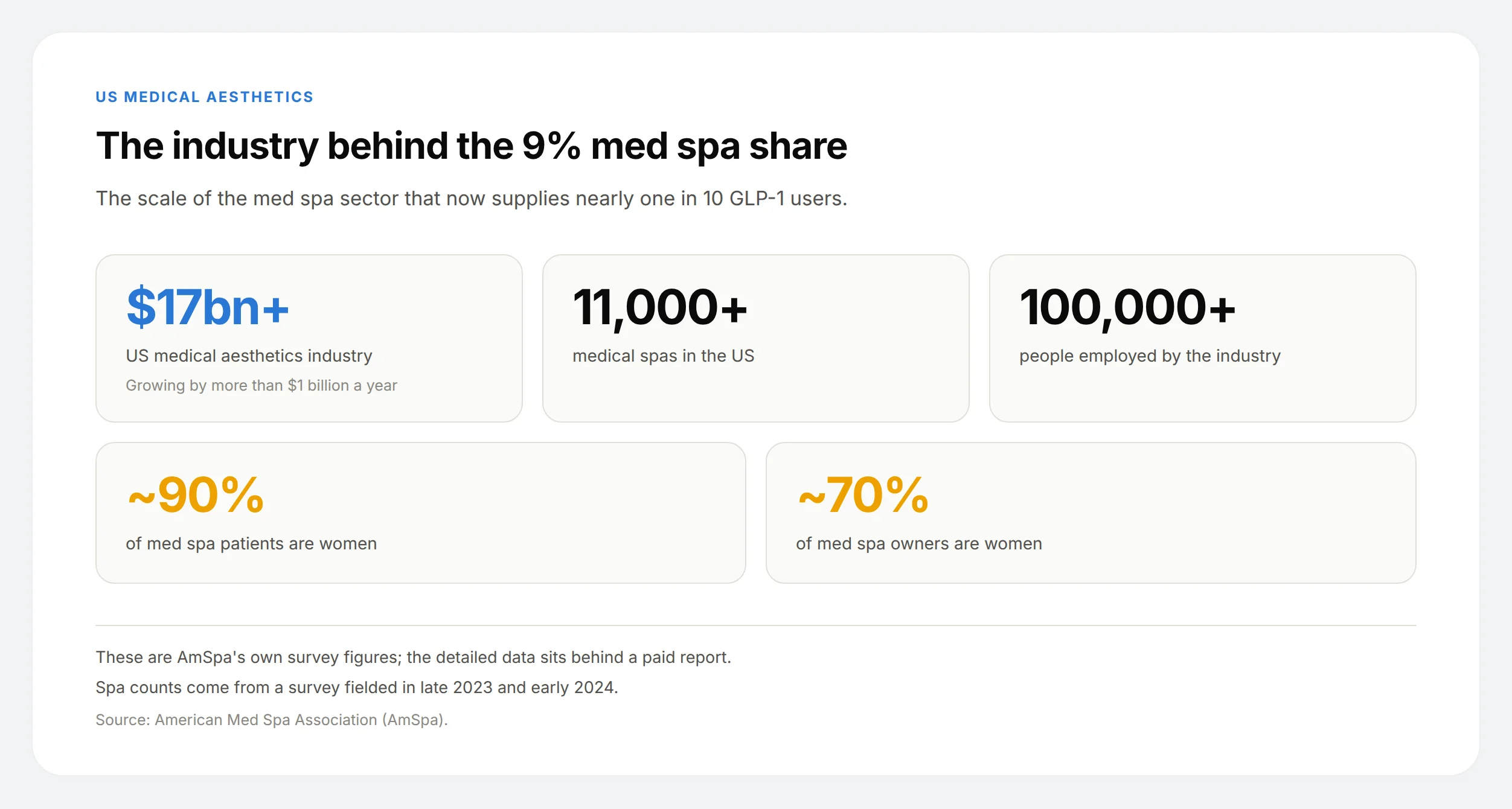
The US medical aesthetics industry has passed $17 billion, on the American Med Spa Association‘s own survey40. It is growing by more than $1 billion a year. The underlying survey data sits behind a paid report, so these are the association’s published headline figures.
The association’s most recent openly published report counts more than 11,000 medical spas employing over 100,000 people41. Close to 90% of their patients are women, and nearly 70% of med spa owners are women. Those figures come from a survey fielded from late 2023 to early 2024, so they trail the market they describe.
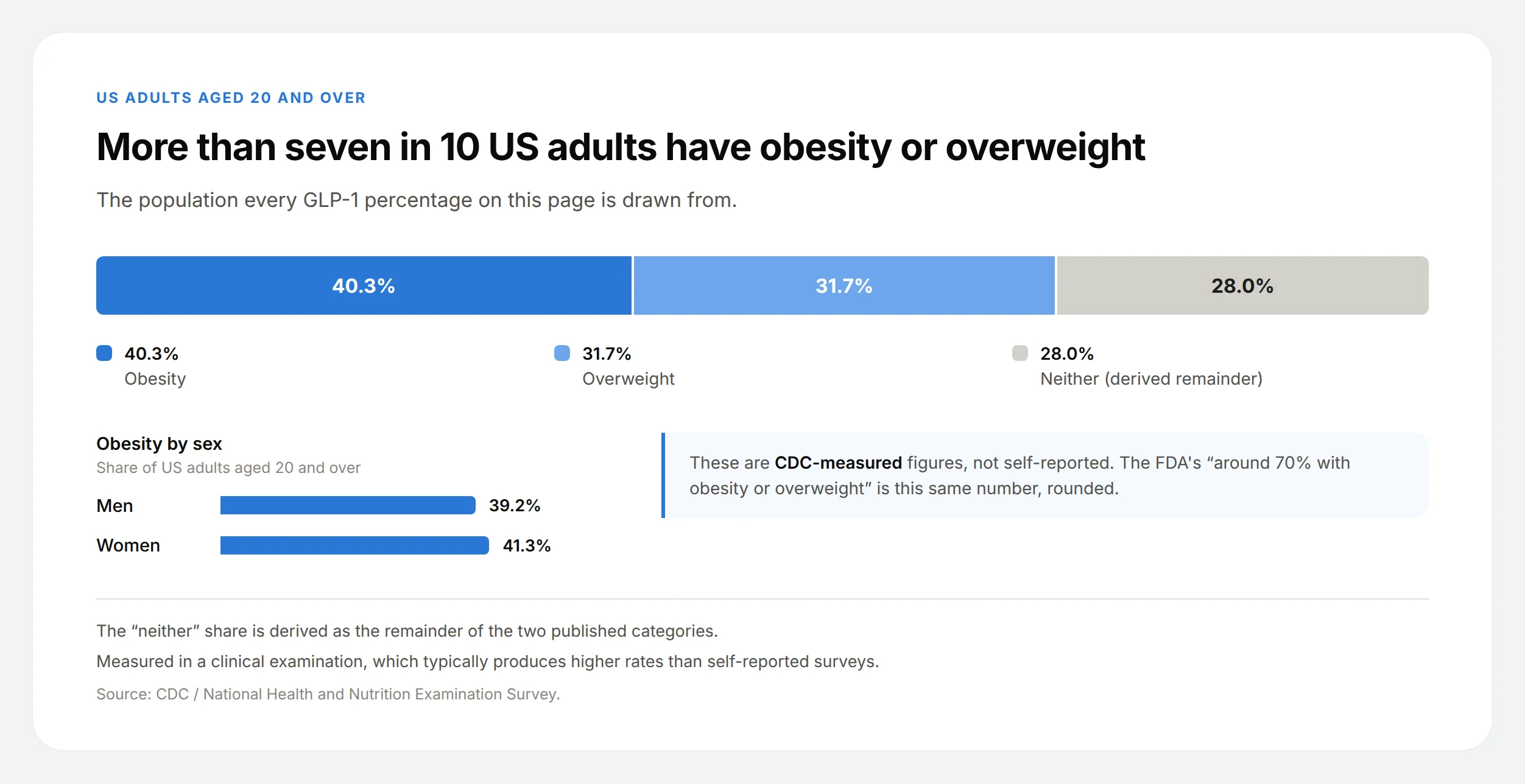
40.3% of US adults have obesity, and around 70% have obesity or overweight42. Every GLP-1 percentage above is a share of this population. Meanwhile, three independent readings now show US obesity flat or falling, agreeing on direction while measuring differently.
40.3% of US adults aged 20 and over have obesity, and another 31.7% are overweight, in the CDC’s most recent measured survey cycle42. These figures are measured, not self-reported. Men run 39.2% and women 41.3%.
The FDA frames the combined population as around 70% of American adults with obesity or overweight26. That matches the measured split of 40.3% plus 31.7%, rounded. The two ways of saying it are the same number, not a contradiction.
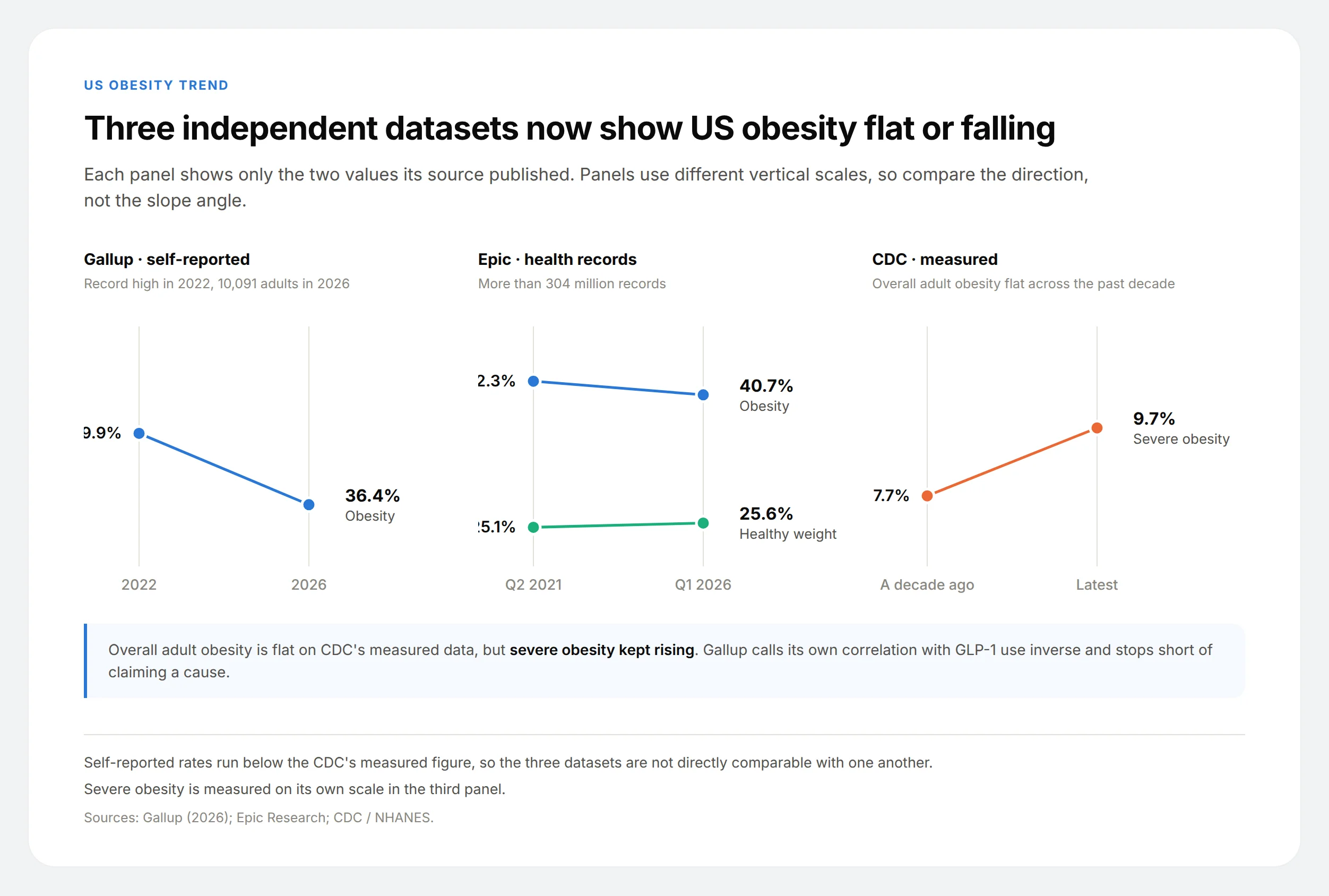
Overall adult obesity has been flat across the past decade of CDC measurement, while severe obesity rose from 7.7% to 9.7%42. Two different trends sit inside one population. The second one is the population the highest-efficacy products are aimed at.
21.1% of US children and teenagers aged 2 to 19 have obesity, including 7% with severe obesity, with another 15.1% overweight43. The figures come from the same measured CDC cycle as the adult data. They connect to the adolescent approvals earlier in this article: Wegovy has been cleared for patients aged 12 and over since late 202224.
Gallup’s self-reported obesity rate fell from a record 39.9% in 2022 to 36.4% in 2026, across 10,091 adults2. Self-reported rates run below the CDC’s measured figure. Gallup describes the correlation with GLP-1 use as inverse and stops short of claiming causation.
Health records point the same way. The obese share of US adults in one 304-million-record dataset slipped from 42.3% in Q2 2021 to 40.7% in Q1 20263. The healthy-weight share rose from 25.1% to 25.6%.
That is a third independent read on the same direction of travel. For decades the national obesity line moved in only one direction. Three separate readings agreeing on even a modest decline is a milestone.
890 million adults worldwide live with obesity, 16% of the adult population, and another 2.5 billion are overweight, per the WHO’s latest fact sheet44. Adult overweight rose from 25% in 1990 to 43% in the most recent data, and obesity more than doubled over the same period.
The children’s figures are starker. 160 million children and adolescents aged 5 to 19 were living with obesity in the latest global data, four times the 1990 rate44. A further 35 million children under 5 were overweight.
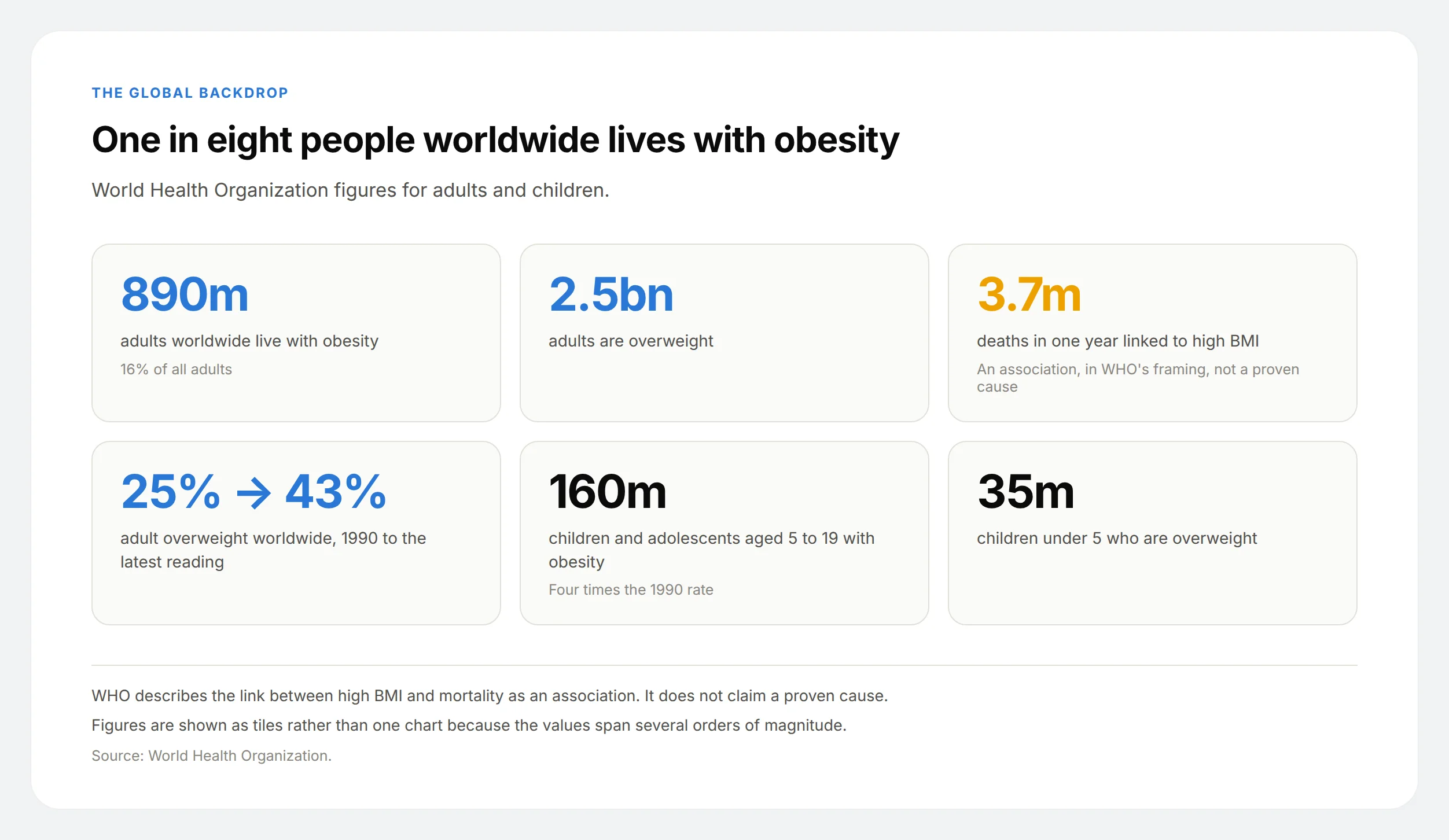
High BMI was linked to 3.7 million deaths from non-communicable diseases globally in the WHO’s most recent mortality data44. The WHO reports it as an association rather than a proven cause.
More than 38 million Americans have diabetes, and 90% to 95% of them have type 2, per CDC figures cited by the FDA39. This is the population the whole class was originally built for, and the one the prevalence section opened on.
Three trends run through this record, and all three are accelerating. The first is the move to pills. Two oral GLP-1s reached the US market within four months of each other across late 2025 and early 202624. Pills need no needles and no cold storage, which removes two of the biggest barriers to mass adoption.
The second is raw efficacy. Retatrutide posted 28.3% average weight loss in trials, and CagriSema 22.7%. Neither is approved yet12,14. Results in that range used to require bariatric surgery.
The third is price. One November 2025 agreement took the class from a $1,350 list price to $350 self-pay29. A $274 negotiated Medicare price follows in 202731. Each wave of this market arrives bigger and cheaper than the last, which looks more like a technology curve than a typical drug launch.
Put the three together and the direction is hard to miss. GLP-1s are moving from scarce, expensive specialty products toward everyday chronic medication. The open question is whether patients stay on them long enough to collect the benefit, and the numbers below tackle exactly that.
The single largest number in this dataset is a retention number, not a weight-loss number. 85% of people who start a GLP-1 for weight loss have stopped within two years, and only 8% remain at three19,20.
Yet one-year persistence nearly doubled between 2021 and 2024 starters20. Follow-up is the variable that moved. That makes retention a practice operations problem, and it is the one number in this dataset a practice can influence.
Pabau, the practice management software we build, turns that follow-up into a system instead of a memory test. Automated recalls contact a patient who is due a check-in before the prescription lapses. 14% of patients stop over cost and 13% over side effects1. Packages and payment plans catch the first reason, and scheduled check-ins catch the second.
The withdrawal trials showed weight returning when treatment stops, so maintenance deserves a record of its own. Progress tracking and before-and-after photos sit inside each patient’s file, making maintenance a documented phase rather than an assumption. Digital forms handle the intake, medical history, and consent paperwork a weight-loss program needs, including a food frequency questionnaire for baseline nutrition history. Patients complete them before the appointment, and everything files straight to the record.
The med spa channel is measurable, too. 9% of GLP-1 users got their medication from a med spa or aesthetic center1. The industry behind that channel tops $17 billion across more than 11,000 US practices40. A practice running a structured GLP-1 program, rather than issuing a prescription, is working the one lever the persistence data says matters. Esteem Life Medical Group built its practice on digital records from day one, and keeps them in Pabau.

Pabau’s automated recalls, progress tracking and digital forms give your GLP-1 program the structured follow-up the persistence data rewards, so patients stay engaged.

The figures that get quoted about this class are trial figures. The figures that decide whether a patient benefits are persistence figures. They come from different studies, measure different things, and disagree.
A trial result answers what the drug can do under supervised escalation and steady follow-up. A persistence rate answers what happens in ordinary life, where cost, side effects, and lapsed appointments do their work. Use the first to judge the medicine and the second to judge the program around it. The programs are where the numbers are still moving.
For practices offering GLP-1 programs, the follow-up layer is the part you own. Book a demo to see how Pabau helps your practice keep GLP-1 patients engaged from first consult to maintenance.

Prepping intake for a bariatric surgery candidate? bariatric intake form covers demographics, medical history, comorbidities, medications, surgical history, and signed consent in one form.
Running a weight-loss program? Best EMR for weight loss clinics compares the platforms built for exactly this patient journey.
Comparing platforms for your practice? Top 7 weight loss clinic software ranks the systems US practices use to run these programs.
Tracking a patient’s glucose readings over time? blood glucose log gives a dated reading grid with reference ranges for fasting, post-meal, A1C, and OGTT results.
Wondering where the revenue comes from? How weight loss clinics make money breaks down the income streams behind a GLP-1 program.
12% of US adults currently take a GLP-1, and 18% have taken one at some point, per KFF’s poll fielded in late 2025. That works out to roughly one in eight American adults.
12% on KFF’s all-indication measure, and 11% on Gallup’s weight-loss-specific measure from mid-2026. The two differ because they ask different questions. KFF counts every reason for taking one, while Gallup counts weight loss only.
2 million Medicare Part D enrollees took Ozempic in the most recent year of program data, per KFF. No organization publishes a total US patient count by brand, so the Medicare figure is the best verifiable number.
Ozempic is approved for type 2 diabetes, not weight loss, so no weight-loss average exists for it. The semaglutide weight-management figure is 14.9% over 68 weeks in the STEP 1 trial, at the 2.4 mg dose sold as Wegovy.
In the STEP 1 extension, patients regained 11.6 percentage points in the year after stopping semaglutide, ending 5.6% below baseline. Real-world health records are more optimistic. 56% of semaglutide patients held their loss two years after stopping.
Ten branded GLP-1 medicines are FDA-approved: Byetta, Victoza, Trulicity, Saxenda, Ozempic, Rybelsus, Wegovy, Mounjaro, Zepbound, and Foundayo. The Wegovy pill and two generics referencing the older drugs sit alongside them. Retatrutide and CagriSema are investigational and not approved.
12% of US adults currently take one, but 37% say a close friend or family member does, and 91% are aware of the drugs. The distance between use and social visibility is what creates the impression that everyone is on one.