Piercing consent form
A piercing consent form is a signed record that a client understood a piercing&#...

4
Last Updated: Oct 2, 2026

An ADD ADHD medication list is a prescribing reference that sets out each FDA-approved drug by class, duration of action, and approved age range.
Stimulants are first-line for most patients, while non-stimulants suit stimulant intolerance, a substance use history, or comorbid anxiety.
Duration of action is the practical deciding factor, running from 3 hours on immediate-release Ritalin to about 12 on Concerta.
FDA-approved ages follow the formulation, not the drug family. Immediate-release Adderall starts at age 3, most other products at 6, and Intuniv and Kapvay stop at 17.
Practice management software like Pabau keeps each dose change, side effect, and symptom score in the client record, so a trial stays auditable.
The file opens with stimulant and non-stimulant reference tables covering FDA-approved ages, typical duration, and DEA schedule. It also carries a pre-prescription checklist, a review schedule, and printable trial and monitoring logs.
Download templateAn ADD ADHD medication list answers the two questions that come up in every medication review. How long does this dose last, and is my patient old enough for it? The list sets out each FDA-approved stimulant and non-stimulant by class, duration of action, and approved age range.
One rule matters more than the rest. Ages and durations belong to the exact formulation, not to the drug family. Adderall is indicated from age 3, but Adderall XR starts at 6.
Prescribe from the family name and you can land outside the label without noticing. This guide covers both drug tables, how to use the list in a visit, monitoring, and what changes for children, adults, and pregnancy.
The list is a structured inventory of the medications the FDA has approved for ADHD, split into two classes. Each row names the brand, the generic and its drug class, and the formulation. It then gives the typical duration of action, the DEA schedule where one applies, and the approved age range.
Kept in one place, that reference does two jobs. Prescribing stays consistent across every clinician in the practice. Parents and adult patients also get something concrete to look at while they weigh the options.
Two pharmacological routes sit behind the whole list. Stimulants raise dopamine and norepinephrine availability in the brain, which improves focus, impulse control, and sustained attention.
Non-stimulants reach the same target by another road, either norepinephrine reuptake inhibition or alpha-2 adrenergic agonism.
Speed is the honest difference between them. A stimulant tells you within a week or two whether it helps. Non-stimulants need at least four weeks at a therapeutic dose before the result counts.
Stimulants divide into two chemical families, amphetamine and methylphenidate. Both are DEA Schedule II controlled substances, so refills are not permitted and each prescription is written fresh.
Follow your state’s electronic prescribing rule for controlled substances, and check the prescription drug monitoring program before the first prescription.
Duration is usually what decides the formulation, and the spread is wider than a table makes obvious.
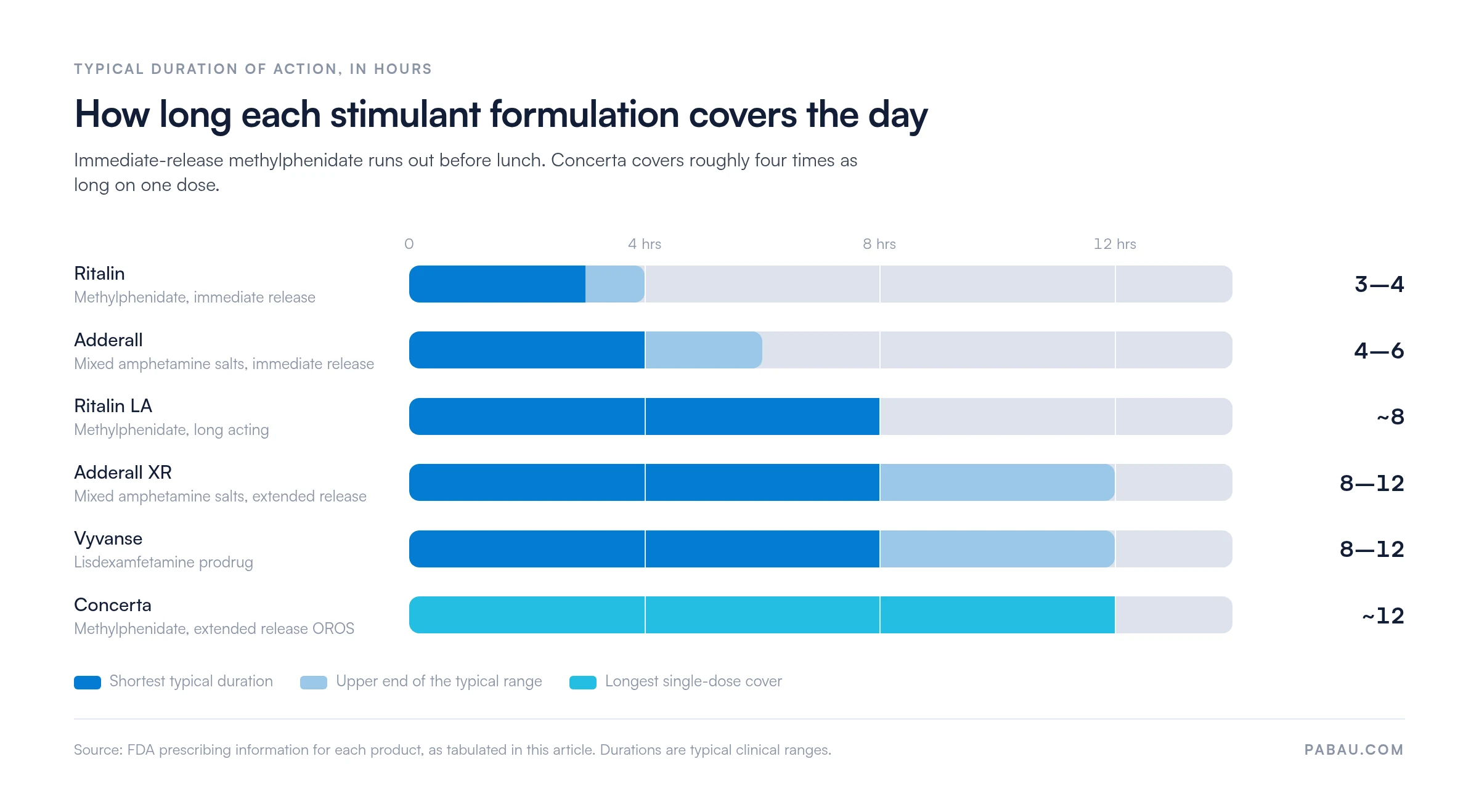
Amphetamine and methylphenidate are separate families, and a patient who gains little from one often responds to the other. Try the second family before you leave stimulants altogether. Match the duration to the hours the patient needs covered, then adjust the dose rather than the class.
Non-stimulants are the choice when a stimulant is unsafe, unwelcome, or has already failed. None of the four is DEA-scheduled, so they can be refilled, which matters for a patient with a substance use history.
Two are norepinephrine reuptake inhibitors, and two are alpha-2 adrenergic agonists.
Three label details change how you counsel a patient on these four:
Both alpha-2 agonists also work as an add-on to a partly effective stimulant, not only as monotherapy. For a version you can hand to a family, the National Institute of Mental Health covers the same options in plain language.
Both tables only earn their keep at the point of prescribing. In the visit itself, the list drives five steps:
Work down this list once, and the awkward questions come up in the room rather than at the pharmacy:
The list is a clinical aid, not a substitute for the prescribing information. Confirm dosing, contraindications, and age limits in the current label for each product.
Psychiatrists and psychiatric nurse practitioners use it most, but they are not the only ones. Pediatricians starting a first trial, neuropsychologists writing an assessment report, and nursing staff running titration calls all work from the same rows.
Practices that run ADHD care alongside talk therapy usually keep both in one therapy practice management software. The medication history then sits next to the session notes.
Comorbidity is where the list earns its keep. Anxiety, depression, or a substance use history all push the decision toward the non-stimulant column. Having that column in front of you shortens the conversation.
Four things change once the list stops living in one clinician’s head:
Most stimulant discontinuations come down to two side effects, appetite loss and poor sleep. Both usually respond to a change of formulation or timing rather than a change of class. Ask about them at every contact during titration.
Monitoring follows the phase of treatment rather than the calendar:
Plot weight and height against the child’s own growth curve at every visit. A falling percentile is the earliest sign that appetite suppression needs attention.
Caution flags. Stimulants need care in a patient with a personal or family history of sudden cardiac death. Active psychosis, severe hypertension, and a substance use disorder are the other flags. Alpha-2 agonists need baseline blood pressure and heart rate, plus a taper on stopping.
The same list reads differently depending on who is sitting in front of you.
Every one of those decisions has to be findable six months later. In a lot of practices this history lives in three places. The prescription sits in one system, the side effect report in a phone message, and the symptom score on a paper questionnaire. At the six-month review, somebody rebuilds the trial from memory.
Practice management software like Pabau holds the whole trial in the client record. Prescribing, treatment notes, and digital questionnaires all write to the same file, so each dose change lands next to the score that followed it. Reminders carry forward the review date you set at the last visit.
The outcome is a trial you can defend. Because medical records management keeps the history in one thread, the six-month review starts from the record rather than a reconstruction. A clinician covering for a colleague can pick the patient up without a handover call.
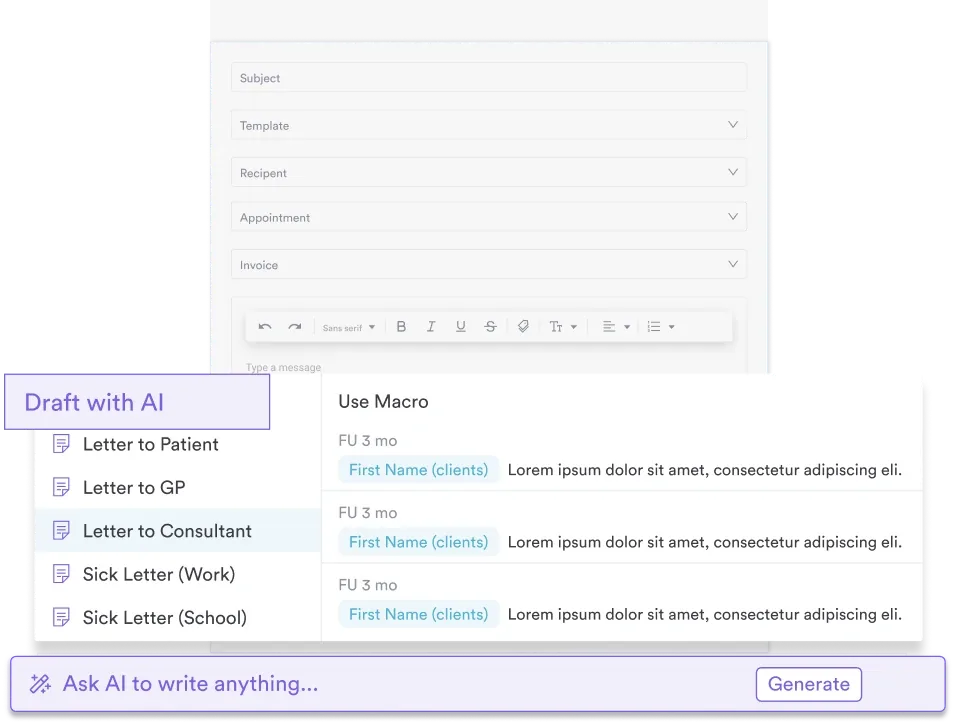

Pabau logs each dose change, side effect, and symptom score against the client record, then carries the review date forward. Your ADHD caseload stays auditable without a second spreadsheet.

The list itself is not the hard part. Holding to it is. A reference that lives on one clinician’s desktop drifts out of date, and the version in somebody’s memory drifts faster.
So download the file, cut it down to the products you actually prescribe, and put it where the whole team opens it. Then set the review dates as you prescribe, because the list only pays off when somebody checks the response it predicted.
One trade-off is worth keeping in view. A longer-acting formulation buys a covered afternoon and costs some control over the evening. Duration, not brand, is usually the decision. Book a demo to see how Pabau keeps a full ADHD medication trial in one patient record.

Need to confirm the diagnosis first? DSM-5 ADHD checklist template documents the criteria you have to meet before any of these medications is on the table.
Screening a new referral? ADHD screening test template gives you a first-pass instrument to run before you commit to a full assessment.
Want to measure the response? ADHD symptom tracker turns a patient’s week into the score you compare against baseline.
Assessing an adult? ADHD psychological assessment for adults covers the history and functional impact an adult diagnosis needs.
Stimulants raise dopamine and norepinephrine, and they work within 1-2 hours. The cost is appetite suppression, disturbed sleep, and abuse potential. Non-stimulants act through norepinephrine reuptake inhibition or alpha-2 agonism, need 1-6 weeks to reach full effect, and carry no abuse risk.
Yes. A Schedule II prescription cannot be refilled, so each supply needs a fresh prescription. Federal rules do let a prescriber issue several prescriptions on the same day, covering up to 90 days of treatment. Each one carries a do-not-fill-before date. State law can be stricter, so check yours.
Often yes, but MAOIs are the exception. Stimulants and atomoxetine are contraindicated with an MAOI, and the label wants at least 14 days between stopping one and starting the other. Viloxazine inhibits CYP1A2, so check every other drug cleared by that route.
It depends on the drug. A stimulant needs no taper, and neither does atomoxetine or viloxazine. Guanfacine ER and clonidine ER do need one. Their labels direct decrements of no more than 1 mg or 0.1 mg every 3 to 7 days, to avoid rebound hypertension.