Despina Petrushevska

The clinical audit cycle: Stages, challenges, and how to complete it
The clinical audit cycle is a repeating process for measuring care against an ag...

Last Updated: Nov 10, 2026
Free PDF 2 pages, print-ready Clinician-reviewed
A CBT triangle handout is a printable psychoeducation tool that shows patients how their thoughts, feelings and behaviors influence each other. Therapists use it to explain the cognitive model in plain language, usually early in treatment. They then return to the same three corners when they review a difficult week with the patient. This free two-page version adds a worked example, a guided exercise with evidence questions and a practice log. The rest of this page covers how the model works and how to use the handout with adults and children. It also shows where the completed sheet fits in your notes.
A two-page handout with a labeled triangle, a worked example that compares an unhelpful loop with an alternative one, and a guided exercise. It also includes evidence questions, a 0–10 feeling rating and a practice log for use between sessions.
Start from scratch, or upload this PDF or any form you already use, and Pabau's AI Form rebuilds it with tick boxes, text fields and a signature. Attach it to the treatment once, and every patient gets it on time.
AI Form rebuilds the consent, history and aftercare forms you already use. You review each one, then publish.
Patients complete forms on their phone before they arrive, so the front desk stops retyping paper.
Every signed form is versioned and attached to the treatment record, ready when you need it.
Set how long a consent stays valid. Returning patients skip forms they have already signed.
Supports HIPAA and GDPR compliance AES-256 encryption 4.8 on G2 4.7 on Capterra Trusted by 4,000+ practices worldwide

The CBT triangle is a model linking thoughts, feelings and behaviors, where a change in one corner affects the other two.
Introduce the handout as psychoeducation before asking patients to complete any practice records.
Adapt the language and layout, as well as the examples, for children and patients with lower literacy.
Test the alternative thought against evidence, so patients look for an accurate reading rather than a cheerful one.
Store completed handouts within the patient record so progress is documented and easy to review.
A CBT triangle handout is a printable diagram of the cognitive model, with thoughts, feelings and behaviors placed at the three corners. The handout is used in psychoeducation to show patients that these three areas are connected rather than separate problems. Many therapists call the same diagram the cognitive triangle, and the two names are used interchangeably.
The model draws on Beck’s cognitive theory, which places the meaning a person attaches to events at the center of emotional and behavioral responses. Guidance from the National Institute for Health and Care Excellence (NICE) recommends cognitive behavioral therapy (CBT) as a treatment for generalized anxiety disorder. The triangle is one of the most common ways practitioners introduce its core ideas.
The thoughts, feelings and behaviors triangle works by showing that each corner feeds the others. A patient who interprets a missed call as rejection may feel anxious, then avoid calling back, which confirms the original interpretation.
Changing one corner, such as a thought, can shift the other two. This is why the handout works as a planning tool as well as a diagram.
Use the handout after you have explained the model and the patient has identified a recent situation to work with. Keep the session focused on one example so the triangle stays concrete.
Common pitfalls include filling in all three corners with the therapist’s wording rather than the patient’s. Patients engage more when the language is theirs, even if it is less precise. For the last step, a behavioral experiment worksheet gives the test a prediction, a plan and a place to record the result.
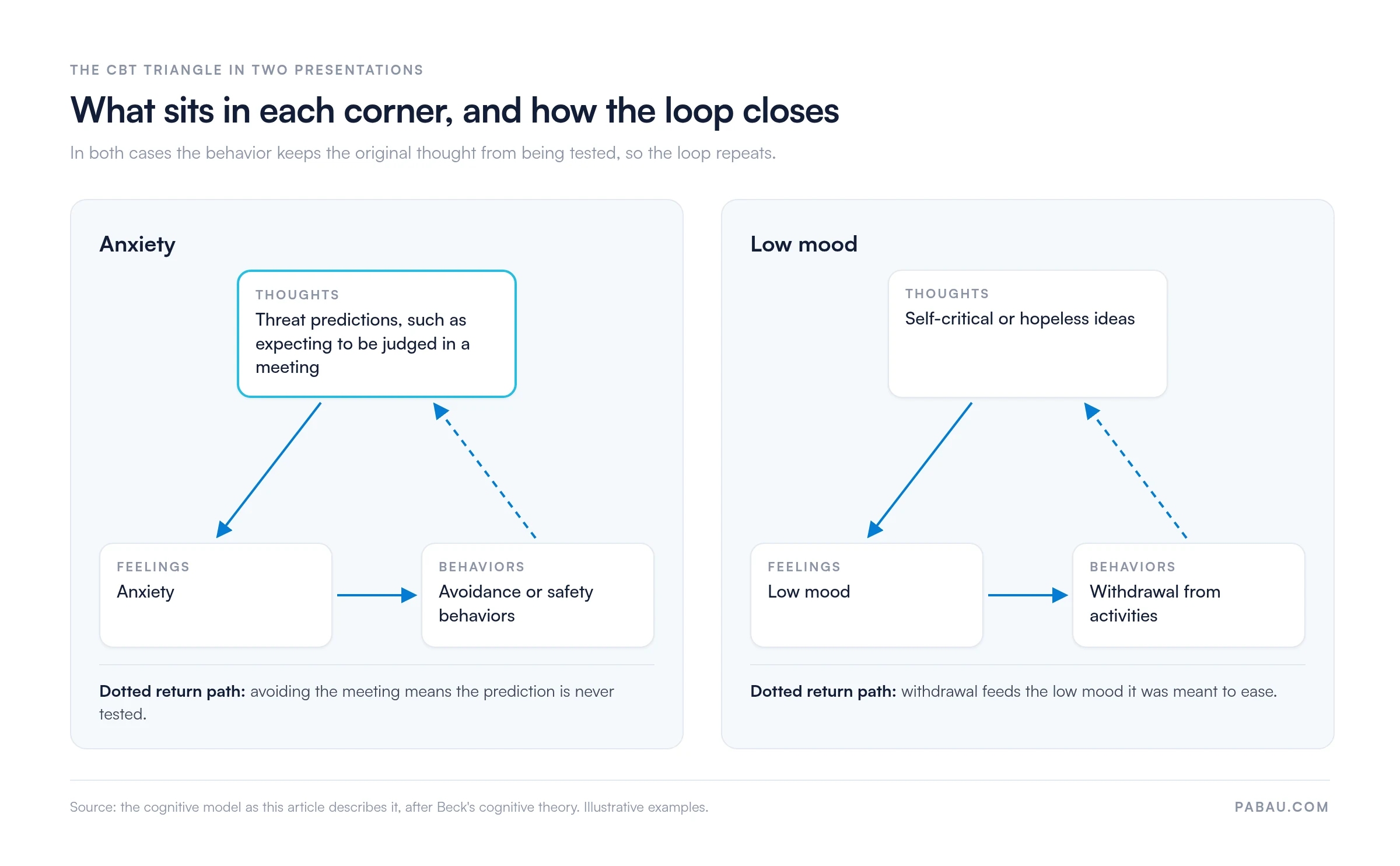
In anxiety, the thought corner often holds threat predictions, such as expecting to be judged in a meeting. The behavior corner usually holds avoidance or safety behaviors that keep the prediction from being tested. A decatastrophizing worksheet helps patients weigh those predictions once the triangle has named them.
In low mood, the thought corner tends to hold self-critical or hopeless ideas, and the behavior corner often shows withdrawal from activities. NICE guideline NG222 on depression in adults recommends CBT among its treatment options. The triangle helps patients see how withdrawal feeds the low mood it was meant to ease.
Set side by side, the two presentations follow the same loop, with the behavior corner protecting the original thought. In low mood, a behavioral activation worksheet turns that corner into a plan of small, scheduled activities.
Children can use a simplified version of the triangle when the language is concrete and the examples are familiar, such as school or friendships. Use drawings, colors or faces in place of abstract labels where it helps.
Only practitioners with appropriate training and safeguarding awareness should adapt the handout for young patients. Check your practice’s guidance on consent and information sharing before using it with a child.
A simple CBT model handout uses fewer words, a single example and larger spaces to write in. Patients with lower literacy, reduced concentration or early-stage engagement often respond better to this format.
Keep a fuller version for patients who want to track patterns in more detail, such as those who already use a thought record.
A useful handout labels each corner clearly, includes example prompts and leaves room for the patient’s own words. Instructions for completion should fit on the same page.
The handout on this page runs one situation through two loops. A friend does not reply to a message all day. In the unhelpful loop, the patient decides the friend is annoyed, feels anxious and cancels evening plans. In the alternative loop, the patient decides the friend is busy, stays settled and keeps those plans.
The alternative thought is framed as the more accurate reading, which keeps the exercise about evidence. Patients then test their own thought with three questions: the evidence for it, the evidence against it, and what they would tell a friend. The second page closes with a practice log and a note pointing anyone in crisis to the 988 line.
Completed worksheets are part of the clinical record, so they need a home that matches the rest of your notes. A handout kept in a paper folder or a separate drive makes it harder to show what was covered in session and when.
Pabau, the practice management platform we build for therapists and other healthcare practices, keeps those records in one place. Pabau’s client record lets therapists keep session notes, treatment plans and completed handouts together for each patient. Its digital forms can carry the triangle exercise, so a patient completes it between sessions and it lands on their file.
Your psychotherapy progress notes then sit beside the patient’s own triangle entries. A review of a difficult week starts from what the patient wrote at the time. Scheduling, reminders and billing run from the same system, as our page on therapy practice management software explains.

Pabau’s client records and digital forms keep completed CBT handouts, session notes and treatment plans together for each patient. Your team can send an exercise between sessions and review it at the next appointment.

The CBT triangle handout earns its place early in treatment. That is when a patient first needs to see why one event sets off a chain of reactions. Work through one recent situation at a time, in the patient’s own words, and come back to it whenever a difficult week needs unpicking.
The trade-off is depth. The triangle shows how the three corners connect, and it stops short of breaking one situation down in detail. Move a patient on to a thought record once the loop makes sense to them.
Book a demo to see how Pabau keeps completed handouts, session notes and treatment plans on one patient record.

Want the full A-to-E structure for disputing a belief? ABCDE CBT worksheet walks patients from activating event to a more effective belief.
Need names for the thinking traps the triangle uncovers? Cognitive distortions worksheet helps patients label the patterns behind their automatic thoughts.
Ready to break one situation down in detail? Thought record worksheet captures the situation, thought, evidence and balanced response on one page.
Working on beliefs that hold a patient back? Limiting beliefs worksheet gives patients a structured way to question long-held assumptions.
Need to track anxiety between sessions? Anxiety tracker records triggers and intensity so patterns show up across weeks.
A CBT triangle handout is a printable diagram showing how thoughts, feelings and behaviours connect. Therapists use it in psychoeducation to explain the cognitive model.
The three corners are thoughts, feelings and behaviours. A change in one corner can influence the other two.
Yes, with adaptation. Use simpler language and familiar examples, and only practitioners with appropriate training and safeguarding awareness should adapt it for young patients.
The triangle shows how three areas connect, while a thought record captures one situation in detail. Many therapists use the triangle first and the thought record once patients want more structure.