Maja Popovska

The clinical audit cycle: Stages, challenges, and how to complete it
The clinical audit cycle is a repeating process for measuring care against an ag...

Last Updated: Nov 10, 2026
Free PDF 2 pages, print-ready Clinician-reviewed
A limiting beliefs worksheet is a structured CBT tool that guides patients through identifying, examining, and reframing a fixed negative belief that holds them back. Therapists, counselors, and coaches use it to make belief work concrete and repeatable. The free PDF covers the belief, where it came from, how it affects daily life, and the evidence for and against it. It closes with a replacement belief and three small steps to reinforce it. Beck's cognitive model treats core beliefs as deep cognitive targets that CBT works on over successive sessions.
A structured worksheet with belief identification prompts, origin and evidence exploration, a replacement belief, and a three-step action plan.
Start from scratch, or upload this PDF or any form you already use, and Pabau's AI Form rebuilds it with tick boxes, text fields and a signature. Attach it to the treatment once, and every patient gets it on time.
AI Form rebuilds the consent, history and aftercare forms you already use. You review each one, then publish.
Patients complete forms on their phone before they arrive, so the front desk stops retyping paper.
Every signed form is versioned and attached to the treatment record, ready when you need it.
Set how long a consent stays valid. Returning patients skip forms they have already signed.
Supports HIPAA and GDPR compliance AES-256 encryption 4.8 on G2 4.7 on Capterra Trusted by 4,000+ practices worldwide

A limiting beliefs worksheet is a CBT-informed tool for identifying and reframing deep negative self-beliefs, distinct from fleeting negative thoughts.
Limiting beliefs often feel like facts. The worksheet separates belief from evidence using structured prompts.
The four-step process covers identification, origin exploration, challenging, and replacement belief commitment.
Practitioners can build this worksheet as a digital form in Pabau, the practice management platform we build, and assign it to patients.
A limiting beliefs worksheet is a structured self-reflection tool for surfacing and challenging the fixed negative beliefs that restrict a person’s behavior, choices, and well-being. Therapists, counselors, and coaches use it, and the completed sheet doubles as clinical documentation. It turns CBT core belief work into a format a patient can work through in session and between sessions.
The worksheet belongs to a family of CBT tools that includes thought records and belief logs. What sets it apart is its focus on deep, stable beliefs about the self, where a thought record targets situational negative automatic thoughts.
In the UK, the BACP Ethical Framework sets out the ethical principles and professional standards for the profession. BACP members are expected to follow them when choosing and applying methods. In the US, the American Psychological Association recognizes CBT as an evidence-based treatment, and worksheets are a common way of delivering it. The worksheet has no diagnostic function, so clinical judgment still decides when and how you use it.
Limiting beliefs cluster across four life domains. Knowing the common patterns helps you prompt patients who struggle to put their beliefs into words in session.
Each of these is a stable, generalized belief a patient may have held for years, often since early adverse experiences. A passing low mood often lifts with a quick reframe. Beliefs this stable need structured worksheet work over several sessions.
A limiting belief is usually tied to one area of life, while a core belief is a global, unconditional verdict about the self. The difference matters clinically because each one calls for a different intervention.
Coaches and many therapists use the two terms interchangeably. This worksheet is built to handle both: It starts with a specific limiting belief a patient can name, then probes the deeper belief beneath it. When that deeper belief needs mapping on its own, a core beliefs inventory covers it in more depth.
The worksheet follows a four-step sequence grounded in standard CBT belief work. Each step builds on the last, so work through them in order. The map below shows which of the worksheet’s 15 prompts belong to each step.
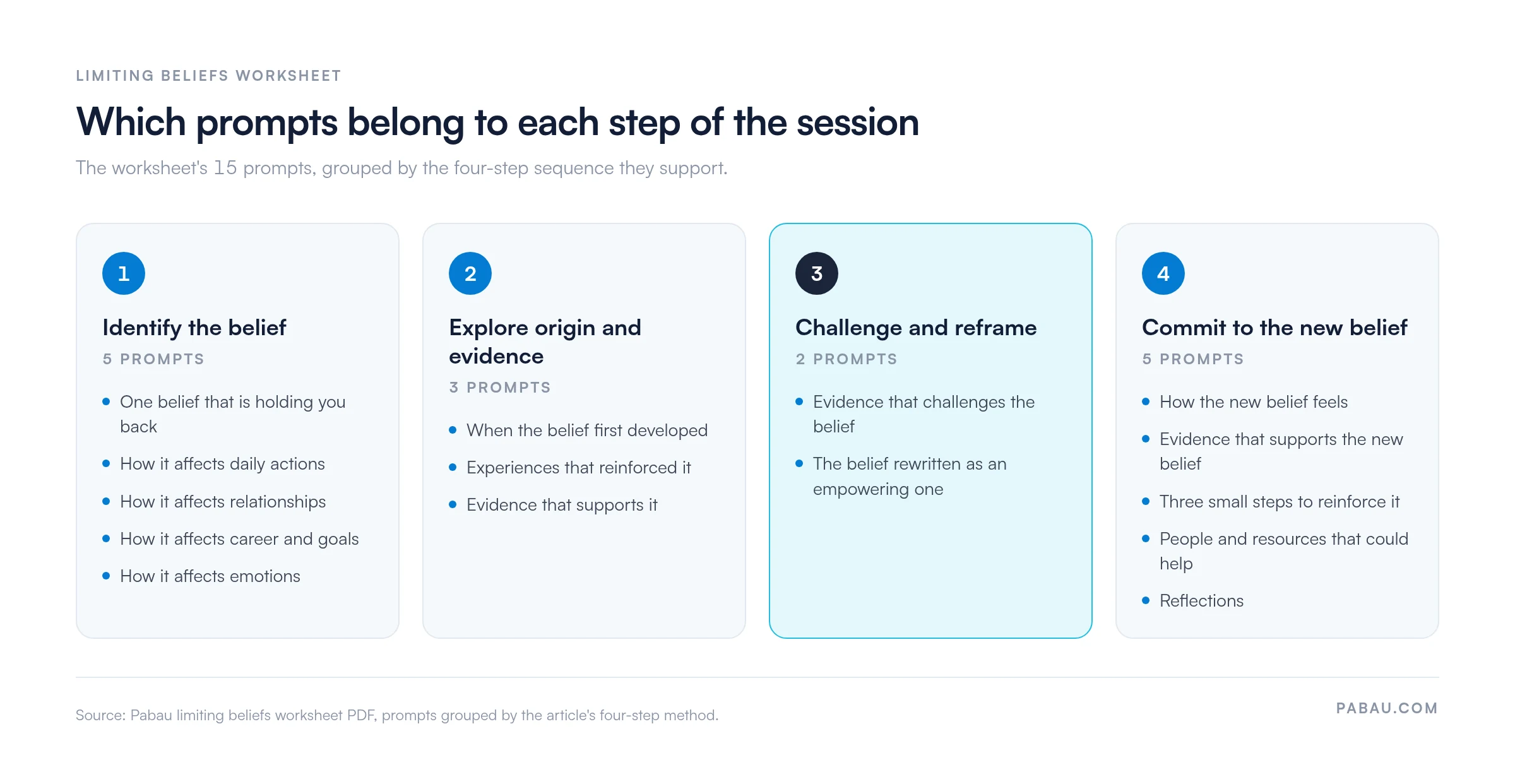
Ask the patient to describe a recent situation where they felt stuck, held back, or judged negatively. Use guided questions to surface the underlying belief: “What does that situation say about you as a person?” or “What do you believe to be true about yourself in that moment?” The goal is a clean, first-person belief statement the patient can write down (“I am not good enough”).
Distinguish the belief from the fact. “My manager criticized my report” is a fact. “I am incompetent” is a belief derived from it. This distinction is the foundation of the whole process. The worksheet then asks how the belief affects the patient’s daily actions, relationships, career goals, and emotions.
Once the belief is named, the worksheet asks when the patient first remembers holding it and which experiences reinforced it. Evidence-for and evidence-against prompts let the patient see, often for the first time, that the belief has less support than it feels like it has.
This is where practitioners draw on CBT’s Socratic questioning: “Is there any time that belief was NOT true?” Patients typically identify exceptions they had previously discounted.
Practitioners can use the evidence-against prompt to guide patients to evaluate the belief as a hypothesis rather than a fact. Standard CBT reframing questions include: “What would you say to a friend who held this belief?” and “What is a more balanced or compassionate alternative?” The patient then rewrites the limiting belief as an empowering one.
This is also the point to introduce behavioral experiments, which you can plan on a separate behavioral experiment worksheet. The patient tests the new belief in low-stakes situations before the next session.
The worksheet closes with the patient’s replacement belief in first person (“I am capable of learning from mistakes”). The patient then lists the evidence that supports it and three small steps to reinforce it. A final prompt lists the people and resources that could help. Those three small steps move the worksheet from reflection into behavior change.
Review the completed worksheet at the start of the following session, before any other agenda item. Asking the patient to read their replacement belief aloud reinforces the shift and tells you straight away how the week went.
The limiting beliefs worksheet is grounded in Aaron Beck’s cognitive model, developed through the 1960s and 1970s. Beck proposed that negative automatic thoughts maintain psychological distress, and that deeper, unconditional core beliefs about self, others, and the world drive those thoughts. Judith Beck developed the core belief framing further in 1995.
Decades of outcome research support CBT-based belief work across depression, anxiety, and personality difficulties. The National Institute of Mental Health lists CBT as an evidence-based therapy shown to reduce symptoms of depression, anxiety, and other mental disorders. Worksheet exercises, including thought records and belief logs, are standard components of evidence-based CBT delivery.
In mental health practice management, treat the worksheet as one input to clinical formulation. It informs your formulation and leaves the clinical decisions with you.
Qualified therapists, counselors, psychologists, coaches, and occupational therapists can use this worksheet within a structured therapeutic or coaching process. It isn’t intended for unsupported self-use by people in an active mental health crisis.
A note on contraindications: Patients with active psychosis, severe dissociation, complex trauma, or personality disorder presentations may find direct belief challenging destabilizing. In those cases, stabilization work comes first.
Structured worksheet use improves session consistency and documentation quality across practitioner types. Key benefits include:
Practices with several practitioners benefit further from a standard worksheet format. When every therapist uses the same tool, clinical leads can review completed forms consistently across the caseload.
On paper, the worksheet goes home in a bag and often comes back half-finished. The completed copy then gets scanned into a file that’s hard to find before the next session.
In Pabau, the practice software for therapists we build, you can rebuild this worksheet as a digital form and assign it to patients. Send it alongside your digital intake forms, so the identification step is done before the patient arrives. Their answers are stored in their patient record.
Pabau Scribe, our AI medical scribe, drafts the session note while you review the worksheet together. AI letter drafting then helps you update the patient’s GP or referrer without starting from a blank page.
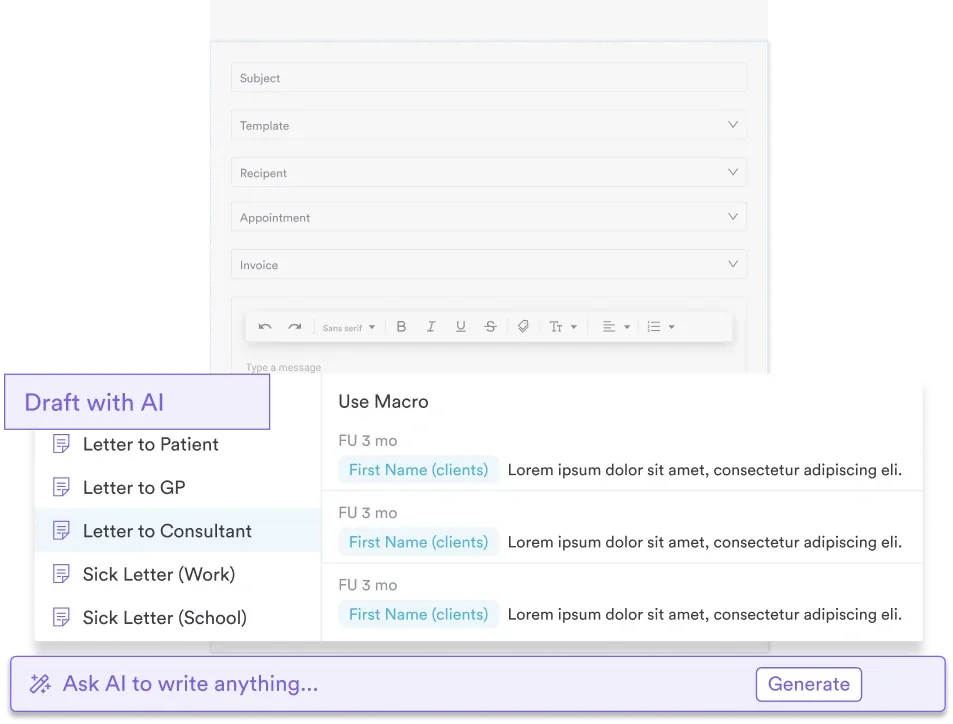

Practitioners can build this worksheet as a digital form in Pabau and assign it to patients. Completed answers are stored in the patient record, ready for the next session.

Start with the belief the patient can name, before the deeper core belief you suspect sits beneath it. A specific belief gives the evidence prompts something concrete to test, and core belief work can follow once that first shift holds.
The trade-off is time. Belief change usually takes several sessions. The worksheet pays off when you review it at the start of each session and compare it with the last one.
Practitioners can build this worksheet as a digital form in Pabau and assign it to patients, so every completed version is ready for that review. Book a demo to see how Pabau handles worksheets, session notes, and follow-up for therapy and coaching practices.

Need a template built around core beliefs? Core belief worksheet gives you a printable CBT template for working on the global beliefs beneath a limiting belief.
Looking for a tool for automatic thoughts? Dysfunctional thought record helps patients log situational thoughts alongside the belief work this worksheet covers.
Need a structured format for mental health assessments? Psychiatric evaluation template provides a step-by-step guide for comprehensive mental health evaluations in psychiatry and psychology settings.
Looking for guidance on documenting therapy sessions? SOAP notes for social work covers how to write clinical notes that meet professional documentation standards.
Supporting patients with complex presentations? Therapist burnout signs, causes, and prevention addresses the practitioner well-being that affects clinical effectiveness over time.
A limiting beliefs worksheet is a structured CBT-informed tool for naming a restrictive belief and examining the evidence for and against it. The patient then commits to a replacement belief and an action plan. Therapists, counselors, coaches, and psychologists use it in session and as between-session homework.
Start with a specific situation where the patient felt stuck or judged negatively. Then use Socratic questions to uncover the underlying belief: “What does that say about you as a person?” or “What do you believe to be fundamentally true about yourself here?” Express the belief as a first-person statement (“I am not capable”), not as a description of events.
Common examples include “I am not smart enough,” “I am unlovable,” “I always fail,” “I am a burden to others,” and “I have no willpower.” These cluster across self-worth, work, relationships, and health. They feel like facts to the person holding them, which is why structured evidence examination works better than reassurance.
The core techniques are Socratic questioning, cognitive restructuring, behavioral experiments, and thought records. This worksheet supports the evidence-for and evidence-against examination and the replacement belief. Practitioners add Socratic questioning, behavioral experiments, and thought records in session.
Therapists guide patients through a structured process: Naming the belief, tracing its origin, and reviewing the evidence. The patient then writes a compassionate alternative and sets small steps tied to it. The process typically unfolds across several sessions. Between-session homework, including completing or reviewing the worksheet, speeds up the change.