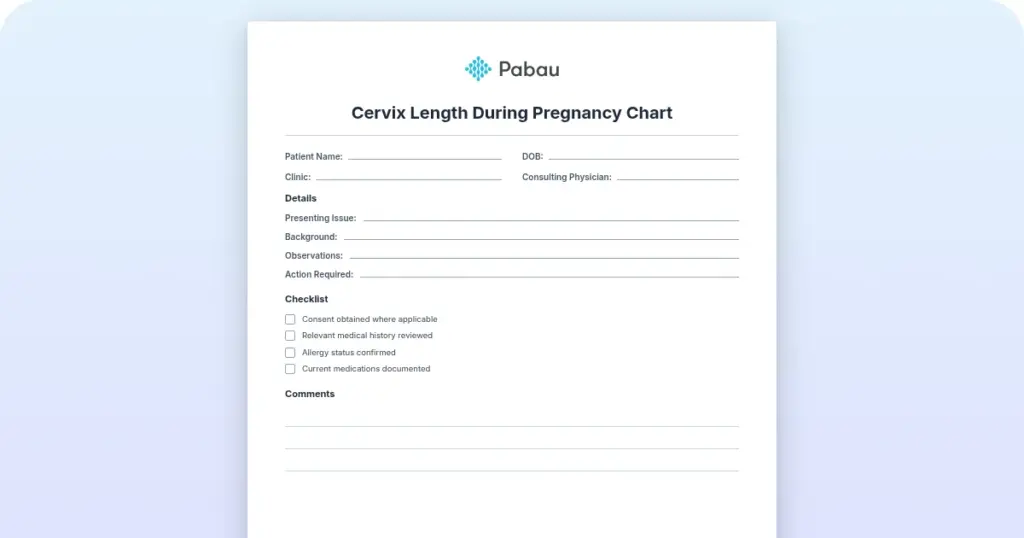
Cervix length during pregnancy chart
A cervix length during pregnancy chart records cervical length in millimeters ag...

1
Last Updated: Oct 14, 2026

Abortion survey questions gather essential clinical, emotional, and circumstantial data to personalize reproductive health care.
Underreporting is common – trauma-informed framing and integrating abortion alongside other sexual health services improves disclosure rates significantly.
HIPAA-compliant digital survey tools protect patient privacy while enabling real-time data capture and analysis across multiple care sites.
Pabau’s digital forms and secure client portal deliver encrypted survey administration, automated workflows, and integrated patient records in one HIPAA-aligned system.
A comprehensive assessment tool for gathering sensitive information from patients considering or having undergone abortion procedures, including medical history, psychological factors, and personal circumstances in a confidential and respectful manner.
Download templatePatients often underreport their abortion history in standard clinical surveys. Research shows that integrating medical forms alongside other sexual and reproductive health services can improve disclosure rates significantly. This template provides trauma-informed abortion survey questions designed for clinical intake, patient satisfaction assessment, and post-procedure follow-up – ensuring your team captures the full picture of patient needs while maintaining confidentiality and respect.
The abortion survey questions template is structured to gather four essential data streams: demographic and medical history, decision-making context, clinical experience during care, and post-procedure recovery and emotional support needs. Every question follows trauma-informed design principles – neutral framing, optional disclosure, and psychological safety – so patients feel supported rather than interrogated.
An abortion survey questions template is a structured clinical assessment tool that enables reproductive health providers to gather sensitive information from patients considering or undergoing abortion care. Unlike generic reproductive health survey questions or patient satisfaction surveys, this template is purpose-built for abortion-specific workflows – acknowledging the emotional, medical, and circumstantial complexity of the decision and procedure.
The template typically covers five domains: patient demographics and relevant medical history, the context of the pregnancy decision, clinical experience during the procedure or consultation, post-procedure physical recovery, and emotional support and follow-up care needs. Each section is designed to be administered either on paper or digitally.
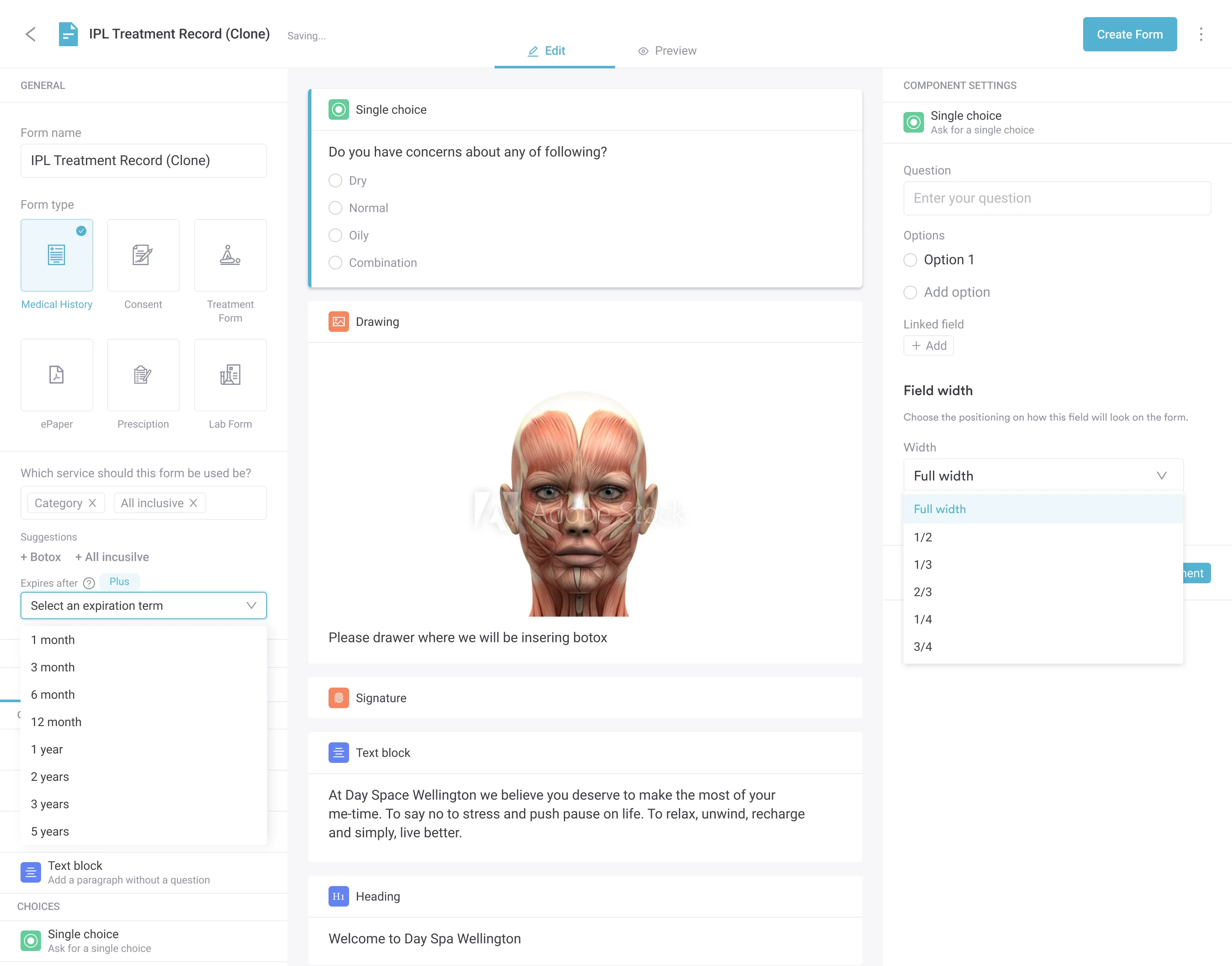
From a regulatory standpoint, abortion survey data falls under HIPAA protection (in the US) and GDPR protection (in Europe). This template supports HIPAA-compliant survey design by enabling anonymous or de-identified responses where appropriate and secure data storage within encrypted clinical systems.
Throughout administration, emphasize that responses are confidential, voluntary, and will never affect the care they receive. Train your entire team – front desk, nurses, counselors, and clinicians – on the sensitivity required when discussing abortion and reproductive health.
Here are example survey questions about abortion you can lift straight into your intake, mapped to each stage of care. Every prompt uses neutral, shame-reducing phrasing so patients feel supported rather than interrogated – the same trauma-informed design the full template follows. Use them as-is or as a starting point for your own free abortion survey questions.
In a psychology practice platform, completed assessments file straight into the client record.
Researchers studying abortion outcomes, decision-making, and health equity also use structured abortion research questions to gather rigorous data.
Practice managers and medical directors benefit by having a validated, ready-to-use tool that avoids the need to build surveys from scratch – saving months of development time and ensuring compliance with trauma-informed standards. Clinicians gain actionable patient feedback that directly informs procedure protocols, counseling approaches, and aftercare pathways.
Every question in this template follows trauma-informed principles – acknowledging that abortion decisions and experiences carry emotional weight and potential trauma histories. Trauma-informed design means: questions are framed as open invitations rather than interrogations, shame-reducing language is prioritized, patient autonomy is centered, and pathways to support are integrated throughout.

Pabau’s digital forms and secure patient portal integrate your abortion survey questions directly into your clinical workflow – capturing patient data, automating follow-ups, and keeping all responses HIPAA-encrypted in one system.

Abortion survey administration exists within a complex legal landscape. Post-Dobbs (2022), the legal status of abortion varies dramatically by US state – with 13 states imposing near-total bans and others protecting abortion access. This means your clinic’s obligations regarding patient privacy, data retention, and mandatory reporting differ significantly depending on jurisdiction.
Store survey responses in an encrypted, access-controlled system separate from the main medical record when legally and clinically feasible. Use unique identifiers (not names) and limit staff access to only those who need survey data for care delivery. This reduces legal exposure if law enforcement requests patient records.
Abortion survey questions are a cornerstone of patient-centered reproductive health care. By gathering structured, trauma-informed feedback, your clinic demonstrates commitment to understanding patient needs, optimizing care protocols, and advocating for equitable access to safe, compassionate abortion services.
Download the template, adapt it to your clinic’s specific workflows and legal context, and integrate it into your patient care cycle. Use secure patient portal delivery for privacy and convenience. Then act on what you learn – refining your procedures, expanding support services, and building trust with every patient who comes through your doors. Book a demo to see how Pabau’s digital forms and clinical management platform can automate your survey workflows while keeping all patient data HIPAA-encrypted and secure.

Working in an IVF lab instead? Time-lapse assessment template documents morphokinetic parameters, KIDScore grading, and blastocyst selection criteria for IVF clinics.
Helping a patient plan a VBAC delivery? VBAC birth plan template covers labor and pain preferences, fetal monitoring, and an emergency cesarean contingency.
Running a full wellness exam instead? Women’s wellness exam template covers pelvic and breast exam fields, preventive screening, and the visit’s billing codes.
An abortion survey questions template is a structured clinical assessment tool that gathers sensitive information from patients considering or undergoing abortion care – covering medical history, decision-making context, procedural experience, and post-procedure recovery and support needs – using trauma-informed, confidential framing.
Yes. The downloadable template works as a ready-made questionnaire you can adapt to your practice. Start from the intake, decision-making, peri-procedure, and post-procedure sections, then reword or remove items to match your clinical pathway. Review every prompt for neutral, trauma-informed language before you roll it out.
Abortion clinics, family planning organizations, fertility practices, OB/GYN clinics, midwifery teams, and researchers studying reproductive health outcomes benefit from this template. Practice managers use it to standardize patient feedback; clinicians use it to personalize care and identify complications early.
The template itself is a neutral tool; HIPAA compliance depends on how you administer and store responses. Use encrypted digital forms, limit staff access to authorized clinical personnel, minimize identifiable data, and retain responses only as long as clinically necessary. Consult your clinic’s legal counsel for state-specific obligations.
Start with the core sections (intake, decision-making, peri-procedure, post-procedure), then remove or reword questions that don’t fit your clinical pathway. Review all questions for trauma-informed language. Pilot the survey with a small patient cohort before full rollout, gather feedback, and iterate.
Use survey responses to identify individual patient needs (triggering immediate follow-up, counseling referral, or support services) and to spot systemic trends (e.g., “50% of patients report inadequate pain management” signals a procedural protocol review). Share anonymized findings with your clinical team to drive continuous improvement.
Yes, if you obtain IRB approval and explicit patient consent for research use. Store research data separately from clinical records, use de-identified codes, and follow your institution’s data security and retention protocols. Inform patients how their de-identified responses may contribute to advancing reproductive health knowledge.