Newborn assessment
A newborn assessment is a structured head-to-toe check of a baby’s health,...

4
Last Updated: Oct 9, 2026

A period tracker records your cycle dates, flow, symptoms, and mood on one printable sheet you can hand to your provider.
To estimate your next period, add your average cycle length to the first day of your last period.
Normal cycles run 21 to 35 days, and bleeding normally lasts two to seven days.
Symptom patterns matter as much as dates, because clustered pain or mood changes can point to PCOS, fibroids, or thyroid problems.
Bring three to six months of entries to your appointment, so your clinician sees a pattern instead of one remembered date.
This printable period tracker holds cycle dates, flow intensity, daily symptoms, and mood on one page. Fill in three to six months, then bring it to your appointment for review.
Download templateSearch for a period tracker and you’ll mostly get apps that keep your cycle data on your phone. This one is a printable sheet, built to leave the house with you and land in front of your provider. You track period dates, flow, symptoms, and mood by hand, then give the page to your clinician at the appointment.
No period calculator can tell your clinician how heavy the bleeding got, or which day the pain started. A filled-in log can. It takes about 20 seconds a day to keep, and three months of entries is usually enough to show a pattern.
Quick calculation: last period start date + average cycle length = the date your next period is due. A period that started on March 3 with a 29-day cycle puts the next one around April 1.
A period tracker is a dated record of your menstrual cycle. It captures when bleeding starts and stops, how heavy it is, and which symptoms arrive with it. The format is your choice. An app logs it on your phone, and a period tracker journal keeps it in your handwriting. A printable template keeps it in a layout a clinician can read in seconds.
Whichever format you pick, the template captures three layers of data:
Those three layers are what make the sheet clinically useful. A completed log informs the assessment of polycystic ovary syndrome (PCOS), hormonal imbalance, and thyroid dysfunction. It also supports fertility planning, because cycle regularity and estimated ovulation timing both come straight out of the dates.
Fill in five things: the first day of your last period, your average cycle length, daily flow, symptoms, and mood. Here is what goes in each field.
A normal cycle runs 21 to 35 days, with two to seven days of bleeding and ovulation about 14 days before the next period. Anything that sits consistently outside those ranges is worth raising with your provider.
| Metric | Typical range | When to flag it |
|---|---|---|
| Cycle length | 21 to 35 days, averaging 28 | Consistently under 21 or over 35 days, or a sudden shift of more than seven days |
| Bleeding length | 2 to 7 days | Bleeding past seven days, or a period that stops inside two days |
| Flow volume | 5 to 80 mL per period, roughly two to six soaked products a day | Soaking a pad or tampon within an hour, or clots larger than a quarter |
| Ovulation timing | About 14 days before the next period starts | No mid-cycle signs across several cycles, or spotting mid-cycle every month |
A menstrual cycle calculator will average those numbers for you in a second. What it can’t show you is the spread, and the spread is the part a clinician reads first.
Regularity matters more than landing on 28 days. If you track menstrual cycle length for six months and every cycle comes in at 32 days, then 32 days is your normal. Unexplained lengthening, shortening, or a skipped period is the signal worth acting on.
Every menstruation period calculator assumes your cycles repeat. Six months of written entries are what tell you whether that assumption holds in your case, and roughly how far off it can be.
A menstrual cycle tracker gets far more useful once you can match each entry to the phase you were in. The table below sets out what happens in each one, and what tends to show up in a log.
| Phase | Typical days | What’s happening | Common symptoms |
|---|---|---|---|
| Menstrual | Days 1 to 5 | Estrogen and progesterone sit at their lowest, and the uterine lining sheds | Bleeding, cramps, fatigue, low mood |
| Follicular | Days 1 to 13 | Estrogen rises as the ovaries mature a follicle for release | More energy, clearer skin, sharper focus |
| Ovulation | Around day 14 | A luteinizing hormone (LH) surge releases the mature egg | One-sided twinge, clear stretchy fluid, slight temperature rise |
| Luteal | Days 15 to 28 | The empty follicle makes progesterone to prepare the lining | Bloating, breast tenderness, cravings, irritability, broken sleep |
One detail worth knowing before you adjust those numbers. The luteal phase stays fairly fixed at around 14 days, whatever your cycle length. On a 34-day cycle it is the follicular phase that stretches, so ovulation lands near day 20 rather than day 14.
Track five things daily: flow intensity, pain, headaches, mood and energy, plus bloating or breast tenderness. Dates alone tell a clinician when your cycle happens. Symptoms tell them what it does to you.
Print this grid and complete one row a month. Three to six rows is the point where scattered dates turn into a pattern you can act on.
Keep the finished cycle tracker with the rest of your appointment paperwork. Six filled rows take a clinician under a minute to read, which beats scrolling an app at the desk while the consultation clock runs.
Count back 14 days from the first day of your next expected period. That day is your estimated ovulation date, and the five days before it complete your fertile window. So the fertile stretch is six days long, ending on ovulation day itself.
An ovulation tracker is the same log read from the other end. Instead of predicting the next bleed, you are predicting the release that precedes it. For fertility planning or family building, that is the date that matters.
The count-back method works because the luteal phase barely moves. A 28-day cycle usually ovulates around day 14, and a 35-day cycle around day 21. Here is the sequence, using the entries you already have:
All of this assumes your cycles repeat closely. If your period cycle tracker shows swings of more than seven or eight days, calendar math stops being dependable. With PCOS or another hormonal condition it can be misleading altogether.
In that case, ask your provider about basal body temperature (BBT) charting, ovulation predictor kits (OPKs), or ultrasound monitoring. Bring the log anyway, because the irregularity itself is the finding they need to see.
Your provider reads a completed log for four things: cycle regularity, flow pattern, where symptoms cluster, and red flags. Handing one over shortens the history-taking part of the appointment considerably.
Recall is the weak link in all of this. A start date guessed at the desk can change what happens next, from the tests ordered to the referral made. An accurate period tracker removes the guesswork for about 20 seconds of effort a day.
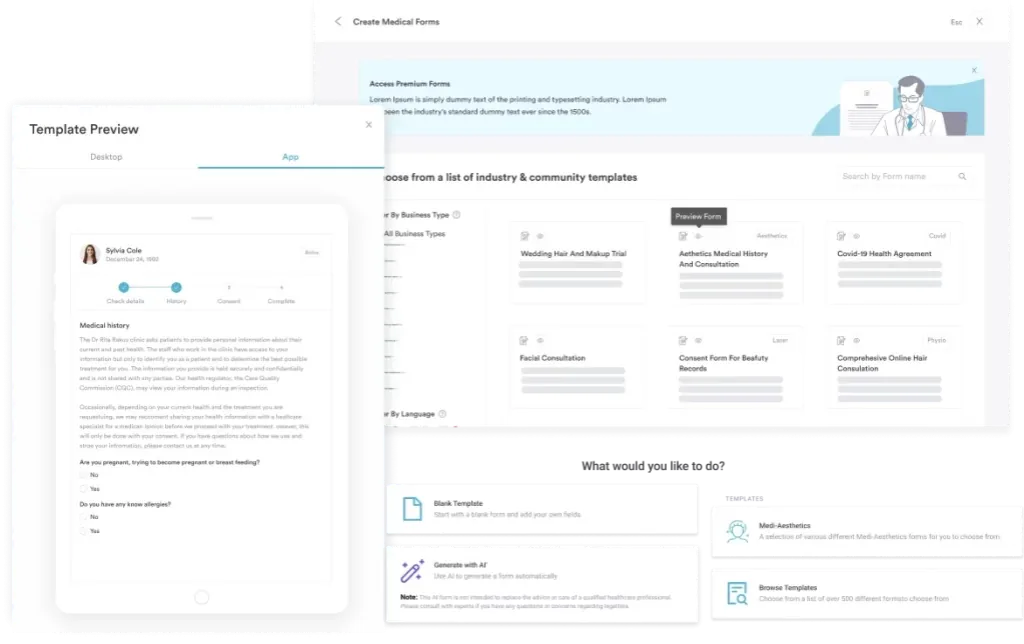
Practice management software like Pabau collects the same fields digitally. Patients complete the log through Pabau’s digital forms before the visit, and the answers land in their chart. The clinician can then review the record in the minutes before the consultation rather than during it.
Contact your provider if your log shows any of the following. Each one is a recognized reason for clinical review, and the dates in your sheet are what make the conversation quick.
Photograph each completed month on your phone. Paper has one weakness, which is that nobody backs it up, and a lost sheet takes your history with it. Many practices now pull patient logs into their patient management systems, so the record survives the paperwork.
A paper log works right up to the moment somebody has to type it into a record. In a busy women’s health practice, that retyping step is where the detail quietly goes missing.
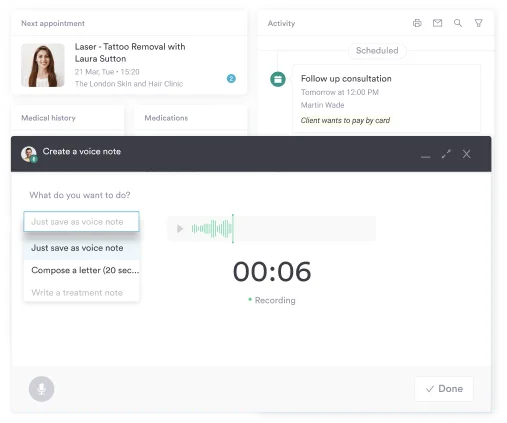
Practice management software like Pabau removes the step. Patients fill in their cycle log in the patient portal before the appointment, and it lands in the chart next to their history. Pabau Scribe, our AI scribe, then summarizes those entries into the consultation note. Nobody spends the visit transcribing dates.
OB-GYN and women’s health practices use the same setup to ask for a completed log when the appointment reminder goes out. Fewer consultations then open with “I think it was around the tenth”, which is time back for both sides of the desk.
Ask your provider which format they prefer to receive. Some practices still want paper for certain patients, while others use secure patient portals where you log entries before the visit. The best tracker is the one you will actually keep filling in.

See how Pabau captures patient-completed period trackers before the appointment, files them in the chart, and summarizes them into your consultation notes.

Print the sheet, keep it somewhere you will see it daily, and give it three cycles before you draw any conclusions. One month of entries tells you very little. Three months tells you what your own normal looks like.
The trade-off with paper is fragility, so photograph each finished month. What you gain is a page your provider can read in a minute, without asking you to remember dates under pressure.
If you run a women’s health practice, the same entries are worth capturing on your side of the desk. Book a demo to see how Pabau moves patient-completed cycle logs into the clinical record automatically.

Suspecting a patient has PCOS? PCOS hormone levels template tracks the hormonal markers used to evaluate and manage polycystic ovary syndrome.
Need a comprehensive patient record system? OB-GYN and women’s health practice software consolidates tracker data, appointment history, and clinical notes in one secure record.
Documenting a pelvic exam? Pelvic exam documentation template records findings across the four phases of a gynecological examination.
A period tracker records the start date, duration, and intensity of your period, plus symptoms and mood each day. Over three to six months, those entries reveal your cycle pattern. You get a typical length, a regular ovulation window, and the symptom clusters that go with them.
Start with your last menstrual period (LMP) date and your average cycle length. Cycle length is the count of days from the first day of one period to the first day of the next. Add flow, symptoms, and mood daily once the sheet is running.
Add your average cycle length to the first day of your last period, and that is your next period date. A period starting March 3 with a 29-day cycle puts the next one around April 1. The math assumes your cycles repeat, so irregular cycles need clinician guidance.
The average is 28 days, but anything from 21 to 35 days is normal. Your own settled length matters more than the average. If yours is consistently 24 days or 33 days, that is your normal, and consistency is what clinicians assess.
It gives you a good estimate, not a clinical confirmation. Calendar math assumes a repeating cycle, so it drifts when yours varies. For fertility planning, ask your provider about ovulation predictor kits (OPKs), basal body temperature charting, or ultrasound monitoring.
Log flow intensity, cramps, headaches, breast tenderness, bloating, mood, and energy. Tracking several at once is what reveals patterns, such as mood changes clustering before ovulation. Those patterns help your clinician assess hormonal balance.
Seek advice for missed periods, very heavy flow, or bleeding that lasts beyond seven days. The same applies to severe pain, a sudden change in cycle length, cycles outside 21 to 35 days, or bleeding between periods. Your completed log speeds up that assessment.
Track for at least three to six months to establish your baseline pattern. After that, ongoing tracking keeps you aware of changes. If you are investigating fertility, irregularity, or a hormonal condition, keep going for as long as your clinician recommends.