CPT Code 62284: Injection procedure for myelography
CPT Code 62284: official descriptor and procedure overview The American Medical ...

Last Updated: Oct 19, 2026
V5254 is the HCPCS Level II code for a hearing aid that is digital, monaural and completely-in-canal (CIC). It covers one custom CIC device for a single ear, plus its fitting and programming at dispensing.
Payer rules decide whether the claim pays. Medicare Part B excludes hearing aids by law. State Medicaid programs vary widely. Commercial plans carry plan-specific benefit limits, often with prior authorization requirements that differ by payer and plan year. Understanding each of these up front prevents the denials that cost audiology practices weeks of rework.
Let Pabau's smart automation suggest the right codes, reduce claim denials, and keep your practice compliant—effortlessly.
Automate repetitive tasks and focus on what matters most—your patients.
Reduce coding errors and ensure compliance with the latest regulations.
Clean claims, fewer denials, and faster reimbursements.
Powerful insights and reporting to help your practice thrive.
HIPAA compliant SOC 2 certified GDPR-compliant Trusted by 4,000+ clinics worldwide

HCPCS Code V5254 covers one digital, completely-in-canal (CIC) hearing aid fitted to a single ear.
Other styles and binaural fittings take their own codes, such as V5255 for a monaural ITC device and V5258 for a binaural CIC pair.
Medicare Part B excludes hearing aids by statute, so V5254 claims sent to Original Medicare are denied.
Payers that cover V5254 expect a recent audiogram, a medical necessity statement, the prescribing order and the dispensing record with serial number.
Pabau’s claims management software checks authorization details before a V5254 claim goes out, so fewer claims come back denied.
HCPCS Code V5254 describes a hearing aid that is digital, monaural (single ear), and completely-in-canal (CIC) in fitting style. It sits in the V5120-V5267 hearing aid range of the HCPCS Level II codes. Each qualifier in the official descriptor carries a specific billing meaning that determines which device is correctly coded under this number.
The CIC style is the smallest custom hearing aid available. Because it fits entirely within the canal, it requires a sufficient ear canal diameter and a milder degree of hearing loss. Using V5254 for a device that sits partially outside the canal (in-the-canal or in-the-ear styles) is a code specificity error and grounds for denial.
Verify the device’s fitting style against the dispensing order before coding, as confirmed by the CMS HCPCS Level II coding framework.
V5254 covers the dispensed CIC device and the initial fitting service. It does not bundle every related service or accessory. Billing staff frequently overbundle or miss separate billable items because the scope of the code is not reviewed at point of care.
Billing a hearing evaluation CPT code on the same claim as V5254 is common practice when separate services occur on the same date. Payers handle unbundling differently, so check plan-specific guidelines before submitting both on one claim. Batteries are billed separately too, and the supply line goes out under V5266.
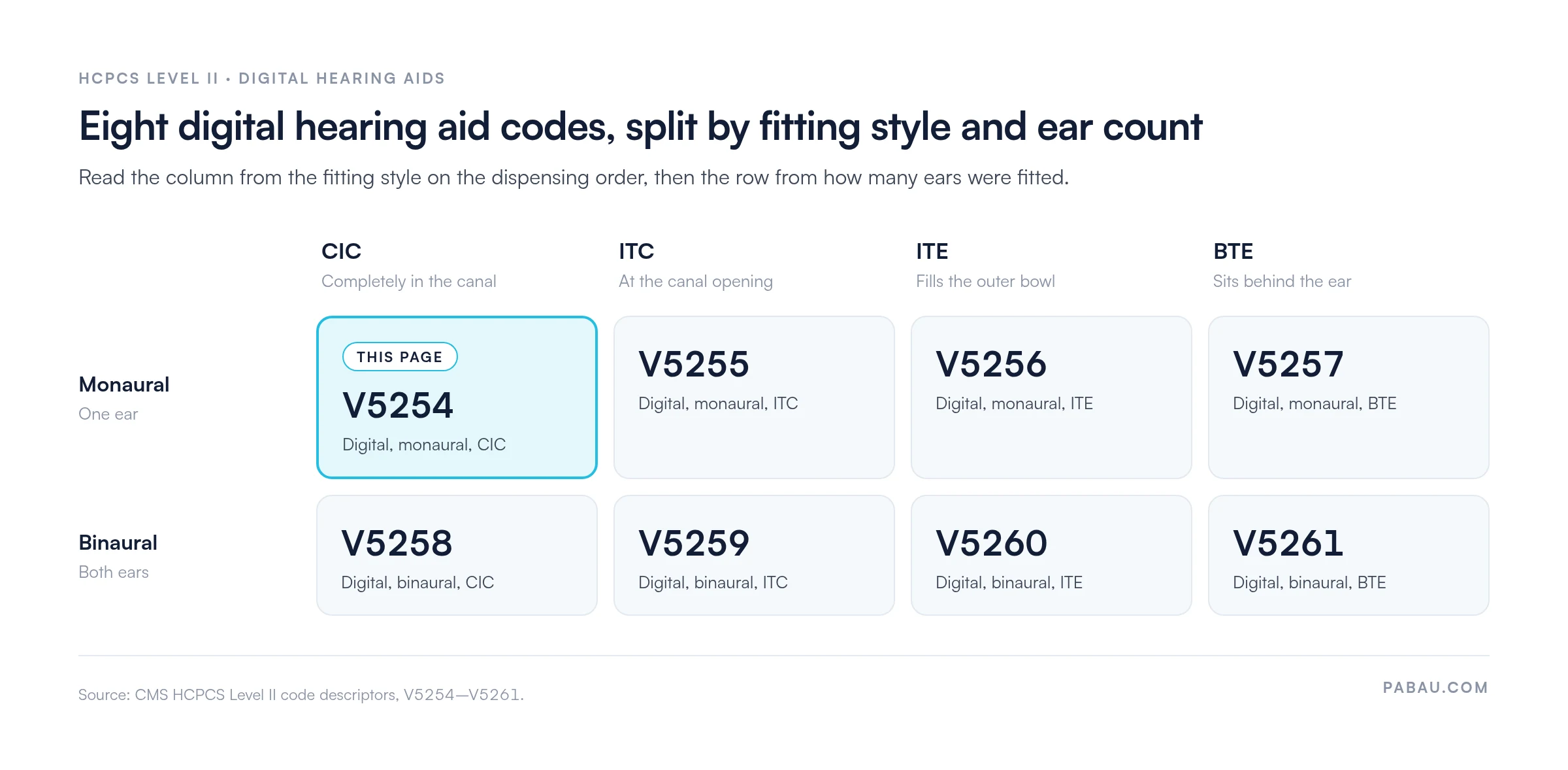
V5254 is one of dozens of hearing aid V-codes. The most common coding errors involve selecting a code for the wrong fitting style or the wrong ear count. The table below covers the neighboring digital codes most often confused with V5254.
The V5254/V5255 confusion is the most common. Both are monaural digital devices. The only differentiator is the physical fitting style recorded in the dispensing order.
If the dispensing order does not specify CIC or ITC, contact the prescribing audiologist for clarification before submitting. Submitting V5254 when the dispensed device is an ITC produces a code-to-device mismatch that payers can claw back after a medical record review. A disposable monaural device fitted completely in the canal is billed as V5262, not V5254.
Circuitry matters as much as fitting style. An in-the-canal aid with analog circuitry bills as V5243, because the V5254 range covers digital devices only.
The digital codes follow a fixed pattern, which the grid below lays out. Monaural codes run from V5254 to V5257 across CIC, ITC, ITE and BTE. Binaural codes run from V5258 to V5261 in the same order, so V5259 is the binaural ITC code. See the full HCPCS Level II hearing aid code range using the AAPC HCPCS code lookup.
Medicare Part B does not cover hearing aids, including V5254. The exclusion is statutory under Section 1862(a)(7) of the Social Security Act. CMS addresses it in the Medicare Benefit Policy Manual, Chapter 16, Section 100 (“Hearing Aids and Auditory Implants”). No waiver, appeal, or advance beneficiary notice changes this: the exclusion is absolute for conventional hearing aids.
The only exception relevant to V5254-adjacent billing involves osseointegrated implant components (bone-anchored hearing systems). Those are distinct from conventional hearing aids and are billed under different codes with different coverage criteria. Do not generalize this exception to standard CIC devices.
Because the exclusion is statutory, Medicare does not require an Advance Beneficiary Notice of Noncoverage (ABN) before you collect from the patient. Many practices still issue one voluntarily, so the patient confirms in writing that Medicare will not pay. Keep it in the patient record.
Medicaid hearing aid coverage is state-determined. Some states cover hearing aids for adults; many restrict coverage to children or do not cover them at all. Coverage limits, device allowances, and prior authorization processes differ significantly across state programs. Run insurance eligibility verification through your practice management system before every fitting appointment to catch benefit limits early.
Do not assume Medicaid coverage from one plan year carries forward. State programs revise benefit schedules annually. Always confirm current coverage status, applicable allowance amounts, and prior authorization requirements directly with the payer before dispensing.
CMS does not publish a Medicare reimbursement rate for V5254 because Medicare excludes hearing aids by statute. Published fee schedule amounts for V5254 originate from state Medicaid programs and from private payer contracts. These figures vary by geography, payer contract, and plan year.
Use the CMS Physician Fee Schedule lookup for reference on related services, and contact individual Medicaid programs for current V5254 allowed amounts.
The state Medicaid rate range above reflects general industry benchmarks and varies significantly by state and policy year. Always obtain the current allowed amount directly from the state Medicaid program or through your payer contract before quoting reimbursement to staff or patients.
Payers that cover V5254 require specific documentation in the patient record before a claim can be approved. Missing a single required item is the most common reason clean claims become pending audits.
Build a documentation checklist into the dispensing workflow, so a missing audiogram or unsigned order is caught before submission. Solid billing documentation starts at the point of care, not at the claims desk.
Documentation requirements vary by payer. Some state Medicaid programs require the audiogram to show thresholds at specific levels before approving a hearing aid benefit. Confirm the exact threshold and documentation requirements with each payer before the fitting appointment rather than after.
Prior authorization requirements for V5254 are payer-specific. No universal rule applies across all plans. Staying compliant means verifying PA requirements with every payer before each dispensing appointment, not relying on a general rule from a previous claim.
When submitting a PA request, include the complete audiogram, the prescribing order specifying CIC style, the device model and pricing, and the medical necessity statement. An incomplete PA submission delays approval and pushes back the dispensing date. Most audiology practices that use structured billing workflows build PA submission into their pre-appointment intake process.
Build a payer-specific checklist for prior authorization requirements. Some state Medicaid programs update PA thresholds and benefit limits each January. Review your top five payers’ PA policies at the start of each benefit year and update your practice’s dispensing workflow before the first appointment.
V5254 claims fail for predictable reasons. The denial table below maps each common cause to a specific prevention action. It also notes the claim adjustment reason code (CARC) you will see on the explanation of benefits (EOB) or electronic remittance advice. Tracking denials by CARC through your claims management software converts patterns into actionable workflow fixes.
A robust denial management workflow catches patterns across these CARC codes. If CARC 16 (missing information) appears repeatedly, the problem sits upstream in the intake or audiogram workflow rather than in the claims department. Fix the root cause, not just the individual denial.
A clean V5254 claim requires the right payer, the right supporting documentation, and the right claim form fields completed in sequence. Most submission errors are preventable with a structured pre-submission checklist.
Use the NLM HCPCS Level II API for programmatic code verification when integrating V5254 into practice management or billing software workflows.
Audit your V5254 claims by denial reason quarterly. If CARC 119 (benefit limit exceeded) appears more than twice in a quarter, your eligibility check is not capturing last paid dates reliably. Adjust your pre-visit eligibility workflow to pull benefit history, not just current coverage status.
Most V5254 denials trace back to a check skipped before the fitting: eligibility, the frequency limit, the PA number, or the style on the order. In many audiology practices those checks are spread across a payer portal, a spreadsheet and the paper chart.
Pabau, the practice management platform we build, keeps each patient’s insurer and policy on the patient record, so every invoice routes to the right payer. In the US, it connects to Claim.MD for electronic submission, real-time eligibility checks, claim status tracking and ERA posting.
Before a claim goes out, Pabau checks that details such as authorization codes are in place. The Send button stays disabled until they are. That means fewer CARC 15 and CARC 16 denials, and fewer weeks spent reworking hearing aid claims.

Pabau checks authorization details before a claim is sent, runs eligibility checks through Claim.MD, and tracks every hearing aid claim from submission to payment.

The code is the easy part of a V5254 claim. Denials come from the payer rules around it, and those differ for Medicare, each state Medicaid program, and every commercial plan.
So move the checks forward. Confirm benefits, the frequency limit, the PA number and the fitting style before the patient sits down for the fitting, not after the remittance arrives. The trade-off is a few extra minutes at intake against weeks of rework on a denied device claim.
Book a demo to see how Pabau catches missing authorization details before your hearing aid claims reach the payer.

Need to verify patient insurance before every appointment? Insurance eligibility verification explains how to run real-time checks before dispensing to prevent coverage surprises.
Looking to understand the full billing compliance picture? Medical billing compliance outlines the documentation and regulatory requirements that protect audiology practices from audit risk.
Fitting a behind-the-ear device instead? HCPCS Code V5257 covers the digital monaural BTE hearing aid and how payers treat it.
HCPCS Code V5254 covers a hearing aid that is digital, monaural (single ear), and completely-in-canal (CIC) in fitting style. The code includes the dispensed device and standard fitting at the time of dispensing. It does not cover batteries, repairs, binaural fittings, or devices in other styles such as ITC, ITE, or BTE.
No. Medicare Part B excludes hearing aids under the statutory exclusion in Section 1862(a)(7) of the Social Security Act. V5254 claims submitted to Medicare will be denied automatically. Some Medicare Advantage plans include hearing aid benefits beyond Original Medicare, so verify each plan’s specific coverage before billing.
V5254 is for a digital monaural hearing aid in a completely-in-canal (CIC) style. V5257 is for a digital monaural hearing aid in a behind-the-ear (BTE) style. Both are single-ear digital devices, but the physical style differs. Use V5254 only when the dispensed device sits entirely within the ear canal.
A clean V5254 claim needs a recent audiogram with thresholds that support medical necessity, plus a signed medical necessity statement from the prescribing provider. It also needs a written order specifying CIC style with the provider’s NPI, and a dispensing record with the serial number. Include prior authorization documentation where the payer requires it.
Medicaid coverage for V5254 is set state by state. Some states cover hearing aids for adults. Others restrict coverage to enrollees under 21 through EPSDT services, and some do not cover hearing aids at all. Always verify the specific state Medicaid program’s current hearing aid benefit, allowed amount, and prior authorization requirements directly before dispensing.
Billing Original Medicare is the most common cause, since the statutory exclusion returns CARC 96. A missing or outdated audiogram brings CARC 16, and billing V5254 for an ITC or ITE device brings CARC 4. Claims without required prior authorization get CARC 15, and claims past the plan’s frequency limit get CARC 119.
Prior authorization requirements vary by payer. Most state Medicaid programs that cover hearing aids require PA. Some commercial plans and Medicare Advantage plans with hearing aid benefits also require PA. There is no universal rule: verify the current PA requirement with each payer before the dispensing appointment.