

CPT Code 30801: Superficial turbinate ablation billing guide
CPT Code 30801: Official descriptor and procedure overview The American Medical ...

Last Updated: Nov 27, 2026
V5180 is the HCPCS Level II code for a CROS hearing aid worn behind the ear, officially "Hearing aid, cros, behind the ear." CMS deleted it, so it is not valid for dates of service on or after January 1, 2019.
For a single behind-the-ear contralateral routing device, bill V5181 today. Dispensing fees go under V5200 for one device or V5240 for two. Original Medicare still excludes hearing aids, so check the patient's other coverage first.
Let Pabau's smart automation suggest the right codes, reduce claim denials, and keep your practice compliant—effortlessly.
Automate repetitive tasks and focus on what matters most—your patients.
Reduce coding errors and ensure compliance with the latest regulations.
Clean claims, fewer denials, and faster reimbursements.
Powerful insights and reporting to help your practice thrive.
HIPAA compliant SOC 2 certified GDPR-compliant Trusted by 4,000+ clinics worldwide

HCPCS Code V5180 described a CROS hearing aid worn behind the ear, and CMS deleted it for dates of service from January 1, 2019.
A single behind-the-ear contralateral routing device now bills under V5181, and a binaural BTE/BTE system under V5221.
Dispensing fees moved to V5200 for one contralateral routing device and V5240 for two devices, including legacy CROS and BiCROS fittings.
Original Medicare excludes hearing aids under Section 1862(a)(7) of the Social Security Act, so check Medicare Advantage, Medicaid or commercial benefits first.
Pabau, a practice management platform with built-in insurance billing, keeps fitting notes and claims together so the codes can be checked before submission.
HCPCS Code V5180 is a deleted Level II code for a CROS hearing aid worn behind the ear. American Academy of Audiology coding guidance lists V5180 among the codes discontinued for services from January 1, 2019. Its official descriptor reads Hearing aid, CROS, behind the ear, and it described the device, not a dispensing fee. The Centers for Medicare and Medicaid Services (CMS) maintains the HCPCS Level II code set.
CMS deleted V5180 effective January 1, 2019, so its last valid date of service was December 31, 2018. The code still appears in the CMS HCPCS file with that termination date. It is not valid on any claim for a later date of service.
V5180 sat in the V5100-V5299 hearing services category of HCPCS Level II. Like every hearing aid code in that category, it carries the Section 1862(a)(7) Medicare exclusion. That exclusion outlived the code and still applies to the codes that replaced it.
Before 2019, HCPCS described CROS and BiCROS aids by style alone, with one code per device type. The January 2019 update replaced that set with contralateral routing codes that state whether the fitting is monaural or binaural. The American Academy of Audiology summarized the change when it took effect.
Four legacy codes were deleted: V5170, V5180, V5210 and V5220. Nine new device codes were added, and four existing codes received new descriptors. The table maps each deleted code to its current replacement.
The same update rewrote two dispensing fee descriptors. V5200 now reads Dispensing fee, contralateral, monaural, and V5240 reads Dispensing fee, contralateral routing system, binaural. V5190 and V5230, the eyeglass codes, also received new contralateral routing descriptors.
A post-2019 CROS claim needs two decisions: the device code and the dispensing fee code. Both depend on how many devices you dispense and their styles, as the chart below shows.
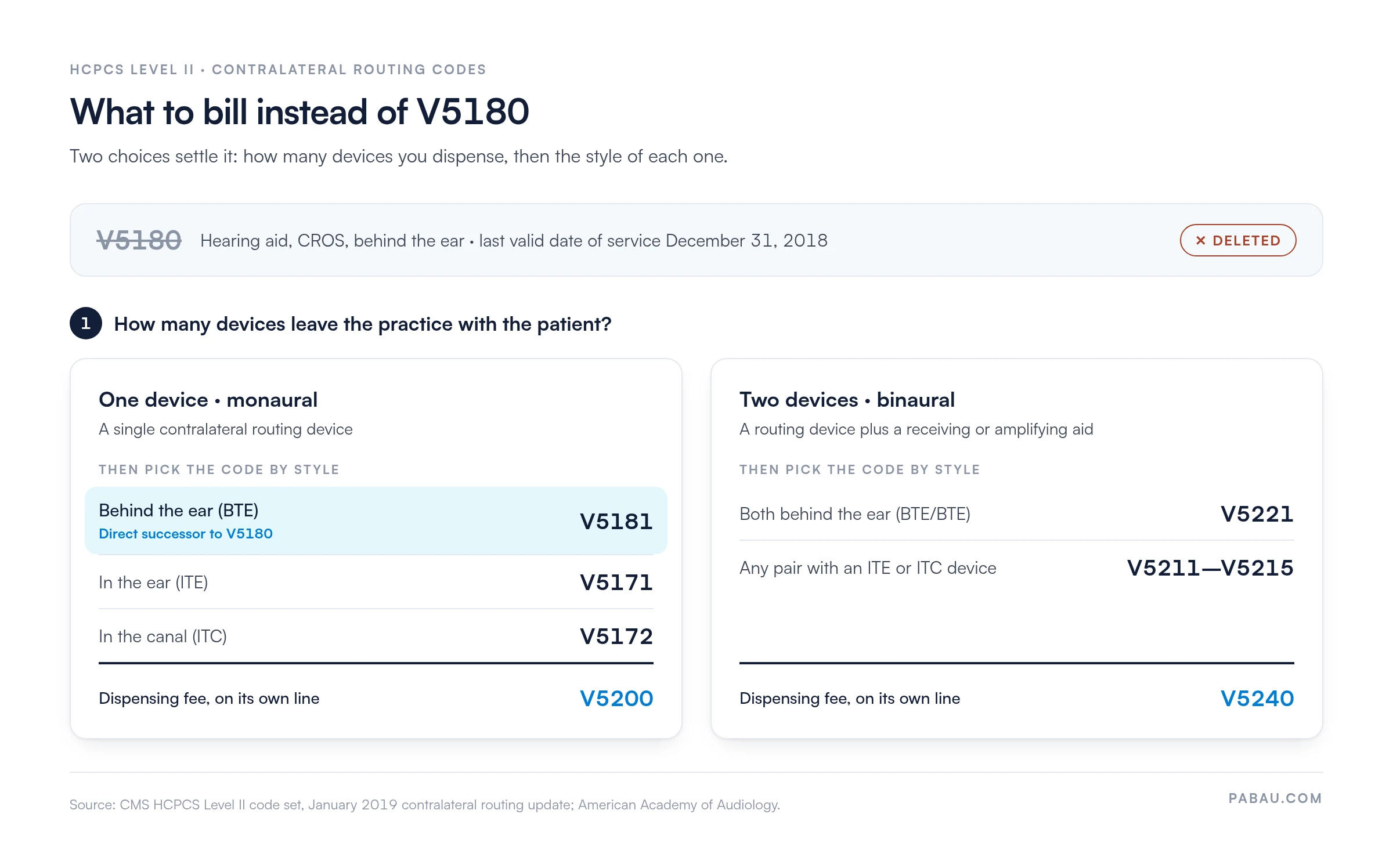
Each current device code names the fitting style, so the code follows from the devices the patient leaves with.
HCPCS V5200 is the fee for dispensing one monaural contralateral routing device. HCPCS V5240 is the fee for dispensing two devices. The American Academy of Audiology names a binaural contralateral routing system, a legacy CROS and a BiCROS as examples.
Bill the device and the fee on separate claim lines. A V5181 line pairs with V5200, and a binaural device code pairs with V5240. Each payer decides whether the fee is paid separately or folded into a device allowance.
Before you choose between V5200 and V5240, count the devices that leave the practice with the patient. One contralateral routing device means V5200. A transmitter plus a receiving or amplifying aid means two devices and V5240.
A CROS (contralateral routing of signals) aid serves patients with single-sided deafness or severe unilateral loss and usable hearing in the other ear. A transmitter on the poorer ear picks up sound and sends it to a receiver on the better ear. The patient then hears sound from both sides through one ear.
BiCROS is prescribed when the better ear also has hearing loss. The device on the better ear receives the routed signal and amplifies sound for that ear. The audiogram for the better ear therefore decides between CROS and BiCROS.
Original Medicare does not cover hearing aids or the examinations for them. Section 1862(a)(7) of the Social Security Act sets the exclusion, and 42 CFR 411.15(d) repeats it. The Medicare Benefit Policy Manual, Chapter 16, §100 applies it to hearing aids.
The exclusion is why every contralateral routing code, including V5181, V5200 and V5240, carries the 1862(a)(7) reference in the CMS HCPCS file. Coverage has to come from somewhere other than original Medicare Part B.
Payers that cover contralateral routing devices want the record to show why this device suits this patient. The list below covers what most hearing aid policies ask for. Your payer’s written policy has the final say.
These ICD-10-CM codes come from the FY2026 tabular list. Pick the one that matches the poorer ear and the hearing in the better ear.
Laterality has to agree across the claim. A right-ear diagnosis with a left-ear device note invites a manual review or a denial.
No modifier is built into V5181, V5200 or V5240. Some payers ask for one, so check the policy before you add any.
An unneeded modifier can fail a payer edit just as a missing one can. Follow each plan’s billing guide.
The table covers the errors behind common CROS claim rejections. The claim adjustment reason code (CARC) on the remittance tells you which one you hit.
Check the CMS HCPCS quarterly update for hearing codes at least once a year. A code you billed last year may have been revised or deleted since.
A deleted code can linger in an old fee schedule, superbill template or saved claim long after CMS retires it. The safest fix is a workflow where the code, the fitting notes and the claim sit side by side.
Pabau handles insurance billing through its claims management software. US practices send CMS-1500/837P claims through Claim.MD, run eligibility checks and receive ERA remittances.
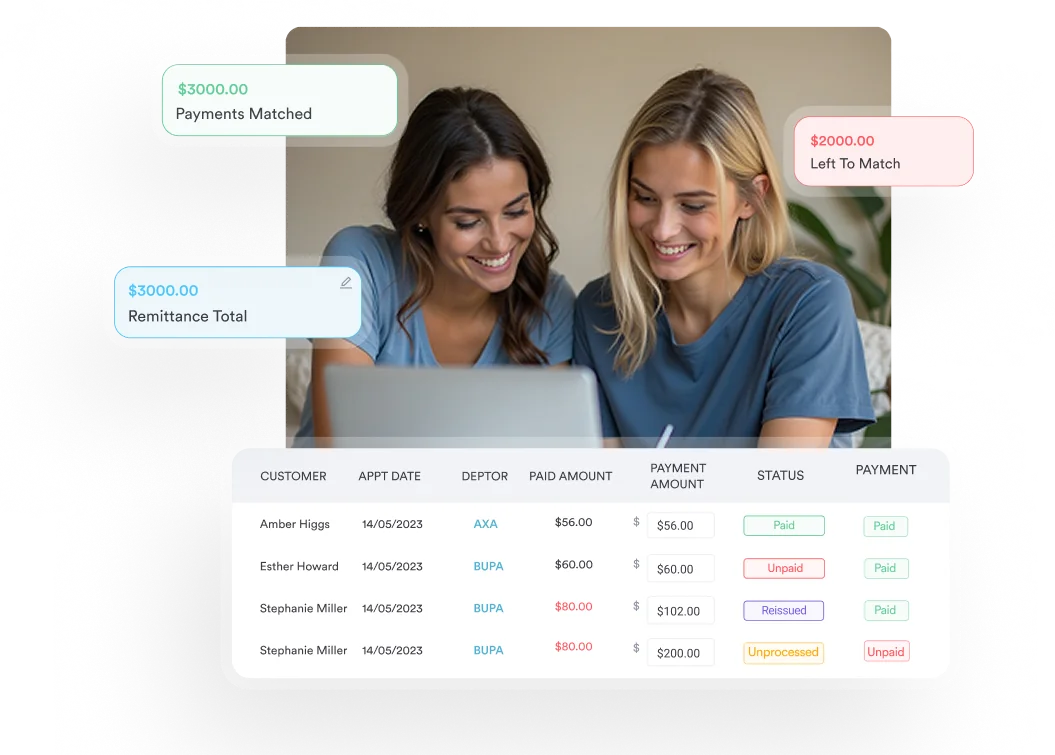
Audiograms, fitting notes and claims sit in one system. Your billing team can compare the device and fee codes with the documented fitting before a claim goes out. A clean claim on the first submission saves the rework a deleted code would cause.

Pabau keeps audiograms, fitting notes and insurance claims in one system, so your team can check every HCPCS code before a claim goes out. See it in action.

V5180 now appears only on claims for dates of service through December 31, 2018. CMS deleted it on January 1, 2019, and the update split CROS billing into device codes and two dispensing fees.
For a single behind-the-ear contralateral routing device, bill V5181 with V5200. When two devices are dispensed, use the binaural device code with V5240. Original Medicare still excludes all of them, so confirm the patient’s other benefits before the fitting.
To see how insurance billing runs alongside your audiology records, book a demo of Pabau.

Billing the dispensing fee for one contralateral routing device? HCPCS code V5200 covers the monaural fee that replaced the old CROS dispensing setup.
Fitting a full CROS or BiCROS system? HCPCS code V5240 explains the binaural dispensing fee for two devices.
Billing a pre-2019 BiCROS fitting worn behind the ear? HCPCS code V5220 covers the deleted BiCROS code and the binaural codes that replaced it.
Seeing high denial rates across your claims? Denial management in healthcare outlines a systematic approach to categorising, appealing, and preventing recurring claim rejections.
Correcting an old in-the-ear CROS claim? HCPCS code V5170 explains its status and the monaural in-the-ear and in-the-canal replacements.
No. CMS deleted V5180 effective January 1, 2019, so the last valid date of service was December 31, 2018. A claim that carries it for a later date is rejected as an invalid code.
A single behind-the-ear contralateral routing device bills under V5181. A binaural BTE/BTE contralateral routing system bills under V5221. The dispensing fee goes under V5200 for one device or V5240 for two.
Its official descriptor was Hearing aid, CROS, behind the ear. It described the device itself, not a dispensing fee. CROS stands for contralateral routing of signals.
American Academy of Audiology guidance says to use V5200 for dispensing one monaural contralateral routing device. Use V5240 for two devices, such as a binaural contralateral routing system, a legacy CROS or a BiCROS.
Original Medicare does not. Section 1862(a)(7) of the Social Security Act excludes hearing aids and examinations for them. Medicare Advantage plans may offer hearing benefits, and coverage varies by plan.
Yes. CMS deleted V5170, V5210 and V5220 alongside V5180. The same update added nine contralateral routing device codes and revised V5190, V5200, V5230 and V5240.




