

CCSD code G5100: Bypass of duodenum billing guide
CCSD code G5100 bills a bypass that leaves the duodenum in place CCSD code G5100...

Last Updated: Oct 16, 2026
V5220 was the HCPCS Level II code for hearing aid, BiCROS, behind the ear. It described a behind-the-ear system that routes sound from an unaidable ear to an aided better ear.
CMS deleted V5220 effective January 1, 2019, and no single code replaced it. BiCROS fittings now bill as V5211 to V5215 or V5221 by device style. A standard binaural BTE pair bills as V5140, with V5160 as the dispensing fee.
Let Pabau's smart automation suggest the right codes, reduce claim denials, and keep your practice compliant—effortlessly.
Automate repetitive tasks and focus on what matters most—your patients.
Reduce coding errors and ensure compliance with the latest regulations.
Clean claims, fewer denials, and faster reimbursements.
Powerful insights and reporting to help your practice thrive.
HIPAA compliant SOC 2 certified GDPR-compliant Trusted by 4,000+ clinics worldwide

V5220 described a BiCROS behind-the-ear hearing aid, not a standard pair of hearing aids for both ears.
CMS deleted V5220 effective January 1, 2019, along with V5170, V5180 and V5210, and it has not been reinstated.
No single code replaced V5220. Binaural BiCROS systems now bill as V5211 to V5215 or V5221, chosen by the style worn on each ear.
V5221 covers a BTE/BTE contralateral routing system, and V5240 is the binaural contralateral routing dispensing fee.
A standard binaural behind-the-ear fitting with no signal routing is billed with V5140 and the V5160 dispensing fee, never V5220.
Medicare Part B excludes hearing aids by statute, so these claims go to Medicaid, Medicare Advantage or commercial plans.
HCPCS code V5220 was the Level II code for a BiCROS hearing aid in the behind-the-ear (BTE) style. CMS retired it at the end of 2018, so it can’t be billed for any current date of service. The table summarizes what a coder needs when V5220 turns up on an old order, a payer table or a denial.
A BiCROS system serves a patient with little or no usable hearing in one ear and a hearing loss in the other. A transmitter on the poorer ear picks up sound and sends it to a hearing aid on the better ear. That hearing aid also amplifies sound for the better ear.
V5220 named the behind-the-ear version of that system. It was never a code for two ordinary hearing aids, one per ear. That reading is the most common misuse of the code, and it is covered in the next section.
Both codes involve two ears and behind-the-ear devices, which is why they get confused. The difference is signal routing. If no sound crosses from one ear to the other, the fitting is a standard binaural pair and V5220 never applied.
Read the fitting note before the order. If the note records a transmitter or “routing” device, the claim needs a contralateral routing code. If it records two hearing aids that each amplify their own ear, it needs V5140 and V5160. The decision path below runs those checks in order, starting with the date of service.
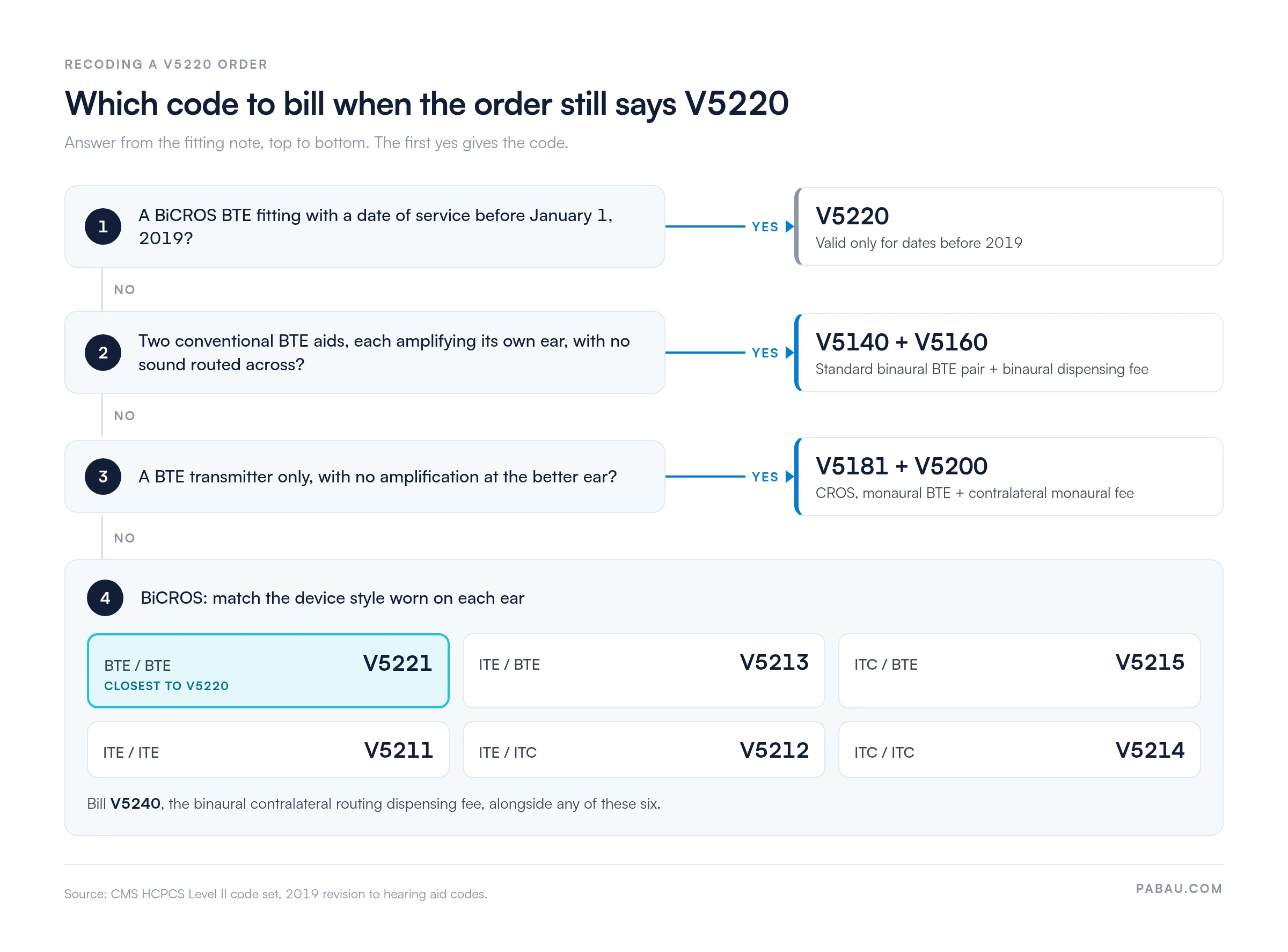
CMS deleted V5220 effective January 1, 2019, and it has not come back. A claim with a date of service on or after that date must carry a current code instead. The American Academy of Audiology summary of the 2019 changes lists the full set of deletions, additions and revisions.
V5220 went out in the same revision as V5170 (CROS, in the ear), V5180 (CROS, behind the ear) and V5210 (BiCROS, in the ear). CMS rebuilt the family around monaural devices and binaural systems, so no code inherited V5220 one for one.
Some lookup sites still show V5220 because the CMS master file keeps terminated codes alongside a termination date. A tool that reads the descriptor without the date will report the code as present. Present in the file does not mean valid for billing.
Search your practice management system for any open order, quote or claim template that still carries V5220. A template built before 2019 keeps generating the deleted code until someone edits it, and every claim it produces will reject.
The 2019 codes describe a BiCROS fitting as a binaural system and name the style of each device in the pair. The table lists the binaural system codes, their dispensing fee, and the monaural CROS code a BTE fitting most often gets confused with.
V5221 is the nearest successor because it names a BTE device on both sides. A patient with a BTE transmitter and an in-the-ear hearing aid takes V5213 instead, even though the clinical system is the same. The in-the-ear side of the same revision is covered on the V5210 page.
The dispensing fee bills alongside the device code and never in place of it. Confirm with each payer whether V5240 needs its own claim line or is bundled into the device allowable.
Payers that cover hearing aids review the chart against the device code. These records should be complete before the claim goes out.
Medicare Part B does not cover hearing aids. Section 1862(a)(7) of the Social Security Act excludes “hearing aids or examinations therefor”. The exclusion applied to V5220 and applies equally to the codes that replaced it.
Run insurance eligibility verification before the fitting appointment. Confirm that the current binaural code is on the plan’s covered list and ask about deductibles and replacement limits.
Most denials on these claims trace back to the deleted code, a style mismatch or missing paperwork. The table pairs each one with its fix.
Reviewing denial reason codes after each remittance cycle shows which of these keeps recurring. A repeat pattern usually points to an order template or fitting note, so fix it there.
Every hearing aid claim needs an ICD-10-CM code that supports the device. For a BiCROS fitting, that code has to reflect loss in both ears, because the better ear is also being aided. When both losses are sensorineural, the usual choice is H90.3.
Pick the code that matches the audiogram. If the better ear hears normally, the clinical picture is CROS rather than BiCROS, and the device code should change with it.
In many audiology practices, the fitting note and the claim live in separate systems. A biller rekeys the code from an order that may still say V5220, and nobody sees the error until the remittance arrives.
Pabau, the practice management and billing platform we build, keeps both on one patient record. Its claims tools for billers build the claim beside the audiogram, fitting note and delivery signature. Missing items are flagged before submission, so the code on the claim matches the devices in the chart.
Denials that still land are grouped by reason code. A deleted V-code or a style mismatch gets fixed once at the source instead of repeating across a month of fittings.

Pabau ties each hearing aid claim to the fitting record, flags missing documentation before submission, and groups denials by reason code. Your team fixes the cause once, not claim by claim.

V5220 is a historical code. It belongs only on a corrected claim with a date of service before 2019. Any order that still names it needs recoding before it reaches a payer.
The harder question is which devices the patient wears. A routing transmitter means a binaural contralateral routing code, usually V5221 with V5240. Two conventional BTE aids mean V5140 with V5160. Settle that from the fitting note, and the rest of the claim follows.
Book a demo to see how Pabau keeps hearing aid claims matched to the fitting record.

Working a stack of hearing aid denials? Denial management in healthcare sets out the workflow for triaging, appealing and tracking denied claims.
Want fewer rejections on first submission? What is a clean claim? explains the checks that get a claim paid the first time.
Reading remittance files each week? Electronic remittance advice breaks down the adjustment reason codes behind a V-code denial.
Checking your billing against payer audits? Medical billing compliance outlines the standards practices must meet to avoid recoupment.
HCPCS code V5220 described a BiCROS hearing aid in the behind-the-ear style. It applied when a patient had an unaidable ear on one side and an aidable loss on the other. CMS deleted the code effective January 1, 2019. Current fittings bill with V5211 to V5215 or V5221.
No. CMS deleted V5220 effective January 1, 2019, and it has not been reinstated. It is invalid for any date of service from 2019 onward. It still appears in some lookup tools because the CMS master file keeps terminated codes with their termination date.
No single code replaced it. A BiCROS system with a BTE device on each side bills as V5221. Mixed pairs bill as V5213 (ITE/BTE) or V5215 (ITC/BTE). The binaural dispensing fee is V5240.
No, and it never could. V5220 was a BiCROS code, which means one device routes sound from the poorer ear to the better one. Two conventional behind-the-ear hearing aids bill as V5140, with V5160 as the binaural dispensing fee.
V5220 was the BiCROS behind-the-ear code that CMS deleted in 2019. V5221 is the 2019 code for a binaural contralateral routing system with a BTE device on both sides. It is the closest successor, but other style pairs take V5211 to V5215.
Medicare Part B does not cover hearing aids, including BiCROS systems, under Section 1862(a)(7) of the Social Security Act. Some Medicare Advantage plans offer a supplemental hearing benefit. Coverage varies by plan, so verify it before the fitting.
V5240 is the dispensing fee for a binaural contralateral routing system. It is a service code, not a device code. Bill it alongside V5211 to V5215 or V5221 where the payer reimburses the fee separately.



