HCPCS code V5259: Digital binaural ITC hearing aid billing
HCPCS code V5259 reports a digital ITC hearing aid pair HCPCS code V5259 reports...

Last Updated: Oct 22, 2026
HCPCS code V5170 is a deleted Level II code for a hearing aid, CROS, in the ear. CROS stands for contralateral routing of signals. A microphone on the poorer ear sends sound to a receiver on the better ear, which helps patients with single-sided deafness.
CMS deleted V5170 for dates of service on or after January 1, 2019. A claim that still carries it is rejected as an invalid code. Bill V5171 for an in-the-ear contralateral routing device, V5172 for in-the-canal, or V5181 for behind-the-ear.
Let Pabau's smart automation suggest the right codes, reduce claim denials, and keep your practice compliant—effortlessly.
Automate repetitive tasks and focus on what matters most—your patients.
Reduce coding errors and ensure compliance with the latest regulations.
Clean claims, fewer denials, and faster reimbursements.
Powerful insights and reporting to help your practice thrive.
HIPAA compliant SOC 2 certified GDPR-compliant Trusted by 4,000+ clinics worldwide

HCPCS code V5170 described a CROS hearing aid in the in-the-ear style, not a standard monaural hearing aid.
CMS deleted V5170 for dates of service on or after January 1, 2019, together with V5180, V5210 and V5220.
Bill V5171 for an in-the-ear contralateral routing device, V5172 for in-the-canal, or V5181 for behind-the-ear.
Traditional Medicare excludes hearing aids by statute, so payment comes from Medicare Advantage, Medicaid or commercial plans.
The dispensing fee follows the fitting: V5200 for one CROS device, V5240 for a BiCROS system.
HCPCS code V5170 is a deleted Level II code whose official descriptor reads “Hearing aid, CROS, in the ear.” CROS stands for contralateral routing of signals. The device places a microphone on the ear that can’t benefit from amplification and sends that sound to the better-hearing ear.
The code is no longer valid. The American Academy of Audiology confirms that V5170 was discontinued for services on or after January 1, 2019. Practices now report CROS devices with the contralateral routing codes that CMS added on the same date. For an in-the-ear device, V5171 is the direct successor.
A CROS aid is built for single-sided deafness, where one ear has little usable hearing and the other hears normally. Amplifying the poorer ear would not help, so the device reroutes sound instead.
A microphone worn on the poorer ear picks up sound from that side. It sends the signal to a receiver on the better ear, so the patient hears sounds that would otherwise be lost to head shadow.
BiCROS is the related setup for a patient whose better ear also has some hearing loss. There, the better-ear device both receives the routed signal and amplifies sound.
Those fittings use the binaural contralateral routing codes rather than the monaural ones. The old in-the-ear BiCROS code, V5210, was retired on the same day as V5170.
CMS deleted V5170 for dates of service on or after January 1, 2019. A claim that carries it after that date is rejected as an invalid code.
The original CROS and BiCROS codes dated from the 1980s and described technology that is no longer made. Audiology groups asked CMS to restructure them, and the 2019 HCPCS update did so. It deleted four codes, added nine, and revised four.
MassHealth published the same additions and deletions in its 2019 HCPCS code revisions bulletin for hearing instrument specialists. It lists the new monaural contralateral routing codes as individually considered, which is common for state Medicaid pricing.
Search your fee schedules, charge master and saved claim templates for V5170 and V5180. A legacy template is the usual reason a deleted CROS code still reaches a payer years after it was retired.
The replacement depends on how many devices you supply and where each one sits. Use a monaural code when you fit one contralateral routing device. Use a binaural code when you fit one hearing aid and one contralateral routing device.
The chart below starts from the audiogram and ends at the code.
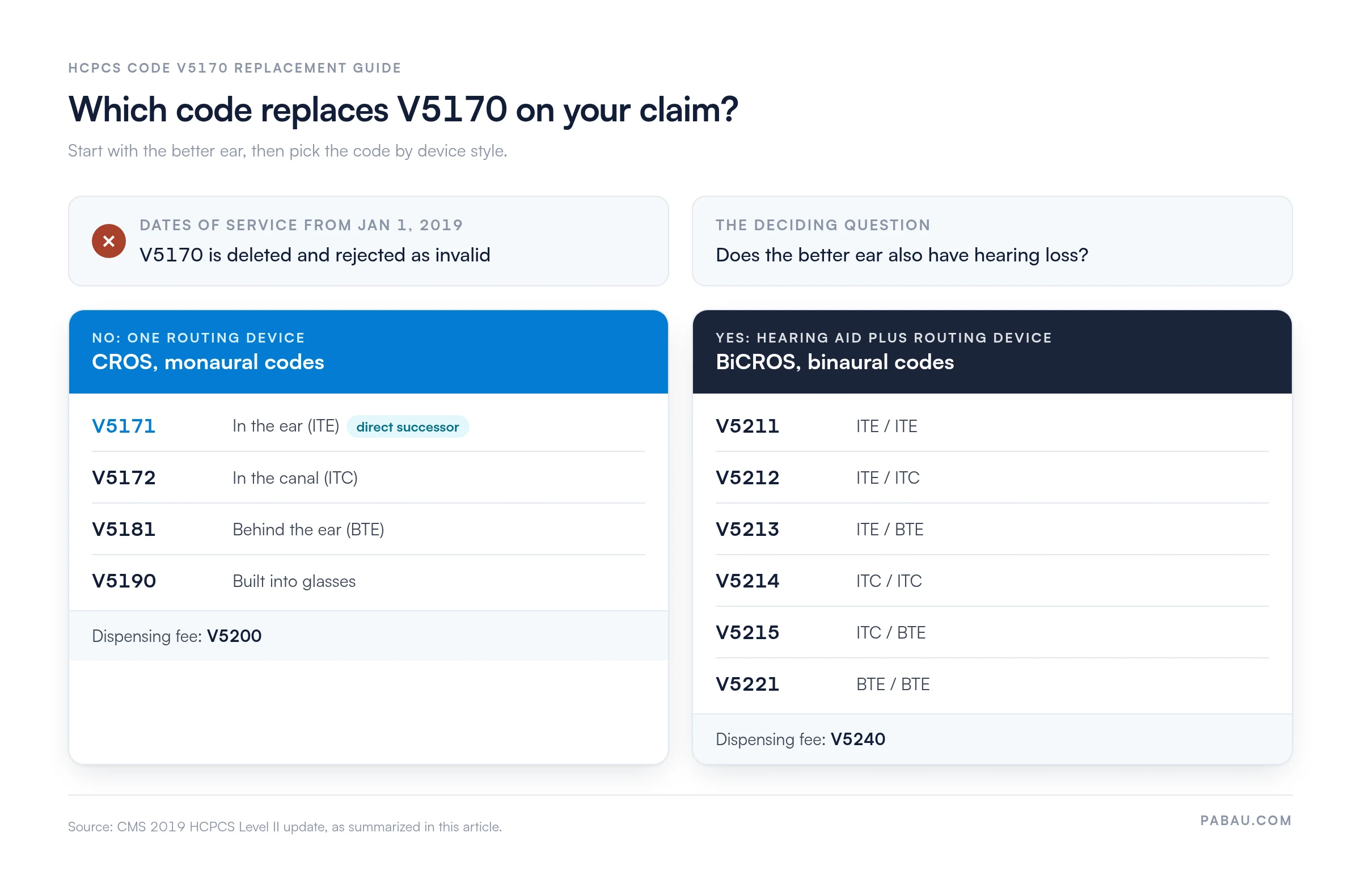
The binaural codes are split by the style of each of the two devices.
A conventional hearing aid that amplifies sound in the ear it sits in is not a CROS device. It has its own codes, and none of them is a substitute for V5170.
The device code covers the hardware only. The assessment, the dispensing service and the supplies each carry their own HCPCS codes. Each payer decides which ones it pays separately.
V5268 is sometimes listed with batteries, but it describes a telephone amplifier for assistive listening. Keep it off a battery line, or the claim will describe a different item.
Check the payer’s policy before you add V5200 alongside the device code. Some plans pay a bundled allowance that already includes dispensing.
Traditional Medicare does not pay for hearing aids, CROS devices included. Section 1862(a)(7) of the Social Security Act bars Part A and Part B payment for hearing aids and examinations for them. The Medicare Benefit Policy Manual, Chapter 16, Section 100 restates that exclusion, and 42 CFR 411.15(d) codifies it.
Because the exclusion is statutory, an Advance Beneficiary Notice is not required before you dispense to a traditional Medicare patient. Many practices still give the patient written notice of the cost so the conversation is documented.
A CROS claim is easier to defend when the record shows why rerouting sound was the right choice. Keep these items in the patient file:
The diagnosis code should describe one-sided loss and the state of the other ear. These ICD-10-CM codes are the usual fit:
Payer rules on side modifiers differ for routing devices, because the microphone and receiver sit on opposite ears. Confirm the payer’s requirement before you add LT or RT to the line.
Rejected CROS claims usually come from the 2019 code change or from a mix-up with standard hearing aid codes. Track them by denial code so the same error does not repeat.
Run an insurance eligibility check before the fitting appointment. It tells you whether the patient has a hearing benefit at all, and which payer to bill.
A quick check at the claim screen catches most of the errors above. Work through this list before the claim leaves the practice:
When staff key HCPCS codes from memory or an old spreadsheet, a code retired in 2019 can keep reaching payers. Each rejection then costs a rebill and a delayed payment.
Pabau, the practice management platform we build, offers simpler claims management by pre-filling the claim form from the patient record. Its HCPCS lookup library is refreshed with official releases, so staff pick a current code instead of a remembered one. Required fields such as authorization numbers must be complete before the claim can be sent.
In the US, claims go out through Claim.MD with eligibility checks, claim-status tracking and remittance posting in the same workflow. The result is fewer rejections for invalid codes and less time chasing them.
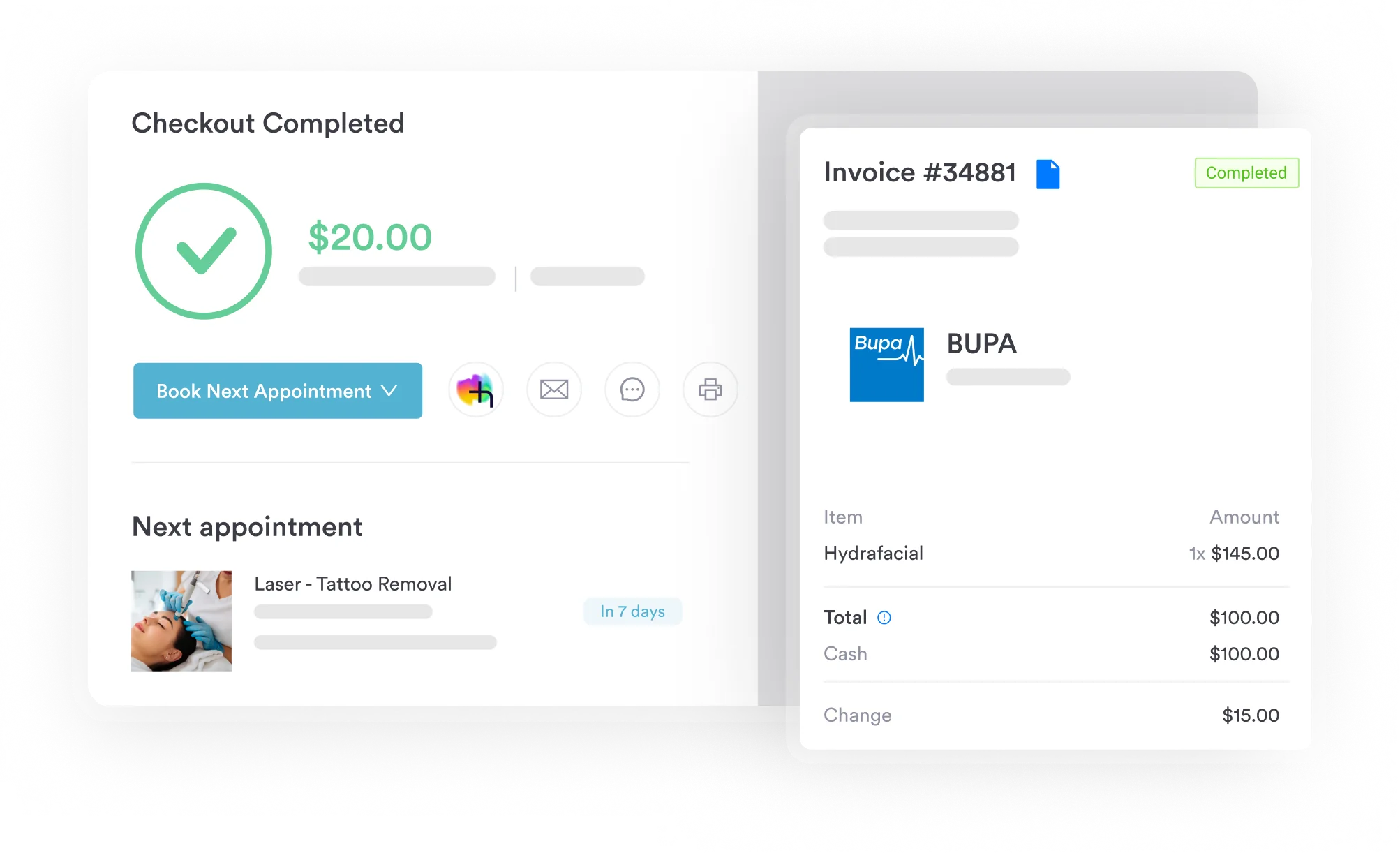

Pabau pre-fills claims from the patient record and draws on an up-to-date HCPCS library, so CROS fittings go out with valid codes.

If V5170 still appears anywhere in your billing setup, remove it now. Map in-the-ear CROS fittings to V5171, in-the-canal to V5172, and behind-the-ear to V5181.
The harder call is choosing between monaural and binaural codes, and between CROS and standard aid codes. Get that right from the audiogram, and the dispensing code follows. Book a demo to see how Pabau keeps hearing aid claims on current HCPCS codes.

Billing a BiCROS fitting? HCPCS code V5210 covers the deleted in-the-ear BiCROS code and what replaced it.
Dispensing a single CROS device? HCPCS code V5200 explains the monaural contralateral routing dispensing fee.
Need to understand how denial codes affect your revenue cycle? Common medical billing denial codes breaks down the most frequent CARC codes and how to respond to each.
Want to streamline pre-claim eligibility checks? Insurance eligibility verification covers benefit checks and how to document results for payer audits.
Fitting a behind-the-ear BiCROS? HCPCS code V5220 explains the retired behind-the-ear BiCROS code and its binaural successors.
V5170 was the HCPCS Level II code for a hearing aid, CROS, in the ear. CMS deleted it for dates of service on or after January 1, 2019.
Only for a date of service before January 1, 2019, because a code’s validity follows the date of service. Most payers’ timely filing limits for those dates have long passed, so a corrected claim is rarely possible.
Use V5171 for an in-the-ear contralateral routing device, V5172 for in-the-canal, and V5181 for behind-the-ear. A BiCROS system uses a binaural code from V5211-V5215 or V5221.
Bill V5200 for dispensing one monaural contralateral routing device and V5240 for a binaural system. V5010 is the hearing aid assessment, not a dispensing fee.
Traditional Medicare does not. Section 1862(a)(7) of the Social Security Act excludes hearing aids from Part A and Part B. Some Medicare Advantage plans include a hearing benefit.
Usually, yes. A CROS fitting pairs with H90.41 or H90.42, unilateral loss with unrestricted hearing in the other ear. A BiCROS fitting pairs with H90.A21 or H90.A22, where the other ear is also restricted.