CCSD code H4430: Examination of rectum under anaesthetic
CCSD code H4430 pays for the examination alone CCSD code H4430 is the UK private...

Last Updated: Oct 20, 2026
T2034 is the HCPCS Level II code for crisis intervention, waiver; per diem.
It sits in the T2012-T2041 waiver services range maintained by the Centers for Medicare and Medicaid Services. Only providers enrolled in a state Home and Community-Based Services (HCBS) waiver program may bill it. One unit covers one calendar day of crisis intervention, whatever the hours delivered. Billing staff often confuse T2034 with H2034, which covers a different service under standard Medicaid.
Let Pabau's smart automation suggest the right codes, reduce claim denials, and keep your practice compliant—effortlessly.
Automate repetitive tasks and focus on what matters most—your patients.
Reduce coding errors and ensure compliance with the latest regulations.
Clean claims, fewer denials, and faster reimbursements.
Powerful insights and reporting to help your practice thrive.
HIPAA compliant SOC 2 certified GDPR-compliant Trusted by 4,000+ clinics worldwide

HCPCS Code T2034 covers Medicaid waiver crisis intervention services billed one unit per calendar day, not per hour or visit.
T2034 is a T-series state Medicaid agency code. Standard Medicare Part B and non-waiver Medicaid plans do not reimburse it.
Many state Medicaid programs and managed care organizations require prior authorization before T2034 can be billed. Missing authorization is the top denial reason.
Practice management software like Pabau can track waiver eligibility, attach documentation to claims, and flag denial codes before submission.
HCPCS Code T2034 is the Level II code for crisis intervention, waiver; per diem. It is a Medicaid waiver service billed in daily units for community-based crisis stabilization. CMS maintains the T-series as state Medicaid agency codes inside the HCPCS Level II code set.
They sit apart from CPT codes and from the H-series mental health codes. T2034 belongs to the T2012-T2041 waiver services block. That block covers home and community-based services funded through CMS-approved state waivers, not the standard Medicaid State Plan.
The table below summarizes the key attributes billing staff need before submitting a claim.
T2034 covers crisis intervention delivered under a CMS-approved HCBS waiver. The provider must be waiver-enrolled, and the beneficiary’s waiver eligibility must be active on the date of service.
The code captures the full calendar day in which qualifying crisis intervention occurs. That day includes assessment, stabilization support, safety planning, and coordination with follow-up care.
Knowing what T2034 does not cover prevents the most common non-covered-service denials.
Pairing T2034 with an appropriate ICD-10-CM diagnosis code is standard practice. The state Medicaid program sets the accepted diagnosis list, not CMS. Verify that list before the first claim goes out.
Provider eligibility for T2034 is determined by state waiver terms, not by a single federal rule. That said, several provider types appear consistently across state HCBS waiver programs as eligible to bill this code.
NPI and taxonomy note: The billing NPI must match the waiver provider agreement on file. Some states also require a specialty taxonomy code designating behavioral health or crisis services. Submitting with a generic taxonomy is a common reason for CO-4 denials.
Per diem billing means one unit of T2034 equals one calendar day of crisis intervention. The hours delivered that day never change the count, whether the team gave two hours of support or twelve. Billing staff used to time-based or per-visit codes have to adjust their unit logic. The chart below runs four common scenarios through that rule.
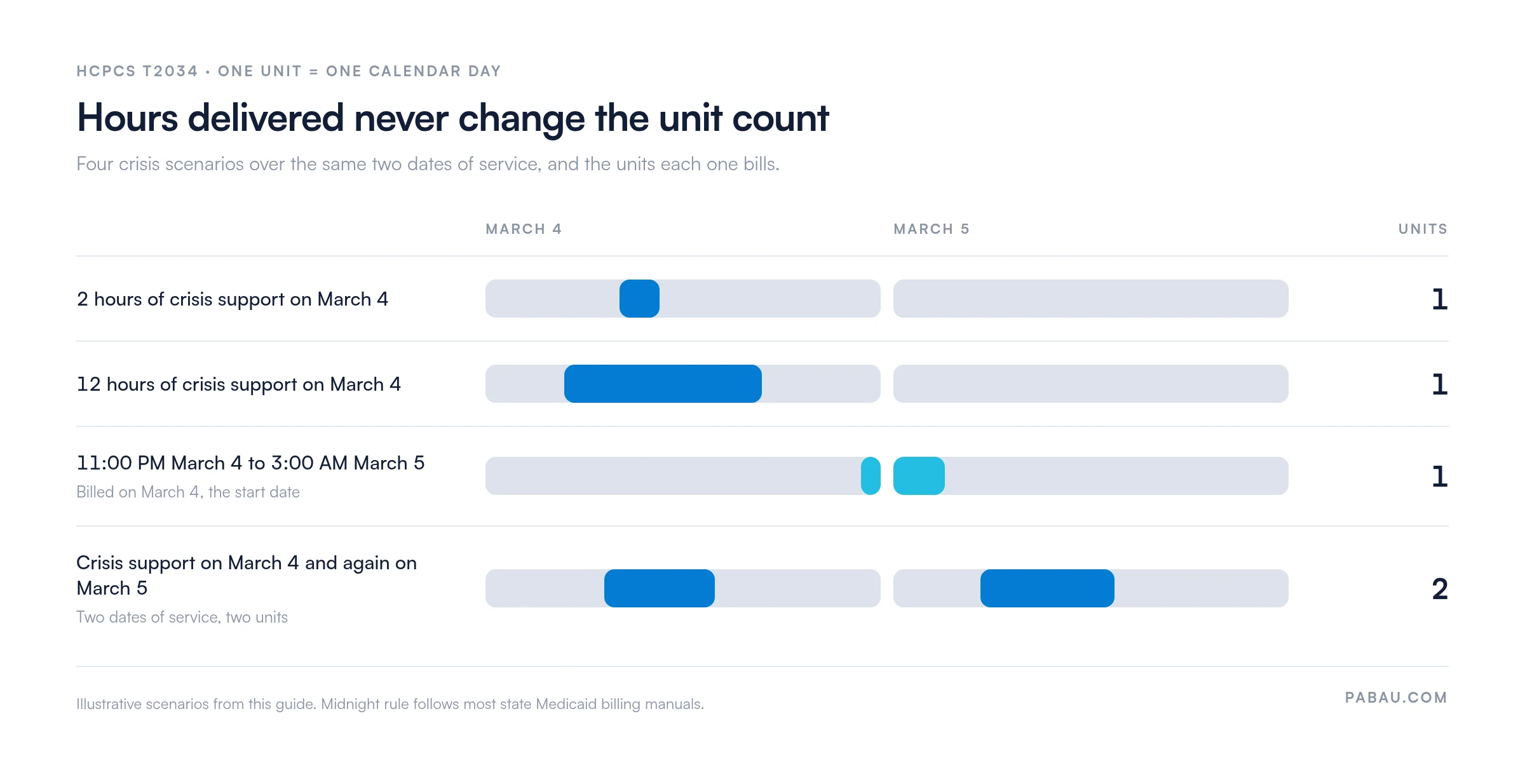
The steps below walk through how to calculate and submit units correctly.
Medicaid waiver audits for T2034 turn almost entirely on documentation. The service must have happened, must have been delivered by an eligible person, and must be recorded in enough detail to demonstrate medical necessity. Missing or vague records are the root cause of most post-payment recoupments for this code.
Every T2034 claim should be supported by all of the elements below. Standardized digital forms keep those records consistent across a crisis team that works in shifts.
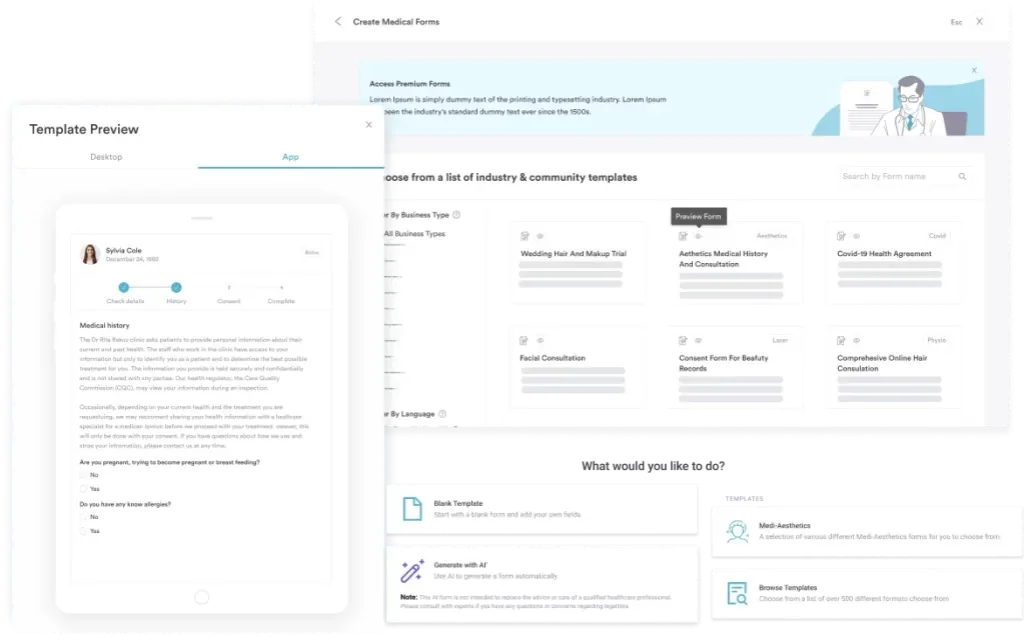
Build a T2034 documentation checklist into your intake workflow. Run it before submitting each claim batch: waiver eligibility confirmed, daily note present for every date of service, PA number matched, credential on file. Catching missing elements before submission is faster than working denials after the fact.
Prior authorization is required for T2034 in many state Medicaid programs and most Medicaid managed care organizations. The requirements vary by state and by MCO contract.
Treating authorization as optional is the fastest way to produce a clean-looking claim that pays nothing. Build insurance eligibility verification into intake so waiver enrollment and any active authorization are confirmed before service begins.
What to include in a T2034 PA request:
Payers reviewing these requests want evidence that the crisis does not require a higher level of care. An episode that settles into long-term residential care with room and board is billed under T2048 instead, per diem.
T2034 and H2034 are two distinct HCPCS codes that billing staff frequently confuse, because the code numbers look alike and both sit in behavioral health.
Both are billed per diem, so the unit gives no clue about which one applies. Using the wrong code produces an automatic non-covered-service denial from payers that recognize only one of them.
The core distinction: T2034 requires an active Medicaid waiver for both the provider and the beneficiary, and H2034 does not. H2034 is a standard H-series behavioral health code billable under regular Medicaid plans. Submitting T2034 for a beneficiary who is not waiver-enrolled generates a PR-96 non-covered charge denial every time.
T2034 sits within a defined block of waiver-specific HCPCS codes, and the codes immediately around it cover distinct service types. Selecting the wrong neighboring code is a common miscoding error. Check the descriptor against the AAPC HCPCS code range lookup whenever a service could plausibly match more than one entry.
T2033 vs T2034: T2033 covers residential care in a waiver setting, while T2034 is specific to crisis intervention. A patient in a crisis stabilization unit receiving crisis intervention is billed under T2034, not T2033. Billing T2033 for crisis services creates a descriptor mismatch that payers flag during post-payment review.
Specialized childcare sits in the same waiver range but bills in time units, not per diem. A child on that waiver plan who receives it is billed under T2027, per 15 minutes.
Utility services that support medical equipment sit in the same waiver range, and T2034 is one of the codes most often confused with them. A patient whose waiver plan covers that support is billed under T2035, not T2034.
Most T2034 denials trace back to six root causes, and each one has a corrective action that prevents a resubmission cycle. Reading the denial code meanings on the remittance tells you whether the fix belongs to documentation, authorization, or eligibility.
Modifier guidance rarely appears alongside the T2034 descriptor, yet a missing or incorrect modifier is enough to trigger a CO-4 denial. The modifiers below appear in state Medicaid billing manuals and payer clinical policy documents. None of them is universally required, so verify each one against your state program and MCO contract.
Because T2034 is a state Medicaid agency code, each state’s Medicaid program sets its own reimbursement rate and updates it through State Plan Amendments.
No single national fee schedule rate exists for T2034. The figures below reflect publicly available data from state MMIS portals and CMS filings, so verify them against your state’s current published schedule before billing.
For current state-specific rates, go to the fee schedule section of your state Medicaid agency’s provider portal. The Medicare Physician Fee Schedule does not carry T2034, because the code is a Medicaid benefit and no federal database consolidates state Medicaid rates.
Set a calendar reminder each October to pull the updated state Medicaid fee schedule for T2034. State rates typically update on January 1 and July 1. Submitting at the prior year’s rate after an update causes systematic underpayment that takes months to detect.
Tracking per diem units by hand across a busy crisis program costs money quietly. One missing daily note makes a billable day unbillable. One expired authorization that nobody caught denies a whole batch of claims. Practice management software like Pabau keeps those checks attached to the claim instead of to somebody’s memory.
Pabau gives crisis billing teams tighter claims management. The workflow attaches daily notes to claims and tracks authorization status by date of service. Waiver eligibility, documentation, and unit counts sit on the same record as the appointment. The billing team works from what the clinical team already wrote.
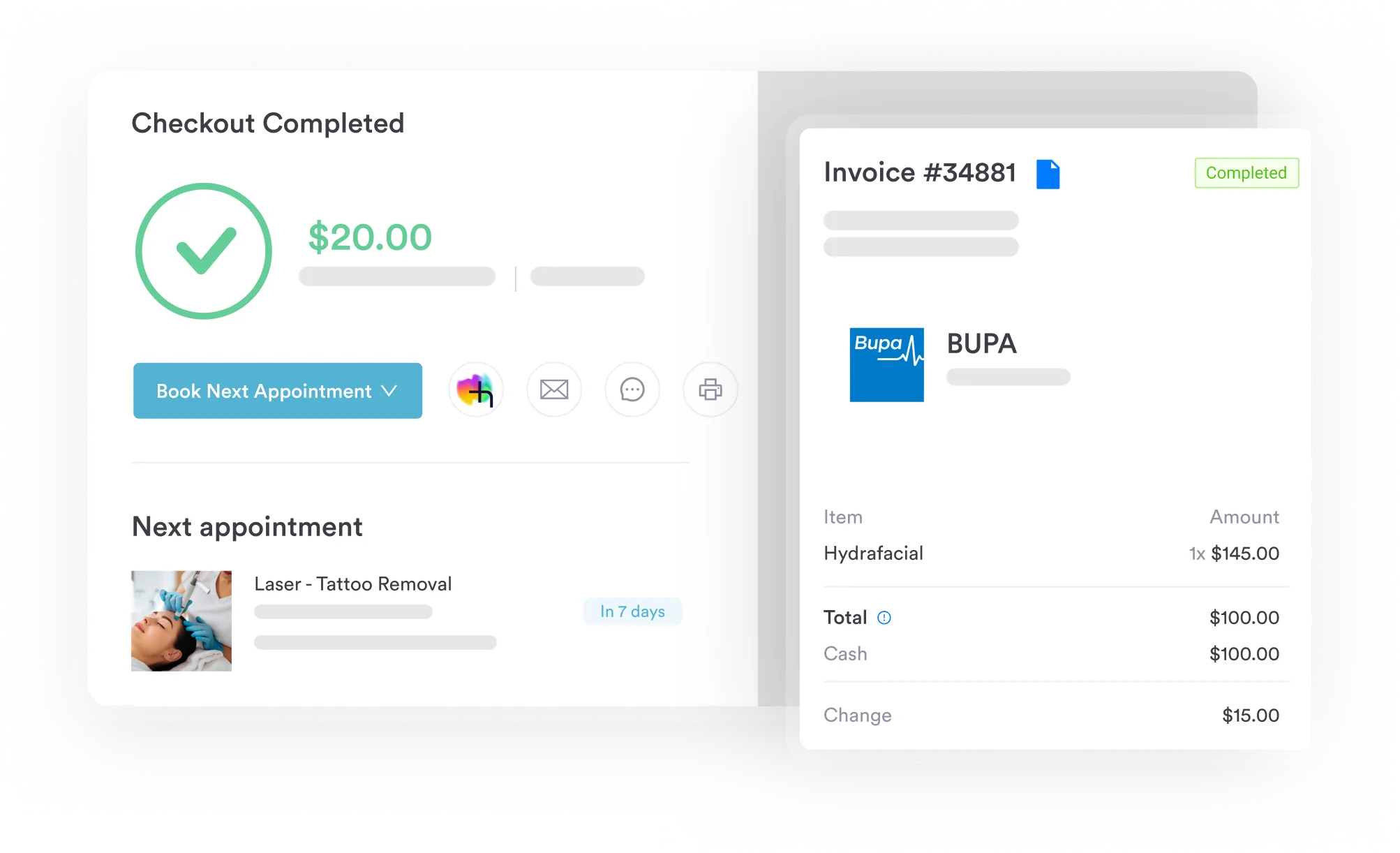
Three capabilities do most of the work on T2034 denial rates. Authorization expiry alerts stop claims going out against a lapsed PA. Documentation completeness checks catch a missing daily note before submission rather than after a CO-50. Per diem unit validation flags a second unit on the same calendar day while the claim can still be corrected.

Pabau helps behavioral health practices track prior authorization status, attach documentation to claims, and flag T2034 denial codes before they become write-offs.

T2034 pays on a mechanic that most behavioral health codes do not use, and the money is lost before the claim is ever submitted. Authorization expires mid-episode. Waiver eligibility lapses on day nine. A calendar day passes with no note against it. Each of those is decided during the crisis, not during billing. The remittance only reports what was already true.
So the controls that matter sit at intake and at the end of each shift, not in the denial queue. A crisis team that confirms eligibility before the first date of service has answered half of what an auditor asks. Writing one note per calendar day answers the rest.
Book a demo to see how Pabau keeps waiver authorization status and daily documentation attached to the claim your billing team submits.

Working a stack of behavioral health denials? Denial management in healthcare sets out how to triage rejections by root cause instead of reworking them one by one.
Want fewer T2034 claims coming back at all? What makes a clean claim explains the fields and attachments that decide whether a claim pays on first submission.
Reading remittances line by line? Electronic remittance advice shows how ERA processing helps billing teams spot denial patterns faster.
HCPCS Code T2034 covers crisis intervention services provided under a Medicaid Home and Community-Based Services (HCBS) waiver. It is billed per diem, with one unit equaling one calendar day. Only waiver-enrolled providers serving beneficiaries with active waiver eligibility may bill it, and standard Medicaid and Medicare Part B do not reimburse the code.
T2034 is billed per diem: one unit per calendar day, regardless of how many hours of crisis service were provided. Billing multiple units for multiple service hours on the same day is a miscoding error that results in a denial or a post-payment recoupment.
T2034 covers crisis intervention under a Medicaid HCBS waiver. H2034 covers alcohol and/or drug abuse halfway house services under standard Medicaid, with no waiver enrollment required. Both codes are billed per diem, so the unit does not separate them. Waiver enrollment does, and submitting T2034 for a beneficiary who is not waiver-enrolled generates a PR-96 non-covered-service denial.
Yes, in most state Medicaid programs and Medicaid managed care organizations, prior authorization is required before T2034 services can be billed. Some states allow retrospective authorization for unanticipated crisis starts, typically within a 72-hour window. Check your state’s MMIS billing manual for the exact requirements.
Concurrent billing of T2034 with other crisis codes on the same date of service is governed by state-specific payer policy. Some programs allow pairing with H-series crisis codes when distinct service components are documented, while others prohibit same-day concurrent billing. Confirm with your state Medicaid program or MCO before submitting concurrent claims.
T2034 is reimbursed by state Medicaid programs and Medicaid managed care organizations that administer CMS-approved HCBS waiver programs. Medicare Part B and commercial insurance plans do not recognize T-series codes, so this code is strictly a Medicaid waiver benefit.