CCSD code H4430: Examination of rectum under anaesthetic
CCSD code H4430 pays for the examination alone CCSD code H4430 is the UK private...

Last Updated: Oct 20, 2026
T1010 is the HCPCS Level II code for meals for individuals receiving alcohol and/or substance abuse services (when meals not included in the program).
The "T" prefix designates it as a temporary national code established primarily for state Medicaid program use. Temporary does not mean short-lived. T-codes can stay active for decades while CMS decides whether to assign a permanent code.
Let Pabau's smart automation suggest the right codes, reduce claim denials, and keep your practice compliant—effortlessly.
Automate repetitive tasks and focus on what matters most—your patients.
Reduce coding errors and ensure compliance with the latest regulations.
Clean claims, fewer denials, and faster reimbursements.
Powerful insights and reporting to help your practice thrive.
HIPAA compliant SOC 2 certified GDPR-compliant Trusted by 4,000+ clinics worldwide

HCPCS code T1010 is a Level II temporary national code describing meals provided to individuals actively receiving alcohol or substance abuse treatment.
T1010 is primarily a Medicaid code, and Medicare does not cover it. Reimbursement rates vary by state, so never rely on a single national rate.
Missing or vague documentation is the most common denial trigger. Every T1010 claim needs a treatment plan, a dated meal record, and proof of concurrent services.
Two codes in the T1006 to T1012 range are no longer billable: T1008 and T1011 were deleted on January 1, 2003.
Practice management software like Pabau helps behavioral health providers submit accurate T1010 claims and catch missing documentation before submission.
The table below summarizes the key administrative attributes of HCPCS code T1010 as of the 2026 CMS HCPCS release. Always verify current status against the AAPC HCPCS code database or the official CMS HCPCS file. Code status can change with each annual update.
Reimbursement for HCPCS code T1010 is set at the state level. There is no single national Medicaid rate. Each state Medicaid agency publishes its own fee schedule. Allowable amounts differ by state policy, program type, and whether you bill through managed Medicaid or fee-for-service.
For current figures, use the CMS Physician Fee Schedule lookup tool and your state’s Medicaid fee schedule portal. The table below sets out which payers recognize T1010 and where each rate comes from.
Verify all figures directly with your state Medicaid agency before billing, as rates are updated periodically throughout the year.
Run a payer-by-payer eligibility check before billing T1010. Because T-codes are Medicaid-designated, submitting to Medicare or most commercial plans will generate an automatic denial. Confirm payer acceptance of T1010 during enrollment verification, not at claim submission.
The most common coverage error with HCPCS code T1010 is submitting it to Medicare. T-codes are temporary national codes established specifically for state Medicaid programs. Medicare does not cover T1010, and claims submitted to Medicare will be denied without adjudication.
Medicaid covers T1010 in states that have elected to include meal services as an ancillary benefit in substance abuse treatment programs. Not every state does. Some states cover T1010 under their rehabilitation services benefit. Others bundle meal costs into per-diem residential rates, which makes separate T1010 billing inappropriate.
Check your state Medicaid provider manual before billing. It tells you whether meals are separately payable or already sitting inside the residential per-diem rate.
Eligibility to bill HCPCS code T1010 depends on state Medicaid program rules, not a single federal standard. The provider types below are the ones states typically recognize. Your state Medicaid agency is the definitive source on which types qualify and what enrollment they require.
Dual-diagnosis programs that combine behavioral health and substance abuse services need a closer look. Confirm that your Medicaid enrollment covers both service types before billing T1010 alongside behavioral health codes.
Insufficient documentation is the primary reason T1010 claims get denied on audit rather than at initial submission. Payers often pay claims initially and recoup them later during post-payment review. Strong medical billing compliance practices require that documentation be complete before the claim is submitted.
Every T1010 claim should be supported by the documentation elements below. Some state Medicaid programs require additional items, so confirm the list in your state provider manual.
Capturing treatment attendance, meal service dates, and authorization status in one workflow keeps those records aligned. Paper systems that separate meal logs from clinical records create the discrepancies auditors flag.
Behavioral health billing teams consistently encounter the same cluster of errors on T1010 claims. Most are preventable with process controls rather than specialized expertise.
Tracking which claims generate T1010-specific denials, and why, is the fastest way to find a systemic process fault. Reviewing denial codes alongside your T1010 claim data reveals patterns that individual claim reviews miss.
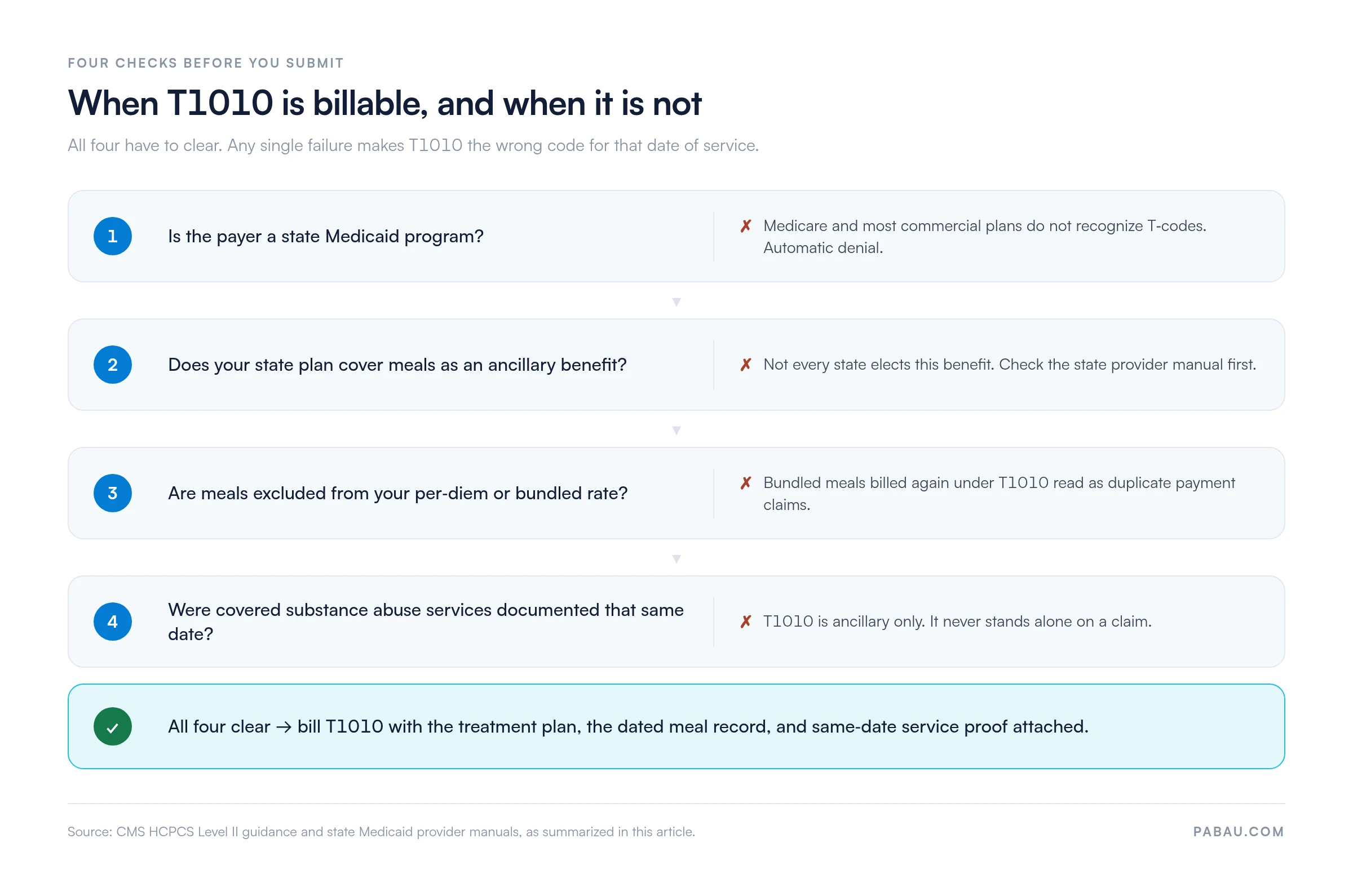
Four conditions decide whether T1010 belongs on a claim at all, and the diagram below runs through them in order.
HCPCS code T1010 sits in the T1006 to T1012 range, which covers alcohol and substance abuse rehabilitation services. Only five of those codes remain active: T1006, T1007, T1009, T1010, and T1012. T1008 and T1011 were deleted effective January 1, 2003, so neither is billable today.
Billing teams in behavioral health still need the whole range to avoid upcoding, undercoding, or duplicate billing. The NLM HCPCS Level II API gives programmatic access to the full T-series descriptor set for practices building billing integrations.
T1010 is the only active ancillary code in this range. It describes a support service provided alongside direct substance abuse treatment, not instead of it. Never bill it as a standalone code without evidence of concurrent treatment services on the same date.
Behavioral health programs billing T1010 alongside primary substance abuse codes face a coordination problem. Treatment notes, meal service logs, and billing records often live in different systems. Each handoff between those systems is an opportunity for date mismatches, missing documentation, and claim errors.
Practice management software like Pabau addresses this by linking documentation to billing at the point of care. When a client’s treatment attendance is recorded, the system flags the ancillary services eligible for that date.
That includes T1010 meal services, and it prompts your billing team to attach the required documentation before the claim goes out. The result is fewer unbilled services and fewer denials traced to missing paperwork.
Claims management software built for multi-payer behavioral health handles Medicaid claim rules, payer routing, and remittance reconciliation in one workflow. Your team stops cross-checking two systems by hand.
Pabau supports HCPCS Level II code entry and Medicaid claim workflows in one place. Behavioral health providers can generate superbills and track claim status without switching between a clinical system and a separate billing tool.
For practices managing multiple ancillary codes alongside T1010, that integration reduces the manual reconciliation that creates compliance exposure.

Pabau helps behavioral health and substance abuse providers submit accurate HCPCS claims and track Medicaid reimbursement by code. It also catches missing documentation before claims go out. See how it works for your program.

Audit your T1010 claims monthly against attendance records. Pull every claim billed in the period and verify that meal service dates align with treatment attendance dates in the clinical record. Mismatches you find internally are recoverable. Those found by Medicaid auditors trigger repayment demands and possible compliance reviews.
Behavioral health programs leave Medicaid revenue unclaimed by skipping T1010 altogether. Others submit it without the concurrent-service documentation their state program requires. Both outcomes come from the same cause, which is treating a meal record as an afterthought.
The code itself is straightforward. It covers meals provided during active alcohol and substance abuse treatment, billed to state Medicaid at state-determined rates. Check your state manual once, set your payer routing rules once, and T1010 stops generating denials.
Pabau connects clinical documentation to HCPCS billing, so a T1010 claim goes out complete. Book a demo to see how it handles behavioral health claim management.

Need a full overview of how medical billing works? What is medical billing explains the end-to-end revenue cycle process for healthcare providers.
Handling claim denials across multiple Medicaid codes? Denial management in healthcare covers the processes that reduce write-offs and recoupment risk.
Want to see how Medicaid billing fits your wider revenue cycle? What is revenue cycle management breaks down how each stage connects from eligibility through payment.
HCPCS code T1010 is a Level II temporary national code used to bill meals provided during alcohol or substance abuse treatment. The code applies only when meals are concurrent with covered treatment on the same date. It cannot be billed as a standalone service.
T1010 is covered by Medicaid in states that include meal services as an ancillary benefit within their substance abuse treatment programs. Medicare does not cover T1010. T-codes are temporary national codes designated for state Medicaid use, so submitting T1010 to Medicare will result in an automatic denial.
At minimum, T1010 claims require a current treatment plan showing active enrollment in substance abuse services. They also need a dated meal record tied to the billing date, plus documentation of covered services on that same date. Some state Medicaid programs require more items, so confirm the list in your state provider manual.
T1010 sits in the T1006 to T1012 range covering alcohol and substance abuse rehabilitation services. The active codes are T1006 (family and couple counseling), T1007 (treatment plan), T1009 (child sitting services), and T1012 (skills development). T1008 and T1011 were deleted on January 1, 2003, so T1010 is the only active ancillary code left in the range.
T-codes are temporary national HCPCS codes. CMS established them provisionally, pending a decision on whether to assign a permanent code. Temporary does not imply short-lived. Many T-codes remain active for years, so always verify current code status against the annual CMS HCPCS release before billing.
There is no single national reimbursement rate for T1010. Each state Medicaid agency sets its own rate. Amounts vary by program type, provider setting, and whether you bill fee-for-service or managed Medicaid. Contact your state Medicaid agency or check your state’s published fee schedule for current allowable amounts.