CCSD code H4430: Examination of rectum under anaesthetic
CCSD code H4430 pays for the examination alone CCSD code H4430 is the UK private...

Last Updated: Oct 20, 2026
T1000 is the HCPCS Level II code for private duty / independent nursing service(s) - licensed, up to 15 minutes.
T-codes (T1000 through T5999) are HCPCS Level II codes maintained by CMS for state Medicaid agencies. Medicare does not recognize T-codes, so any T1000 claim sent to a Medicare payer will be rejected automatically.
Let Pabau's smart automation suggest the right codes, reduce claim denials, and keep your practice compliant—effortlessly.
Automate repetitive tasks and focus on what matters most—your patients.
Reduce coding errors and ensure compliance with the latest regulations.
Clean claims, fewer denials, and faster reimbursements.
Powerful insights and reporting to help your practice thrive.
HIPAA compliant SOC 2 certified GDPR-compliant Trusted by 4,000+ clinics worldwide

HCPCS Code T1000 covers private duty nursing by a licensed RN or LPN, billed in 15-minute units under state Medicaid.
T1000 is a Medicaid-only code. Medicare rejects T1000 claims because T-codes do not exist in its fee schedule.
Modifier rules change from state to state. Check your state billing manual for TF, TG, UA, UB, UC and UD before submitting.
Practice management software like Pabau tracks time units and modifier fields automatically, which cuts manual errors on time-based codes.
HCPCS Code T1000 is classified under HCPCS Level II, Section T (State Medicaid agency codes), within the nursing services range T1000 through T1005. The official HCPCS Level II descriptor reads: Private duty/independent nursing services, licensed, up to 15 minutes.
The “licensed” qualifier in the descriptor decides who may render the service. T1000 requires a registered nurse (RN), or a licensed practical or vocational nurse (LPN/LVN) where state scope-of-practice law allows it.
Care delivered by an unlicensed aide or a nursing assistant belongs to T1004, the personal care code. T1003 is not the aide code either, since it covers LPN/LVN services, which are skilled and licensed.
Private duty nursing (PDN) is one-on-one nursing care for a patient who needs continuous skilled attention. Intermittent home health visits cannot deliver that level of cover. The nurse stays with the patient through a scheduled shift rather than dropping in for a single task.
T1000 applies when the patient’s condition requires a licensed nurse on-site for extended periods. Ventilator dependency, tracheostomy care, complex medication management and frequent skilled interventions are the usual reasons. State Medicaid programs set their own criteria for which conditions qualify, so documentation must tie directly to those criteria.
T1000 is billed in time-based units of up to 15 minutes each. One unit equals one 15-minute interval of private duty nursing services. For an 8-hour shift, a biller submits 32 units of T1000, which is 4 units per hour. The shift record has to carry the exact start and end time to support that count.
Many T1000 billing errors trace back to rounding in the unit count. State Medicaid programs often follow CMS guidance on time-based billing, where a unit becomes billable at 8 minutes of service. That threshold is the 8-minute rule used in other time-based coding contexts. Individual state manuals may apply their own rounding, so verify yours before adopting any default.
Documentation must support every unit billed. Nursing notes should record activity at each interval, the nurse’s credentials and the patient’s status. Submitting 32 units behind a single generic shift note is a common reason T1000 audits end in repayment demands. State law also sets how long those nursing records must be kept, so check your retention schedule.
Track start and end times for every nursing shift in your billing system before the shift ends. Reconstructing time from memory days later produces unit-count discrepancies that trigger Medicaid audits. Automated time-logging at check-in and check-out removes that risk.
Modifiers on T1000 specify the nurse’s qualification level, the supervision structure, or the service setting. Requirements differ by state, and one program may mandate a modifier that another prohibits. Treat the table below as a common reference, then check it against your state billing manual.
UA and UB are the modifiers most billers meet daily, because they identify the nurse’s license type. Many state Medicaid programs require one or the other on every T1000 claim line. Submitting without a license-type modifier, or submitting the wrong one, is a common cause of T1000 denials.
There is no national Medicare fee schedule for HCPCS Code T1000, because T-codes are state Medicaid agency codes. Each state program sets its own rate per 15-minute unit and updates it on its own schedule, often annually. The CMS Physician Fee Schedule lookup does not return T-code rates. Use your state Medicaid agency’s published fee schedule instead.
The current rate comes from the state itself, and there are three places to find it.
RN rates usually sit above LPN/LVN rates, separated by the UA and UB modifiers. Reading the remittance advice on each paid claim confirms which rate the payer applied and flags any state-level change.
T1000 through T1005 form the HCPCS nursing services T-code range. Choosing the wrong code in this range is a frequent billing error, most often between T1000 and the codes that split RN and LPN time.
The chart below routes a service to its code by license first, then by the kind of care delivered.
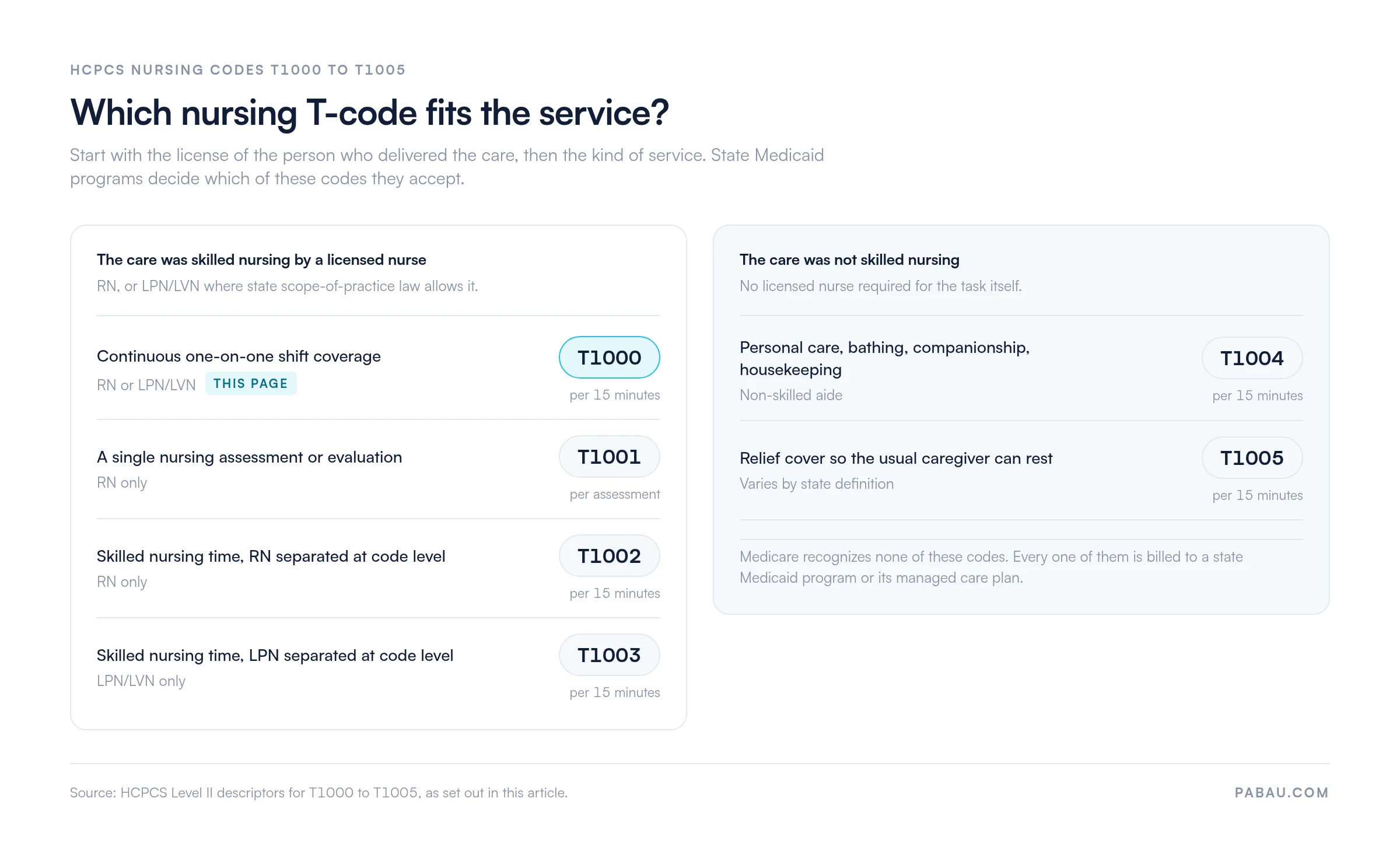
T1002 is RN-only, while T1000 covers both RN and LPN/LVN work. Some state Medicaid programs have moved away from T1000 in favor of T1002 for RNs and T1003 for LPNs. That separates license types at the code level instead of through modifiers. Verify which codes your state recognizes for private duty nursing before defaulting to T1000.
A state that pays registered nurse home nursing by the day, rather than in 15-minute units, uses HCPCS Code T1030 instead.
Medicare does not cover private duty nursing services under HCPCS Code T1000. T-codes are, by definition, state Medicaid agency codes. Medicare’s claim processing system does not recognize them at all. A T1000 claim billed to Medicare Part A or Part B is rejected at the payer level rather than denied after adjudication.
State Medicaid programs cover PDN under T1000 when the patient meets the medical necessity criteria that program sets. Medicaid managed care organizations (MCOs) may also cover it, usually at negotiated rates that differ from the state fee-for-service rate. Some MCOs require prior authorization once PDN hours pass a daily or monthly threshold. Confirm coverage and authorization rules before starting a new PDN case.
T1000 claims draw audit attention because the amounts are large and the documentation rules are specific. A full-day shift alone can generate 48 units. Knowing which errors produce the most rejections is what keeps that volume clean.
Review your denial codes monthly to catch T1000 patterns before they accumulate. A run of CO-4 or CO-16 remark codes usually points to a modifier problem or missing documentation. Both are correctable before submission, which is what clean claim submission means in practice.
State Medicaid programs have wide latitude over how they implement PDN coverage, which codes they accept, and what authorization they require. What works in Texas may not work in New Mexico or Florida. The table below summarizes where state programs vary, rather than specific rates, which change annually.
Agencies billing PDN in more than one state need a billing profile per state rather than one national workflow. Payer-specific modifier rules and authorization limits belong in the system that builds the claim, so an error surfaces before submission.
Time-based HCPCS billing puts a heavy load on manual process. Every 15-minute unit needs a documented time entry, the correct modifier, and an authorization counter that matches the approved hours. When nurses log time on paper, billers key the codes by hand and authorizations live in a spreadsheet, those three records drift apart.
Pabau, our practice management software, links shift time logging directly to the billing module. When a nurse checks in and out, the system calculates the unit count and attaches the modifier that matches the nurse’s credential profile. That single record is what makes cleaner claims management possible, because nobody retypes a shift into the claim.
Authorization alerts do the same job further upstream. When a patient’s approved monthly PDN hours are close to exhausted, the account is flagged before the next shift is scheduled. The care coordinator can request an extension then, instead of finding the shortfall weeks later when the claim denies.
Audit one week of T1000 claims every quarter. Pull the nursing notes for those dates. Confirm each billed unit has a documented 15-minute interval, a start and end time, and the rendering nurse’s credential. Whatever the sample shows will repeat in the weeks you did not pull, so repair the documentation workflow itself.

Pabau automates time-unit tracking, modifier fields and Medicaid claim submission. Your team spends less time correcting claims and more time on patient care.

The descriptor for HCPCS Code T1000 is short, but the rules around it are not. Modifier requirements change from state to state. Unit documentation has to be interval-level. Some state programs no longer accept the code for private duty nursing at all.
Before the next PDN claim goes out, check three things against your state manual: the active code, the required modifier, and the authorized hours left. Those checks catch most T1000 denials at the point where they are cheapest to fix.
Automating them removes the manual step where the errors start. Book a demo to see how Pabau tracks time-based units and payer-specific modifiers on Medicaid claims.

Need to understand how medical billing works from the ground up? What is medical billing covers the end-to-end process from charge capture to payment posting.
Struggling with Medicaid claim denials? Denial management in healthcare explains how to build a systematic appeals and prevention workflow.
Want the broader revenue cycle context? Revenue cycle management walks through every stage from eligibility verification to final collections.
HCPCS Code T1000 covers private duty nursing by a licensed nurse, either an RN or an LPN/LVN. It is billed in units of up to 15 minutes under state Medicaid programs. The code applies to continuous one-on-one care for patients with medically complex needs who require a licensed nurse on-site for extended periods.
T1000 is billed per time unit, not per visit. Each unit covers up to 15 minutes of service. A four-hour nursing shift is billed as 16 units, which is 240 minutes divided by 15. Nursing documentation must support each unit with a start time, an end time and the rendering nurse’s credentials.
T1000 is a Medicaid-only code. Medicare does not recognize T-codes, so a claim submitted under Medicare Part A or Part B is rejected. Coverage comes from state Medicaid programs and, in some cases, from Medicaid managed care organizations.
T1000 covers private duty nursing billed per 15-minute unit by a licensed RN or LPN/LVN. T1001 covers a nursing assessment or evaluation, billed per encounter rather than per time unit, and is limited to registered nurses. T1001 suits a discrete assessment visit, not ongoing continuous nursing coverage.
Common modifiers include UA (services by RN), UB (services by LPN/LVN), TG (complex or high-tech level of care) and TF (intermediate level of care). Requirements vary by state Medicaid program. Some states require UA or UB on every claim line, while others use TG for ventilator-dependent or IV-dependent patients. Always verify against your state billing manual.
CPT codes are five-digit numeric codes maintained by the American Medical Association for physician and outpatient procedures. They are used mainly for Medicare and commercial billing. HCPCS Level II codes are alphanumeric codes maintained by CMS for non-physician services, supplies and equipment, including the T-codes used by state Medicaid programs. T1000 is an HCPCS Level II code with no CPT equivalent.
Yes. LPNs and LVNs can generally bill under T1000, because the descriptor specifies “licensed” without restricting the code to RNs. State scope-of-practice law and individual Medicaid program rules govern which license types qualify. When billing for LPN services, modifier UB is typically required to identify the rendering nurse’s license type.
There is no single national rate for T1000. Each state Medicaid program sets its own per-unit rate. Rates differ by nurse license type (RN vs LPN) and by geographic region within a state. Fee-for-service and managed care rates differ as well. Contact your state Medicaid agency’s provider relations line for the current published rate.