CCSD code H4430: Examination of rectum under anaesthetic
CCSD code H4430 pays for the examination alone CCSD code H4430 is the UK private...

Last Updated: Oct 20, 2026
S0621 is the HCPCS Level II code for a routine ophthalmological examination including refraction, established patient.
It belongs to the S-code series maintained by the Blue Cross Blue Shield Association. Commercial vision plans such as VSP and EyeMed recognize it, but traditional Medicare does not reimburse S-codes. Some Medicare Advantage plans accept them under a supplemental vision benefit. Denials on S0621 usually trace back to three mistakes. Practices submit it to traditional Medicare, confuse it with S0620 for new patients, or leave refraction results out of the chart.
Let Pabau's smart automation suggest the right codes, reduce claim denials, and keep your practice compliant—effortlessly.
Automate repetitive tasks and focus on what matters most—your patients.
Reduce coding errors and ensure compliance with the latest regulations.
Clean claims, fewer denials, and faster reimbursements.
Powerful insights and reporting to help your practice thrive.
HIPAA compliant SOC 2 certified GDPR-compliant Trusted by 4,000+ clinics worldwide

HCPCS Code S0621 covers a routine ophthalmological examination including refraction for an established patient.
Traditional Medicare does not reimburse S-codes, so S0621 goes to commercial vision plans and Medicaid managed care.
S0621 crosswalks to CPT 92014, but vision plans and medical insurers use different code sets.
Refraction results must appear in the chart, because missing values are the leading cause of S0621 denials.
Practice management software like Pabau handles HCPCS Level II entry and vision plan claims in one billing workflow.
HCPCS Code S0621 is the billing code for a routine ophthalmological examination including refraction, established patient. The code belongs to HCPCS Level II, maintained by the Centers for Medicare and Medicaid Services (CMS).
It sits in the S-code series, a temporary national code category maintained by the Blue Cross Blue Shield Association (BCBSA) for non-Medicare payers. S-codes exist because Medicare’s CPT-based fee schedule does not bundle refraction into its ophthalmological examination codes, while most commercial vision plans do.
That pattern runs through the whole series. HCPCS Code S0630 covers suture removal by a physician who did not close the wound. Traditional Medicare does not pay it either, so each commercial contract sets its own rate.
The table below captures the key structured attributes coders and billers need before submitting a claim.
S-codes carry no CMS-assigned RVUs and do not appear on the Medicare Physician Fee Schedule. Practices negotiate reimbursement directly with each vision benefit plan, so rates vary by plan and by geographic market. S0621 sits alongside the rest of the HCPCS codes that cover supplies, drugs and services the CPT manual does not describe.
S0621 applies to established patients; S0620 applies to new patients. These two codes are not interchangeable. Selecting the wrong one is among the most common reasons vision plan claims get denied or returned for correction.
The established patient definition in ophthalmology and optometry billing follows the standard three-year rule. A patient counts as established if the same physician has provided professional services within the past three years.
Another physician of the same specialty in the same practice also counts. Confirm the patient’s last visit date before choosing S0621 over S0620, and record it in the encounter note.
S0621 crosswalks to CPT code 92014, which describes comprehensive ophthalmological services for an established patient. The crosswalk matters because the same patient encounter may need to be billed under different code sets depending on the benefit plan being invoiced.
CPT 92014 does not bundle refraction. When a medical plan covers the patient and the practice also bills refraction, CPT 92015 is billed separately. That code covers the determination of refractive state.
With S0621 the refraction is already inside the code descriptor, so adding CPT 92015 to the same vision plan claim is duplicate billing. Check the individual payer’s bundling policy before submitting.
The choice is really two questions in sequence. Who is paying, and has this patient been seen in the practice before?
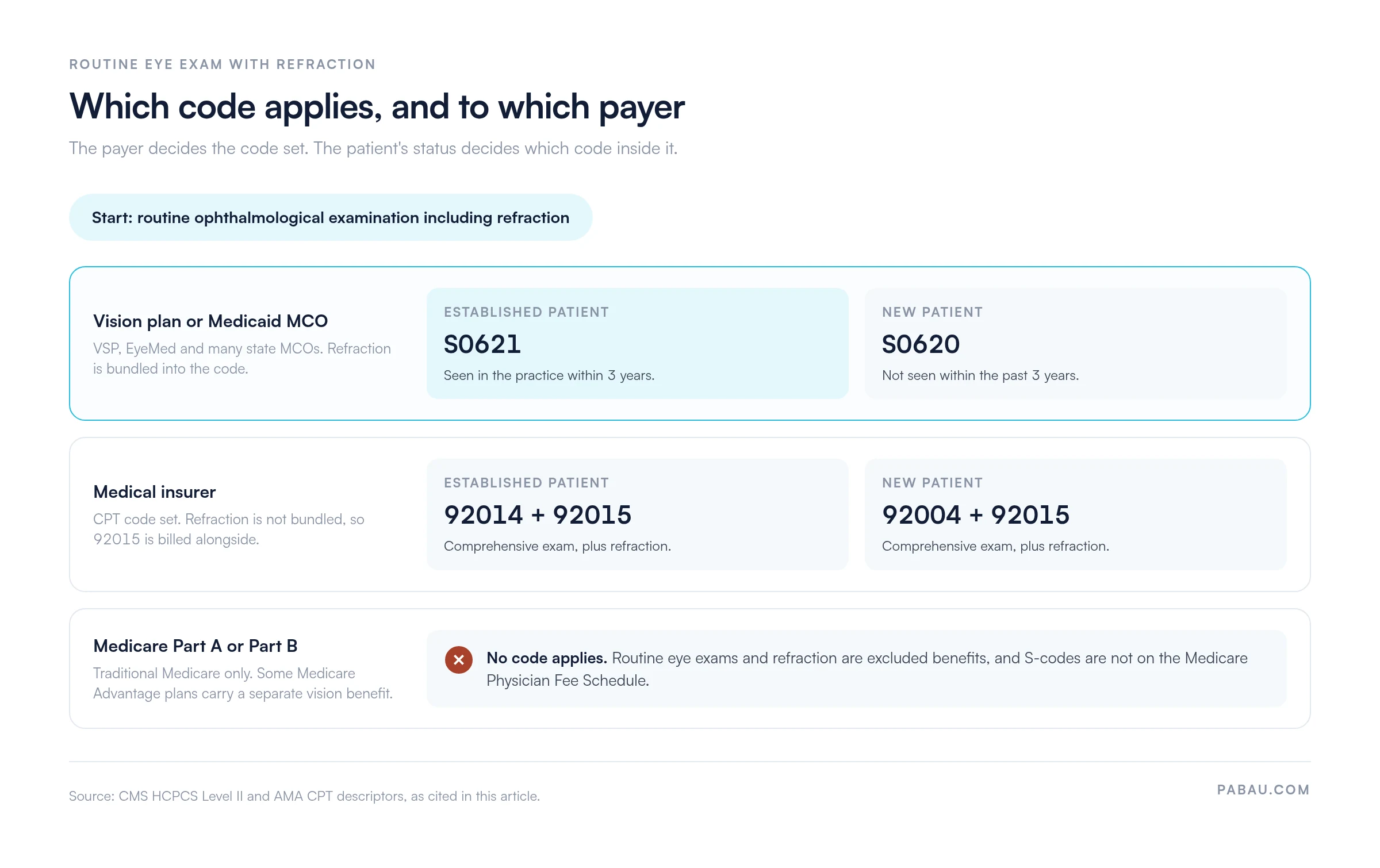
When a patient has both medical insurance and a vision plan, split the claim correctly. Bill CPT 92014 to the medical insurer for the comprehensive exam components. Bill HCPCS Code S0621 to the vision plan for the routine exam including refraction. Confirm coordination of benefits rules with each payer before splitting claims this way.
S0621 is accepted by commercial vision benefit plans and many Medicaid managed care organizations. Traditional Medicare does not recognize it. Check eligibility before every visit to confirm which plan the patient is presenting under, and whether that plan accepts S-codes.
The AAPC’s HCPCS code reference carries additional payer policy notes for S0621, updated as payer positions change. Cross-reference it with your own plan contracts before relying on any third-party summary.
Reimbursement rates for S0621 vary by payer, by geographic region, and by the contract a practice holds with each vision plan. Because S-codes are not on the CMS Physician Fee Schedule, there is no single national rate to reference.
Typical allowed amounts from vision plans run from roughly $45 to $85 per encounter, depending on the plan and the market. Practices should verify current contracted rates with each payer directly. Rates in high cost-of-living markets tend to be negotiated higher, and practices contracting directly rather than through a third-party administrator typically see higher allowed amounts.
Reconciling each vision plan’s remittance advice shows the allowed amount actually paid on every S0621 claim. That is where underpayments against a contracted rate surface, rather than at claim submission. Watch in particular for claims paid at the wrong benefit tier.
Payer-specific allowed amounts come from plan contracts or provider portals. S-code rates are not published in a standard national schedule the way Medicare RVUs are for CPT codes. Every contract has to be read on its own terms.
Vision plans audit S0621 claims, and thin documentation is the most common reason for a post-payment recoupment request. The chart has to support every element coded: a routine comprehensive examination, performed on an established patient, that included refraction.
A standardized ophthalmology exam form keeps refraction fields and exam component checkboxes in front of the clinician at the point of care. The chart then already carries what an auditor asks for, and nobody has to reconstruct the visit months later.
S0621 and a CPT code can appear on the same date of service when the encounter involves two distinct services. A routine vision exam goes to the vision plan as S0621. A medically necessary eye disease evaluation goes to the medical insurer as a CPT ophthalmology or E/M code. The scenario is legitimate when documented properly, but payer rules vary.
Practices that bill vision plans and medical insurers side by side need billing software that routes each code to the correct payer. Manual re-keying between two systems is where most dual-billing errors start.
S0621 claim denials follow recognizable patterns. These are the errors that recur most often in optometry and ophthalmology practices, along with what to do instead.
Sort your denials by reason code and the pattern separates itself. A recurring cause, such as missing refraction values, needs a workflow fix. A one-off needs training. Correcting a claim before it leaves the practice costs far less than answering a recoupment letter afterwards.
Coders working with S0621 regularly need to reference these adjacent codes. Each has a specific scope that determines when it applies.
Knowing how these codes interact prevents dual-billing errors and helps a practice bill correctly across benefit types. Practices seeing patients with both vision plans and medical coverage will use combinations from this table routinely. The CMS HCPCS official reference is the authoritative source for S-code definitions, while the AMA CPT manual governs 92004, 92014, and 92015.
Audit your S0621 and S0620 submissions quarterly. Filter remittance data by denial reason code. If denials cluster around refraction documentation, make refraction values a required field in your exam template. If they cluster around patient status, add a patient-type prompt to the front-desk eligibility workflow.
Many optometry and ophthalmology practices run vision plan billing alongside medical billing in separate systems. The front desk verifies benefits in one portal, and the coder selects S0621 in another. Refraction values often sit on a paper exam sheet that never reaches the claim.
Practice management software like Pabau keeps the exam and the claim in the same patient record. Refraction fields live in the charting template, so the values an auditor asks for are captured during the visit rather than added afterwards. The coder then submits S0621 from that same record.
Pabau’s claims management software handles HCPCS Level II entry and multi-payer routing. The vision claim and the medical claim from one visit reach different payers without re-keying. Remittance data returns to the same screen, which is where an underpayment against a contracted vision plan rate becomes visible.


Pabau’s claims management tools support HCPCS Level II code entry, multi-payer routing, and remittance reconciliation in one place. Fewer manual steps mean fewer billing errors on S0621 and on every other code your practice submits.

S0621 covers one narrow situation. It is a routine exam including refraction, performed on an established patient, and billed to a vision plan or a Medicaid managed care organization. Most of what goes wrong with the code happens before the claim is ever built.
Three checks remove nearly every denial. Confirm the payer is not traditional Medicare. Confirm the patient was seen within the past three years. Confirm the refraction values are written in the chart. Front-desk eligibility and a charting template handle the first two. The third is a documentation habit, and it is the one that costs practices money at audit.
Fix those three and S0621 claims move without follow-up. Book a demo to see how Pabau handles vision plan and medical billing from the same patient record.

Want to understand the full billing lifecycle for eye care claims? What is medical billing explains how the revenue cycle works from code selection through payment posting.
Concerned about claim rejection patterns? Denial management in healthcare covers how to categorize, track, and systematically reduce claim denials across all payer types.
Need to verify patient benefits before the encounter? Insurance eligibility verification outlines how real-time eligibility checks prevent billing errors before they happen.
HCPCS Code S0621 bills a routine ophthalmological examination including refraction for an established patient. It goes to a commercial vision benefit plan or a Medicaid managed care organization. It is an HCPCS Level II S-code maintained by the Blue Cross Blue Shield Association, and traditional Medicare does not reimburse it.
S0620 is for new patients; S0621 is for established patients. Both include refraction and are billed to vision plans. An established patient is one who has received professional services from the same physician or same-specialty practice within the past three years. Using the wrong code is one of the most common denial causes on vision plan claims.
No. Traditional Medicare does not cover S-codes under any part of the program, because routine eye exams and refraction are excluded benefits. Submitting S0621 to Medicare will result in a claim denial. Some Medicare Advantage plans offer supplemental vision benefits that may accept S-codes, so check the individual plan’s supplemental benefit documentation.
VSP Vision Care and EyeMed Vision Care are the two largest commercial vision plans that accept HCPCS Code S0621. Many state Medicaid managed care organizations also accept the code. Specific acceptance, allowed amounts, and benefit frequency limits vary by plan and geographic region. Verify with each payer’s provider portal before submitting.
S0621 crosswalks to CPT code 92014, which covers comprehensive ophthalmological services for an established patient when billed to a medical insurer. CPT 92014 does not include refraction, which must be billed separately as CPT 92015. S0621 bundles refraction into the code, making it the more efficient code set for vision plan billing.
The chart must document confirmed established patient status, the chief complaint, and entrance testing such as visual acuity, pupils and EOMs. It must also carry anterior and posterior segment findings, plus refraction results giving sphere, cylinder and axis for each eye. The measured refraction values must appear in the record. A note saying refraction was performed, without the values, will not survive an audit.
S0621 and a CPT ophthalmological code can be billed on the same date of service when they go to different payers. S0621 goes to the vision plan, and the CPT code to the medical insurer. Submitting both to the same payer on the same date almost always triggers a bundling denial. Always verify the individual payer’s coordination of benefits policy before splitting claims.