CPT code 93503: Swan-Ganz catheter billing and modifiers
CPT code 93503: Official descriptor and procedure overview In the AMA CPT code s...

Last Updated: Oct 23, 2026
HCPCS code S0136 is the temporary Level II code for clozapine, 25 mg, the antipsychotic used mainly for treatment-resistant schizophrenia. Its Medicare status is I, which means Medicare does not pay it. Medicaid programs and commercial plans may accept it, and each unit equals 25 mg dispensed.
A billing error here can interrupt treatment. A wrong payer route or unit count can delay the next fill. If a patient then misses clozapine for two days or more, titration restarts from a low dose. The unit math, payer routing and pre-submission checks below keep that fill on schedule.
Let Pabau's smart automation suggest the right codes, reduce claim denials, and keep your practice compliant—effortlessly.
Automate repetitive tasks and focus on what matters most—your patients.
Reduce coding errors and ensure compliance with the latest regulations.
Clean claims, fewer denials, and faster reimbursements.
Powerful insights and reporting to help your practice thrive.
HIPAA compliant SOC 2 certified GDPR-compliant Trusted by 4,000+ clinics worldwide

HCPCS code S0136 reports clozapine in 25 mg units, so 100 mg a day for 30 days bills as 120 units.
S0136 carries Medicare coverage status I, not payable by Medicare, and no J-code stands in for it.
Medicare patients usually get oral clozapine through Part D, where the pharmacy bills the NDC.
The FDA ended the Clozapine REMS on June 13, 2025, but ANC monitoring continues under the prescribing information.
Pabau, the practice software we build, sends each claim from the patient record with supporting documents attached.
HCPCS code S0136 is a temporary national Level II code with the descriptor “Clozapine, 25 mg.” It took effect on April 1, 2003. Its Medicare coverage status is I, which means Medicare does not pay it.
The Centers for Medicare and Medicaid Services publishes the code set. S codes, though, exist for private insurers and Medicaid programs, which use them where no national code fits.
Clozapine treats schizophrenia that has not responded to other antipsychotics. It is also approved to reduce the risk of recurrent suicidal behavior in schizophrenia or schizoaffective disorder.
Because it is a later-line drug, payers often ask why it was chosen. On the claim, the diagnosis usually comes from the F20 schizophrenia family, such as F20.9, or from F25 for schizoaffective disorder.
The code pays for clozapine itself, counted in 25 mg units. It does not bundle the services that surround a clozapine prescription.
Bill these separately, or write them off, according to each payer’s policy:
Keeping those lines apart makes the claim easier to review. It also stops a payer from assuming the drug line includes services it never covered.
Payer type decides whether S0136 belongs on the claim at all. The diagram below shows where each payer sends the drug, and the three questions after it are the ones billing teams ask first.
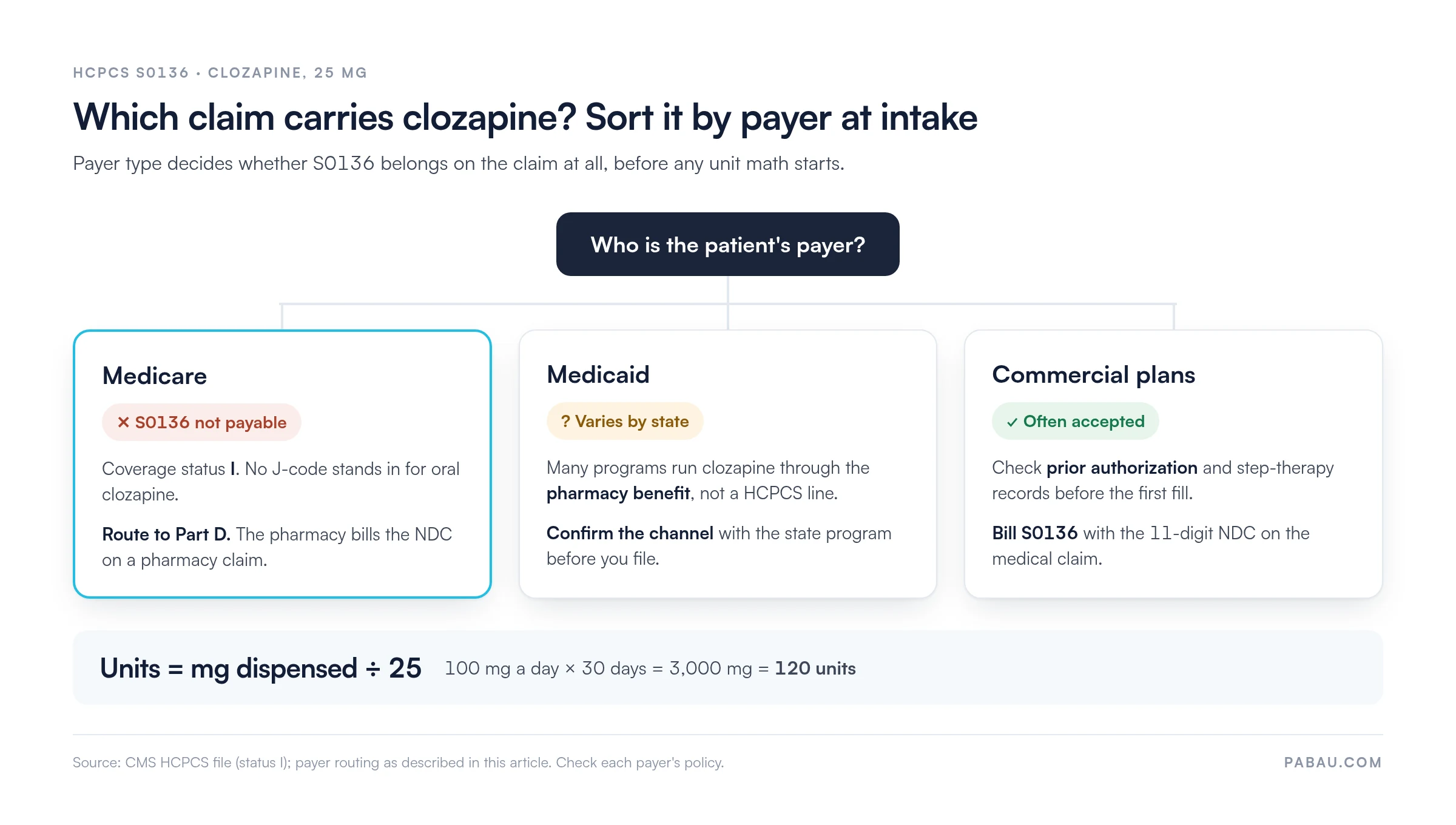
No. CMS lists S0136 with coverage status I, so Medicare does not pay it, and most Medicare Advantage plans follow suit. No J-code substitutes for oral clozapine either. Medicare patients usually receive it through Part D, where the pharmacy bills the NDC on a pharmacy claim.
Often, but it varies by state. Many state programs process clozapine through the pharmacy benefit rather than the medical benefit. In that case, the pharmacy claim carries the drug instead of a HCPCS line. Confirm the billing channel with the state program before you file.
Many do, though prior authorization rules differ widely. Some plans also require step therapy records showing earlier antipsychotic trials. Check the plan’s drug policy before the first fill.
Flag every patient as Medicare or non-Medicare at intake. Non-Medicare patients can carry S0136 on the medical claim. Medicare patients are routed to their Part D pharmacy benefit instead, so the code never reaches a Medicare claim.
The FDA eliminated the Clozapine REMS effective June 13, 2025. It had already stopped enforcing the program from February 24, 2025. Prescribers, pharmacies and patients no longer enroll, and pharmacies no longer need a REMS Dispense Authorization.
Severe neutropenia is still a risk, however. The Boxed Warning remains, and the FDA’s clozapine information points to the prescribing information for ANC monitoring. Prescribers still order baseline and ongoing ANC tests on that schedule.
For billing, the change is simple. A claim no longer depends on REMS enrollment or a dispense authorization. Some payers may still ask for a recent ANC in their prior authorization criteria, so keep results in the chart.
Each billed unit equals 25 mg of clozapine. To find the unit count, divide the total milligrams dispensed by 25.
Here is a worked example. A patient on 100 mg a day receives a 30-day supply. That is 3,000 mg in total, so the claim line shows 120 units. At 300 mg a day, the same supply bills as 360 units.
Under-reporting units is a common cause of underpayment on clozapine claims. Over-reporting, on the other hand, invites an audit. Record the milligrams on the dispensing note so anyone can recheck the math.
Other oral drug S-codes use the same milligram math. S0176 bills oral hydroxyurea in 500 mg units, counted by the milligrams dispensed rather than by the capsule.
Most Medicaid and commercial payers want the National Drug Code on the line as well. Report it in the 11-digit 5-4-2 format, adding leading zeros where needed. The NDC on the claim should match the package dispensed.
Place of service affects routing too. A pharmacy uses POS 01, while an office that dispenses in-house uses POS 11. Some Medicaid programs restrict S0136 to pharmacy billing, so confirm the setting first.
Under buy-and-bill, the practice buys clozapine from a wholesaler, dispenses it and bills the payer. Because clozapine is a tablet, most patients fill it at a pharmacy instead. Some integrated behavioral health programs and psychiatry practices still dispense it in-office.
If you do, keep the purchase invoice on file. Many Medicaid programs ask for acquisition cost records and may audit them against the billed amount.
A clean clozapine claim follows the same path every month. Here is how it usually moves, step by step.
Most problems start at steps 1 and 4. A Medicare patient billed under S0136 fails at once. So does a unit count built from days supplied rather than milligrams.
Speed matters here for a clinical reason, too. If a patient misses clozapine for two days or more, the prescribing information calls for re-titration from a low dose. A stalled refill can set the patient’s treatment back.
Many commercial plans and state Medicaid programs require prior authorization for S0136. Criteria vary, but most requests draw on the same core records.
Turnaround depends on the plan and on whether the request is marked urgent. Track each approval’s end date, because a lapsed authorization denies the next claim. If a plan refuses the request, ask about peer-to-peer review and lead with the clinical rationale.
S0136 has no Medicare fee schedule amount, because Medicare does not pay it. Instead, each Medicaid program and commercial contract sets its own rate.
State Medicaid programs usually price oral drugs against a benchmark, such as acquisition cost plus a dispensing fee. Check the current rate with your state agency, or use the PGM Billing HCPCS lookup tool as a starting point.
Commercial rates are contract-specific, and out-of-network claims often pay usual and customary amounts. Confirm the allowed amount against the ERA from your most recent paid claim.
Clozapine claims deny for predictable reasons, and most are fixable upstream. Good denial management in healthcare starts by matching each error to its adjustment code. Then you fix the step that caused it.
A missing or misformatted NDC is a common cause of Medicaid denials on this code. A quick NDC check at dispensing prevents many of them.
A paid claim can still be recouped after an audit. The chart and the dispensing record should show these items.
Linking the clinical record, the dispensing note and the claim surfaces missing items sooner. Treating medical billing as part of the clinical workflow makes that link routine. For what auditors expect to see, read our medical billing compliance guide.
Run this list before each claim leaves the practice. It takes a minute, and a claim that passes all seven checks stands the best chance of paying as a clean claim.
Many psychiatric practices split clozapine billing across a chart, a pharmacy note and a separate billing tool. Each handoff is a chance to lose the NDC, the unit count or the authorization number.
Pabau, the practice management platform we build, keeps the patient record and the claim in one place. Its claims management builds each claim from the patient’s invoice, and US practices submit through Claim.MD.
Before you send, you can attach supporting documents to the claim. That means fewer handoffs between clinical and billing staff, and a clearer trail when a payer asks questions.
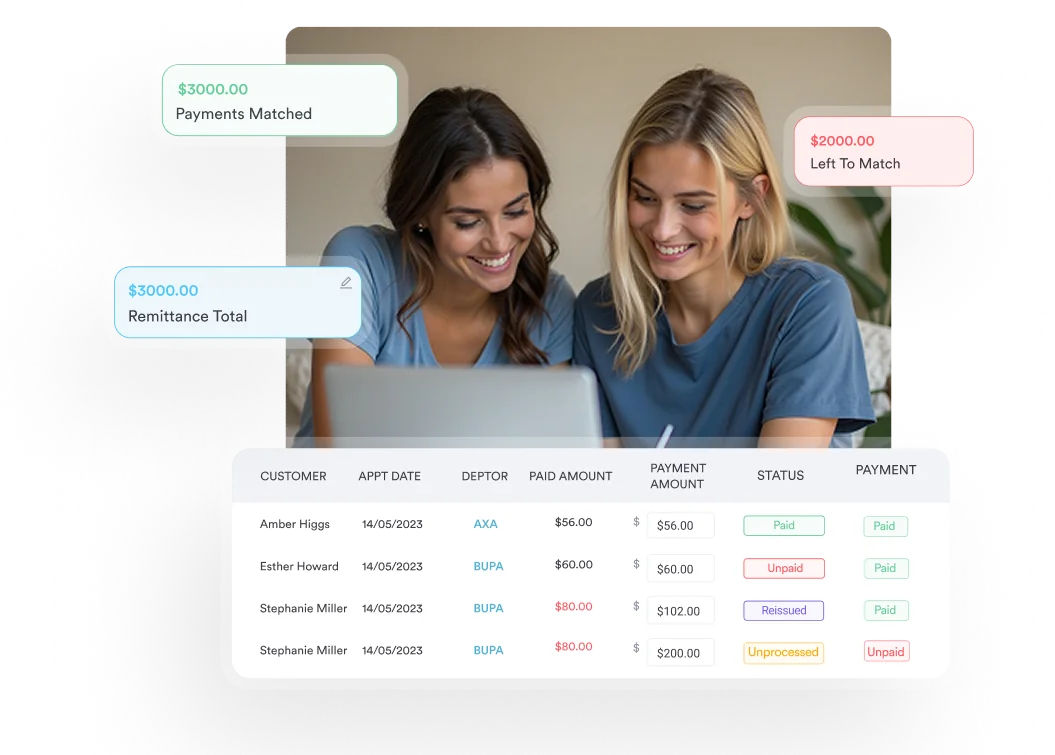

Pabau builds claims from the patient’s invoice and sends them with supporting documents attached. Your team spends less time passing paperwork between clinical and billing staff.

Treat S0136 as a non-Medicare code from the first conversation with the patient. Once the payer route is settled, the rest is arithmetic and records. That means milligrams over 25, a matching NDC and a linked diagnosis.
With the REMS gone, attention shifts to prior authorization and audit-ready charts. Keep ANC results filed on schedule, because clinicians and payers still look for them.
If clozapine billing still runs across separate systems, closing those handoffs is the next step. Book a demo to see how Pabau sends psychiatric claims with the right documents attached.

Want fewer clozapine denials? Denial management in healthcare shows how to build checks into billing before claims go out.
Comparing claims tools for psychiatric billing? Claims management software explains how Pabau builds and submits claims from the patient record.
Coding the diagnosis line? ICD-10 code F20.9 explains how to report unspecified schizophrenia on a claim.
Preparing for a billing audit? Medical billing compliance covers what auditors check and how to document it.
Private insurers and Medicaid programs use S codes for drugs and services that lack a national code. Medicare does not pay them. Each payer decides which S codes it accepts, so check its billing manual first.
Status I means not payable by Medicare. CMS assigns it in the HCPCS file to codes Medicare does not pay. Check the latest CMS HCPCS release, because a code’s status can change in a quarterly update.
Yes. S0136 describes clozapine by strength, not by brand or manufacturer. The NDC on the claim identifies the specific product, so it must match the package dispensed.
The descriptor names only the drug and its strength, so units are counted in 25 mg increments. Payers differ on which NDCs they accept under S0136, so confirm before billing other forms.
Yes. S0136 remains in the HCPCS code set. S codes are temporary, though, and CMS can revise or delete them. Check the current CMS HCPCS release before each new year of claims.