CCSD code H4430: Examination of rectum under anaesthetic
CCSD code H4430 pays for the examination alone CCSD code H4430 is the UK private...

Last Updated: Oct 20, 2026
P9019 is the HCPCS Level II code for platelets, each unit.
Clinically, one unit of platelets typically represents a single donor unit from a whole blood donation. Bills submitted under P9019 reflect the number of units transfused. Each unit is reported as its own line item, or the unit count is stated on the claim.
Let Pabau's smart automation suggest the right codes, reduce claim denials, and keep your practice compliant—effortlessly.
Automate repetitive tasks and focus on what matters most—your patients.
Reduce coding errors and ensure compliance with the latest regulations.
Clean claims, fewer denials, and faster reimbursements.
Powerful insights and reporting to help your practice thrive.
HIPAA compliant SOC 2 certified GDPR-compliant Trusted by 4,000+ clinics worldwide

HCPCS code P9019 describes Platelets, each unit, a Permanent National Level II code for standard platelet transfusions.
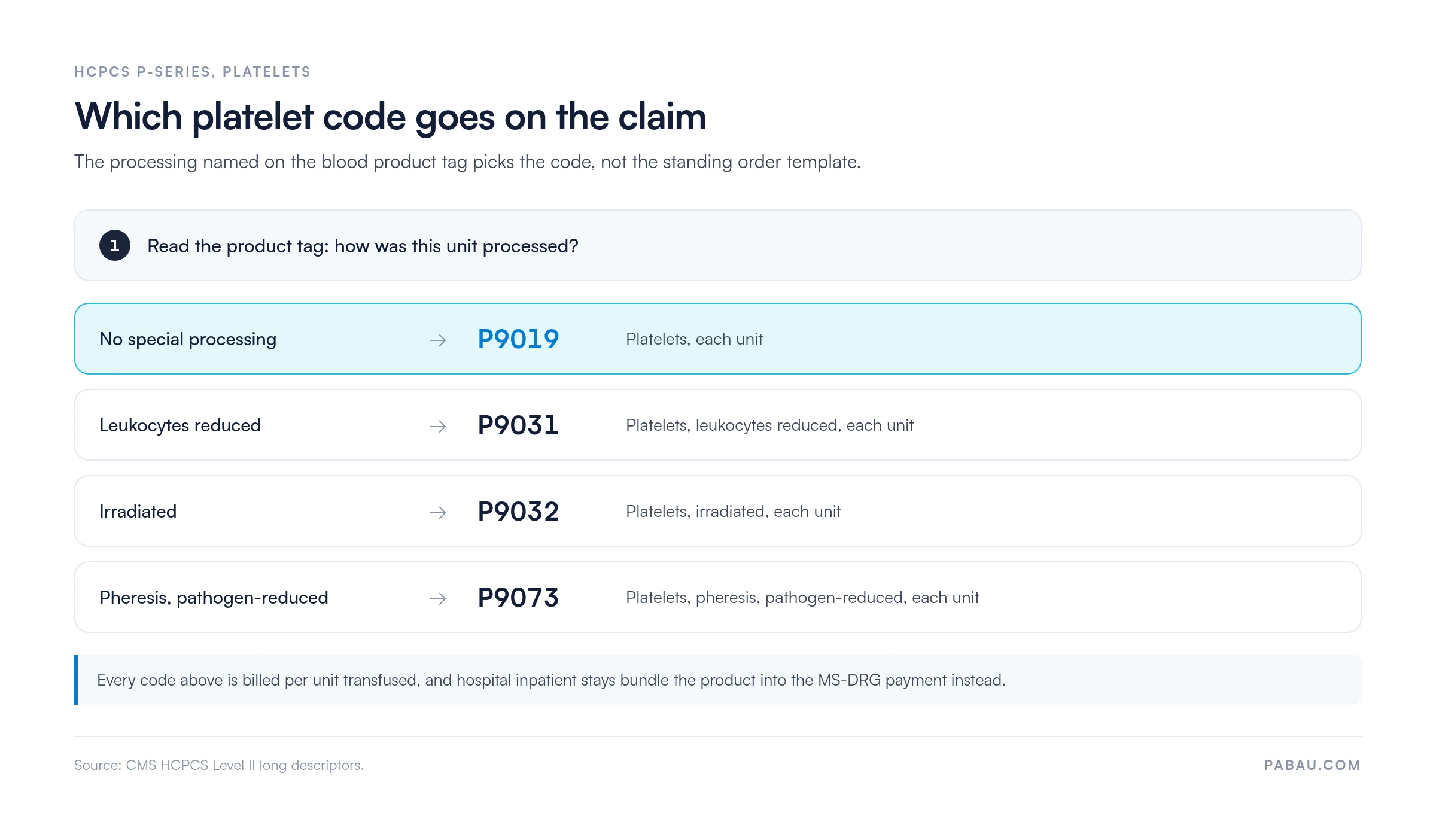
Standard means the unit was not irradiated, leukoreduced, or pathogen-reduced before it reached the patient.
P9019 is billed per unit in hospital outpatient settings under OPPS, and its APC assignment changes with each annual CMS update.
Use P9032, not P9019, for irradiated platelets. Picking the wrong product code is the most expensive platelet billing error.
Practice management software like Pabau ties the transfusion record to the claim, which cuts the incomplete-record denials that hit blood product billing.
The P-series of HCPCS Level II covers blood, blood derivatives, and related products. P9019 sits alongside several closely related codes, each describing a distinct platelet product. Selecting the right code depends on the clinical characteristics of the product transfused, not billing preference.
Donor source separates two of these codes. HCPCS code P9020 covers platelet rich plasma drawn from the patient, while P9019 is an allogeneic donor product.
Collection method separates another pair of platelet codes. A leukoreduced unit collected by apheresis is billed as P9035, not as P9019 or P9031.
According to the Association for the Advancement of Blood and Biotherapies (AABB), documentation must support the specific product type transfused. Billing P9019 for a leukoreduced or irradiated product is a coding error that can trigger audits and recoupments.
The distinction between P9019 and P9032 is clinical, not administrative. Irradiation is ordered when a patient faces risk of transfusion-associated graft-versus-host disease (TA-GvHD), typically immunocompromised patients, bone marrow transplant recipients, and certain neonatal cases. When a physician orders irradiated platelets, P9032 is the correct code.
Always pull the transfusion order before selecting a platelet code. If the order reads ‘irradiated’ or ‘leukoreduced,’ the product carries special processing and P9019 is wrong. Route those claims to P9032 or P9031 respectively, and document the clinical justification.
P9019 is primarily a hospital outpatient code. Understanding where it applies, and where it does not, prevents place-of-service errors that payers catch immediately.
Under OPPS, CMS assigns each HCPCS code to an Ambulatory Payment Classification (APC) group. The APC determines the payment rate for hospital outpatient claims. For HCPCS code P9019, the APC assignment falls within the blood and blood product payment groupings, which CMS updates annually in the OPPS final rule.
Because APC assignments and payment rates change each calendar year, the figures below reflect the 2026 structure as published. Confirm current rates against CMS OPPS Addendum B before submitting claims.
Payer-specific rate differences add up quickly for a facility billing blood products at volume. Compare each remittance against the APC rate you expected. Allowed amounts that land consistently below it point to a contract review, or to an appeal on the individual claim.
Modifier selection for HCPCS code P9019 is governed primarily by CMS drug and biological wastage policy. Blood products are subject to the same wastage reporting rules as other separately payable HCPCS products under OPPS.
CMS wastage policy for blood products has specific nuances that differ from pharmaceutical wastage rules. Verify current instructions in the applicable CMS HCPCS and OPPS guidance documents before applying JW or JZ to platelet claims. MAC-specific local policies may also apply.
Medicare requires documentation that supports both medical necessity and accurate unit counting on every P9019 claim. Incomplete records are one of the top reasons blood product claims get rejected, which makes denial management a documentation job first.
No single National Coverage Determination (NCD) governs all platelet transfusions. Coverage is instead governed by Local Coverage Determinations (LCDs) issued by each Medicare Administrative Contractor (MAC). Each LCD names the ICD-10-CM diagnosis codes that support a covered platelet transfusion in that MAC’s jurisdiction. Always cross-reference the applicable LCD before submitting claims in a new region.
Store those records so they can be produced quickly during an audit. A P9019 claim that cannot be evidenced within the payer’s response window is a recoupment waiting to happen, however sound the underlying transfusion was.
State Medicaid programs handle P9019 billing independently of Medicare. Medi-Cal, California’s Medicaid program, maintains its own fee schedule for blood and blood products, which may differ from the Medicare OPPS APC rate. Billing staff in California should verify current rates through the Medi-Cal provider portal directly, rather than assuming the Medicare figure carries across.
Other state Medicaid programs similarly set their own fee schedules and coverage criteria. The core documentation requirements (physician order, diagnosis, units transfused) generally apply across programs, but reimbursement rates and prior authorization policies vary. Meeting one payer’s clean-claim rules does not guarantee the next payer accepts the same submission. Always verify program-specific policies before billing.
Platelet billing errors cluster around five predictable mistakes, and the first one is settled by the product tag. The chart below shows how that tag routes each unit to its code.
A pathogen-reduced unit carries its own code. P9073 covers pheresis platelets treated for pathogen inactivation, and billing those units as P9019 repeats the wrong-product error.
Connecting clinical documentation directly to billing submission is what cleaner claims management looks like in practice. A system that flags a missing modifier or an unsupported diagnosis before submission catches most of these errors while the transfusion record is still open. Capturing product type, unit count, and diagnosis at the point of transfusion removes the rest.
Most P9019 errors start as a hand-off. The transfusion details sit in one record, the claim is built in another, and someone retypes the unit count between the two. Nobody re-reads the product tag at that point, which is exactly when an irradiated unit gets billed as standard.
Pabau is practice management software that keeps clinical documentation and billing in the same system. Product details, unit counts, and the supporting diagnosis are captured once, at the point of care. The claim is then built from those fields instead of a rekeyed summary.
That same connection protects the claim during an audit. The record behind each billed unit is already attached. A payer request is answered in minutes, not after a week of chasing paper between departments.

Pabau links clinical documentation to billing in one system. Product details, unit counts, and supporting diagnosis codes are captured at the point of care.

P9019 is a simple code with an unforgiving input. Get the product tag right and the rest of the claim follows. Get it wrong and no modifier, diagnosis, or appeal will save the line. The judgment worth carrying is that platelet coding lives or dies on the documentation, long before anyone builds the claim.
Fix the capture step and the denial rate follows it down, because the biller stops guessing at what the blood bank recorded. Book a demo to see how Pabau keeps product details, unit counts, and diagnoses on the claim.

Need to understand how claims move from submission to payment? Medical billing fundamentals explains the full claims lifecycle from code capture to remittance.
Struggling with denied blood product claims? Denial management in healthcare covers how to identify, appeal, and prevent the most common denial patterns.
Want the claim accepted on first submission? What a clean claim is sets out the fields a payer needs before it will pay without a query.
Building the charge document at the point of care? The superbill explained walks through the fields that carry a procedure from the record to the claim.
Checking what the payer paid against what you billed? Electronic remittance advice explains how to read each remittance line against the rate you expected.
HCPCS code P9019 is a Permanent National HCPCS Level II code that describes Platelets, each unit. It is used to bill for standard platelet transfusion products in eligible care settings, primarily hospital outpatient departments under the Medicare OPPS.
P9019 covers standard, unprocessed platelets. P9032 covers irradiated platelets, where the irradiation prevents transfusion-associated graft-versus-host disease in immunocompromised patients. The correct code depends on the product ordered and administered, not on the clinical setting.
P9019 is billed per unit administered. If a patient received three units of standard platelets, the claim should reflect three units of P9019. The transfusion record is the authoritative source for unit count.
The JW modifier (drug amount discarded or not administered) and JZ modifier (zero drug discarded) apply to P9019 under CMS wastage reporting policy. Always confirm current CMS MLN guidance before applying these modifiers, as policy details have been updated in recent years.
Billing P9019 in a physician office is uncommon and depends on whether the facility purchased and administered the platelet product directly. Most P9019 claims originate in hospital outpatient departments. Verify payer-specific requirements before submitting physician office claims for platelet transfusions.
Yes, Medicare covers P9019 for hospital outpatient platelet transfusions when medical necessity criteria are met. Coverage is governed by MAC-issued Local Coverage Determinations (LCDs). Each one names the ICD-10-CM diagnosis codes that support a covered transfusion. Always cross-reference the applicable LCD for your MAC jurisdiction before submitting.