CCSD code H4430: Examination of rectum under anaesthetic
CCSD code H4430 pays for the examination alone CCSD code H4430 is the UK private...

Last Updated: Oct 20, 2026
M1004 is the HCPCS Level II code for a documented medical reason not to screen for TB before biologic therapy begins. It also covers a documented reason for leaving the screening results uninterpreted. Only two situations qualify. The patient is already positive for TB with documentation of past treatment, or the patient recently completed a course of anti-TB therapy.
The code belongs to MIPS quality measure #176, tuberculosis screening prior to a first course of biologic or immune response modifier therapy. As the measure's denominator exception, it carries no payment. M1003 reports screening done and interpreted, and M1005 reports screening not done with no reason given.
Let Pabau's smart automation suggest the right codes, reduce claim denials, and keep your practice compliant—effortlessly.
Automate repetitive tasks and focus on what matters most—your patients.
Reduce coding errors and ensure compliance with the latest regulations.
Clean claims, fewer denials, and faster reimbursements.
Powerful insights and reporting to help your practice thrive.
HIPAA compliant SOC 2 certified GDPR-compliant Trusted by 4,000+ clinics worldwide

M1004 is the denominator exception code for MIPS quality measure #176, tuberculosis screening before a first course of biologic therapy.
Only two medical reasons qualify, a positive TB history with documented past treatment or a recently completed course of anti-TB therapy.
The code is non-payable at $0.00, and it belongs on professional claims for eligible clinicians rather than institutional claims.
The MIPS adjustment it feeds lands on Medicare Part B payments two years after the performance year, not the following one.
Practice management software like Pabau pre-fills claims from the patient record, checks the required fields, then sends them to your clearinghouse.
HCPCS code M1004 records a documented medical reason for not screening a patient for TB, or for leaving an existing screening result uninterpreted.
The Centers for Medicare and Medicaid Services (CMS) maintains it in the HCPCS Level II M-code series. The official long descriptor reads: Documentation of medical reason for not screening for tb or interpreting results.
The parenthetical that follows the descriptor names the only two situations that qualify.
The M1000 series is the HCPCS Level II block set aside for MIPS quality reporting rather than billable procedures. Code publishers group M1003, M1004 and M1005 together as the TB screening codes, inside the wider M1003-M1070 screening procedures range.
All three report on a single quality measure. That measure is MIPS #176, tuberculosis screening prior to a first course of biologic or immune response modifier therapy. None of them works as a general exception code for another measure.
Verify M1004 against the current-year CMS HCPCS release file before it goes on a live claim. HCPCS codes are updated annually, so a code that was valid last year may not be valid this year.
The AAPC HCPCS code lookup gives a quick cross-reference, though the CMS Alpha-Numeric file stays the authoritative source for every HCPCS Level II code.
With those attributes settled, the question that decides most claims is which patients the code covers.
M1004 applies to one measure, and only to patients inside that measure’s denominator. Measure #176 counts patients aged 18 and older who are starting a first course of biologic or immune response modifier therapy. The clinician screens for TB, or interprets an existing result, in the 12 months before that therapy begins.
None of the three works as a general-purpose exception. This range holds no all-measure medical reason M-code, so M1004 cannot stand in for a contraindication under a different quality measure. Reporting it for a patient who is not starting first-course biologic therapy puts the wrong case into the measure.
The measure is also not limited to rheumatoid arthritis. Its pre-2022 title named RA, which is where the narrower reading comes from. CMS now lists measure #176 in the specialty measure sets for dermatology, family medicine, infectious disease, internal medicine and rheumatology.
The code you report changes the measure’s arithmetic, not the payment on the claim. MIPS, the Merit-based Incentive Payment System, is the CMS payment adjustment program that sits under the Quality Payment Program.
Quality and cost each carry 30% of the MIPS final score under current CMS weights, and measure #176 reports into the quality category.
M1003 is the performance met code, so it lands in the numerator. M1005 is performance not met, and it counts against the performance rate. M1004 is the denominator exception, which lifts the case out of the performance rate calculation instead of scoring it either way.
That difference bites hardest on a small denominator. Take a practice that starts 20 patients on biologic therapy in a year. Coding two qualifying exceptions as M1004 shrinks the denominator to 18, so neither case drags the reported rate down.
Pull the current-year specification for MIPS measure #176 before you code the encounter. It defines the denominator, the 12-month screening window, and the documentation each of the three codes needs. M1004 is valid only inside that measure, so checking whether another measure accepts it is wasted effort.
Documentation decides the outcome on an M1004 line. The chart has to name which of the two qualifying situations applies, at the encounter where biologic therapy starts.
Five elements carry the code:
The superbill used at the encounter should carry a field for the measure #176 code, so the reason is captured at the point of care. Rebuilding it from the chart weeks later invites the wording problems behind most rejections.
The three codes are not interchangeable. Each one reports a different outcome for the same measure, and each needs different documentation. The table below shows what each code says about the encounter.
The decision rule is short. Screened and interpreted inside the window is M1003. A qualifying TB history that makes screening unnecessary is M1004. Every other case, including a screening that was simply never done, is M1005.
A worked example makes the split clearer. Take a rheumatology patient who tested positive for TB in 2019 and finished a nine-month course of isoniazid. The note records both facts, and the clinician now starts adalimumab. That encounter is M1004, because the past treatment is documented.
Reporting M1003 because the chart is thin is a compliance risk. CMS cross-references quality codes against the medical record, and a mismatch is treated as a performance data integrity failure.
HCPCS code M1004 carries a $0.00 Medicare fee schedule value, so no payment posts against the line. That is by design, since the code reports quality performance rather than a billable service. CMS’s Physician Fee Schedule lookup shows a non-payable status for M-series quality reporting codes.
Commercial payers handle M-codes inconsistently. Most follow Medicare and treat them as informational codes with no payment attached. Some do not recognize HCPCS M-codes at all, and reject the line rather than ignore it. Submit once to a new payer, then read the remittance advice to see whether the code caused a line-level rejection.
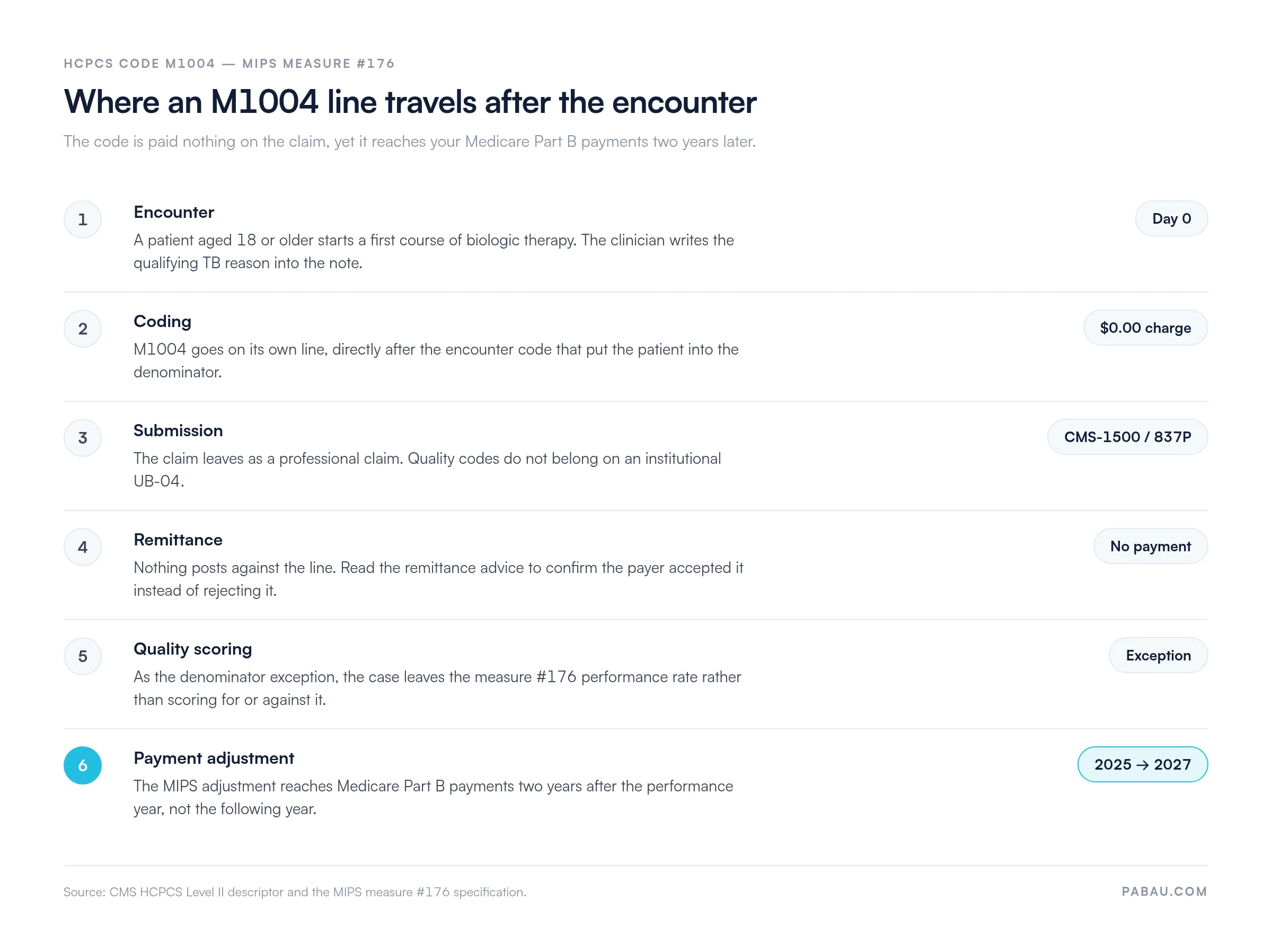
The MIPS payment adjustment that measure #176 feeds into is applied two years after the performance year. Performance in 2025 therefore reaches Medicare Part B payments in 2027. That adjustment reflects the whole reporting period rather than one code on one claim.
Billing teams tend to misjudge that lag, so it helps to see where an M1004 line goes after the encounter.
M1004 problems cluster around a few predictable failure points, and each one has a clear corrective action. Catching them before the claim leaves the practice is far cheaper than reworking the quality data later.
A short pre-submission check catches most of these. Before the claim goes out, confirm four things.
Run a quarterly sample of the encounters where M1004 was reported. Read the note beside the claim and check that a positive TB history, or a completed course of anti-TB therapy, is written out in full. A small sample shows quickly whether the wording holds up.
Reporting M1004 correctly is mostly a clerical problem. The clinical decision was already made at the encounter. What remains is getting the right code onto the right claim line, with the encounter code beside it.
Pabau, practice management software for medical and aesthetic practices, builds the claim from the patient record rather than from a separate billing form. Encounter details, patient data and treatment notes pre-fill the claim, so the billing team is not retyping what the clinician already wrote.
A built-in code lookup library sits beside the claim. Whoever is coding can search for M1004 and drop it onto its own line. Required-field checks then flag an incomplete claim before submission, which keeps an M1004 line from going out without its encounter code.
Those checks read claim completeness rather than whether the note supports the code, so the attestation review stays with your billing or compliance lead. Pabau’s claims management software then sends the finished claim on to your clearinghouse. Claims leave the same system the patient record lives in.


Pabau pre-fills claims from the patient record, checks the required fields before submission, and sends them on to your clearinghouse. Your team codes from the note instead of rebuilding it.

M1004 belongs to one measure and one clinical question. It reports that TB screening was skipped before a first course of biologic therapy, for a documented medical reason. That reason is either a positive TB history with documented past treatment, or a recently completed course of anti-TB therapy.
Treating M1004 as a general medical-reason exception for any MIPS measure is the error worth unlearning. Code it accurately and the measure reports what your clinicians did. Code it loosely and a well-documented exception scores as a miss two years before the money moves.
Pabau keeps the code, the encounter and the note in one record, so quality lines leave the practice complete. Book a demo to see how that fits your billing workflow.

Coding the other outcome on measure #176? HCPCS code M1005 covers screening that was never performed, or results left uninterpreted, with no reason recorded.
Chasing rejected claim lines? Denial management in healthcare sets out how to triage, appeal and prevent the denials that follow coding errors.
Want claims to pass at first submission? Clean claim explains what a payer checks before it accepts a claim without edits.
Reading remittances line by line? Electronic remittance advice shows how to spot a rejected reporting line among the paid ones.
Mapping the whole billing cycle? Revenue cycle management walks through each stage, from patient registration to posted payment.
No. It covers patients aged 18 and older starting a first course of biologic or immune response modifier therapy. CMS lists it in the specialty measure sets for dermatology, family medicine, infectious disease, internal medicine and rheumatology. The pre-2022 title named rheumatoid arthritis, which is where the narrower reading comes from.
No. M1004 carries a $0.00 Medicare fee schedule value and is non-payable. The financial effect is indirect, through the MIPS payment adjustment. That adjustment lands on Medicare Part B payments two years after the performance year.
No. Only the two medical reasons named in the descriptor qualify. A refusal is neither of them, so the encounter is reported with M1005 as performance not met.
No. The medical reason sits inside the code itself, so no exception modifier is appended. Report M1004 on its own line after the encounter code, at a $0.00 charge.
M1004 is a HCPCS Level II code, not a CPT code. CMS maintains the M1000 series for MIPS quality reporting, which is why the code carries no fee schedule value.