CCSD code H4430: Examination of rectum under anaesthetic
CCSD code H4430 pays for the examination alone CCSD code H4430 is the UK private...

Last Updated: Oct 20, 2026
M1005 is the HCPCS Level II code for tb screening not performed or results not interpreted, reason not given.
The full CMS descriptor is Tb screening not performed or results not interpreted, reason not given.
That second half of the descriptor gets dropped often, and it changes what the code means. An ordered test with no interpretation in the chart still lands on M1005. So does a test that was never ordered at all.
M1005 is a quality data code, or QDC. It reports performance on quality measure 176 in the Merit-based Incentive Payment System, known as MIPS.
The measure's full name is Tuberculosis Screening Prior to First Course of Biologic and/or Immune Response Modifier Therapy. CMS maintains M1005 in the HCPCS Level II M-code range, next to M1003 and M1004.
This is not a general preventive screening code, and no HEDIS measure uses it. It applies only when a patient is starting a biologic or an immune response modifier for the first time. That trigger decides whether the code belongs on the claim at all.
Let Pabau's smart automation suggest the right codes, reduce claim denials, and keep your practice compliant—effortlessly.
Automate repetitive tasks and focus on what matters most—your patients.
Reduce coding errors and ensure compliance with the latest regulations.
Clean claims, fewer denials, and faster reimbursements.
Powerful insights and reporting to help your practice thrive.
HIPAA compliant SOC 2 certified GDPR-compliant Trusted by 4,000+ clinics worldwide

HCPCS code M1005 is a CMS quality data code, not a payable service code. Its full descriptor is “Tb screening not performed or results not interpreted, reason not given.”
M1005 belongs to MIPS quality measure 176, tuberculosis screening before a first course of biologic or immune response modifier therapy. It is not a HEDIS code and not a general preventive screening code.
The code only applies to a patient starting a biologic or immune response modifier for the first time. Latent TB can reactivate once that therapy suppresses the immune system.
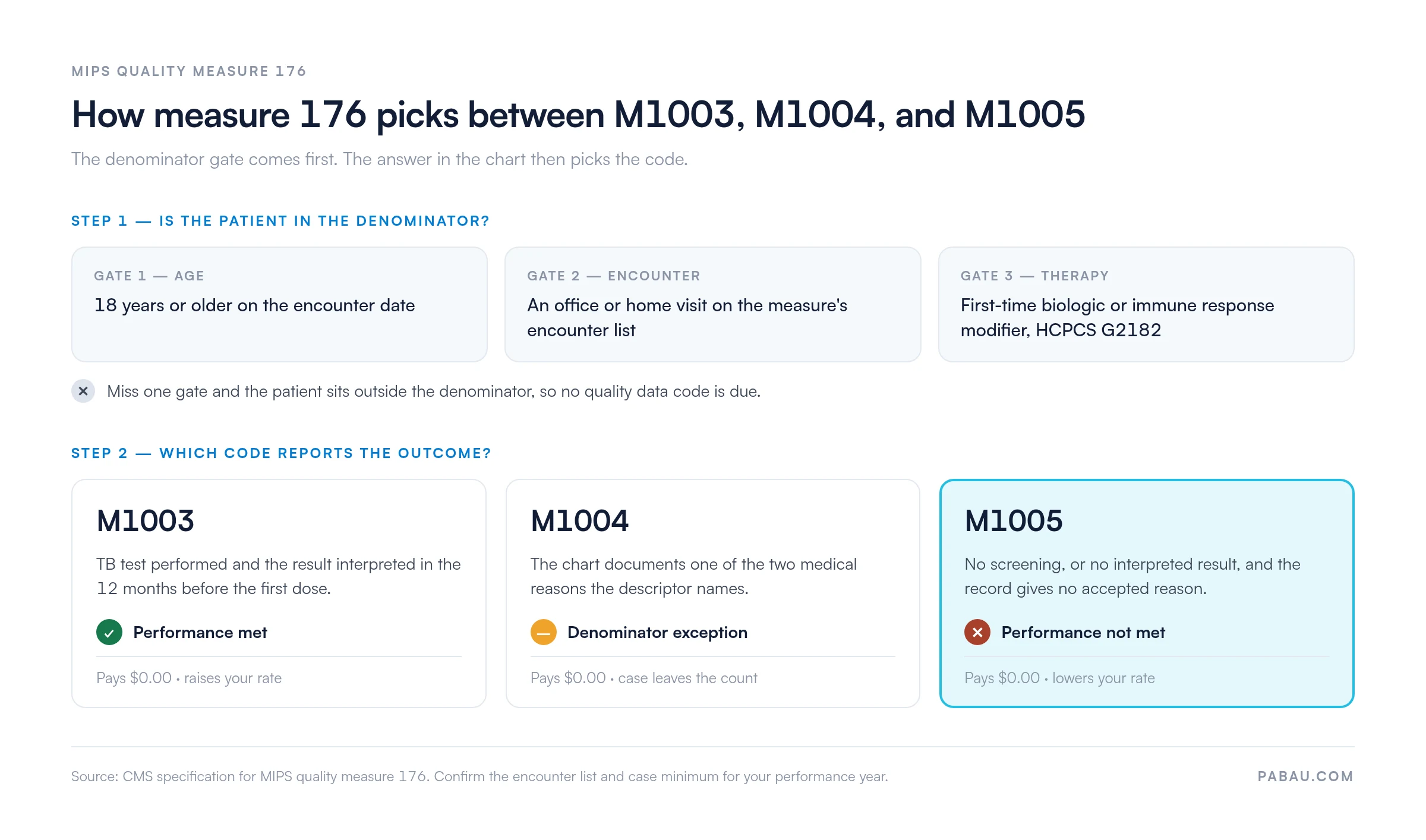
Report M1003 when screening was done and the results were interpreted within the prior twelve months. Report M1004 for a documented medical reason, and M1005 when no reason is given.
M1005 pays nothing and records performance not met, which pulls down your score on measure 176. Practice management software like Pabau helps your team capture the interpreted result at the point of care, so the right code goes out.
The table below covers the administrative attributes of HCPCS code M1005. Verify active status against the latest CMS HCPCS annual release files. Check the measure itself against the current-year specification, which CMS publishes through its quality measures resources and the Quality Payment Program resource library.
Biologics and immune response modifiers suppress the immune response that keeps a latent TB infection dormant. Once that suppression starts, a dormant infection can reactivate. Research has documented a higher incidence of TB after therapy that blocks tumor necrosis factor alpha. That is why the labels on those drugs carry a reactivation warning.
Measure 176 turns that warning into a reportable step. If a clinician newly prescribes one of these drugs, the record should show TB testing in the preceding twelve months. Most of that work sits with rheumatology, dermatology, and gastroenterology, where TNF inhibitors are routine.
Measure guidance is deliberately broad on who gets tested. Every patient being considered for a biologic or immune response modifier should be screened, including patients who previously received the BCG vaccination. A prior BCG shot is not a reason to skip the test, and it is not a documented exception under M1004.
You only report M1003, M1004, or M1005 for a patient the measure actually counts. Three conditions have to line up: age, an eligible encounter, and a first-time biologic prescription. Miss one and the patient is outside the denominator, so no QDC is due.
A patient who has been on a TNF inhibitor for three years is not a measure 176 case. Neither is a patient who gets a TB test at an annual physical with no biologic in sight. The prescription is what opens the denominator.
Picking the wrong code in this range is the most common measure 176 reporting error. Each code maps to one performance outcome, and the scoring engine treats them very differently. The table below carries the full CMS descriptors, not the shortened versions that circulate in billing notes.
M1004 is narrower than it looks. A patient refusal is not one of the two examples in its descriptor. Neither is a scheduling problem, a lab backlog, or a patient who simply never came back for the test.
So M1005 is the code you report when the chart is silent. It is also the code when the only documented reason is one the measure does not accept. Read the current-year specification before you treat any other note as an exception. The chart below puts the denominator gate and the code choice on one path.
Run a monthly report of every patient with a G2182 line and no M1003 next to it. Those are your measure 176 misses while you can still fix the documentation. Chasing them after the submission deadline only tells you what the score will be.
Measure 176 asks for two entries in the chart, the test and its interpretation. A lab order alone does not satisfy it. Before a coder reports M1003 instead of M1005, the record should carry each of the items below.
Structured documentation keeps these fields in one place. A free-text note buried in a scanned PDF is technically documentation, but no coder will find it in time.
Reporting the code correctly starts with the submission mechanics. The rules below apply to Medicare claims-based reporting of measure 176. Registry submission follows the same clinical logic through a different pipe.
HCPCS code M1005 pays nothing. Quality data codes carry no relative value units and no payment amount on the CMS Physician Fee Schedule. All three codes in the range behave the same way.
The money shows up one step later. Your performance rate on measure 176 feeds the MIPS quality category. The final MIPS score then sets a positive, neutral, or negative adjustment on future Medicare payments. So M1005 is a scoring event rather than an accounts receivable event.
Because the line is non-payable, it should never reach a patient statement as a balance. If M1005 shows up on a patient ledger, fix the posting rule that put it there.
Measure 176 is not defined by diagnosis, so there is no official ICD-10 crosswalk for M1005. The diagnosis on the claim is whatever condition the biologic is being prescribed for. These are the codes that turn up most often on those encounters.
One code that does not belong here is Z11.1, encounter for screening for respiratory tuberculosis. It describes a preventive screening visit, which is a different scenario from measure 176. Pairing it with M1005 signals a screening encounter that the measure never asked for.
Accurate diagnosis pairing keeps the claim consistent with the note behind it. Confirm every code against the current fiscal year tabular list before you submit, using the CMS ICD-10-CM code files.
Most M1005 lines land on patients who were screened. The care happened, and the chart failed to record it in the way the measure asks for. These five patterns account for the bulk of them.
Reviewing these patterns belongs in the same routine as your denial review. Both look for a repeatable process defect, then close it before the next reporting cycle.
Audit five M1005 charts by hand each quarter. Label each one by root cause. Was the patient never screened, never interpreted, screened outside the window, or was the reason never abstracted? The mix tells you whether to fix the clinical workflow or the documentation workflow.
M1005 belongs to one measure, and that measure sits inside the Medicare quality programs listed below. Knowing which one applies to you tells you where the code actually lands.
M1005 is not a HEDIS code. The Healthcare Effectiveness Data and Information Set, known as HEDIS, holds no latent TB screening measure that uses the M1003 to M1005 range. That set belongs to the National Committee for Quality Assurance, not to CMS. If a payer asks you for HEDIS TB screening data, ask which measure they mean.
The M1005 problem is a timing problem. The prescription, the test, and the interpretation happen at three separate moments, and the patient record is the only place they can meet. Practice management software like Pabau closes that loop at each step.
The outcome is a measure 176 rate you can stand behind. The interpreted result sits in the record, and the reason field offers only what the descriptor accepts. The code that goes out then matches the care that happened.

Pabau’s claims management software helps your team capture the TB screening result and record who interpreted it. The right quality data code then goes out with the claim. Book a demo to see it on your own workflow.

HCPCS code M1005 reports one specific failure, and it is narrower than its reputation. A patient was starting a first course of biologic or immune response modifier therapy.
TB screening was not performed, or the results were never interpreted, and no accepted reason was documented. That is MIPS quality measure 176, not a general preventive screen and not a HEDIS measure.
Report the code honestly when it applies, then work on the reason it applied. Most M1005 lines trace back to an uninterpreted result or a reason nobody wrote down.
Keep the screening result, the interpretation, and the quality data code in one workflow, and your measure 176 rate reflects the care you gave. To see how that works for your team, book a demo.

Need a medical billing compliance framework? Medical billing compliance covers the rules and documentation standards practices need to meet CMS and payer requirements.
Tracking why claims and quality data come back wrong? Denial management in healthcare explains how to spot, track, and resolve the recurring defects behind both.
HCPCS code M1005 reports performance not met on MIPS quality measure 176. It means TB screening was not performed, or the results were never interpreted, before a first course of biologic therapy. No reason was documented either. It is a quality data code, so it pays nothing.
No. M1005 is a quality data code with no relative value units and no payment amount. Submit the line at $0.00, or at $0.01 if your billing system will not accept a zero charge. The line normally denies with claim adjustment code CO 246 and remark code N620, and it creates no patient balance.
M1003 reports that TB screening was performed and the results interpreted within the twelve months before first-time biologic therapy. M1004 reports a documented medical reason for not screening or not interpreting. Its descriptor limits that to two examples, a patient positive for TB with documented past treatment, or one who recently completed anti-TB therapy. M1005 reports that neither happened and no reason was given.
M1005 is used for MIPS quality measure 176, Tuberculosis Screening Prior to First Course of Biologic and/or Immune Response Modifier Therapy. It is a CMS quality data code, not a HEDIS code. NCQA’s HEDIS measure set does not include a latent TB screening measure that uses the M1003 to M1005 range.
Patients aged 18 or older who are starting a biologic or immune response modifier for the first time. They also need an eligible encounter during the performance period. HCPCS G2182 identifies the therapy trigger. A patient already established on a biologic, or screened for TB at a routine physical, is outside the denominator.
There is no official crosswalk, because measure 176 is defined by therapy rather than diagnosis. The claim carries the condition the biologic treats. Common examples are M06.9 for rheumatoid arthritis, L40.0 for psoriasis vulgaris, and K50.90 for Crohn’s disease. Z11.1 describes a preventive TB screening visit and does not fit this measure.
A previous BCG vaccination does not exempt a patient, and measure guidance still expects screening before therapy. A prior positive result with documented past treatment is different, since the descriptor names it as a medical reason under M1004. Document the result and the treatment history in the chart, then report M1004 rather than M1005.