CCSD code H4430: Examination of rectum under anaesthetic
CCSD code H4430 pays for the examination alone CCSD code H4430 is the UK private...

Last Updated: Oct 20, 2026
L1832 is the HCPCS Level II code for knee orthosis, adjustable knee joints (unicentric or polycentric), positional orthosis, rigid support, prefabricated item that has been trimmed, bent, molded, assembled, or otherwise customized to fit a specific patient by an individual with expertise.
Let Pabau's smart automation suggest the right codes, reduce claim denials, and keep your practice compliant—effortlessly.
Automate repetitive tasks and focus on what matters most—your patients.
Reduce coding errors and ensure compliance with the latest regulations.
Clean claims, fewer denials, and faster reimbursements.
Powerful insights and reporting to help your practice thrive.
HIPAA compliant SOC 2 certified GDPR-compliant Trusted by 4,000+ clinics worldwide

HCPCS Code L1832 covers a knee orthosis with adjustable knee joints (unicentric or polycentric), positional orthosis, rigid support. The device is prefabricated, then customized to fit the patient by an individual with expertise.
L1833 is the off-the-shelf version of the same device, so the fitting requirement decides which of the two codes you bill.
Medicare coverage requires documentation supporting medical necessity under LCD L33318, including a physician order, detailed written order, and proof of delivery.
Reimbursement rates vary by MAC jurisdiction and by competitive bidding area. Verify the 2026 national limitation amount against the current CMS DMEPOS fee schedule before billing.
Practice management software like Pabau keeps the HCPCS documentation chain on one patient record, which reduces audit exposure and claim denials.
HCPCS Code L1832 covers a knee orthosis with adjustable knee joints, a positional orthosis, and rigid support.
The device is prefabricated, then trimmed, bent, molded, or assembled to fit one patient by an individual with expertise. That fitting step is what separates it from L1833, the off-the-shelf version of the same brace.
This reference covers the official descriptor, the Medicare coverage criteria under LCD L33318, and the ICD-10 diagnoses that support medical necessity. It also sets out 2026 fee schedule context, the documentation chain, and the neighboring knee orthosis codes. It is written for medical billers, DME suppliers, and orthopedic practice managers.
The L-series prefix places this code in the HCPCS Level II Orthotic Procedures and Devices section. The Centers for Medicare and Medicaid Services (CMS) maintains it. Unlike CPT codes, HCPCS Level II codes cover supplies, equipment, and orthoses. Those items bill through Medicare and Medicaid rather than a physician fee schedule claim.
Medicare coverage for L1832 is governed by LCD L33318 (Knee Orthoses). That Local Coverage Determination is maintained by the Durable Medical Equipment Medicare Administrative Contractors (DME MACs). Coverage requires demonstrated medical necessity. The orthosis must be ordered by a treating physician and dispensed by a DMEPOS-enrolled supplier. CMS guidance also references Policy Article A52465 for additional coding and documentation rules.
Covered conditions under LCD L33318 include:
Non-covered conditions and limitations:
Medical necessity must be documented at the time of the order, not reconstructed after the fact. Auditors routinely flag L1832 claims where the physician order predates any documented functional assessment. Contemporaneous records, captured before the brace is dispensed, cut that risk sharply.
Pairing L1832 with the correct ICD-10-CM diagnosis code is essential for medical necessity review. The diagnosis code must be documented in the treating physician’s clinical record and reflect the condition requiring the knee orthosis. Only use codes that match the patient’s documented clinical findings per LCD L33318. The codes below are commonly accepted when documentation supports them.
Note that the M23.5- subcategory splits by laterality rather than by ligament. M23.51 is the right knee and M23.52 is the left knee, so the side has to match the knee you braced.
The M23.6- codes carry the same trap. M23.611 describes a spontaneous, non-traumatic disruption of the ACL, so a tear caused by an injury belongs in the S83.5- range instead. Always verify the code against the current LCD L33318 covered diagnosis list before billing. Our ICD-10-CM code reference shows how these diagnosis families are structured.
Reimbursement for L1832 is calculated using the CMS DMEPOS fee schedule. The national limitation amount (NLA) acts as the ceiling for Medicare payment. Paid amounts vary by MAC jurisdiction and by whether the dispensing location falls within a Competitive Bidding Area (CBA). In CBAs, suppliers must be enrolled in the DMEPOS Competitive Bidding Program and accept program prices. Outside CBAs, the NLA applies.
The 2026 fee schedule reflects annual CMS adjustments. Verify current figures against the CMS DMEPOS fee schedule before submitting claims. Rates update annually and vary by state and MAC region. The table below shows the general reimbursement structure.
Suppliers working across several states should check the DMEPOS fee schedule jurisdiction by jurisdiction before finalizing claim amounts. A rate that is correct in one MAC region can be wrong in the next. The difference is rarely large enough to notice on a single claim, but it compounds across a year of dispensing.
Check whether your dispensing location falls within a Competitive Bidding Area before submitting L1832 claims. Billing the national limitation amount inside a CBA without competitive bidding enrollment is a frequent trigger for DMEPOS audits. Verify your MAC jurisdiction and CBA status at the CMS CBIC portal before filing.
Incomplete documentation is the leading cause of L1832 claim denials and post-payment audits. CMS Policy Article A52465 and LCD L33318 specify a documentation chain that must exist before and at the time of dispensing. The orthosis cannot be dispensed and billed before all required elements are in place.
Required documentation for a compliant L1832 claim:
Capture these elements at the point of care rather than assembling them after a denial. Practices billing L1832 regularly should build the checklist into the dispensing workflow. The fitting note then gets written while the fitter still remembers what they adjusted.
L1833 describes the same positional knee orthosis as L1832, supplied off-the-shelf instead of fitted to the patient. The fitting requirement is the only difference between them. So the question that decides the code is who adjusted the brace, and how much expertise that took.
Under CMS Policy Article A52465, L1832 applies when a prefabricated brace is customized for one specific patient. The trimming, bending, molding, or assembly must be done by an individual with expertise. L1833 applies when the same type of brace needs no more than minimal self-adjustment at delivery. Substituting one code for the other is a coding error, and the off-the-shelf rate is the lower of the two.
Neither code is bilateral. CMS Policy Article A52465 treats a single claim line billed RTLT with two units of service as incorrect coding. Bill each knee on its own line with the matching modifier and one unit. Document medical necessity separately for both knees.
Knee orthosis codes split into three fabrication tiers, and picking the wrong tier is the costliest coding error in this family. L1832 sits in the middle tier, prefabricated and then customized for the patient. Two questions about the brace settle the tier, and the diagram below works them in order.
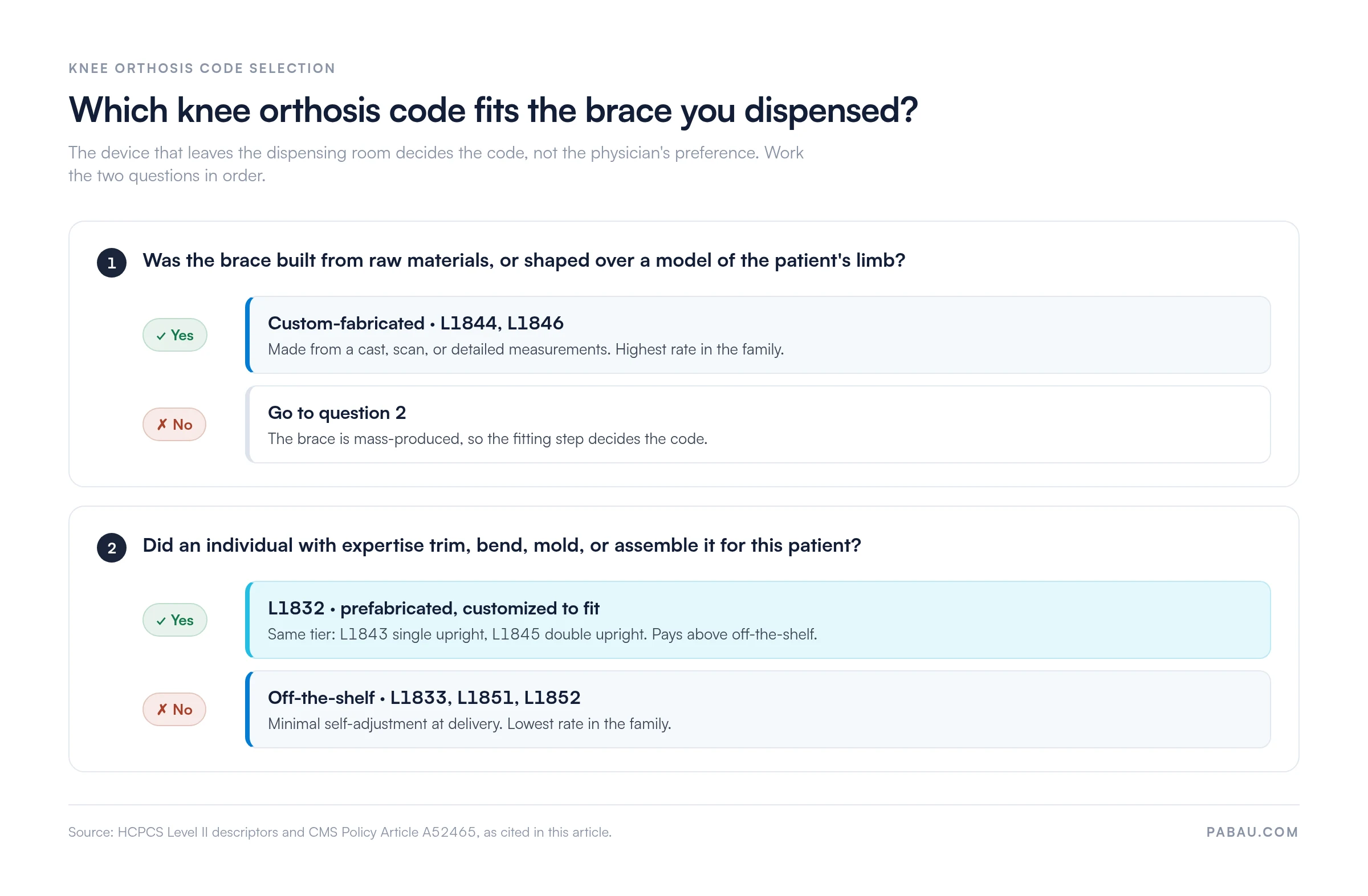
Off-the-shelf (L1833, L1851, L1852): The brace is supplied ready to wear. The patient or caregiver can apply it and make any minor adjustment without help from a fitter.
Prefabricated and customized (L1832, L1843, L1845): The brace is mass-produced, then trimmed, bent, molded, or assembled for one patient by an individual with expertise. That expertise is what separates this tier from off-the-shelf.
Custom-fabricated (L1844, L1846): The brace is built from raw materials or a shell shaped over a model of the patient’s limb. Fabrication takes a cast, scan, or detailed measurements, and it draws the highest rate in the family.
L1840 belongs in that custom-fabricated tier as well. The code covers a derotation knee orthosis with medial-lateral and anterior cruciate ligament control, built from the patient’s own measurements.
When a physician orders a knee orthosis without naming a fabrication tier, the dispensing supplier must document why it supplied that particular product. The product dispensed determines the correct HCPCS code, not the physician’s preference. Practices that regularly dispense functional knee orthoses should keep a written code-selection protocol on file. Fabrication decides the code elsewhere in the L-series too. A supplier that dispenses a prefabricated plastic ankle-foot orthosis runs the same test before billing L1930.
Billing the correct knee orthosis code requires knowing where L1832 sits in the broader HCPCS Level II knee orthosis family. Adjacent codes differ in design, fabrication type, joint configuration, and coverage criteria. The table below is a reference for the most commonly used related codes.
For a searchable reference of the full HCPCS Level II knee orthosis range, use the AAPC HCPCS code reference. Check each descriptor against the current CMS HCPCS file before you bill it. A code that was correct last year may have been revised or retired.
Build a product-to-code crosswalk for every knee orthosis your practice or DME business regularly dispenses. For each device, note the HCPCS code, the fabrication tier, the PDAC verification status, and the RT or LT modifier rule. Auditors check whether the code matches the device dispensed, not what the physician ordered.
HCPCS orthotic billing is audit-prone because the documentation chain spans three parties. The treating physician writes the order and the clinical notes. The dispensing supplier handles fitting, adjustment, and proof of delivery. The billing team owns code selection, modifier application, and claim submission. A breakdown at any point puts the claim at risk.
These are the workflow steps where L1832 claims most commonly fail:
Every one of those failures is a record that was written in the wrong place, or at the wrong moment. That makes it a workflow problem before it is a coding problem.
In most orthopedic practices and DME operations, the pieces of an L1832 claim live apart. The physician order sits in the clinical system, and the fitting note is on paper in the dispensing room.
The delivery slip is in a folder, and the claim itself is in a separate billing tool. Answering a DME MAC request means pulling from four places and hoping the dates line up.
Pabau is practice management software that holds those records together. The physician order, the face-to-face evaluation, the fitting note, and the signed proof of delivery all attach to the same patient record. Pabau’s claims management software then links the submitted claim line, with its RT or LT modifier, back to that record.
The practical outcome is that an audit response becomes one export rather than a hunt. It also means the fitting detail that justifies L1832 over L1833 is captured while the brace is being adjusted. That is the only moment anyone can describe it accurately.

Pabau helps orthopedic practices and DME suppliers capture the documentation that compliant L1832 billing needs. Physician orders, clinical notes, and proof of delivery all live in one place.

L1832 rewards a habit more than a lookup. A supplier who records what was done to the brace, and by whom, at dispensing will pick the right code almost every time.
The trade-off worth remembering is that the higher rate carries the higher burden of proof. Every dollar L1832 pays above L1833 has to be earned by a fitting note an auditor can read. The diagnosis code also has to match the knee you braced.
Build that record once, into the dispensing workflow, and the code stops being a judgment call. Book a demo to see how Pabau keeps orthotic orders, fitting notes, and delivery proof on one claim-ready record.

Dispensing the off-the-shelf version of the same brace? HCPCS Code L1833 walks through the fitting test that separates the two codes.
Billing a single upright thigh and calf brace? HCPCS Code L1843 sits in the same prefabricated, customized tier as L1832.
Fitting a double upright frame instead? HCPCS Code L1845 covers the double upright brace and how it differs from the single upright codes.
Supplying a simpler elastic knee brace? HCPCS Code L1810 covers the elastic knee orthosis with joints, customized to fit by an individual with expertise.
Want the audit rules behind all of this? Medical billing compliance explains the documentation standards payers apply across every code family.
HCPCS Code L1832 covers a knee orthosis with adjustable knee joints (unicentric or polycentric), positional orthosis, rigid support. The device is prefabricated, then trimmed, bent, molded, or assembled to fit a specific patient by an individual with expertise. It sits in HCPCS Level II Orthotic Procedures and Devices and is billed mainly to Medicare and Medicaid.
Medicare reimbursement for L1832 comes from the DMEPOS fee schedule as a national limitation amount (NLA). Rates vary by MAC jurisdiction and by whether the dispensing location sits in a Competitive Bidding Area. Verify the current 2026 NLA using the CMS DMEPOS fee schedule tool before submitting claims, as rates are adjusted annually.
Required documentation starts with a physician order that precedes dispensing. You also need a completed Detailed Written Order with beneficiary name, date, and physician signature. Add face-to-face clinical evaluation notes supporting medical necessity and a signed proof of delivery. PDAC product verification may also be required depending on the specific device dispensed.
L1833 describes the same adjustable positional knee orthosis as L1832, supplied off-the-shelf rather than customized to fit. Bill L1832 when an individual with expertise trims, bends, molds, or assembles the brace for the patient. Neither code is bilateral, so two knees means two lines with RT and LT, one unit each.
Submit two claim lines, one with the RT modifier and one with LT, at one unit of service each. CMS Policy Article A52465 treats a single line billed RTLT with two units as incorrect coding. Each knee also needs its own medical necessity documentation in the record.
Under LCD L33318, L1832 requires a documented condition such as ligamentous laxity or instability. Post-surgical stabilization needs and symptomatic joint instability causing functional limitation also qualify. Prophylactic use without documented functional impairment does not meet Medicare’s coverage criteria.
In Competitive Bidding Areas (CBAs), only suppliers enrolled in the competitive bidding program may bill L1832. They must accept the competitive bidding rate as payment in full. Outside CBAs, the national limitation amount applies. Billing the NLA inside a CBA without competitive bidding enrollment is an audit trigger and may result in claim denial or recoupment.