



CCSD code G5100: Bypass of duodenum billing guide
CCSD code G5100 bills a bypass that leaves the duodenum in place CCSD code G5100...

Last Updated: Oct 16, 2026

CPT Code 00635 reports anesthesia services for diagnostic or therapeutic lumbar puncture procedures under the spine and spinal cord anesthesia section.
The code carries 4 ASA-assigned base units. Medicare pays base units plus time units, while ASA RVG and commercial-payer formulas may also add physical status modifier units before applying the conversion factor.
Missing or incorrect modifiers (AA, QK, QS, P-modifiers) are the most common reason claims for CPT Code 00635 are denied.
Practice management software like Pabau captures structured pre-anesthesia intake data and keeps clinical documentation tied to the patient record, supporting the audit-ready recordkeeping anesthesia billing requires.
CPT Code 00635 reports anesthesia for diagnostic or therapeutic lumbar puncture. It carries its own base unit value, modifier requirements, and documentation standards, distinct from other spinal anesthesia codes. Getting the descriptor, base units, and modifiers right from the first submission is what keeps a claim out of the rework queue.
This guide covers the official code descriptor, the base units and reimbursement formula, and the modifiers required on every claim. It also walks through Medicare fee schedule context and the ICD-10 codes that support medical necessity. It closes with the documentation anesthesia billing teams need to keep on file.
Anesthesia claims for lumbar puncture generate a disproportionate share of modifier-related denials. CPT Code 00635 is the correct reporting code when an anesthesia provider administers anesthesia for a diagnostic or therapeutic lumbar puncture. Getting the modifiers and documentation right from the start keeps the claim out of a multi-week rework cycle.
According to the American Medical Association (AMA), CPT Code 00635 falls within the anesthesia section covering procedures on the spine and spinal cord. The official code description reads: Anesthesia for procedures in lumbar region; diagnostic or therapeutic lumbar puncture. Both diagnostic and therapeutic lumbar punctures fall under this single code. Diagnostic lumbar punctures are spinal taps performed to analyze cerebrospinal fluid, while therapeutic punctures relieve elevated intracranial pressure. The procedure may be performed by a physician anesthesiologist or a Certified Registered Nurse Anesthetist (CRNA), each billing with different modifier sets.
CPT Code 00635 sits in the parent code grouping for lumbar region anesthesia, alongside adjacent codes 00630 and 00640. Coders should confirm the specific procedure documented before selecting among this family. Lumbar puncture has its own dedicated code rather than mapping to adjacent spinal anesthesia codes.
Anesthesia reimbursement does not work like standard fee-for-service codes. Medicare’s formula combines base units assigned by the American Society of Anesthesiologists (ASA) with time units based on intraoperative duration. ASA RVG and most commercial-payer formulas add a third component: physical status modifier units that reflect patient complexity. The same three-part formula applies across the anesthesia code family.
CPT Code 00635 carries 4 ASA-assigned base units. Medicare and most commercial payers calculate the payment differently, so the two formulas below are not interchangeable:
Medicare (CMS): Total Units = Base Units (4) + Time Units
Payment = Total Units × Medicare Anesthesia Conversion Factor
ASA RVG / commercial payers: Total Units = Base Units (4) + Time Units + Physical Status Modifier Units
Payment = Total Units × payer’s conversion factor
Time units are the variable in every anesthesia claim. A 30-minute lumbar puncture generates 2 time units. A 45-minute procedure generates 3. Documenting start and stop times precisely is not optional. It is the primary audit trigger when time unit calculations look inconsistent with procedure complexity.
Anesthesia codes require modifiers that other CPT families do not. Two distinct modifier types apply to CPT Code 00635. Provider-role modifiers identify who administered the anesthesia and how, while physical status modifiers describe the patient’s preoperative health classification. Both types are required on every claim.
CRNA billing rules for CPT Code 00635 vary by state supervision requirement and payer policy. Depending on the state and payer contract, a CRNA may bill independently (QZ) or must bill under medical direction (QX). Always verify the applicable supervision rules before submitting. Incorrect modifier pairing is a common audit trigger for anesthesia claims.
Always append both a provider-role modifier (AA, QK, QX, or QZ) and a physical status modifier (P1-P6) on every CPT Code 00635 claim. A claim missing either type will typically reject at the clearinghouse before it reaches the payer, requiring a full resubmission.
Comparing practice management systems for medical teams is worth the effort before anesthesia time-unit billing becomes a spreadsheet job.
Medicare pays anesthesia using the base plus time formula with a geographically adjusted conversion factor. National average rates for CPT Code 00635 vary by locality. Confirm 2026 rates directly through the CMS fee schedule tool, since CMS updates conversion factors annually. A patient billed out-of-network still needs an itemized statement carrying this code and its charge for reimbursement.
Use the FastRVU RVU lookup tool to calculate locality-specific payment estimates for CPT Code 00635. Commercial payer rates are contract-dependent and should be confirmed against the individual payer agreement rather than assumed to track Medicare.
Every CPT Code 00635 claim requires a paired ICD-10 diagnosis code. Payers use this pairing to confirm the procedure was clinically indicated. The ICD-10 code should reflect the underlying condition that made the lumbar puncture necessary, not the procedure itself.
Use the most specific ICD-10-CM code available. Unspecified codes (R51.9, G03.9) increase denial risk because payers may question whether documentation supports the level of clinical complexity billed. When the clinical picture supports a more specific code, always use it. Cross-referencing related codes. Auditors read the note before the code, so the documentation level has to support what was submitted.
Incomplete anesthesia records are the second most common reason CPT Code 00635 claims are flagged in post-payment audits. Good HIPAA-compliant documentation practices require maintaining a complete anesthesia record that satisfies both the payer and any subsequent audit review. Anesthesia carries meaningful liability exposure. Every element below should be present in the anesthesia record before the claim is submitted.
The patient record documentation must be retrievable for up to 7 years under Medicare rules. Storing records in a format that can be exported quickly for payer requests reduces audit response time significantly.
Lumbar puncture is frequently performed under monitored anesthesia care rather than general anesthesia. When MAC is the method used, modifier QS must be appended to CPT Code 00635. CMS covers MAC for lumbar puncture when the patient’s clinical condition makes general or regional anesthesia risky. It also applies when the procedure requires monitoring beyond moderate sedation. Outpatient settings such as infusion centers face the same MAC documentation standard for their own procedures.
The key documentation requirement for MAC cases is demonstrating why moderate sedation was insufficient. A MAC claim without a clinical justification for anesthesia involvement is the most common source of MAC-specific denials. Document the complicating clinical factors (patient anxiety, inability to remain still, prior adverse reactions to sedation) in the pre-anesthesia evaluation note.
Most CPT Code 00635 denials fall into a small number of categories. Addressing these systematically before submission eliminates the majority of rework.
Review CPT Code 00635 denial patterns across providers quarterly. A single coder habit, such as consistently rounding time units incorrectly, can generate a denial pattern. Payers often flag that pattern in post-payment audits before the practice catches it internally. Track denial reasons by modifier type to isolate where errors cluster.
CPT Code 00635 is the correct code specifically for anesthesia during lumbar puncture. Several adjacent codes in the same family apply to related spinal and lumbar procedures. Understanding the distinctions prevents unbundling errors and ensures the correct code is selected when documentation describes a different procedure than lumbar puncture.
Coders sometimes mistakenly bill 00630 when 00635 is clearly documented. CPT 00635 is the more specific code and carries its own base unit value. Using the catch-all 00630 when lumbar puncture is documented constitutes incorrect coding. The same principle applies to less common codes like 00796, reported for liver transplant anesthesia. For other specialty CPT codes in procedure-specific anesthesia contexts, always confirm the most specific available code before falling back to a category-level code.
Most 00635 billing errors, missing modifiers, incorrect time units, and incomplete documentation, come from workflow breakdowns rather than coder mistakes. When clinical documentation and billing happen in separate systems, the information required to build a clean claim gets lost or misrecorded in the handoff.
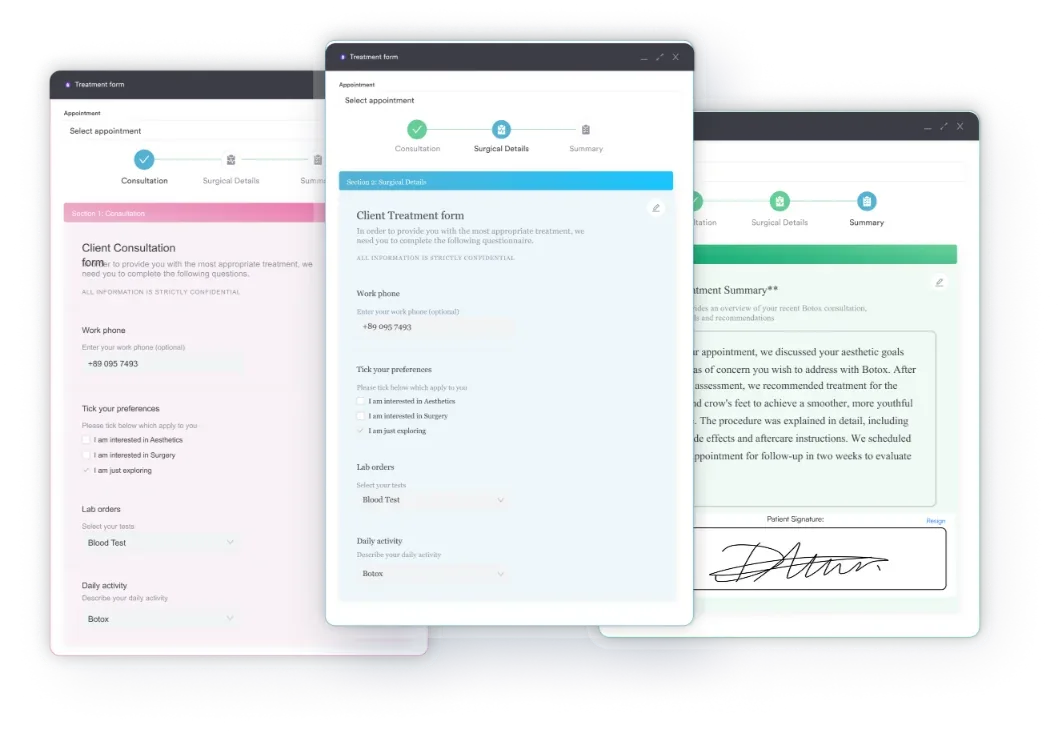
Practice management software like Pabau centers pre-anesthesia documentation in the patient record instead of a separate system. Structured intake and consent forms capture the airway assessment, allergy history, current medications, and ASA physical status classification consistently across every case. Clinical documentation and treatment notes sit in the same patient record as the intake data. Anesthesia start and stop times and the agents administered no longer move between a paper chart and a separate billing system.
For practices managing several anesthesia providers, keeping every provider’s documentation in one record makes missing information easier to catch before a claim goes out. Digital intake forms capture pre-anesthesia evaluation data in a structured format. The physical status classification, allergy documentation, and risk factors that feed into modifier selection are recorded consistently across every case.
Practice management tools like Pabau also support the audit-ready recordkeeping that anesthesia billing requires. Anesthesia records are retrievable in exportable formats, supporting rapid response to payer documentation requests. For practices building or auditing their clinical compliance workflows, integrating documentation and billing into a single platform removes the manual reconciliation step. That step creates most claim errors. See how practices using integrated practice management reduce administrative rework across their billing cycles.

Pabau’s digital intake and consent forms capture pre-anesthesia evaluation data consistently, and clinical notes stay tied to the patient record for audit-ready documentation.

CPT Code 00635 denials are preventable. The overwhelming majority trace back to missing modifiers, time unit errors, or incomplete documentation that could be caught before submission. The formula itself is fixed: 4 base units plus time units under Medicare, with physical status units added under ASA RVG and commercial-payer formulas. What varies is the accuracy of the inputs that feed into it.
Pabau keeps pre-anesthesia intake, clinical documentation, and treatment notes together in the patient record. This keeps the details a clean CPT Code 00635 claim depends on consistent across every case. Book a demo to see how Pabau supports anesthesia documentation and billing for your practice.

Need to review related billing codes for spinal procedures? Coaching CPT codes provides a structured reference for adjacent procedure code families.
Coding nausea and vomiting of pregnancy? ICD-10 code O21.9 applies when the record confirms NVP but does not specify trimester or severity.
Coding an obstetric injury to a pelvic organ? ICD-10 code O71.5 covers bladder or urethral injury during delivery, and the delivery note must name which one.
CPT Code 00635 is used to report anesthesia services provided during diagnostic or therapeutic lumbar puncture procedures. It falls under the anesthesia section for procedures in the lumbar region, and covers both spinal tap procedures performed for cerebrospinal fluid analysis and therapeutic procedures performed to relieve elevated intracranial pressure. Both physician anesthesiologists and CRNAs may bill this code with the appropriate provider-role modifier.
CPT Code 00635 carries 4 ASA-assigned base units. These base units are fixed and do not change based on the duration or complexity of the individual case. Medicare adds the 4 base units to time units (1 unit per 15 minutes of anesthesia time) to calculate total units before multiplying by the conversion factor. ASA RVG and commercial-payer formulas may also add physical status modifier units (P3 adds 1 unit, P4 adds 2, P5 adds 3).
CPT Code 00635 requires two modifier types on every claim: a provider-role modifier (AA for personally performed by anesthesiologist, QK for medical direction of 2-4 concurrent cases, QX for CRNA under medical direction, or QZ for CRNA without medical direction) and a physical status modifier (P1 through P6). The QS modifier is also added when the procedure is performed under monitored anesthesia care. Both modifier types are required; a claim missing either will typically reject before reaching the payer.
Yes, CRNAs can bill CPT Code 00635, but the correct modifier depends on the supervision arrangement. A CRNA billing under physician medical direction uses modifier QX; a CRNA billing independently in a state that has opted out of the Medicare physician supervision requirement uses modifier QZ. State supervision requirements and individual payer contracts vary, so billing teams should verify the applicable rules before submitting CRNA claims for this code.
CPT 62270 is the surgical/procedural code for diagnostic spinal puncture (the lumbar puncture procedure itself), while CPT 00635 is the anesthesia companion code reported by the anesthesia provider for the same procedure. Both codes may appear on the same patient encounter billed by different providers: the proceduralist bills 62270 and the anesthesia provider bills 00635. They should never be billed by the same provider for the same service.
Required documentation includes a pre-anesthesia evaluation with ASA physical status classification, precise anesthesia start and stop times, the identity and role of the anesthesia provider, an intraoperative monitoring record, agents and doses administered, and a post-anesthesia note. For MAC cases, documentation must also justify why moderate sedation was clinically insufficient. All records should be retrievable for a minimum of 7 years under Medicare requirements.



